60,930  PAGES BROWSED TODAY PAGES TODAY 0  ANTIQUES UPLOADED TODAY NEW ARRIVALS
ID #SA511801
FOR SALE
£950
Email
Save
Margaret Thompson, Exhibited 1883 - 1923 Interior of the Summer Drawing Room Hatfield House, Hertfordshire
Artware Fineart
for sale €1,112     $1,207
£950

Artware Fineart

Sellingantiques Verified Since Sep 2008
View Dealers Stock Page
Id #SA511801
PDF SHARE
SAVE

Margaret Thompson, Exhibited 1883 - 1923 Interior of the Summer Drawing Room Hatfield House, Hertfordshire

1900 - 1920
For Sale by Artware Fineart
Description

Margaret Thompson, Exhibited 1883 - 1923

Interior of the Summer Drawing Room Hatfield House, Hertfordshire

Signed/Inscribed:

" Hatfield House /£3 - 3-0 / Margaret Thompson / Hitchen " on a label

pencil and watercolour
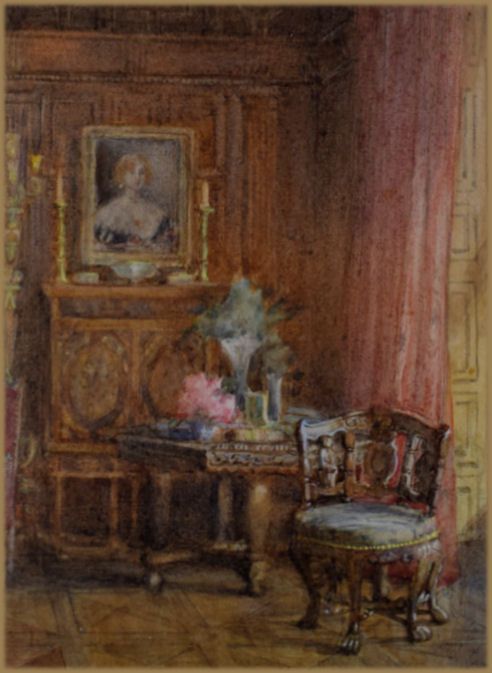
29 x 21.50 cm. (11.3/4 x 8.3/4 in

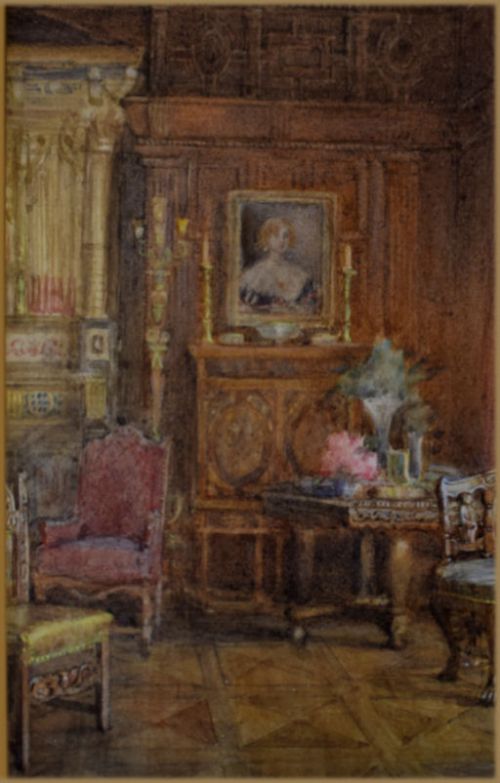
The Summer Drawing Room is one of the rooms in the private quarters of Hatfield House. The portrait depicted is of Lady Anne Cecil and this still hangs in that room. The object on the far left of the painting is in fact a Dutch manual organ, circa 1611. It now sits in the Armoury in Hatfield House.

Hatfield House is a country house set in a large park, the Great Park, on the eastern side of the town of Hatfield, Hertfordshire, England. The present Jacobean house, a leading example of the prodigy house, was built in 1611 by Robert Cecil, First Earl of Salisbury and Chief Minister to King James I and has been the home of the Cecil family ever since. It is a prime example of Jacobean architecture. The estate includes extensive grounds and surviving parts of an earlier palace. The house, currently the home of Robert Gascoyne-Cecil, 7th Marquess of Salisbury, is open to the public.
An earlier building on the site was the Royal Palace of Hatfield. Only part of this still exists, a short distance from the present house. That palace was the childhood home and favourite residence of Queen Elizabeth I. Built in 1497 by the Bishop of Ely, King Henry VII's minister John Cardinal Morton, it comprised four wings in a square surrounding a central courtyard. The palace was seized by Henry VIII with other church properties. The nearby parish church of St Etheldreda's, in Old Hatfield once served the Bishops Palace as well as the village.

Henry VIII's children, King Edward VI and the future Queen Elizabeth I, spent their youth at Hatfield Palace. His eldest daughter, who later reigned as Queen Mary I, lived there between 1533 and 1536, when she was sent to wait on the then Princess Elizabeth, as punishment for refusing to recognise Henry's marriage to Anne Boleyn and his religious reforms. In 1548, when she was only 15 years old, Elizabeth was under suspicion of having illegally agreed to marry Thomas Seymour, the House and her servants were seized by Edward VI's agent Robert Tyrwhit, and she was interrogated there. She successfully defended her conduct with wit and defiance. Seymour was executed in 1549 for numerous other crimes against the crown. After her two months of imprisonment in the Tower of London by her sister Queen Mary, Elizabeth returned to Hatfield. The Queen Elizabeth Oak on the grounds of the estate is said to be the location where Elizabeth was told she was Queen following Mary's death, but is considered unlikely as Mary died in November. In November 1558, Elizabeth held her first Council of State in the Great Hall. Hatfield House is a popular tourist attraction because it has so many objects associated with Queen Elizabeth I, including some gloves and a pair of silk stockings that are believed to have been the first ones in England. The library displays a 22 feet (6.7 m) long illuminated parchment roll showing the pedigree of the Queen with ancestors back to Adam and Eve. The Marble Hall holds the "Rainbow Portrait" of Elizabeth.

The great hall in 1840

Elizabeth's successor, King James I, did not like the palace much and so gave it to Elizabeth's (and his own) chief minister Robert Cecil, 1st Earl of Salisbury in 1607, in exchange for Theobalds Palace which was the Cecils' family home on the current site of Cedars Park, Broxbourne. Cecil, who liked building, tore down three wings of the royal palace (the back and sides of the square) in 1608 and used the bricks to build the present structure. The richly carved wooden Grand Staircase and the rare stained glass window in the private chapel are among the house's original Jacobean features.

Cecil's descendant, Robert Arthur Talbot Gascoyne-Cecil, 3rd Marquess of Salisbury, was three t

Physical Dimensions
Height
29cm (11.42")
Width
21cm (8.27")
Depth
1cm (0.39")
Declaration

Artware Fineart has dated this Antique Interior Watercolour Painting to the 1920s.

Reference Numbers
Sellingantiques Reference
SA511801
Dealers Internal Reference
3944
Description
Margaret Thompson, Exhibited 1883 - 1923

Interior of the Summer Drawing Room Hatfield House, Hertfordshire

Signed/Inscribed:

" Hatfield House /£3 - 3-0 / Margaret Thompson / Hitchen " on a label

pencil and watercolour

fig 1. A framed watercolour painting depicting the dark wood-panelled interior of a stately home drawing room with upholstered chairs and elaborate drapery.
fig 1. Margaret Thompson, Exhibited 1883 - 1923 Interior of the Summer Drawing Room Hatfield House, Hertfordshire

29 x 21.50 cm. (11.3/4 x 8.3/4 in

The Summer Drawing Room is one of the rooms in the private quarters of Hatfield House. The portrait depicted is of Lady Anne Cecil and this still hangs in that room. The object on the far left of the painting is in fact a Dutch manual organ, circa 1611. It now sits in the Armoury in Hatfield House.

Hatfield House is a country house set in a large park, the Great Park, on the eastern side of the town of Hatfield, Hertfordshire, England.
Artware Fineart

The present Jacobean house, a leading example of the prodigy house, was built in 1611 by Robert Cecil, First Earl of Salisbury and Chief Minister to King James I and has been the home of the Cecil family ever since. It is a prime example of Jacobean architecture. The estate includes extensive grounds and surviving parts of an earlier palace. The house, currently the home of Robert Gascoyne-Cecil, 7th Marquess of Salisbury, is open to the public.

fig 2. A framed watercolour painting depicting the dark wood-panelled interior of a stately home drawing room with upholstered chairs and elaborate drapery.
fig 2. Margaret Thompson, Exhibited 1883 - 1923 Interior of the Summer Drawing Room Hatfield House, Hertfordshire

An earlier building on the site was the Royal Palace of Hatfield. Only part of this still exists, a short distance from the present house. That palace was the childhood home and favourite residence of Queen Elizabeth I. Built in 1497 by the Bishop of Ely, King Henry VII's minister John Cardinal Morton, it comprised four wings in a square surrounding a central courtyard. The palace was seized by Henry VIII with other church properties. The nearby parish church of St Etheldreda's, in Old Hatfield once served the Bishops Palace as well as the village.

Henry VIII's children, King Edward VI and the future Queen Elizabeth I, spent their youth at Hatfield Palace. His eldest daughter, who later reigned as Queen Mary I, lived there between 1533 and 1536, when she was sent to wait on the then Princess Elizabeth, as punishment for refusing to recognise Henry's marriage to Anne Boleyn and his religious reforms. In 1548, when she was only 15 years old, Elizabeth was under suspicion of having illegally agreed to marry Thomas Seymour, the House and her servants were seized by Edward VI's agent Robert Tyrwhit, and she was interrogated there. She successfully defended her conduct with wit and defiance. Seymour was executed in 1549 for numerous other crimes against the crown. After her two months of imprisonment in the Tower of London by her sister Queen Mary, Elizabeth returned to Hatfield. The Queen Elizabeth Oak on the grounds of the estate is said to be the location where Elizabeth was told she was Queen following Mary's death, but is considered unlikely as Mary died in November. In November 1558, Elizabeth held her first Council of State in the Great Hall. Hatfield House is a popular tourist attraction because it has so many objects associated with Queen Elizabeth I, including some gloves and a pair of silk stockings that are believed to have been the first ones in England. The library displays a 22 feet (6.7 m) long illuminated parchment roll showing the pedigree of the Queen with ancestors back to Adam and Eve. The Marble Hall holds the "Rainbow Portrait" of Elizabeth.

The great hall in 1840

Elizabeth's successor, King James I, did not like the palace much and so gave it to Elizabeth's (and his own) chief minister Robert Cecil, 1st Earl of Salisbury in 1607, in exchange for Theobalds Palace which was the Cecils' family home on the current site of Cedars Park, Broxbourne. Cecil, who liked building, tore down three wings of the royal palace (the back and sides of the square) in 1608 and used the bricks to build the present structure. The richly carved wooden Grand Staircase and the rare stained glass window in the private chapel are among the house's original Jacobean features.

Cecil's descendant, Robert Arthur Talbot Gascoyne-Cecil, 3rd Marquess of Salisbury, was three t

Height
29cm (11.42")
Width
21cm (8.27")
Depth
1cm (0.39")
Date of Manufacture

Artware Fineart has dated this Antique Interior Watercolour Painting to the 1920s.

Reference Numbers
Sellingantiques Ref
SA511801
Dealers Internal Ref
3944
Artware Fineart
Sellingantiques verified Since Sep 2008
Dealer Profile

You can view the stock and full dealer information on the Artware Fineart Profile Page

PDF SHARE
SAVE
A framed watercolour painting depicting the dark wood-panelled interior of a stately home drawing room with upholstered chairs and elaborate drapery.
1 / 3
Archive I A framed watercolour painting depicting the dark wood-panelled interior of a stately home drawing room with upholstered chairs and elaborate drapery.

Margaret Thompson, Exhibited 1883 - 1923 Interior of the Summer Drawing Room Hatfield House, Hertfordshire

Archive II A framed watercolour painting depicting the dark wood-panelled interior of a stately home drawing room with upholstered chairs and elaborate drapery. View II
Archive III A framed watercolour painting depicting the dark wood-panelled interior of a stately home drawing room with upholstered chairs and elaborate drapery. View III
FURTHER BROWSING

Visitors also looked at these ⇣

Enlarged Archival View
Telephone 07958 699 645
Location
18 La Gare
51 Surrey Row
London
SE1 0BZ
United Kingdom
Verified Since Sep 2008
Items For Sale 243
Items Sold 223
Artware Fineart
Verified Since Sep 2008
View Dealer Info
Location: 18 La Gare , 51 Surrey Row , London , SE1 0BZ , United Kingdom
Verified
Sep 2008
For Sale
243
Sold
223
A framed watercolour painting depicting the dark wood-panelled interior of a stately home drawing room with upholstered chairs and elaborate drapery.
Margaret Thompson, Exhibited 1883 - 1923 Interior of the Summer Drawing Room Hatfield House, Hertfordshire
Ref: SA511801
A framed watercolour painting depicting the dark wood-panelled interior of a stately home drawing room with upholstered chairs and elaborate drapery.
Detail View 1
Detail View 2
Archival Detail
Every single antique dealer on our platform is individually approved by our internal team. We verify their professional trade history, ethical standards, and photographic quality to ensure a secure, high-standard buying environment. Upon joining, every dealer agrees to a strict 9-point code of conduct. While issues can occasionally arise, our dealers typically resolve them swiftly and directly with the buyer. In fact, since our founding in 2002, Sellingantiques has only had to step in to help resolve an issue on roughly five occasions—a true testament to the quality of our dealers and their dedication to your happiness.
Our dealers are highly experienced in packing and shipping fragile, high-value antiques. Because you are in direct contact with the dealer, you will be able to easily go through all available shipping and insurance options together to ensure your item arrives safely.
Antiques are the ultimate green purchase. By choosing historical pieces over newly manufactured goods, you completely eliminate the carbon footprint of modern mass production while preserving exceptional, timeless craftsmanship.

Interior watercolours gained popularity in the 19th century as record drawings of grand country houses and stately homes, capturing detail, lighting, and decor before wide-scale photography.

Artists rendered watercolours using water-soluble pigments applied to heavy cotton or linen paper, often mounted on card and sealed behind glass in gilt or wooden frames.

Authentic original watercolours display natural paper ageing, hand-painted brushstrokes visible under magnification, and an absence of half-tone print dot matrices.

Framed architectural and interior watercolours can be styled as focal points within a gallery wall, mounted above a sideboard, or hung in a quiet reading alcove.

Display watercolours away from direct sunlight and moisture, utilising UV-protective glass and acid-free mounting materials to prevent fading and foxing.
items
Add keywords to the filter
Price
£100
£250000
Era
Movements
Material
Origin
Stock Location
Freshness
Online Payments
Categories