

Marlborough Antiques & Interiors has dated this piece to the 1950s.
CXCVII (197) out of 250 copies, numbered I through CCL printed in 1959 for Grove Press Inc
The original pencil and watercolour drawing on which this plate is based was at the time of the publication of the limited edition portfolio in a private collection in Rome
Image Size 42 cm x 54 cm
Condition Excellent
A copy of the justification page from the portfolio will be provided to a buyer of the print.
The drawings for inclusion in the portfolio were selected by the distinguished Italian art historian, critic and curator, Lamberto Vitali.
The plates were made by Arti Grafiche Pezzini, Milan.
Copyright 1959 by Guilio Einardi Editore and Grove Press inc, NY.
A copy of the justification page from the portfolio will be provided to a buyer of the print.
Signed in the plate by Amedeo Modigliani
Amedeo Clemente Modigliani (1884-1920)
An Overview of Amedeo Modigliani’s Artistic Creations
Modigliani’s artistic influences and antecedents have been the subject of much speculation and conjecture. The artist himself provides very little, if any, direct information on this vexed question.
In his early Paris paintings, there are indications of influences of Toulouse Lautrec and Cezanne. Cezanne’s style is seen in Modigliani’s three extant landscape paintings.
Some commentators have argued that there is evidence of the influence of art from Africa, especially a possible interest in African masks and Cambodian art, whilst others have advanced the view that in both Modigliani’s painting and sculpture, the sitter’s faces resemble ancient Egyptian painting in their flat and mask-like appearance, with distinctive almond eyes, pursed mouths, twisted noses and elongated necks.
Others have contended that Modigliani’s stylisations are just as likely to have been the result of his exposure to medieval sculpture and painting during his studies in Northern Italy.
However, it could be argued that the work of Brancusi was the single most important influence on Modigliani’s artistic development.
In the final analysis, unlike other artists of his age, what is incontrovertible is that Modigliani still defies classification.
A key participant in the Ecole de Paris, Modigliani modernized two of the enduring themes of art history: the portrait and the nude.
Modigliani’s Contribution to Portrait Art
Characterized by a sense of melancholia, elongated proportions, and mask-like faces, Modigliani’s portraits achieve a unique combination of specificity and generalization.
Each reveals the sitter’s inner life, the subject’s personality, while his trademark stylisation and use of recurring motifs – long necks and almond-shaped eyes – render them uniform. Modigliani’s portraits are unmistakably recognizable as works of its creator. In the words of one critic, his portraits are unmistakably ‘Modiglianized’.
Modigliani’s Contribution to Depiction of the Nude in Art
Modigliani completely changed the tradition of the nude; he turned it upside down.
His creations in this genre are candid in their sensuality; they are distinctly devoid of the modesty and mythological subtexts evident in many earlier depictions of nude figures.
Modigliani’s nudes shocked the public with their depiction of features such as pubic hair and their honest, undiluted sexuality.
Modigliani’s works were not commercially successful during his lifetime but they became popular after his death. He was forced to endure poverty right up to his final hours. He was known to exchange works of art for meals at restaurants and to acquire the necessities of daily life.
He is now among the most cel
Marlborough Antiques & Interiors has dated this piece to the 1950s.
We display a variety of antiques at all price levels, including furniture, paintings and other decorative items
You can view the stock and full dealer information on the Marlborough Antiques & Interiors Profile Page
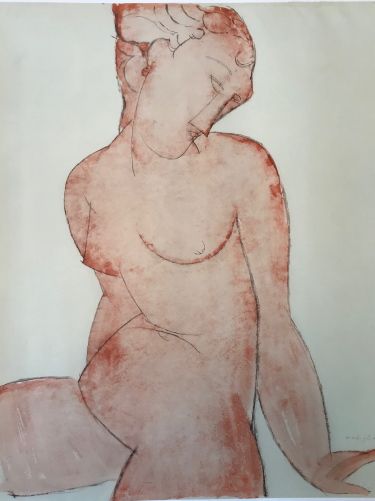
Amedeo Modigliani - Female Nude
