George Richmond, RA, 1809 - 1896
Portrait of William Page Wood, 1st Baron Hatherley 1801-1881, Lord Chancellor
Signed/Inscribed:
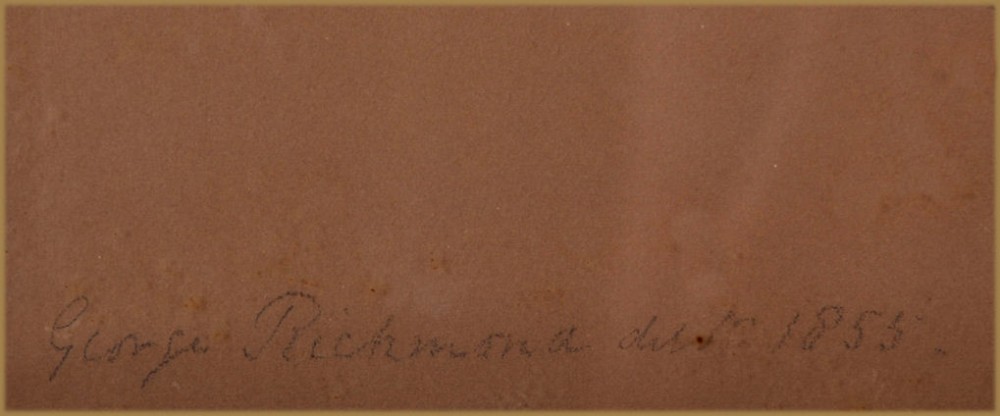
''George Richmond delt / 1855''
pencil, back and white chalk on brown paper
60.96 x 45.72 cm. (24 x 18in.)
This drawing is one of several a preparatory drawings made by George Richmond, some of which were engraved and some used for oil portraits , noteably a full length portrait in the National Portrait Gallery collection.
William Page Wood, Baron Hatherley (1801–1881), lord chancellor, was born at his parents'' home in Falcon Square, London, on 29 November 1801, the second son and fourth child of Sir Matthew Wood, first baronet (1768–1843), hop merchant and sometime lord mayor of London, and his wife, Maria Page (c.1770–1848). Most of his early childhood was spent with his maternal grandmother at Woodbridge in Suffolk, where for a time he attended the free school. From 1809 to 1812 he was at Dr Lindsay''s school at Bow in Essex, and in
...September 1812 he started at Winchester College where he remained until 1818 when, as a senior prefect, he was expelled for his involvement in a school protest against a master who had used corporal punishment on prefects. His expulsion did not hold him back in any way from pursuing further education, and he went for two years to Geneva, where he was placed in the charge of Duvillard, professor of belles-lettres, and attended university lectures. Through his father he was introduced to many politicians both in England and in Paris (1817). At the Auditoire in Geneva he learned French, Italian, and mathematics, and mixed with the university students. In 1820 he returned to England as an escort for Queen Caroline, who enjoyed his support and loyalty during her later court case. Indeed, Wood even collected evidence in Italy on her behalf.
By the time Wood entered Trinity College, Cambridge, in October 1820, he was much more mature, cultivated, and better informed than most undergraduates of his years, but his university years were hampered by ill health. In 1821 he won the second college declamation prize with an essay defending the revolution of 1688, and in 1822 was elected to a scholarship; but he came out only twenty-fourth wrangler in January 1824, and had to withdraw from the final classical examination altogether. In October 1824 he was only narrowly elected to a fellowship, since he was imagined by some to hold his father''s radical opinions, and his prize essay of 1821 had not been forgotten.
On 1 March 1824, through the help of Brougham and Denman, Wood entered Lincoln''s Inn where he read law in the chamber of Roupell. After studying conveyancing under John Tyrrell in 1826, he was called to the bar on 27 November 1827, and started practice at 3 Old Square, Lincoln''s Inn. He soon found clients, and his first speech in court was delivered before the House of Lords in Westmeath v. Westmeath. He did much railway work before parliamentary committees from 1828 to 1841, as well as in the chancery courts, and it was out of one of his cases that the standing order of the House of Lords afterwards known as the Wharncliffe order originated. In 1841 he gave up parliamentary work, and his chancery practice immediately increased. He became a queen''s counsel in February 1845.
Wood''s father had inherited a large fortune, and his own savings from professional earnings were enough to make him independent of practice. As early as 1829 he was earning £1000 a year, and had become engaged to Charlotte (1804–1878), the daughter of Major Edward Moore. They were married on 5 January 1830, and lived in Dean''s Yard, Westminster, until 1844; they had no children. As a queen''s counsel Wood attached himself to the court of Vice-Chancellor Sir James Wigram.
Wood was a strong high-churchman and an advanced Liberal, and, entering parliament for Oxford in 1847, spok
Internal Reference: 3937
Antique ID Number (AIDN): SA496826
Dateline of this antique is 1850
Height is 61cm (24.0inches)Width is 46cm (18.1inches)Depth is 1cm (0.4inches)




Thank you.
Your comment has been sent to Sellingantiques.