22,104  PAGES BROWSED TODAY PAGES TODAY 36  ANTIQUES UPLOADED TODAY NEW ARRIVALS
ID #SA486036
FOR SALE
£1,400
Email
Save
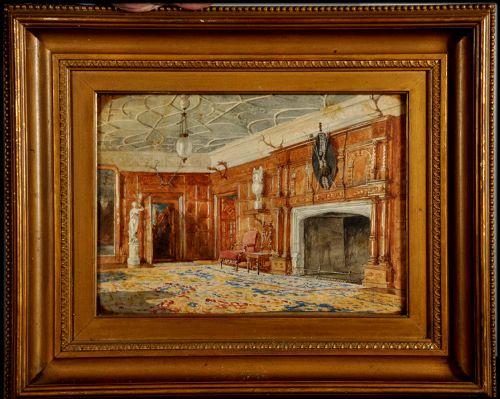
English School 19th, Century the Interior of the Great Hall Old Forde House, Newton Abbot, Devonshire
Artware Fineart
for sale €1,638     $1,778
£1,400

Artware Fineart

Sellingantiques Verified Since Sep 2008
View Dealers Stock Page
Id #SA486036
PDF SHARE
SAVE

English School 19th, Century the Interior of the Great Hall Old Forde House, Newton Abbot, Devonshire

19th century
For Sale by Artware Fineart
Description

English School 19th, Century

The Interior of the Great Hall Old Forde House, Newton Abbot, Devonshire

Signed/Inscribed:

on the reverse "Ford House Newton Abbot"

pencil and watercolour

26 x 35cm. (10 x 14 in.)

The house faces south overlooking an expanse of lawns. Part of the few acres that have been retained from the large estate in which it once stood. Forde House, now also known as Old Forde House, is a Grade I listed Jacobean former manor house in Newton Abbot, Devon, England. It was built in c.?1610 and is noted for its fine 17th-century wood-carving and plasterwork. Once the manor house of the parish of Wolborough, it is now absorbed into a suburb of Newton Abbot. The south front is clearly visible from the busy Brunel Road which cuts across the house's front lawn.
Forde House is named after a ford in the Aller Brook which carried the road to Shaldon, St Marychurch and Aller, and lies within the ancient parish of Wolborough. Prior to the dissolution of the monasteries, Wolborough belonged to Torre Abbey and it is probable that Forde had been one of the Abbey's large granges which paid it tithes on its produce.

John Gaverock had been the Abbot's steward and for his services had received an annual salary of £3.00. Torre Abbey was dissolved in 1539, during the reign of Henry VIII, and soon after, in 1545, the King sold the manor of Wolborough to Gaverock and his wife for the sum of £592 14s 2d. When Gaverock became lord of the manor he set about building himself a new manorial home at Forde. The origin of the older building at the rear of the present Forde House is obscure, but it is probable that it is the house erected by John Gaverock after he acquired the manor in 1545.

John Gaverock's three daughters inherited Forde House and, towards the close of the sixteenth century, sold it to Richard Reynell of the Middle Temple, an eminent lawyer and officer in the Court of the Exchequer, a son of Richard Reynell, the lord of the adjoining manor of East Ogwell. He married Lucy Brandon whose father was sometime Chamberlain of the City of London. Soon after Richard and Lucy Reynell had acquired the manor they set about building themselves a fine new house at Forde.

The present house bears the date 1610 and is built in the shape of the letter E, commonly thought to be in honour of Queen Elizabeth 1, who had just died. It is, architecturally, a plain, substantial structure built of roughcasted stone in the Elizabethan style. The grounds once included a deer park which was later to disappear beneath the inroads of the railway; the area of Newton Abbot now known as Decoy did in fact include a decoy for trapping wildfowl. The present house was built by Sir Richard Reynell (d.1633), Member of Parliament for Mitchell in Cornwall (1593) and his wife Lucy Brandon and was probably completed in about 1610, according to the date on the rainwater heads. The house was built with an E-shaped floor plan, which may have been in honour of Queen Elizabeth I, who had recently died. The grounds were originally extensive, and included the whole of what is called Decoy (so named, because wildfowl were decoyed there to extend the house's larder), as well as a deer park.

On 15 September 1625 King Charles I stayed at the house overnight on his way to Plymouth,to inspect the fleet. He returned a few days later and stayed for a further two nights.

During the Civil War, Forde House gave shelter to Oliver Cromwell and Colonel Fairfax on 24 January 1646 before the second Siege of Exeter.

The facade of Forde House is some 100 feet in length and has two gabled wings and another gabled projection, narrower, but carried up to the same height, which forms the entrance porch. the most striking external feature is the two ranges of square-headed windows, seven of the upper and six of the lower range. These windows are all uniform size

Physical Dimensions
Height
26cm (10.24")
Width
35cm (13.78")
Depth
2cm (0.79")
Declaration

Artware Fineart has dated this 19th Century Interior Watercolour to the 19th Century.

Reference Numbers
Sellingantiques Reference
SA486036
Dealers Internal Reference
3906
Description
English School 19th, Century

The Interior of the Great Hall Old Forde House, Newton Abbot, Devonshire

Signed/Inscribed:

on the reverse "Ford House Newton Abbot"

pencil and watercolour

26 x 35cm. (10 x 14 in.)

The house faces south overlooking an expanse of lawns. Part of the few acres that have been retained from the large estate in which it once stood.

Forde House, now also known as Old Forde House, is a Grade I listed Jacobean former manor house in Newton Abbot, Devon, England.
Artware Fineart

It was built in c.?1610 and is noted for its fine 17th-century wood-carving and plasterwork. Once the manor house of the parish of Wolborough, it is now absorbed into a suburb of Newton Abbot. The south front is clearly visible from the busy Brunel Road which cuts across the house's front lawn.

fig 1. A 19th-century watercolour painting depicting the oak-panelled interior of a grand hall with a decorated plaster ceiling, large carved fireplace, and patterned rug.
fig 1. English School 19th, Century the Interior of the Great Hall Old Forde House, Newton Abbot, Devonshire

Forde House is named after a ford in the Aller Brook which carried the road to Shaldon, St Marychurch and Aller, and lies within the ancient parish of Wolborough. Prior to the dissolution of the monasteries, Wolborough belonged to Torre Abbey and it is probable that Forde had been one of the Abbey's large granges which paid it tithes on its produce.

John Gaverock had been the Abbot's steward and for his services had received an annual salary of £3.00. Torre Abbey was dissolved in 1539, during the reign of Henry VIII, and soon after, in 1545, the King sold the manor of Wolborough to Gaverock and his wife for the sum of £592 14s 2d. When Gaverock became lord of the manor he set about building himself a new manorial home at Forde. The origin of the older building at the rear of the present Forde House is obscure, but it is probable that it is the house erected by John Gaverock after he acquired the manor in 1545.

John Gaverock's three daughters inherited Forde House and, towards the close of the sixteenth century, sold it to Richard Reynell of the Middle Temple, an eminent lawyer and officer in the Court of the Exchequer, a son of Richard Reynell, the lord of the adjoining manor of East Ogwell. He married Lucy Brandon whose father was sometime Chamberlain of the City of London. Soon after Richard and Lucy Reynell had acquired the manor they set about building themselves a fine new house at Forde.

The present house bears the date 1610 and is built in the shape of the letter E, commonly thought to be in honour of Queen Elizabeth 1, who had just died. It is, architecturally, a plain, substantial structure built of roughcasted stone in the Elizabethan style. The grounds once included a deer park which was later to disappear beneath the inroads of the railway; the area of Newton Abbot now known as Decoy did in fact include a decoy for trapping wildfowl. The present house was built by Sir Richard Reynell (d.1633), Member of Parliament for Mitchell in Cornwall (1593) and his wife Lucy Brandon and was probably completed in about 1610, according to the date on the rainwater heads. The house was built with an E-shaped floor plan, which may have been in honour of Queen Elizabeth I, who had recently died. The grounds were originally extensive, and included the whole of what is called Decoy (so named, because wildfowl were decoyed there to extend the house's larder), as well as a deer park.

On 15 September 1625 King Charles I stayed at the house overnight on his way to Plymouth,to inspect the fleet. He returned a few days later and stayed for a further two nights.

During the Civil War, Forde House gave shelter to Oliver Cromwell and Colonel Fairfax on 24 January 1646 before the second Siege of Exeter.

The facade of Forde House is some 100 feet in length and has two gabled wings and another gabled projection, narrower, but carried up to the same height, which forms the entrance porch. the most striking external feature is the two ranges of square-headed windows, seven of the upper and six of the lower range. These windows are all uniform size

Height
26cm (10.24")
Width
35cm (13.78")
Depth
2cm (0.79")
Date of Manufacture

Artware Fineart has dated this 19th Century Interior Watercolour to the 19th Century.

Reference Numbers
Sellingantiques Ref
SA486036
Dealers Internal Ref
3906
Artware Fineart
Sellingantiques verified Since Sep 2008
Dealer Profile

You can view the stock and full dealer information on the Artware Fineart Profile Page

PDF SHARE
SAVE
A 19th-century watercolour painting depicting the oak-panelled interior of a grand hall with a decorated plaster ceiling, large carved fireplace, and patterned rug.
1 / 2
Archive I A 19th-century watercolour painting depicting the oak-panelled interior of a grand hall with a decorated plaster ceiling, large carved fireplace, and patterned rug.

English School 19th, Century the Interior of the Great Hall Old Forde House, Newton Abbot, Devonshire

Archive II A 19th-century watercolour painting depicting the oak-panelled interior of a grand hall with a decorated plaster ceiling, large carved fireplace, and patterned rug. View II
Enlarged Archival View
Telephone 07958 699 645
Location
18 La Gare
51 Surrey Row
London
SE1 0BZ
United Kingdom
Verified Since Sep 2008
Items For Sale 243
Items Sold 223
Artware Fineart
Verified Since Sep 2008
View Dealer Info
Location: 18 La Gare , 51 Surrey Row , London , SE1 0BZ , United Kingdom
Verified
Sep 2008
For Sale
243
Sold
223
A 19th-century watercolour painting depicting the oak-panelled interior of a grand hall with a decorated plaster ceiling, large carved fireplace, and patterned rug.
English School 19th, Century The Interior of the Great Hall Old Forde House, Newton Abbot, Devonshire
Ref: SA486036
A 19th-century watercolour painting depicting the oak-panelled interior of a grand hall with a decorated plaster ceiling, large carved fireplace, and patterned rug.
Detail View 1
Archival Detail
Every single antique dealer on our platform is individually approved by our internal team. We verify their professional trade history, ethical standards, and photographic quality to ensure a secure, high-standard buying environment. Upon joining, every dealer agrees to a strict 9-point code of conduct. While issues can occasionally arise, our dealers typically resolve them swiftly and directly with the buyer. In fact, since our founding in 2002, Sellingantiques has only had to step in to help resolve an issue on roughly five occasions—a true testament to the quality of our dealers and their dedication to your happiness.
Our dealers are highly experienced in packing and shipping fragile, high-value antiques. Because you are in direct contact with the dealer, you will be able to easily go through all available shipping and insurance options together to ensure your item arrives safely.
Antiques are the ultimate green purchase. By choosing historical pieces over newly manufactured goods, you completely eliminate the carbon footprint of modern mass production while preserving exceptional, timeless craftsmanship.

Nineteenth-century English interior watercolours typically depict detailed architectural features, grand country house rooms, and period furnishings, serving as both artistic studies and historical records of interior design.

These artworks were created using natural pigment watercolours applied to heavy cotton rag paper, often featuring graphite or ink underdrawing to establish architectural proportions.

Authentic pieces exhibit natural age toning on paper, evidence of graphite sketching beneath paint layers, historical framing marks, and period-appropriate pigment tones rather than modern synthetic dyes.

Display the artwork within an understated wood or gilded frame above a console table or within a gallery wall to contrast classical architecture with contemporary decor.

Frame the painting using UV-protective glass and acid-free mounting materials, keeping it away from direct sunlight, high humidity, and extreme temperature fluctuations to prevent fading and foxing.
items
Add keywords to the filter
Price
£100
£250000
Era
Movements
Material
Origin
Stock Location
Freshness
Online Payments
Categories