42,920  PAGES BROWSED TODAY PAGES TODAY 98  ANTIQUES UPLOADED TODAY NEW ARRIVALS
ID #SA486009
FOR SALE
£3,800
Email
Save
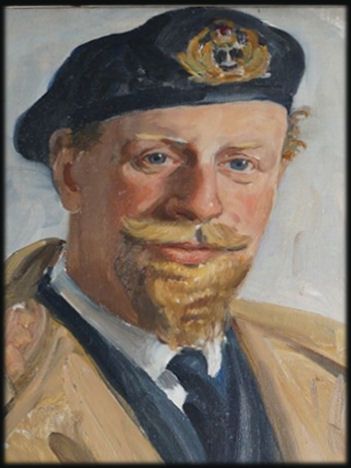
Maurice Codner, 1888-1958 Vice Admiral Sir Charles Leo Glandore (Crash) Evans Kcb Cbe Dso Dsc 1888-1958
Artware Fineart
for sale €4,446     $4,826
£3,800

Artware Fineart

Sellingantiques Verified Since Sep 2008
View Dealers Stock Page
Relevant Links
Id #SA486009
PDF SHARE
SAVE

Maurice Codner, 1888-1958 Vice Admiral Sir Charles Leo Glandore (Crash) Evans Kcb Cbe Dso Dsc 1888-1958

1920 - 1940
For Sale by Artware Fineart
Description

Maurice Codner, 1888-1958

Vice Admiral Sir Charles Leo Glandore (Crash) Evans KCB CBE DSO DSC 1888-1958

11th April 1944

Signed/Inscribed:

and dated 1944

oil on canvas

20 x 16in. (51 x 41 cm.)

Wearing naval Uniform beret and duffle Coat.
Notes

Vice Admiral Sir Charles Evans was a Royal Navy officer who became Deputy Supreme Allied Commander Atlantic. Evans initially joined the Royal Navy in 1922 aged 19 and was trained as a pilot in 1930 and was given a temporary commission as a flying officer in the Royal Air Force in 1931. he served on the Carriers Furious and Courageous flying Fairey Flycathcher Fighters. The outbreak of the War found him Lieutant in the 803 squadron on HMS Ark Royal, where he was involved in the first British Aerial victory on the 26th sept 1939 , with 3 of the Units Skuas bringing down a Do18 flying Boat. In Feb 1940 he formed the 806 Naval Air Squadron.

He served in World War II as Commanding Officer of 806 Naval Air Squadron based at HMS Sparrowhawk Orkney, carrying out bombing attacks on targets around Bergen in Norway in May 1940 and providing cover for the Dunkirk evacuation the following month.According to one source, 806 Naval Air Squadron was formed at HMS Kestrel on 1 February 1940 with Lieutenant Commander Charles Evans as the Commanding Officer and Lieutenant Desmond Vincent-Jones as the Senior Observer and using eight Blackburn Skuas and four Blackburn Rocs. However, another source gives the date and location as being 15 February at Eastleigh, possibly referring to HMS Raven and states that the squadron did not have sufficient crews to operate its aircraft until the next group from the fighter training school had been trained. In the Norwegian operations there was one particular raid on May 11 that was executed with an oil tank farm complex located on Askøy Island as the target. Lieutenant Commander Evans led six Blackburn Skuas who were each armed with a single 250 lb semi-armour-piercing bomb and four 20 lb cooper bombs. Presumably, only six Skuas took part due to the remaining two not being serviceable due to the damage sustained during the attack on 9 May. Three Blenheims armed also with incendiary bombs escorted the Skuas. The squadrons' attack was virtually unopposed with no casualties amongst either squadron and several hits were claimed upon the oil tanks and these were later confirmed to be ablaze by reconnaissance photographs.

On 12 May another attack was made upon shipping around Bergen. In this attack the target was an enemy transport ship believed to be attempting to run through to Bergen Harbour with anti-aircraft guns intended to protect the port area. As in the 11 May raid Lieutenant Commander Evans led six Skuas accompanied by three Blenheims. The squadron located the ship as it was entering the fjords around Bergen with two escorting destroyers or motor torpedo boats and split into two waves they attempted to dive bomb the target however all six 500 lb semi-armour-piercing bombs missed although no casualties were received.

806's final patrol in the operations over Dunkirk was carried out on 2 June 1940 with Charles Evans leading the patrol. During this, an enemy Ju 88 was seen to attack HMS Calcutta and was attacked by the squadron but this machine disappeared into clouds in a slow spiral, possibly destroyed. Another Ju 88 was seen and attacked but this also dived and was lost in the clouds. An Avro Anson of RAF Coastal Command later reported seeing an Ju 88 return over Dunkirk with its port engine alight shortly after the time that 806 Naval Air Squadron attacked the Ju 88.

He served on Iustrious in Bermuda. In June the squadron embarked in HMS Illustrious along with 815 and 819 Naval Air Squadrons with whom they had been temporarily based at RAF Detling for Operation Dynamo. Illustrious then left for Bermuda in order to work-up the ship's compa

Physical Dimensions
Height
51cm (20.08")
Width
41cm (16.14")
Depth
2cm (0.79")
Declaration

Artware Fineart has dated this Naval Officer Portrait Painting to the 1940s.

Reference Numbers
Sellingantiques Reference
SA486009
Dealers Internal Reference
3913
Description
Maurice Codner, 1888-1958

Vice Admiral Sir Charles Leo Glandore (Crash) Evans KCB CBE DSO DSC 1888-1958

11th April 1944

Signed/Inscribed:

and dated 1944

oil on canvas

20 x 16in. (51 x 41 cm.)

Wearing naval Uniform beret and duffle Coat.

fig 1. An oil painting depicting a mid-20th-century Royal Navy officer wearing a cap with naval badge and a beige coat, signed by Maurice Codner in the upper right corner.
fig 1. Maurice Codner, 1888-1958 Vice Admiral Sir Charles Leo Glandore (Crash) Evans Kcb Cbe Dso Dsc 1888-1958

Notes

Vice Admiral Sir Charles Evans was a Royal Navy officer who became Deputy Supreme Allied Commander Atlantic.
Artware Fineart

Evans initially joined the Royal Navy in 1922 aged 19 and was trained as a pilot in 1930 and was given a temporary commission as a flying officer in the Royal Air Force in 1931. he served on the Carriers Furious and Courageous flying Fairey Flycathcher Fighters. The outbreak of the War found him Lieutant in the 803 squadron on HMS Ark Royal, where he was involved in the first British Aerial victory on the 26th sept 1939 , with 3 of the Units Skuas bringing down a Do18 flying Boat. In Feb 1940 he formed the 806 Naval Air Squadron.

fig 2. An oil painting depicting a mid-20th-century Royal Navy officer wearing a cap with naval badge and a beige coat, signed by Maurice Codner in the upper right corner.
fig 2. Maurice Codner, 1888-1958 Vice Admiral Sir Charles Leo Glandore (Crash) Evans Kcb Cbe Dso Dsc 1888-1958

He served in World War II as Commanding Officer of 806 Naval Air Squadron based at HMS Sparrowhawk Orkney, carrying out bombing attacks on targets around Bergen in Norway in May 1940 and providing cover for the Dunkirk evacuation the following month.According to one source, 806 Naval Air Squadron was formed at HMS Kestrel on 1 February 1940 with Lieutenant Commander Charles Evans as the Commanding Officer and Lieutenant Desmond Vincent-Jones as the Senior Observer and using eight Blackburn Skuas and four Blackburn Rocs. However, another source gives the date and location as being 15 February at Eastleigh, possibly referring to HMS Raven and states that the squadron did not have sufficient crews to operate its aircraft until the next group from the fighter training school had been trained. In the Norwegian operations there was one particular raid on May 11 that was executed with an oil tank farm complex located on Askøy Island as the target. Lieutenant Commander Evans led six Blackburn Skuas who were each armed with a single 250 lb semi-armour-piercing bomb and four 20 lb cooper bombs. Presumably, only six Skuas took part due to the remaining two not being serviceable due to the damage sustained during the attack on 9 May. Three Blenheims armed also with incendiary bombs escorted the Skuas. The squadrons' attack was virtually unopposed with no casualties amongst either squadron and several hits were claimed upon the oil tanks and these were later confirmed to be ablaze by reconnaissance photographs.

On 12 May another attack was made upon shipping around Bergen. In this attack the target was an enemy transport ship believed to be attempting to run through to Bergen Harbour with anti-aircraft guns intended to protect the port area. As in the 11 May raid Lieutenant Commander Evans led six Skuas accompanied by three Blenheims. The squadron located the ship as it was entering the fjords around Bergen with two escorting destroyers or motor torpedo boats and split into two waves they attempted to dive bomb the target however all six 500 lb semi-armour-piercing bombs missed although no casualties were received.

806's final patrol in the operations over Dunkirk was carried out on 2 June 1940 with Charles Evans leading the patrol. During this, an enemy Ju 88 was seen to attack HMS Calcutta and was attacked by the squadron but this machine disappeared into clouds in a slow spiral, possibly destroyed. Another Ju 88 was seen and attacked but this also dived and was lost in the clouds. An Avro Anson of RAF Coastal Command later reported seeing an Ju 88 return over Dunkirk with its port engine alight shortly after the time that 806 Naval Air Squadron attacked the Ju 88.

He served on Iustrious in Bermuda. In June the squadron embarked in HMS Illustrious along with 815 and 819 Naval Air Squadrons with whom they had been temporarily based at RAF Detling for Operation Dynamo. Illustrious then left for Bermuda in order to work-up the ship's compa

Height
51cm (20.08")
Width
41cm (16.14")
Depth
2cm (0.79")
Date of Manufacture

Artware Fineart has dated this Naval Officer Portrait Painting to the 1940s.

Reference Numbers
Sellingantiques Ref
SA486009
Dealers Internal Ref
3913
Artware Fineart
Sellingantiques verified Since Sep 2008
Dealer Profile

You can view the stock and full dealer information on the Artware Fineart Profile Page

Relevant Links
PDF SHARE
SAVE
An oil painting depicting a mid-20th-century Royal Navy officer wearing a cap with naval badge and a beige coat, signed by Maurice Codner in the upper right corner.
1 / 3
Archive I An oil painting depicting a mid-20th-century Royal Navy officer wearing a cap with naval badge and a beige coat, signed by Maurice Codner in the upper right corner.

Maurice Codner, 1888-1958 Vice Admiral Sir Charles Leo Glandore (Crash) Evans Kcb Cbe Dso Dsc 1888-1958

Archive II An oil painting depicting a mid-20th-century Royal Navy officer wearing a cap with naval badge and a beige coat, signed by Maurice Codner in the upper right corner. View II
Archive III An oil painting depicting a mid-20th-century Royal Navy officer wearing a cap with naval badge and a beige coat, signed by Maurice Codner in the upper right corner. View III
Enlarged Archival View
Telephone 07958 699 645
Location
18 La Gare
51 Surrey Row
London
SE1 0BZ
United Kingdom
Verified Since Sep 2008
Items For Sale 243
Items Sold 223
Artware Fineart
Verified Since Sep 2008
View Dealer Info
Location: 18 La Gare , 51 Surrey Row , London , SE1 0BZ , United Kingdom
Verified
Sep 2008
For Sale
243
Sold
223
An oil painting depicting a mid-20th-century Royal Navy officer wearing a cap with naval badge and a beige coat, signed by Maurice Codner in the upper right corner.
Maurice Codner, 1888-1958 Vice Admiral Sir Charles Leo Glandore (Crash) Evans KCB CBE DSO DSC 1888-1958
Ref: SA486009
An oil painting depicting a mid-20th-century Royal Navy officer wearing a cap with naval badge and a beige coat, signed by Maurice Codner in the upper right corner.
Detail View 1
Detail View 2
Archival Detail
Every single antique dealer on our platform is individually approved by our internal team. We verify their professional trade history, ethical standards, and photographic quality to ensure a secure, high-standard buying environment. Upon joining, every dealer agrees to a strict 9-point code of conduct. While issues can occasionally arise, our dealers typically resolve them swiftly and directly with the buyer. In fact, since our founding in 2002, Sellingantiques has only had to step in to help resolve an issue on roughly five occasions—a true testament to the quality of our dealers and their dedication to your happiness.
Our dealers are highly experienced in packing and shipping fragile, high-value antiques. Because you are in direct contact with the dealer, you will be able to easily go through all available shipping and insurance options together to ensure your item arrives safely.
Antiques are the ultimate green purchase. By choosing historical pieces over newly manufactured goods, you completely eliminate the carbon footprint of modern mass production while preserving exceptional, timeless craftsmanship.

Mid-20th-century British portraiture often features formal compositional arrangements combined with visible, expressive brushwork. Painters from this era frequently balance realistic representation with painterly textures, capturing both official rank and individual character.

These works are traditionally executed using oil pigments on woven cotton or linen canvas stretched over wooden stretcher bars. Artists applied paint using bristle brushes and palette knives, occasionally sealing the surface with protective varnish.

Authenticity is evaluated by examining artist signatures, period-appropriate canvas weave, timber aging on the stretcher frame, and natural surface craquelure that develops consistently over decades.

A portrait painting can be styled above dark timber sideboards, nestled into a home library shelf, or paired with contemporary neutral walls to create a focused narrative focal point.

Keep the canvas away from direct sunlight, damp areas, and extreme heat sources to prevent cracking or fading. Dust the surface lightly with a dry, soft brush and consult a professional conservator for deep cleaning.
items
Add keywords to the filter
Price
£100
£250000
Era
Movements
Material
Origin
Stock Location
Freshness
Online Payments
Categories