
Artware Fineart has dated this Antique Watercolour Village Painting to the 1920s.
The Ship Inn Porlock, Exmoor, Devon
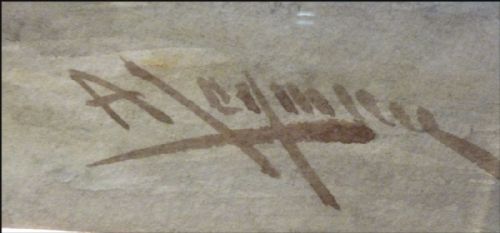
Signed/Inscribed:
"A Leyman"
pencil and watercolour
15 x 22in. (38 x 55 cm.)
The Ship Inn was built in 1290, making it one of the oldest inns in the country. It is believed that even before that date some sort of hostelry existed on the site. In those days the sea came up to where the village school now stands. The Ship Inn was situated very close to the shoreline - an ideal spot for smuggling! It is rumoured that at least one secret tunnel exists, linking the Inn to a nearby cottage: useful for getting rid of contraband when the excise men came knocking! In 1682 The Ship was a venue for a clandestine meeting between smugglers and a corrupt revenue officer. The story leaked out and the revenue officer stood trial.
Throughout its long history the Inn has been at the forefront of village life. Sometimes the close links with the community were not always very happy. In 1754 shooting at the Inn's sign seems to have been a local sport. The then owner was given 10/6d in compensation. Usually however, the Inn and the village lived in harmony.
At the end of the evening the Inn staff would help the riders back on to their ponies who fortunately knew the way home. Occasionally the staff would make a mistake and put the wrong rider on a pony. In those cases the pony arrived home safely but the rider would get a surprise in the morning.
The Ship Inn was well known as an alehouse and had its own malt house in the grounds. This must have been useful when "Club Days" were held here. In the late eighteenth century and early nineteenth century, workers formed self -help organisations. Members would meet regularly and, from time to time, organise social events, outings and meals. The Ship Inn hosted many of these. Close links with hunting were always a feature of life at the Inn. Around the time of the 1800's "Venison Feasts" were held at the Inn to celebrate the end of each stag-hunting season. In more recent times competitors in the Holnicote horse races used to meet at The Ship before taking part and return later to either celebrate or drown their sorrows.
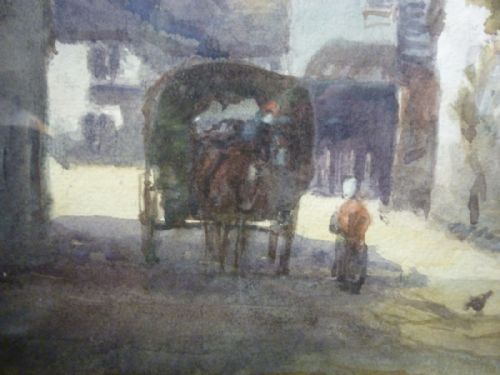
Coach outside the Ship InnOver the centuries The Ship Inn has welcomed many travellers. Until 1843 they would have arrived mainly on foot or on horseback. In that year, however, the first stagecoach came to Porlock. This had been especially hired for an excursion to Lynton. Its appearance outside The Ship led to "scores of the inhabitants" surrounding it.
In 1840 Mr Blathwayt, the Lord of the Manor, had built a new road designed to bypass the infamously steep Porlock Hill. Since it was a toll road many chose not to use it. The road was dug out manually to provide work for local people following the Napoleonic Wars. Tolls were taken at the bottom of the hill by staff at The Ship Inn. There used to be a tollgate opposite what is now the village hall. At busy times of the day staff would run out from the bar to deal with travellers; at less busy times one of the boys would sit by the gate.
Stagecoach descending Porlock HillWith the coming of the stage coach the Inn entered a new phase of its existence. The steepness of Porlock Hill meant that two horses had to be stabled at the Inn. These would help the already exhausted stagecoach horses to climb to the top.
Lots of evidence of the importance of horses and stagecoaches to the Inn still exist. There are mounting blocks just outside, designed to help riders climb onto their horses or passengers to get into the stagecoach.
The old skittle alley was part of the stable block. It is rumoured that the horses used to look over their stalls as the skittler's played their hands
Artware Fineart has dated this Antique Watercolour Village Painting to the 1920s.
You can view the stock and full dealer information on the Artware Fineart Profile Page
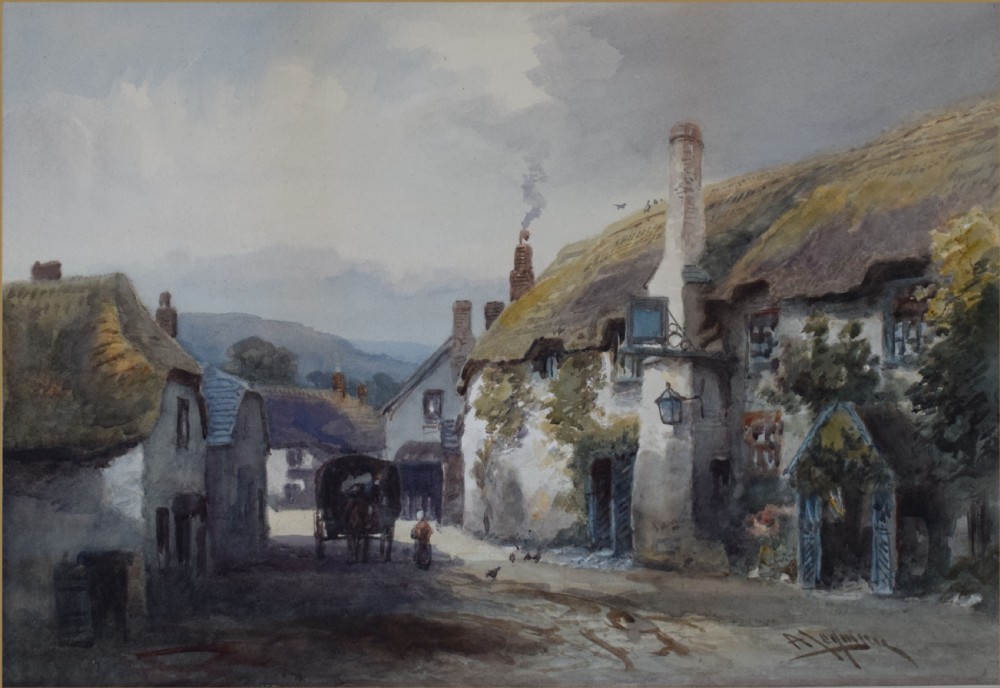

Alfred Leyman, 1856 - 1933 The Ship Inn Porlock, Exmoor, Devon


