Artware Fineart has dated this 19th Century Military Portrait to the 19th Century.
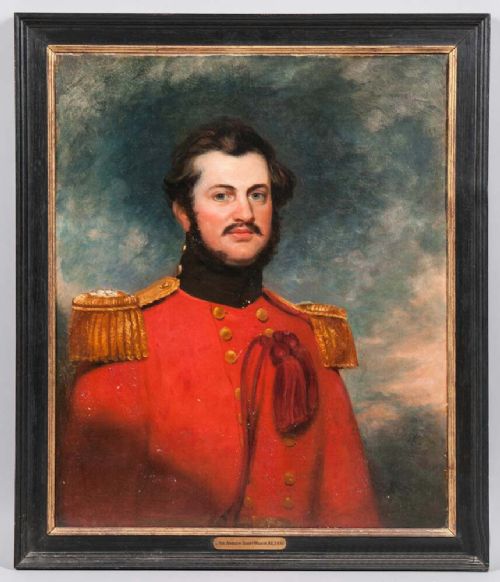
Portrait of Major General Sir Andrew Scott Waugh 1810-1878
Signed/Inscribed:
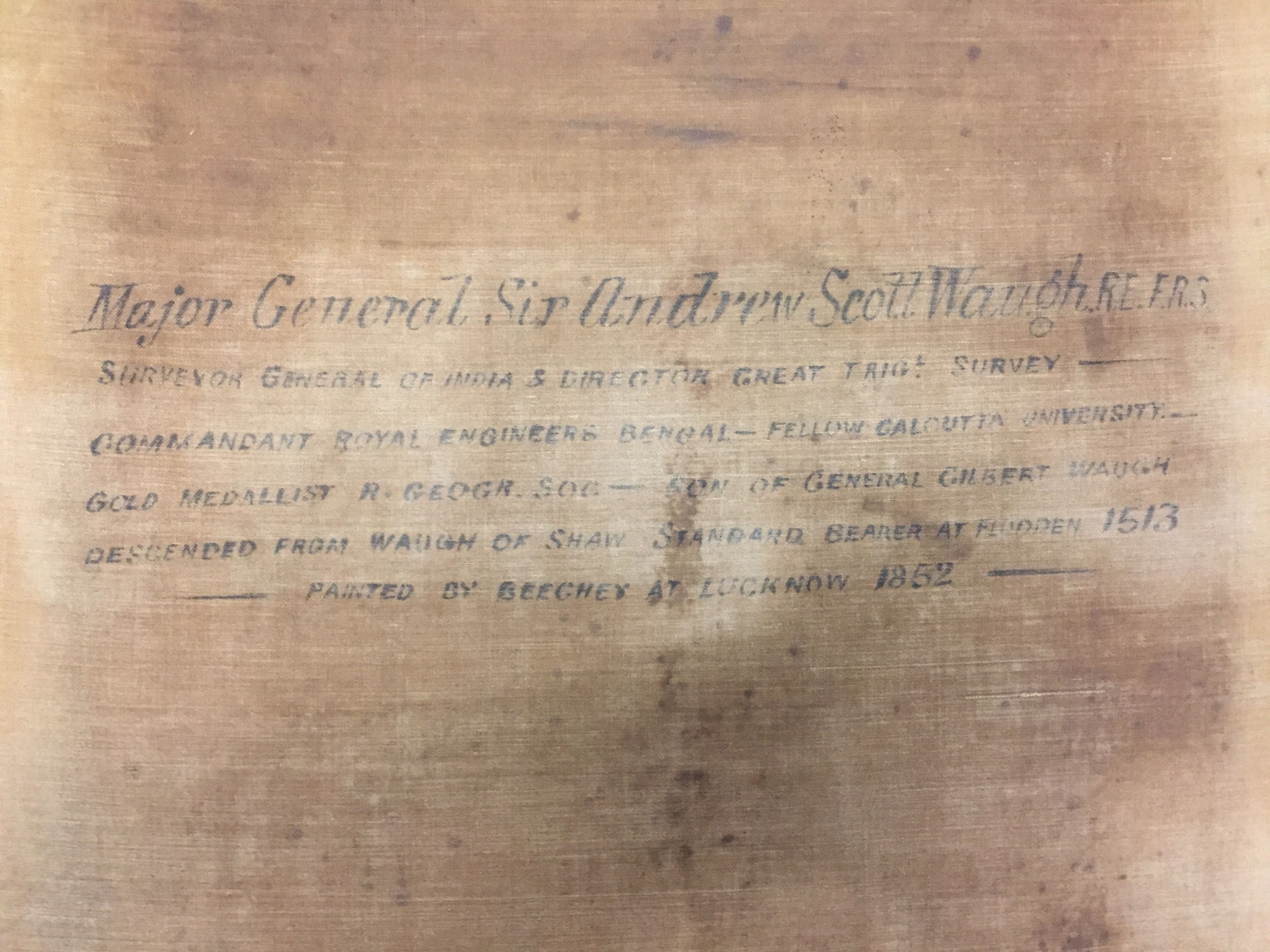
on the original canvas (now relined) "Major General Sir Andrew Scott Waugh, RE, FRS,
Surveyor General of India and Director of Great Trig Survey/ Commandant Royal Engineers Bengal/

Waugh of Shaw standard bearer of Flodden 1513, Painted by Beechey at Lucknow 1852"
oil on canvas
30 x 25in. (76 x 64 cm.)
Major General Sir Andrew Scott Waugh (1810-1878) was a British army officer and surveyor now remembered as the man who named the highest mountain in the world after Sir George Everest, his predecessor in the post of Surveyor-General of India.Waugh, Sir Andrew Scott (1810–1878), army officer and surveyor, eldest son of General Gilbert Waugh, military auditor-general at Madras, grandson of Colonel Gilbert Waugh of Gracemount, Midlothian (descended from Waugh of Shaw, standard-bearer at Flodden Field), and nephew of Sir Murray Maxwell of the Royal Navy, was born in India on 3 February 1810. He was educated at Edinburgh high school, and, after passing through Addiscombe in 1827 in half the usual time, came out first of his term and was commissioned lieutenant in the Bengal Engineers on 13 December 1827. After training at Chatham he went to India, arriving there on 25 May 1829.
Waugh was appointed in 1830 to help build a new foundry at Kashipur. On 13 April 1831 he was appointed adjutant of the Bengal Sappers and Miners, and on 17 July 1832 to the great trigonometrical survey of India under the immediate direction of George Everest, the surveyor-general. Waugh and his friend Lieutenant Thomas Renny (afterwards Major Thomas Renny-Tailyour) were the first engineers on the Indian establishment to join the department as subalterns and to make their careers in it. In 1833 they were sent to Sironj, to carry a series of triangles up one of the meridians fixed by the longitudinal series. They explored the jungle country between Chunar and the sources of the Son and Narbada up to Jubbulpore, and submitted a topographical and geological report to the geographical department of the India Office.
In November 1834 Waugh joined the headquarters of the surveyor-general at Dehra Dun, to help measure the baseline. In April 1835 he was appointed astronomical assistant for the celestial observations connected with the measurement of the great arc, and at the end of that year he was at Fatehgarh, conducting the rougher series of the great trigonometrical survey. In January 1836 he joined Everest at Saini, to help measure the arc of the meridian extending from Cape Comorin to Dehra Dun, starting with the northern baseline in the Dehra Dun valley, and connecting it with the baseline near Sironj, some 450 miles to the south; and remeasuring the latter in 1837 with the new compensation bars which had been used at Dehra Dun. The operation was so accurate that the difference of length of the Dehra Dun baseline as measured and as deduced by triangulations from Sironj was only 7.2 inches.
In November 1837 Waugh was appointed to work southwards on the base Pagaro to Jaktipura. The work was completed by March 1838, when he was sent to test the accuracy of the triangulation between Bedar and Takalkhard and to lay out the site of an observatory at Damargidda. In October he began fieldwork with azimuth observations at Damargidda, and, working north with the triangulation, completed the work by April 1839. He shared with Everest the arduous observatory work carried on simultaneously at the stations of Kaliana, Kalianpur, and Damargidda from November 1839 to March 1840, by which the arc of amplitude was determined. In 1841 Waugh was engaged in the remeasurement of the Bedar base. Between 1834 and 1840 he had conducted the Ranghir series of triangles in the North-Western Provinces, and in 1842 he rapidly but accurately carried
Artware Fineart has dated this 19th Century Military Portrait to the 19th Century.
You can view the stock and full dealer information on the Artware Fineart Profile Page

George Duncan Beechey, 1798 - 1852 Portrait of Major General Sir Andrew Scott Waugh 1810-1878