60,930  PAGES BROWSED TODAY PAGES TODAY 103  ANTIQUES UPLOADED TODAY NEW ARRIVALS
ID #SA485931
FOR SALE
£1,200
Email
Save
Francis Dodd, 1874-1949 Portrait of Charles Prestwich Scott 1846-1932
Artware Fineart
for sale €1,404     $1,524
£1,200

Artware Fineart

Sellingantiques Verified Since Sep 2008
View Dealers Stock Page
Id #SA485931
PDF SHARE
SAVE

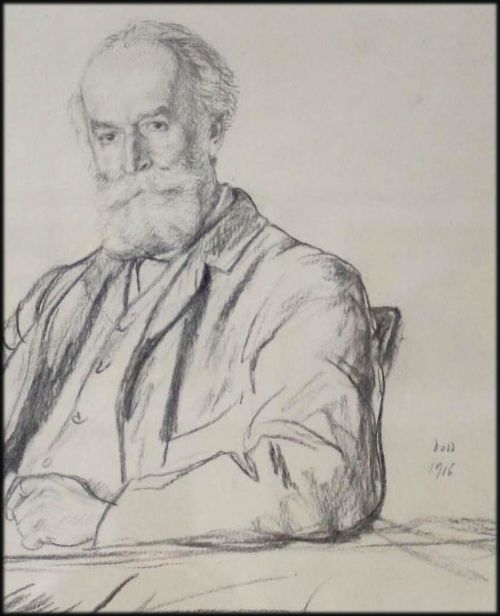
Francis Dodd, 1874-1949 Portrait of Charles Prestwich Scott 1846-1932

1900 - 1920
For Sale by Artware Fineart
Description

Francis Dodd, 1874-1949

Portrait of Charles Prestwich Scott 1846-1932

Signed/Inscribed:

and dated "Dodd 1916"

pencil on paper

35 x 27 cm. (13.3/4 x 10.3/4in.)

working drawing for the oil on canvas portrait in the Manchester City Art Gallery Acsesion number : 1978.180 bequeathed by Mrs Alice Olga Scott, 1978
Literature

etching, 1916 NPG 3997

Notes

Charles Prestwich Scott, (1846–1932), newspaper editor and proprietor, was born at Bath on 26 October 1846. He was the eighth child and fourth son of Russell Scott (1801–1880), a partner in a coal company, and his wife, Isabella Civil, daughter of Joseph Prestwich, wine merchant. Scott's upbringing was Unitarian. He attended Hove School, Sussex, run by a Unitarian minister, and Clapham grammar school. He also, for reasons of health, spent a period with a private tutor on the Isle of Wight, the Revd Arthur Watson. Despite religious obstacles, in 1865 he secured admission to Corpus Christi, Oxford, immersing himself in a full university life—including rowing and debating—and graduating BA in 1869 with a first class in literae humaniores. Thereafter, he habitually looked to Oxford for recruits to his staff.

Scott's choice of career was determined by three things: family connections, his evident literary skills, and his strongly directed personality. J. E. Taylor, his cousin (but many years his senior), owned the Manchester Guardian, which Taylor's father had founded. An organ both of the flourishing cotton trade and of religious and political dissent, it was the most valuable newspaper property outside London. Taylor offered Scott a position on the paper which he took up in 1871, and elevated him to the editorship in January 1872. Scott, aged only twenty-five, was many years junior to the more experienced of his colleagues, but this did not prove a difficulty. His piercing brown eyes, striking good looks, newly acquired beard, and authoritative manner left no doubt who was in charge. Scott remained editor for fifty-seven years.

Within a short time Scott was attracting to the newspaper highly distinguished writers on the arts and sciences, including such figures as A. W. Ward, James Bryce, C. E. Montague, and Arnold Toynbee. In politics the Manchester Guardian in 1872 was more whig than radical. Scott, for more than a decade, seemed content with this. But perhaps he began foreshadowing a change in political direction by the attention his paper began devoting to social questions. The Guardian carried well-documented accounts of conditions in the mining districts of northern England, of the indifferent housing of the poor, and of deficiencies in the medical services. Scott sent W. T. Arnold (grandson of Arnold of Rugby, and nephew of Matthew) to Ireland, from whence came reports of appalling social conditions and their connection with political discontents and political crime.

Hence the ground was not unprepared when, in 1886, W. E. Gladstone committed his party to Irish home rule (thereby splitting the Liberal Party). Scott embraced the cause. It proved a wide-ranging conversion, from which Scott emerged not just a home-ruler but a social radical. His newspaper in the next three decades opposed British imperialism in South Africa (and in particular Cecil Rhodes's exploitation of native labour), resisted large programmes of armaments, and gave devoted support to women's suffrage and the many schemes for social improvement embodied in what, with the Liberals restored to office from 1905, became the ‘new Liberalism’.

In 1895, while remaining editor of the Manchester Guardian, Scott entered parliament for the Leigh division of Lancashire as a Liberal. He remained until 1905. It proved a stormy decade. The South African War not only divided the Liberals (again) but cost the Manchester Guardian readers and advertisers on account of its ‘unpatriotic’ attit

Physical Dimensions
Height
35cm (13.78")
Width
27cm (10.63")
Depth
1cm (0.39")
Declaration

Artware Fineart has dated this Antique Charcoal Portrait Drawing to the 1910s.

Reference Numbers
Sellingantiques Reference
SA485931
Dealers Internal Reference
3925
Description
Francis Dodd, 1874-1949

Portrait of Charles Prestwich Scott 1846-1932

Signed/Inscribed:

and dated "Dodd 1916"

pencil on paper

35 x 27 cm. (13.3/4 x 10.3/4in.)

working drawing for the oil on canvas portrait in the Manchester City Art Gallery Acsesion number : 1978.
Artware Fineart

180 bequeathed by Mrs Alice Olga Scott, 1978

fig 1. An antique monochrome charcoal portrait drawing on paper depicting a bearded gentleman seated at a table.
fig 1. Francis Dodd, 1874-1949 Portrait of Charles Prestwich Scott 1846-1932

Literature

etching, 1916 NPG 3997

Notes

Charles Prestwich Scott, (1846–1932), newspaper editor and proprietor, was born at Bath on 26 October 1846. He was the eighth child and fourth son of Russell Scott (1801–1880), a partner in a coal company, and his wife, Isabella Civil, daughter of Joseph Prestwich, wine merchant. Scott's upbringing was Unitarian. He attended Hove School, Sussex, run by a Unitarian minister, and Clapham grammar school. He also, for reasons of health, spent a period with a private tutor on the Isle of Wight, the Revd Arthur Watson. Despite religious obstacles, in 1865 he secured admission to Corpus Christi, Oxford, immersing himself in a full university life—including rowing and debating—and graduating BA in 1869 with a first class in literae humaniores. Thereafter, he habitually looked to Oxford for recruits to his staff.

Scott's choice of career was determined by three things: family connections, his evident literary skills, and his strongly directed personality. J. E. Taylor, his cousin (but many years his senior), owned the Manchester Guardian, which Taylor's father had founded. An organ both of the flourishing cotton trade and of religious and political dissent, it was the most valuable newspaper property outside London. Taylor offered Scott a position on the paper which he took up in 1871, and elevated him to the editorship in January 1872. Scott, aged only twenty-five, was many years junior to the more experienced of his colleagues, but this did not prove a difficulty. His piercing brown eyes, striking good looks, newly acquired beard, and authoritative manner left no doubt who was in charge. Scott remained editor for fifty-seven years.

Within a short time Scott was attracting to the newspaper highly distinguished writers on the arts and sciences, including such figures as A. W. Ward, James Bryce, C. E. Montague, and Arnold Toynbee. In politics the Manchester Guardian in 1872 was more whig than radical. Scott, for more than a decade, seemed content with this. But perhaps he began foreshadowing a change in political direction by the attention his paper began devoting to social questions. The Guardian carried well-documented accounts of conditions in the mining districts of northern England, of the indifferent housing of the poor, and of deficiencies in the medical services. Scott sent W. T. Arnold (grandson of Arnold of Rugby, and nephew of Matthew) to Ireland, from whence came reports of appalling social conditions and their connection with political discontents and political crime.

Hence the ground was not unprepared when, in 1886, W. E. Gladstone committed his party to Irish home rule (thereby splitting the Liberal Party). Scott embraced the cause. It proved a wide-ranging conversion, from which Scott emerged not just a home-ruler but a social radical. His newspaper in the next three decades opposed British imperialism in South Africa (and in particular Cecil Rhodes's exploitation of native labour), resisted large programmes of armaments, and gave devoted support to women's suffrage and the many schemes for social improvement embodied in what, with the Liberals restored to office from 1905, became the ‘new Liberalism’.

In 1895, while remaining editor of the Manchester Guardian, Scott entered parliament for the Leigh division of Lancashire as a Liberal. He remained until 1905. It proved a stormy decade. The South African War not only divided the Liberals (again) but cost the Manchester Guardian readers and advertisers on account of its ‘unpatriotic’ attit

Height
35cm (13.78")
Width
27cm (10.63")
Depth
1cm (0.39")
Date of Manufacture

Artware Fineart has dated this Antique Charcoal Portrait Drawing to the 1910s.

Reference Numbers
Sellingantiques Ref
SA485931
Dealers Internal Ref
3925
Artware Fineart
Sellingantiques verified Since Sep 2008
Dealer Profile

You can view the stock and full dealer information on the Artware Fineart Profile Page

PDF SHARE
SAVE
An antique monochrome charcoal portrait drawing on paper depicting a bearded gentleman seated at a table.
1 / 2
Archive I An antique monochrome charcoal portrait drawing on paper depicting a bearded gentleman seated at a table.

Francis Dodd, 1874-1949 Portrait of Charles Prestwich Scott 1846-1932

Archive II An antique monochrome charcoal portrait drawing on paper depicting a bearded gentleman seated at a table. View II
Enlarged Archival View
Telephone 07958 699 645
Location
18 La Gare
51 Surrey Row
London
SE1 0BZ
United Kingdom
Verified Since Sep 2008
Items For Sale 243
Items Sold 223
Artware Fineart
Verified Since Sep 2008
View Dealer Info
Location: 18 La Gare , 51 Surrey Row , London , SE1 0BZ , United Kingdom
Verified
Sep 2008
For Sale
243
Sold
223
An antique monochrome charcoal portrait drawing on paper depicting a bearded gentleman seated at a table.
Francis Dodd, 1874-1949 Portrait of Charles Prestwich Scott 1846-1932
Ref: SA485931
An antique monochrome charcoal portrait drawing on paper depicting a bearded gentleman seated at a table.
Detail View 1
Archival Detail
Every single antique dealer on our platform is individually approved by our internal team. We verify their professional trade history, ethical standards, and photographic quality to ensure a secure, high-standard buying environment. Upon joining, every dealer agrees to a strict 9-point code of conduct. While issues can occasionally arise, our dealers typically resolve them swiftly and directly with the buyer. In fact, since our founding in 2002, Sellingantiques has only had to step in to help resolve an issue on roughly five occasions—a true testament to the quality of our dealers and their dedication to your happiness.
Our dealers are highly experienced in packing and shipping fragile, high-value antiques. Because you are in direct contact with the dealer, you will be able to easily go through all available shipping and insurance options together to ensure your item arrives safely.
Antiques are the ultimate green purchase. By choosing historical pieces over newly manufactured goods, you completely eliminate the carbon footprint of modern mass production while preserving exceptional, timeless craftsmanship.

Portrait drawings from the early 20th century reflected a period where artists blended traditional academic realism with rapid observational sketching, capturing notable public and private figures using graphic media such as charcoal and graphite.

Artists typically executed these drawings using compressed charcoal, graphite, or chalk on wove or laid paper, which were subsequently mounted onto backing boards and protected behind glass.

Authentic period drawings display natural age-related toning, hand-drawn paper texture, distinct artist stroke techniques, and original period inscriptions or signatures directly on the paper surface.

Display the drawing within a clean modern frame to highlight its graphic qualities, or group it with contemporary abstract art to build a varied gallery wall.

Keep the artwork framed under UV-filtering glass with acid-free matting to prevent friable charcoal smudging, foxing, or discolouration caused by sunlight and humidity.
items
Add keywords to the filter
Price
£100
£250000
Era
Movements
Material
Origin
Stock Location
Freshness
Online Payments
Categories