Attributed to Frans Pourbus the Elder, 1545 - 1581
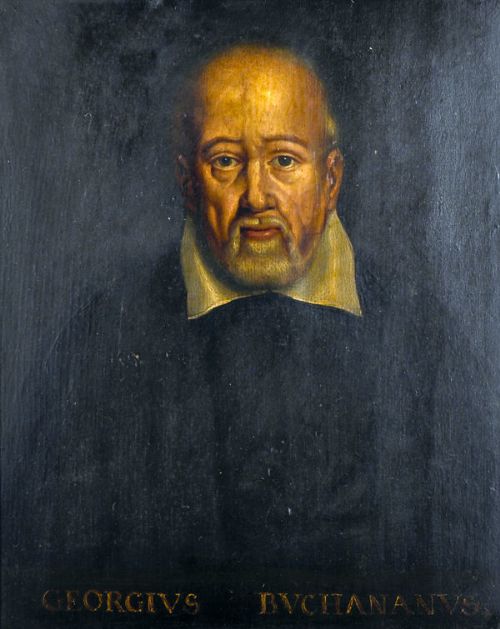
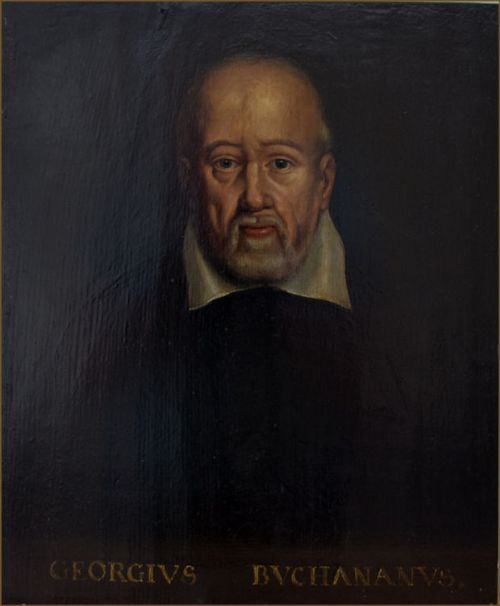
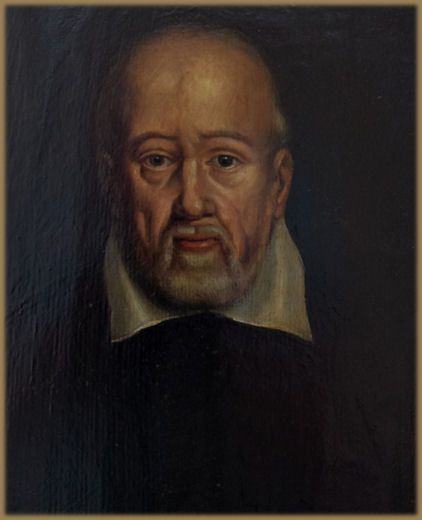
Portrait of George Buchanan, 1506-1582, poet, historian, and administrator
Signed/Inscribed:
''GEORGUS BVCHANVS''
oil on oak panel
35.54 x 27.94 cm. (13.3/4 x 11in.)
Buchanan, George (1506–1582), poet, historian, and administrator, was born about 1 February 1506 at a farm called The Moss in Killearn parish, Stirlingshire, the fifth of eight children of Thomas Buchanan (d. c.1512) and Agnes Heriot, traditionally said to be of the Heriots of Trabroun, Haddingtonshire. His father and grandfather, Robert Buchanan of Drumikill, died while he was a child and he was brought up by his mother, who was given a lease of lands near Cardross, Menteith, in 1513. He probably spoke Gaelic. One of his five brothers, Patrick, became known as a humanist. A nephew Thomas succeeded him as keeper of the privy seal, and Thomas''s wife Janet was Buchanan''s executor.
A few details of Buchanan''s early life are given in his autobiographic
...al Vita, first published in 1598. Its authenticity is generally accepted, though Peter Young, assistant tutor to James VI, has been suggested as a possible author. At the instigation of his uncle James Heriot he left local schooling at the age of fourteen to go to Paris. His uncle''s death caused him to return to Scotland within two years. During 1523 he undertook military service with French troops led by the duke of Albany in a campaign of retaliation against English invasion, and was present at the siege of Wark in October. After a winter''s illness he went to St Andrews to study under John Mair or Major. He took his BA degree at St Andrews on 3 October 1525 and though in a later epigram he described his teacher as ‘Major in name alone’ (Buchanan, Opera, 2.373), he followed him to Paris where he was admitted BA on 10 October 1527. He began to teach in the Collège de Ste Barbe, noted for its Greek studies, and became procurator of the German nation in 1529. For the next five years he was tutor to Gilbert Kennedy (later third earl of Cassillis) to whom he dedicated his first published work, a translation from English into Latin of Linacre''s Rudimenta grammatices (1533), and whom he later commemorated in an elegy.
Buchanan had returned to Scotland with Kennedy by 1536 and was appointed tutor to Lord James Stewart, an illegitimate son of James V who died in 1557. He wrote a satirical poem describing a dream in which St Francis asked the author to join the Franciscan order. He replied that there was more honesty found outside the church. He developed the themes of the Somnium at more length in the Palinodiae, intended as a middle way between offending the Franciscans and being too mild for the king, and in the more pointed Franciscanus. These poems, not published until later, showed Buchanan''s familiarity with classical models. They also involved him in religious controversy: he had eaten meat in Lent and taken an interest in Lutheran questions. Condemned as a heretic he was thrown into prison, but he escaped and fled to London, where he stayed about six months and was assisted by Sir Thomas Rainsforde. After a month in Paris he left for Bordeaux in September 1539.
While Buchanan was at the Collège de Guyenne in Bordeaux (he had been invited by the principal, André Gouvea, nephew of the principal of Ste Barbe) he continued his acquaintance with scholars including the elder Scaliger, as he did during a year or so at the Collège du Cardinal Lemoine in Paris. He visited Toulouse in 1544 and then returned to Bordeaux where Montaigne was among his pupils. At this time he did not appear to be in danger on account of his religious views.
During these years Buchanan worked on his plays: Baptistes, written and produced in 1542, Medea which was produced in 1543 but may have been drafted earlier, and Jephthes and Alcestis which were not produced at that time
Internal Reference: 3885
Antique ID Number (AIDN): SA441092
Dateline of this antique is 16th century
Height is 35cm (13.8inches)Width is 28cm (11.0inches)Depth is 2cm (0.8inches)




Thank you.
Your comment has been sent to Sellingantiques.