19,137  PAGES BROWSED TODAY PAGES TODAY 36  ANTIQUES UPLOADED TODAY NEW ARRIVALS
ID #SA441091
FOR SALE
£6,500
Email
Save
Sir Oswald Hornby Joseph Birley, Rp, Roi, Nps, 1880-1952 Portrait of King George V 1865–1936
Artware Fineart
Id #SA441091
PDF SHARE
SAVE

Sir Oswald Hornby Joseph Birley, Rp, Roi, Nps, 1880-1952 Portrait of King George V 1865–1936

1920 - 1940
For Sale by Artware Fineart
Description

Sir Oswald Hornby Joseph Birley, RP, ROI, NPS, 1880-1952

Portrait of King George V 1865–1936

14th June 1933

oil on canvas

60 x 45 cm. (24 x 18in.)
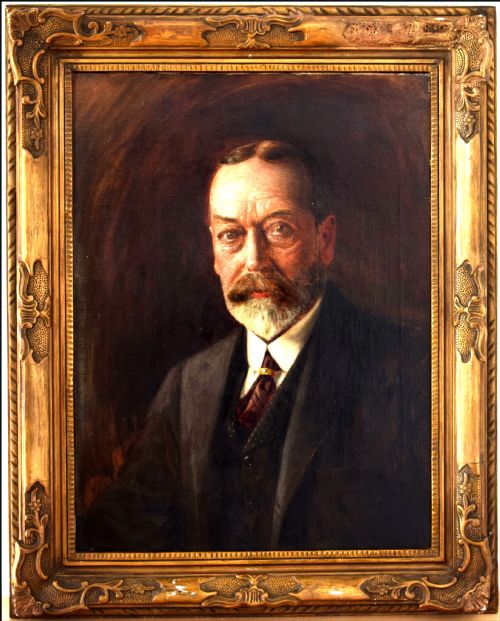
Portrait of King George V 1865–1936, King of Great Britain, Ireland, and the British dominions beyond the seas, and emperor of India

Provenance

Private Collection, Bedfordshire

Notes

This usigned portrait of King George V by Sir Oswald Birley is a version (also the same size), as the portrait in the National Portrait Gallery collection, London, NPG 4013, painted in 1933 and purchased in 1957. The Portrait was painted 3 years before King George V's death and in the same year the Nazi party comes to power in Germany as part of a coalition government with Hitler as Chancellor.
George V (1865–1936), was born at Marlborough House, London, on 3 June 1865, the second child of the prince and princess of Wales, later Edward VII (1841–1910) and Queen Alexandra (1844–1925). He was baptized at Windsor Castle on 7 July by the names of George Frederick Ernest Albert. The prince's elder brother,Prince Albert Victor Christian Edward (later duke of Clarence), was, after his father, heir to the throne should Queen Victoria die. Though much beloved in the family, Prince Albert Victor had a variety of difficulties which encouraged his parents to bring Prince George to the fore. From an early stage George was the dominant of the two brothers. The prince of Wales was determined to avoid for his sons the over-pressured intellectual education which he had been required to undergo, especially as he was aware in his own case of its lack of success. The family was based chiefly at Sandringham, and from an early age George acquired the values of the Norfolk squirearchy which so moulded his contribution to the British monarchy in the twentieth century. The boys' tutor from 1871 was the Revd John Neale Dalton (1839–1931), with whom Prince George formed a close, if sometimes awkward, bond which lasted much of his life; on his marriage he made Dalton his domestic chaplain. Dalton's chief responsibility was to educate the heir to the throne, and the lessons to which Prince George accompanied his brother were directed to that end. Dalton was not as heavy-handed as some of the prince of Wales's tutors had been, and he was not being constantly urged by the parents to make his pupils work. With Queen Victoria keeping a distant but characteristically watchful eye, Dalton gave his charges a limited education: exceptionally among European royalty, the future George V could barely speak French or German, and could not read those languages.
From an early stage Prince George was intended for the navy. It was clear that Prince Albert Victor could not do without him, and in 1877 the two boys were sent to HMS Britannia, the Royal Navy's training ship, with Dalton in attendance. This was followed, again with Dalton on board, by three years in HMS Bacchante, captained by Lord Charles Scott, in which the princes went round the world (1880–82); this was the third of their three voyages on the Bacchante, the first being to the West Indies (1879), the second to Spain and Ireland (1880). In an age when naval disasters were almost commonplace, placing both male heirs in one ship was a risk (as the cabinet pointed out), and indeed between South Africa and Australia the Bacchante was adrift rudderless for several days and several members of the crew were killed. The toughness of the conditions gave Prince George a point of reference to which he returned throughout his life. No member of the royal family had been exposed to such harsh physical and mental conditions since the youth of William IV. The voyage was recorded in The Cruise of HMS Bacchante, 1879–1882 (2 vols., 1886), which Dalton presented as being edited by himself from the journals and letters of the princes, but was in fact largely his own wor

Physical Dimensions
Height
60cm (23.62")
Width
45cm (17.72")
Depth
3cm (1.18")
Declaration

Artware Fineart has dated this King George V Portrait to the 1930s.

Reference Numbers
Sellingantiques Reference
SA441091
Dealers Internal Reference
3887
Description
Sir Oswald Hornby Joseph Birley, RP, ROI, NPS, 1880-1952

Portrait of King George V 1865–1936

14th June 1933

oil on canvas

60 x 45 cm. (24 x 18in.)

Portrait of King George V 1865–1936, King of Great Britain, Ireland, and the British dominions beyond the seas, and emperor of India.
Artware Fineart
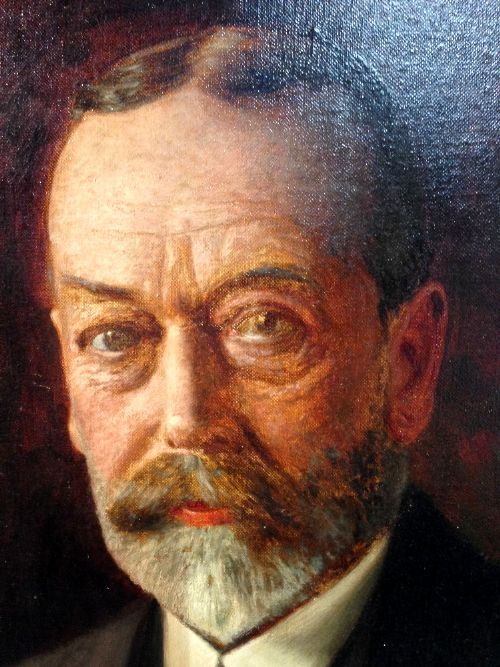
fig 1. A formal half-length oil portrait painting of King George V wearing a dark suit against a shaded brown background.
fig 1. Sir Oswald Hornby Joseph Birley, Rp, Roi, Nps, 1880-1952 Portrait of King George V 1865–1936

Provenance

Private Collection, Bedfordshire

Notes

This usigned portrait of King George V by Sir Oswald Birley is a version (also the same size), as the portrait in the National Portrait Gallery collection, London, NPG 4013, painted in 1933 and purchased in 1957. The Portrait was painted 3 years before King George V's death and in the same year the Nazi party comes to power in Germany as part of a coalition government with Hitler as Chancellor.

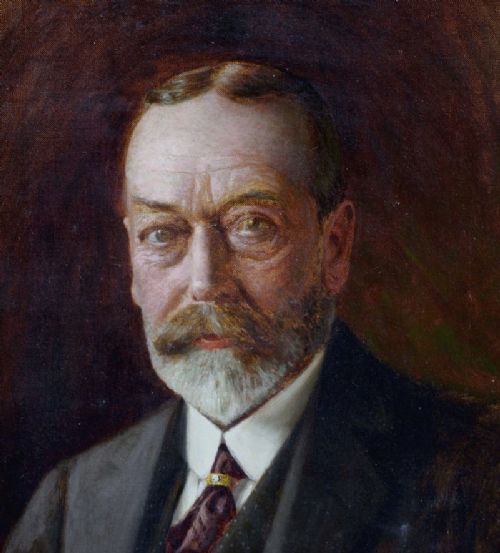
fig 2. A formal half-length oil portrait painting of King George V wearing a dark suit against a shaded brown background.
fig 2. Sir Oswald Hornby Joseph Birley, Rp, Roi, Nps, 1880-1952 Portrait of King George V 1865–1936

George V (1865–1936), was born at Marlborough House, London, on 3 June 1865, the second child of the prince and princess of Wales, later Edward VII (1841–1910) and Queen Alexandra (1844–1925). He was baptized at Windsor Castle on 7 July by the names of George Frederick Ernest Albert. The prince's elder brother,Prince Albert Victor Christian Edward (later duke of Clarence), was, after his father, heir to the throne should Queen Victoria die. Though much beloved in the family, Prince Albert Victor had a variety of difficulties which encouraged his parents to bring Prince George to the fore. From an early stage George was the dominant of the two brothers. The prince of Wales was determined to avoid for his sons the over-pressured intellectual education which he had been required to undergo, especially as he was aware in his own case of its lack of success. The family was based chiefly at Sandringham, and from an early age George acquired the values of the Norfolk squirearchy which so moulded his contribution to the British monarchy in the twentieth century. The boys' tutor from 1871 was the Revd John Neale Dalton (1839–1931), with whom Prince George formed a close, if sometimes awkward, bond which lasted much of his life; on his marriage he made Dalton his domestic chaplain. Dalton's chief responsibility was to educate the heir to the throne, and the lessons to which Prince George accompanied his brother were directed to that end. Dalton was not as heavy-handed as some of the prince of Wales's tutors had been, and he was not being constantly urged by the parents to make his pupils work. With Queen Victoria keeping a distant but characteristically watchful eye, Dalton gave his charges a limited education: exceptionally among European royalty, the future George V could barely speak French or German, and could not read those languages.

fig 3. A formal half-length oil portrait painting of King George V wearing a dark suit against a shaded brown background.
fig 3. Sir Oswald Hornby Joseph Birley, Rp, Roi, Nps, 1880-1952 Portrait of King George V 1865–1936

From an early stage Prince George was intended for the navy. It was clear that Prince Albert Victor could not do without him, and in 1877 the two boys were sent to HMS Britannia, the Royal Navy's training ship, with Dalton in attendance. This was followed, again with Dalton on board, by three years in HMS Bacchante, captained by Lord Charles Scott, in which the princes went round the world (1880–82); this was the third of their three voyages on the Bacchante, the first being to the West Indies (1879), the second to Spain and Ireland (1880). In an age when naval disasters were almost commonplace, placing both male heirs in one ship was a risk (as the cabinet pointed out), and indeed between South Africa and Australia the Bacchante was adrift rudderless for several days and several members of the crew were killed. The toughness of the conditions gave Prince George a point of reference to which he returned throughout his life. No member of the royal family had been exposed to such harsh physical and mental conditions since the youth of William IV. The voyage was recorded in The Cruise of HMS Bacchante, 1879–1882 (2 vols., 1886), which Dalton presented as being edited by himself from the journals and letters of the princes, but was in fact largely his own wor

Height
60cm (23.62")
Width
45cm (17.72")
Depth
3cm (1.18")
Date of Manufacture

Artware Fineart has dated this King George V Portrait to the 1930s.

Reference Numbers
Sellingantiques Ref
SA441091
Dealers Internal Ref
3887
Artware Fineart
Sellingantiques verified Since Sep 2008
Dealer Profile

You can view the stock and full dealer information on the Artware Fineart Profile Page

PDF SHARE
SAVE
A formal half-length oil portrait painting of King George V wearing a dark suit against a shaded brown background.
1 / 4
Archive I A formal half-length oil portrait painting of King George V wearing a dark suit against a shaded brown background.

Sir Oswald Hornby Joseph Birley, Rp, Roi, Nps, 1880-1952 Portrait of King George V 1865–1936

Archive II A formal half-length oil portrait painting of King George V wearing a dark suit against a shaded brown background. View II
Archive III A formal half-length oil portrait painting of King George V wearing a dark suit against a shaded brown background. View III
Archive IV A formal half-length oil portrait painting of King George V wearing a dark suit against a shaded brown background. View IV
FURTHER BROWSING

Visitors also looked at these ⇣

Enlarged Archival View
Telephone 07958 699 645
Location
18 La Gare
51 Surrey Row
London
SE1 0BZ
United Kingdom
Verified Since Sep 2008
Items For Sale 243
Items Sold 223
Artware Fineart
Verified Since Sep 2008
View Dealer Info
Location: 18 La Gare , 51 Surrey Row , London , SE1 0BZ , United Kingdom
Verified
Sep 2008
For Sale
243
Sold
223
A formal half-length oil portrait painting of King George V wearing a dark suit against a shaded brown background.
Sir Oswald Hornby Joseph Birley, RP, ROI, NPS, 1880-1952 Portrait of King George V 1865–1936
Ref: SA441091
A formal half-length oil portrait painting of King George V wearing a dark suit against a shaded brown background.
Detail View 1
Detail View 2
Detail View 3
Archival Detail
Every single antique dealer on our platform is individually approved by our internal team. We verify their professional trade history, ethical standards, and photographic quality to ensure a secure, high-standard buying environment. Upon joining, every dealer agrees to a strict 9-point code of conduct. While issues can occasionally arise, our dealers typically resolve them swiftly and directly with the buyer. In fact, since our founding in 2002, Sellingantiques has only had to step in to help resolve an issue on roughly five occasions—a true testament to the quality of our dealers and their dedication to your happiness.
Our dealers are highly experienced in packing and shipping fragile, high-value antiques. Because you are in direct contact with the dealer, you will be able to easily go through all available shipping and insurance options together to ensure your item arrives safely.
Antiques are the ultimate green purchase. By choosing historical pieces over newly manufactured goods, you completely eliminate the carbon footprint of modern mass production while preserving exceptional, timeless craftsmanship.

Early 20th-century British portraiture is defined by realistic representation, refined brushwork, and formal compositional structure. Influenced by academic traditions, artists focused on capturing character, official stature, and subtle light contrast against neutral backgrounds.

Artists typically used ground oil pigments bound with linseed oil applied to stretched linen or cotton canvas. Double-primed canvas provided a smooth surface for precise brushwork and glazes.

Authenticity is assessed by analyzing natural paint craquelure patterns, artist signatures, wood construction of the canvas stretcher, and historical provenance documentation.

A classic portrait creates visual contrast when displayed against contemporary muted wall colors, framed in a simple gilded or dark timber molding, and illuminated with warm directional accent lighting.

Keep oil paintings out of direct sunlight and maintain stable humidity levels between 45 percent and 55 percent. Cleaning should be performed exclusively by qualified fine art conservators using non-abrasive techniques.
items
Add keywords to the filter
Price
£100
£250000
Era
Movements
Material
Origin
Stock Location
Freshness
Online Payments
Categories