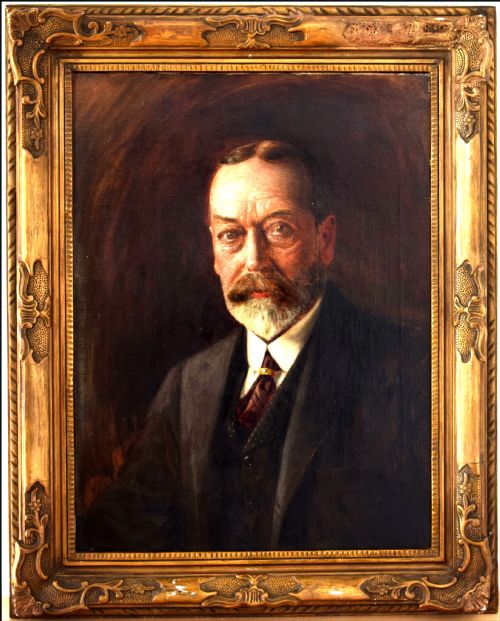
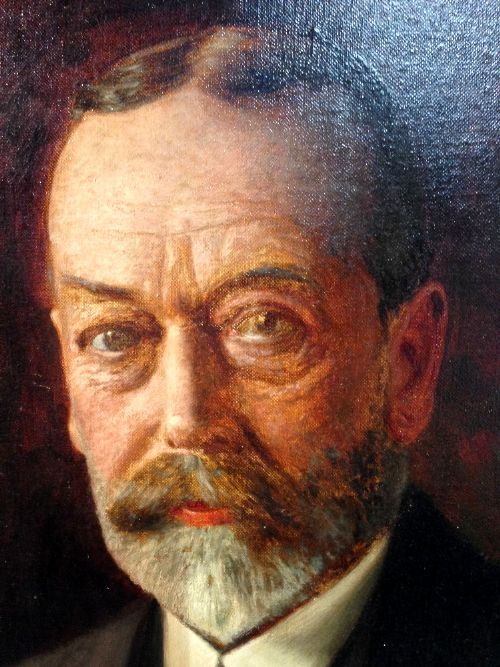
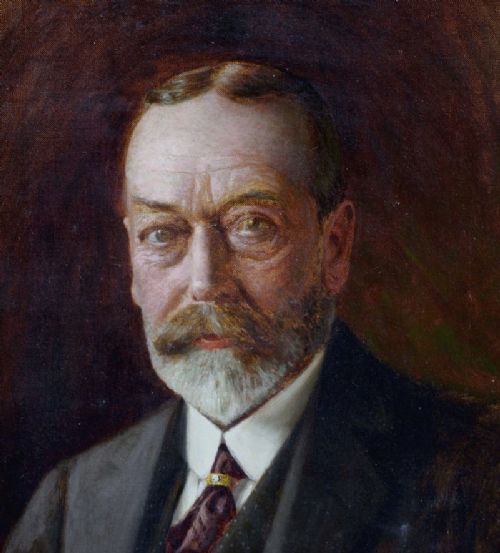
Artware Fineart has dated this King George V Portrait to the 1930s.
Portrait of King George V 1865–1936
14th June 1933
oil on canvas
60 x 45 cm. (24 x 18in.)
Provenance
Private Collection, Bedfordshire
Notes
This usigned portrait of King George V by Sir Oswald Birley is a version (also the same size), as the portrait in the National Portrait Gallery collection, London, NPG 4013, painted in 1933 and purchased in 1957. The Portrait was painted 3 years before King George V's death and in the same year the Nazi party comes to power in Germany as part of a coalition government with Hitler as Chancellor.
George V (1865–1936), was born at Marlborough House, London, on 3 June 1865, the second child of the prince and princess of Wales, later Edward VII (1841–1910) and Queen Alexandra (1844–1925). He was baptized at Windsor Castle on 7 July by the names of George Frederick Ernest Albert. The prince's elder brother,Prince Albert Victor Christian Edward (later duke of Clarence), was, after his father, heir to the throne should Queen Victoria die. Though much beloved in the family, Prince Albert Victor had a variety of difficulties which encouraged his parents to bring Prince George to the fore. From an early stage George was the dominant of the two brothers. The prince of Wales was determined to avoid for his sons the over-pressured intellectual education which he had been required to undergo, especially as he was aware in his own case of its lack of success. The family was based chiefly at Sandringham, and from an early age George acquired the values of the Norfolk squirearchy which so moulded his contribution to the British monarchy in the twentieth century. The boys' tutor from 1871 was the Revd John Neale Dalton (1839–1931), with whom Prince George formed a close, if sometimes awkward, bond which lasted much of his life; on his marriage he made Dalton his domestic chaplain. Dalton's chief responsibility was to educate the heir to the throne, and the lessons to which Prince George accompanied his brother were directed to that end. Dalton was not as heavy-handed as some of the prince of Wales's tutors had been, and he was not being constantly urged by the parents to make his pupils work. With Queen Victoria keeping a distant but characteristically watchful eye, Dalton gave his charges a limited education: exceptionally among European royalty, the future George V could barely speak French or German, and could not read those languages.
From an early stage Prince George was intended for the navy. It was clear that Prince Albert Victor could not do without him, and in 1877 the two boys were sent to HMS Britannia, the Royal Navy's training ship, with Dalton in attendance. This was followed, again with Dalton on board, by three years in HMS Bacchante, captained by Lord Charles Scott, in which the princes went round the world (1880–82); this was the third of their three voyages on the Bacchante, the first being to the West Indies (1879), the second to Spain and Ireland (1880). In an age when naval disasters were almost commonplace, placing both male heirs in one ship was a risk (as the cabinet pointed out), and indeed between South Africa and Australia the Bacchante was adrift rudderless for several days and several members of the crew were killed. The toughness of the conditions gave Prince George a point of reference to which he returned throughout his life. No member of the royal family had been exposed to such harsh physical and mental conditions since the youth of William IV. The voyage was recorded in The Cruise of HMS Bacchante, 1879–1882 (2 vols., 1886), which Dalton presented as being edited by himself from the journals and letters of the princes, but was in fact largely his own wor
Artware Fineart has dated this King George V Portrait to the 1930s.
You can view the stock and full dealer information on the Artware Fineart Profile Page

Sir Oswald Hornby Joseph Birley, Rp, Roi, Nps, 1880-1952 Portrait of King George V 1865–1936