Roy Precious - Antiques & Fine Art has dated this piece to the 1800s.
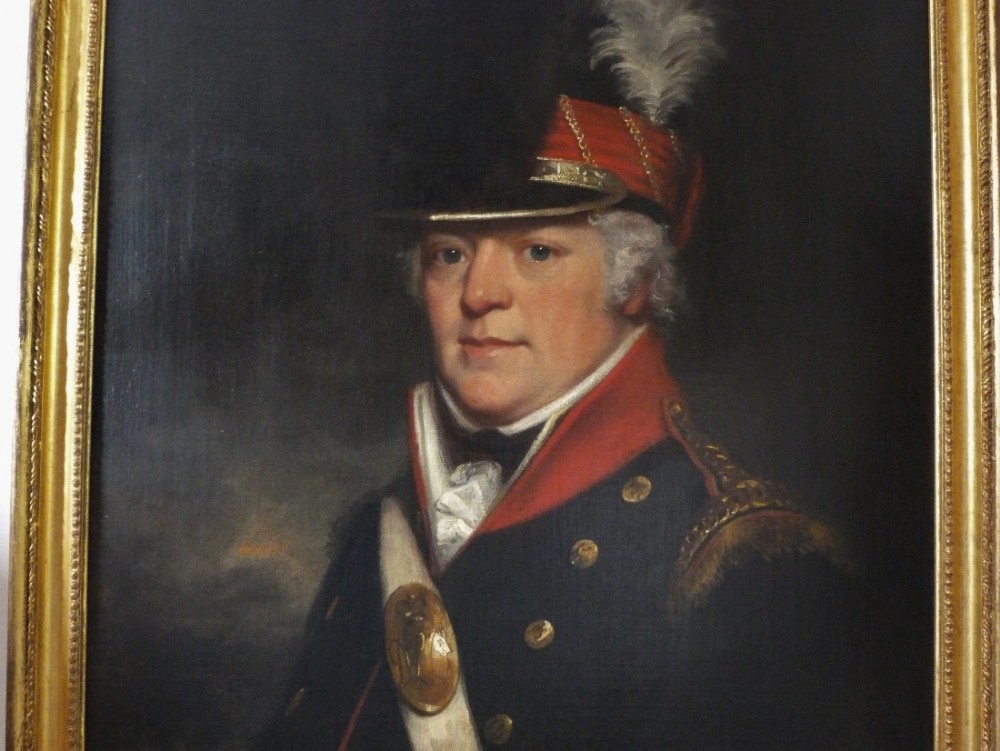
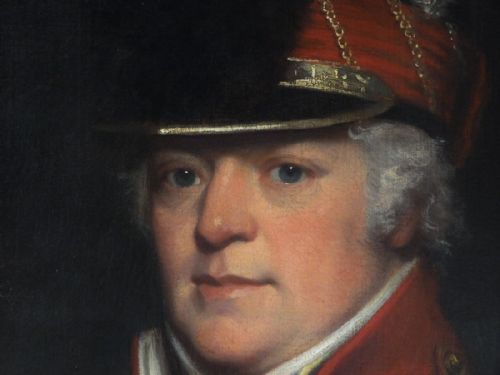
The sitter wears a cavalry officer's uniform, and with the initials on the the shoulder belt rather than a number, it indicates that this is an irregular cavalry unit that is yeoman or possibly fencible cavalry. The 'D' stands for a county and 'LC' for Light Cavalry.
This unit was first formed in 1794 for home defence, as the threat of a French invasion was very real.
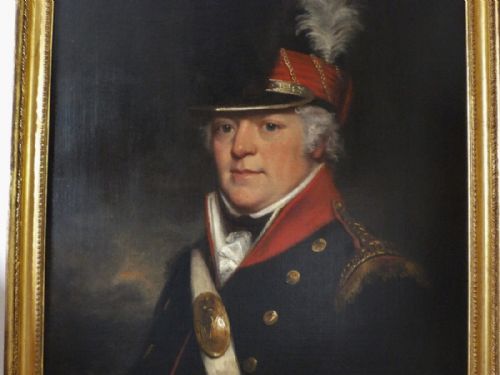
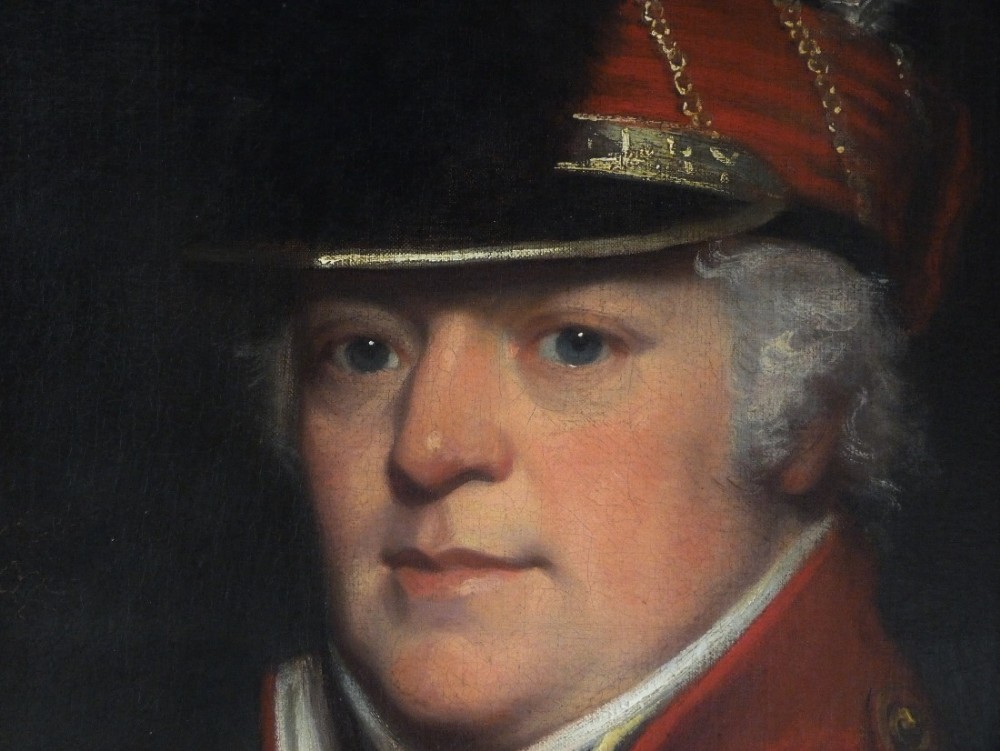
The sitter looks out at us in a calm manner, confident in his uniform; in the background are stormy skies and thunderous clouds, surely a reference to the troubled and dangerous times as Bonaparte's armies swept across Europe.
ADDENDUM, Courtesy of Richard Warren:-
"In theory, this image could be from any one of a number of small and relatively obscure local cavalry units in towns or cities beginning with "D" - many county regimental amalgamations came a bit later. And the blue and scarlet colour scheme is not unusual. Though the "LC" (for Loyal Cavalry) form of initials on the belt plate is much less common than "VC" or "YC". The Derbyshire Volunteer Cavalry of the 1790's are recorded as having buttons marked "DVC", not "DLC" as on the belt plate here, and a surviving belt plate is rectangular, not oval as here. Their helmet's feather was probably red, not white. But it is a possible identification.
The Dudley Loyal Cavalry were organised in 1798, as part of the Dudley Loyal Association. (Dudley, now in the West Midlands, but then in Worcestershire.) Buttons (and therefore also belt plates) were marked "DLC", which is a fit with this image, as is the colour scheme.
The only discrepancy is that the officers' feathers are shown in the painting as white tipped with red, not all white as in your portrait. (And the sitter is an officer, judging by the fringes to the shoulder scales.)
Annoyingly, there's no Parsons among the listed officers of the Derbyshire Volunteer Cavalry for this period, nor among those of the Dudley unit. Dudley's captain was Thomas Dudley, who would be the obvious candidate for a portrait. I'm not quite sure where he fitted among the relations of Viscount Dudley (William Ward), patron of the Association, but presume he was related.
I've also just noticed that Clark's Curiosities of Dudley throws up an R Parsons among a list of names of which the first three are identifiable as officers of the Dudley Loyal Association. (A list of subscribers to something, I think.)"
SIR THOMAS LAWRENCE P.R.A. (1769-1830) was a child prodigy and the most remarkable British portrait painter of his day.
He was born in Bristol and began drawing in Devizes, where his father was an innkeeper. At the age of ten, having moved to Bath, he was supporting his family with his pastel portraits. At eighteen he went to London and soon established his reputation as a portrait painter in oils, receiving his first royal commission, a portrait of Queen Charlotte, in 1790. He stayed at the top of his profession until his death, aged 60, in 1830.
Self-taught, he was a brilliant draughtsman and known for his gift of capturing a likeness, as well as his virtuoso handling of paint. He became an associate of the Royal Academy in 1791, a full member in 1794, and president in 1820. In 1810 he acquired the patronage of the Prince Regent, was sent abroad to paint portraits of allied leaders for the Waterloo chamber at Windsor Castle, and is particularly remembered as the Romantic portraitist of the Regency. Lawrence's love affairs were not happy (his tortuous relationships with Sally and Maria Siddons became the subject of several books) and, in spite of his success, he spent most of life deep in debt. He never married.
Roy Precious - Antiques & Fine Art has dated this piece to the 1800s.
Roy and nadine precious: specialists in portraiture from the 16th to the 20th century. Established in 1972.
You can view the stock and full dealer information on the Roy Precious - Antiques & Fine Art Profile Page
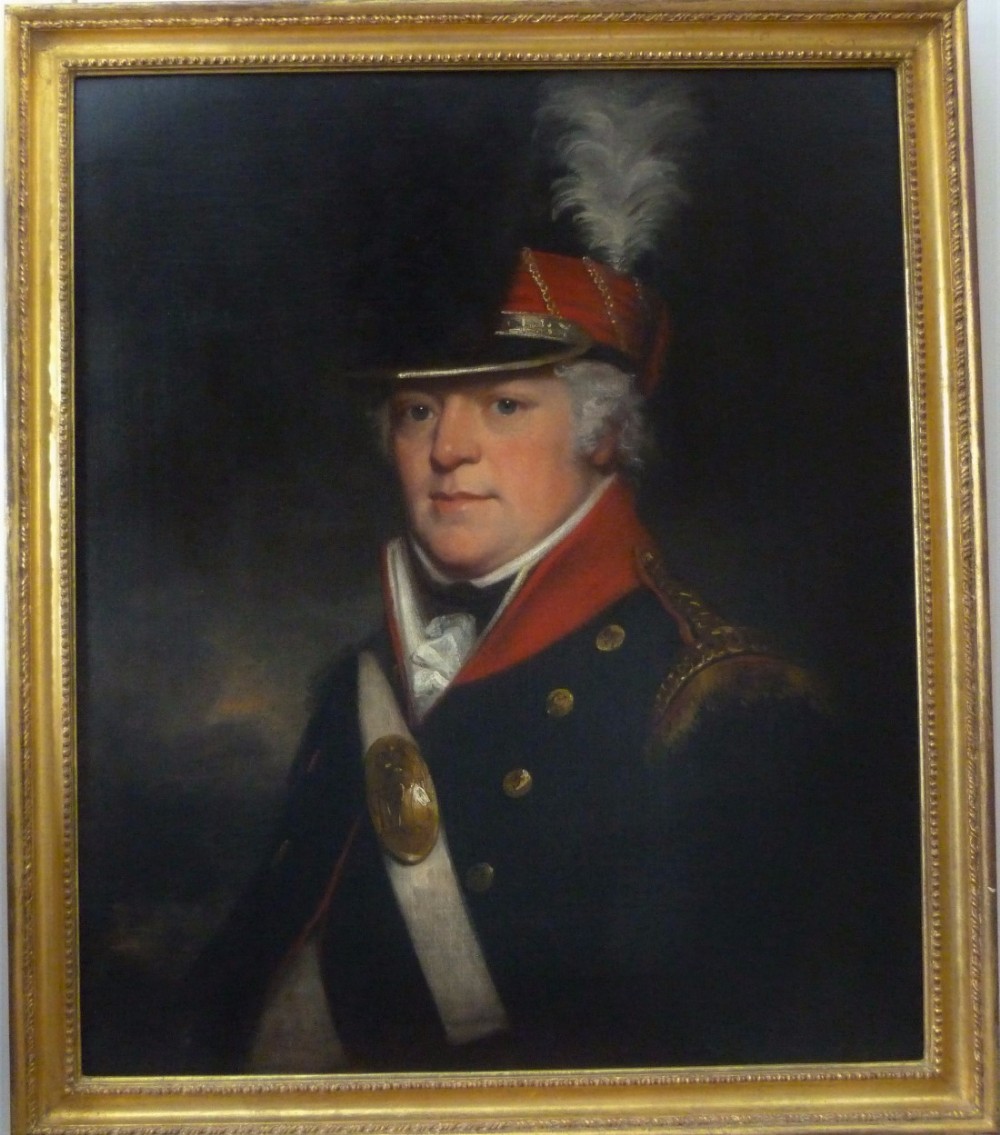
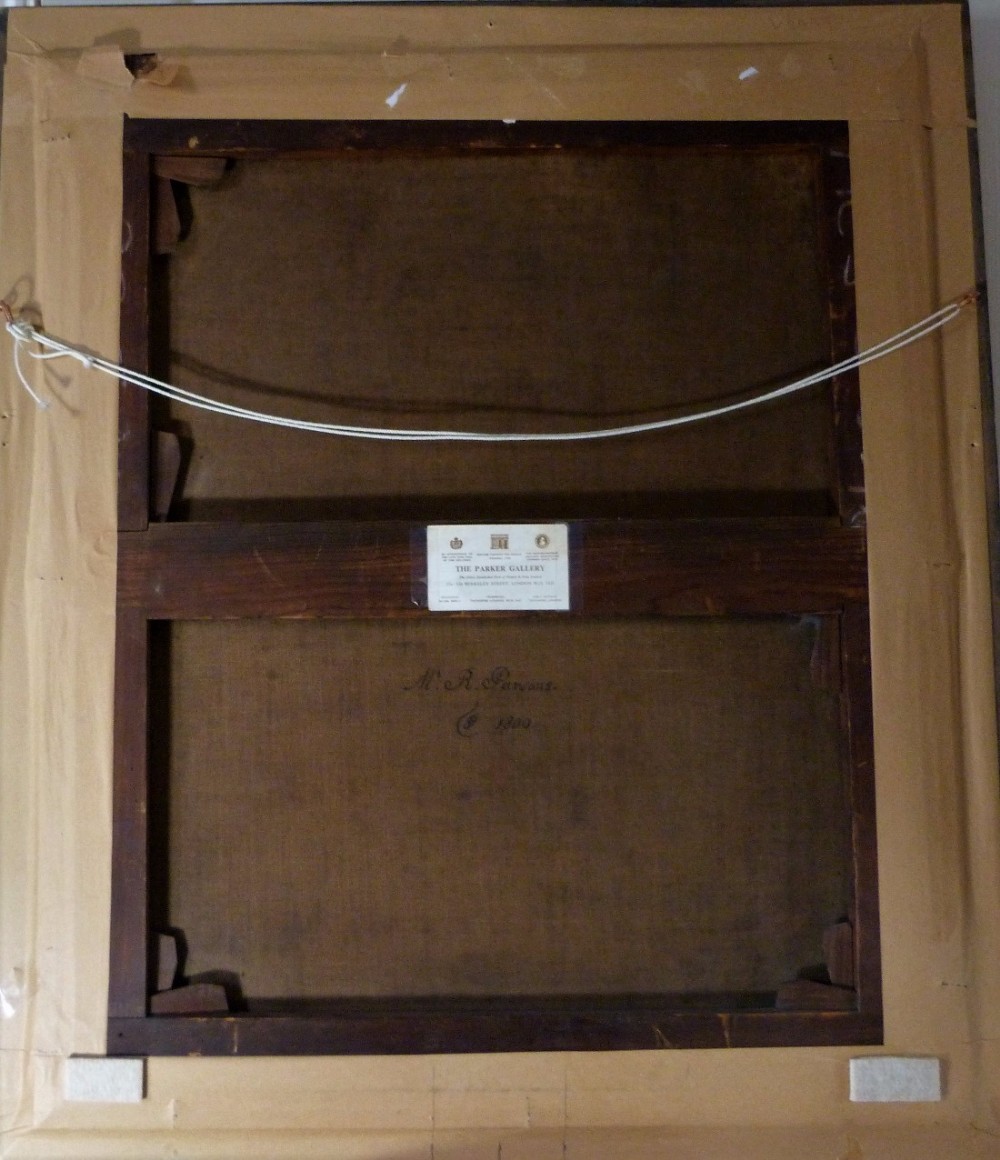
Portrait of R. Parsons, Officer of the Derbyshire Light Cavalry, 1800. Studio or Circle of Sir Thomas Lawrence.