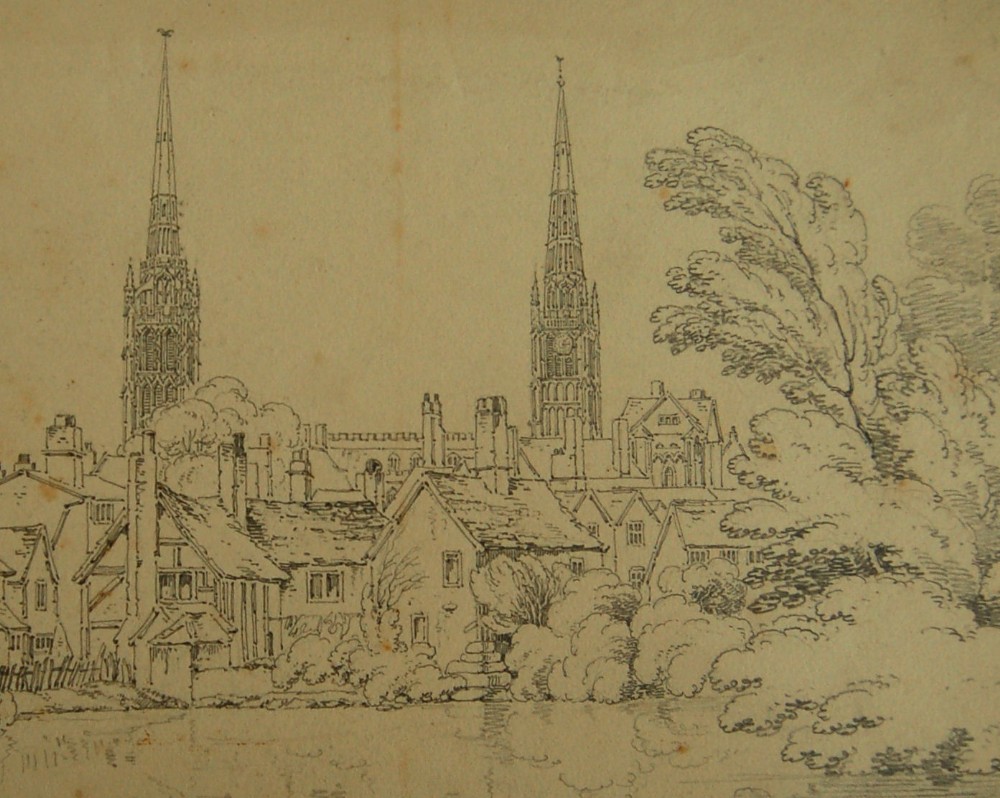
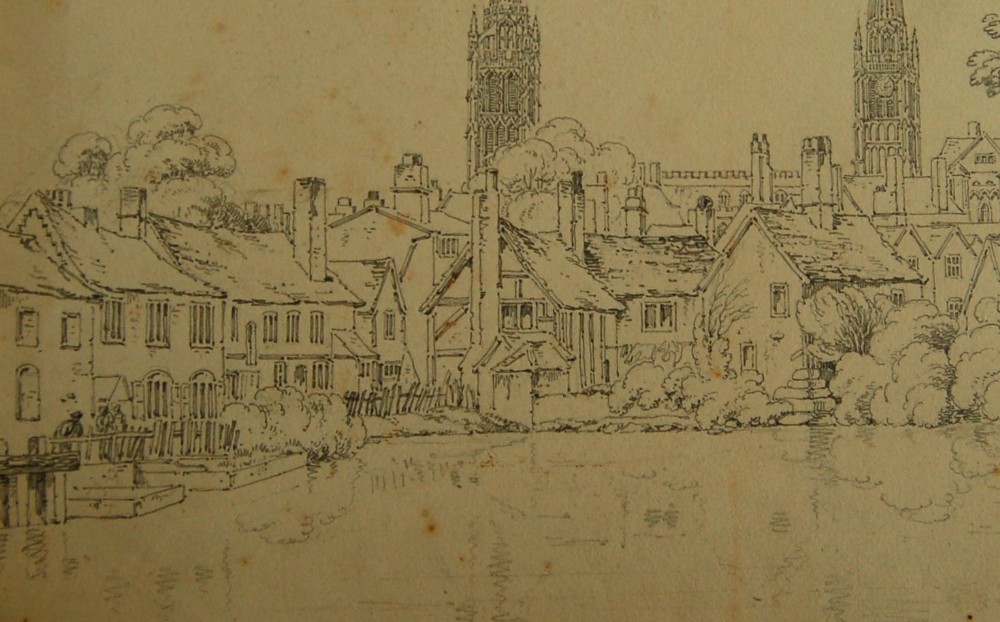
Artware Fineart has dated this Georgian Topographical Pencil Drawing to the 1800s.
Jordan Well, Coventry, Warwickshire
Signed/Inscribed:
on the reverse in pencil "Coventry/ Henry Edridge"
pencil pen and black ink
25 x 38 cm. 10 x 15 in.
?AD 700 by St Osburga,[9] that was later left in ruins by King Canute's invading Danish army in 1016. Leofric, Earl of Mercia and his wife Lady Godiva built on the remains of the nunnery and founded a Benedictine monastery in 1043 dedicated to St Mary. In time, a market was established at the abbey gates and the settlement expanded.
By the 14th century, Coventry was an important centre of the cloth trade, and throughout the Middle Ages was one of the largest and most important cities in England. The bishops of Lichfield were often referred to as bishops of Coventry and Lichfield, or Lichfield and Coventry (from 1102 to 1541). Coventry claimed the status of a city by ancient prescriptive usage, was granted a charter of incorporation in 1345, and in 1451 became a county in its own right.
In the 18th and 19th centuries, Coventry became one of the three main British centres of watch and clock manufacture and ranked alongside Prescot, in Lancashire and Clerkenwell in London. As the industry declined, due mainly to competition from Swiss Made clock and watch manufacturers, the skilled pool of workers proved crucial to the setting up of bicycle manufacture and eventually the motorbike, car, machine tool and aircraft industries.
In the late 19th century, Coventry became a major centre of bicycle manufacture. The industry energised by the invention by James Starley and his nephew John Kemp Starley of the Rover safety bicycle, which was safer and more popular than the pioneering penny-farthing. The company became Rover. By the early 20th century, bicycle manufacture had evolved into motor manufacture, and Coventry became a major centre of the British motor industry. The design headquarters of Jaguar Cars is in the city at their Whitley plant and although vehicle assembly ceased at the Browns Lane plant in 2004, Jaguar's head office returned to the city in 2011, and is also sited in Whitley. Jaguar is owned by the Indian company, Tata Motors.
With many of the city's older properties becoming increasingly unfit for habitation, the first council houses were let to their tenants in 1917. With Coventry's industrial base continuing to soar after the end of the Great War a year later, numerous private and council housing developments took place across the city in the 1920s and 1930s. The development of a southern by-pass around the city, starting in the 1930s and being completed in 1940, helped deliver more urban areas to the city on previously rural land.
Coventry suffered severe bomb damage during the Second World War, most notoriously from a massive Luftwaffe air raid known as the "Coventry Blitz" on 14 November 1940. Firebombing on this date led to severe damage to large areas of the city centre and to Coventry's historic cathedral, leaving only a shell and the spire. More than 4,000 houses were damaged or destroyed, along with around three quarters of the city's industrial plants. More than 800 people were killed, with thousands injured and homeless. The Germans coined the term "Coventrate" to describe the tactics of complete urban devastation developed for the raid.
Aside from London, Hull and Plymouth, Coventry suffered more damage than any other British city during the Luftwaffe attacks, with huge firestorms devastating most of the city centre. The city was probably targeted due to its high concentration of armaments, munitions, aircraft and aero-engine plants which contributed greatly to the British war effort, although there have been claims that Hitler launched the attack as revenge for the bombing of Munich by the
Artware Fineart has dated this Georgian Topographical Pencil Drawing to the 1800s.
You can view the stock and full dealer information on the Artware Fineart Profile Page
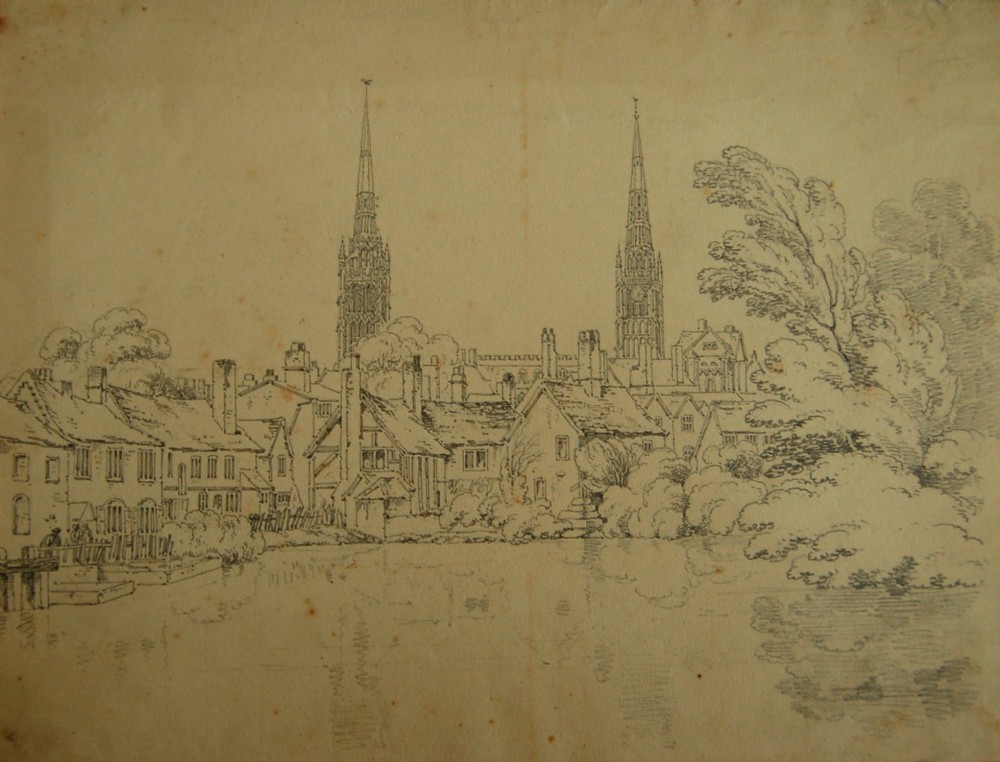
Henry Edridge, ARA, 1768 – 1821 Jordan Well, Coventry, Warwickshire