60,930  PAGES BROWSED TODAY PAGES TODAY 103  ANTIQUES UPLOADED TODAY NEW ARRIVALS
ID #SA398276
FOR SALE
£4,500
Email
Save
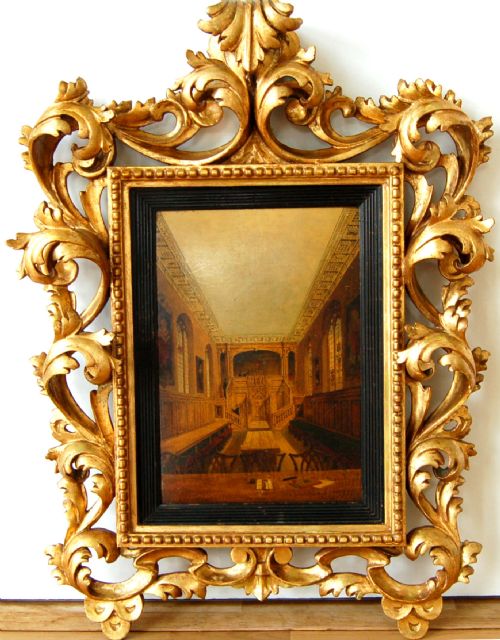
Joseph Murray Ince, 1806 - 1859 Interior of the Formal Hall of Magdalene College, Cambridge
Artware Fineart
for sale €5,265     $5,715
£4,500

Artware Fineart

Sellingantiques Verified Since Sep 2008
View Dealers Stock Page
Id #SA398276
PDF SHARE
SAVE

Joseph Murray Ince, 1806 - 1859 Interior of the Formal Hall of Magdalene College, Cambridge

19th century
For Sale by Artware Fineart
Description

Joseph Murray Ince, 1806 - 1859

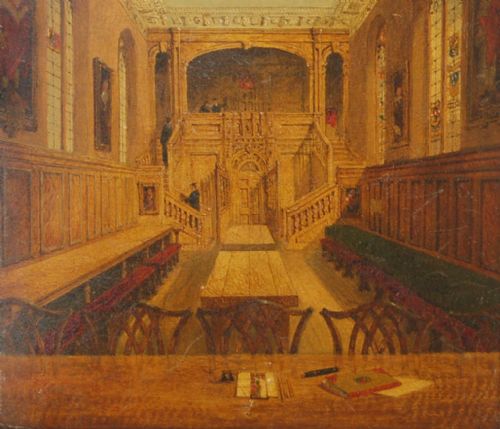
Interior of the Formal Hall of Magdalene College, Cambridge

Signed/Inscribed:

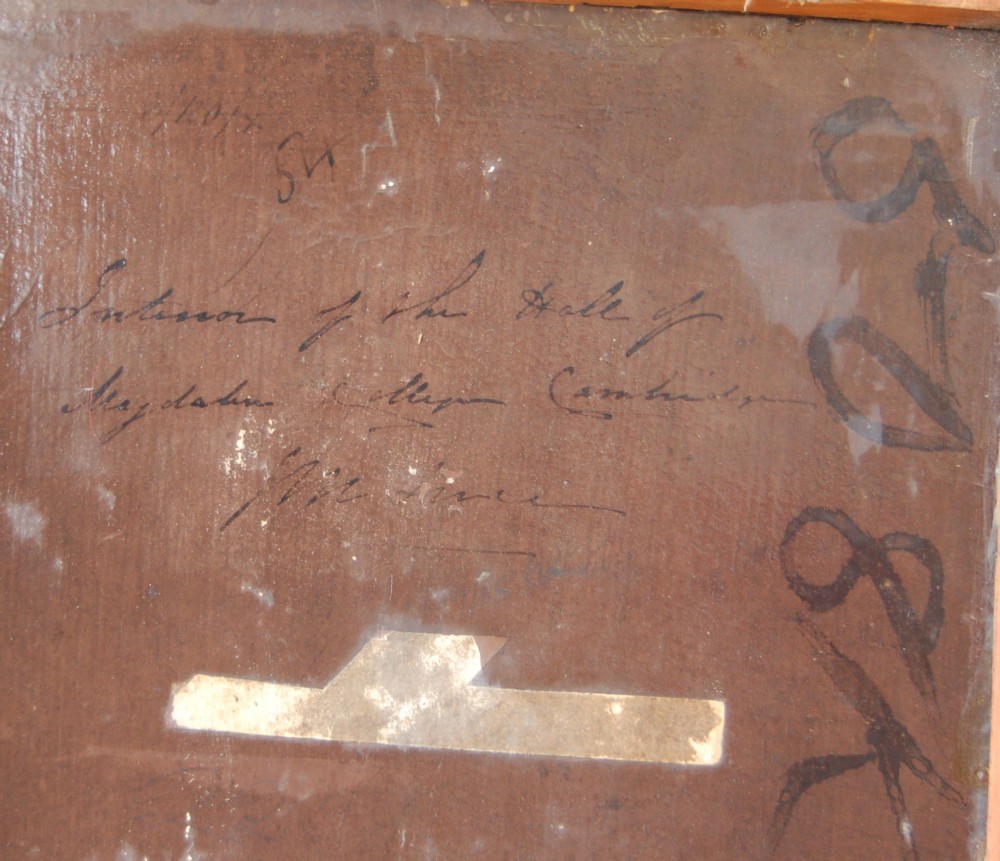
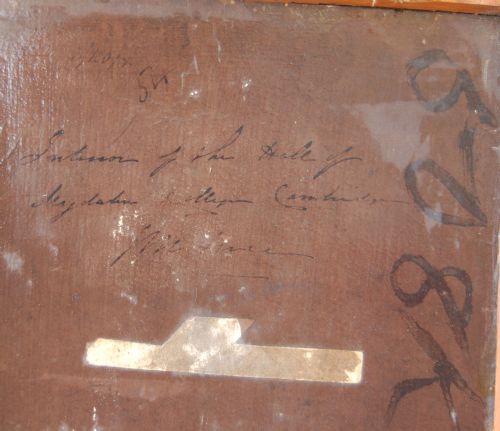
signed and titled , verso, in carved giltwood Florentine frame

oil on board

35 x 25 cm. (13.3/4 x 9.3/4 in.)

Magdalene College is a constituent college of the University of Cambridge, England. The college was founded in 1428 as a Benedictine hostel, in time coming to be known as Buckingham College, before being refounded in 1542 as the College of St Mary Magdalene. Magdalene College has some of the grandest benefactors including Britain's premier noble the Duke of Norfolk, the Duke of Buckingham and Lord Chief Justice Christopher Wray. However the refoundation was largely the work of Thomas Audley, Lord Chancellor under Henry VIII. Audley also gave the college its motto—garde ta foy (Old French: "keep your faith"). Audley's successors in the Mastership and as benefactors of the College were, however, prone to dire ends; several benefactors were arraigned at various stages on charges of high treason and executed.
The college's most famous alumnus is Samuel Pepys, whose papers and books were donated to the college upon his death, and are now housed in the Pepys Building. The college boasts a portrait of the famous diarist by Peter Lely, which hangs in the Hall.
Magdalene is noted for its 'traditional' style: it boasts a well-regarded candlelit formal hall (held every evening) and was the last all-male college in Oxford or Cambridge to admit women in 1988 (Oriel College was the last in Oxford, admitting women in 1985). This change resulted in protests by some male undergraduates, including the wearing of black armbands and flying the college flag at half-mast.
Magdalene's old buildings are representative of the college's ramshackle growth from a monks' foundation into a centre of education. It is also distinctive in that most of the old buildings are in brick rather than stone (save for the frontage of the Pepys Building). Magdalene Street divides the most ancient courts from more recent developments. One of the accommodation blocks in the newer part of the college was built by Edwin Lutyens in the early 1930s. Opened in 2005, Cripps Court, on Chesterton Road, features new undergraduate rooms and conference facilities.
Magdalene remains, despite this 20th-century expansion, one of the smaller colleges within the University, numbering some 300 undergraduates and an expanding postgraduate community.

The hall dates from 1519 but was greatly altered in 1714, when the walls were rewainscotted and the original timber roof concealed by a plaster ceiling; the gallery, with its double staircase, was constructed, incorporating a good deal of earlier woodwork, and over the dais was painted a remarkable group of heraldic 'achievements' which, having become almost invisible, were brought vividly to life again by a very careful process of cleaning in 1949.

Artist Biography

Joseph Murray Ince was born in 1806 (some say in London) and he spent his childhood in Presteigne in Radnorshire. Ince was certain of his career and as a career choice took immediately to painting. Joseph Murray Ince was born in London in April 1806 and christened Josef-Marie Ince. His father was Dr Henry Robert Ince, who came from a family of skilled craftsmen, though he trained as a doctor and worked as a military surgeon; while his mother was Anne-Elisabeth, daughter of Comte le Jeune, an émigré from Revolutionary Paris. At the time of his birth, the family was living at Upper Grafton Street. Soon after Ince was born, his father was invited by an old friend to set up as a general practitioner in Presteign, Radnorshire, Wales. The family rented Roseland, Broad Street, and Ince attended John Beddoes Free Grammar School. During his childhood, he befriended John Scarlett Davis of Leominster who, like him, shared his passions f

Declaration

Artware Fineart has dated this Victorian Architectural Interior Painting to the 1800s.

Reference Numbers
Sellingantiques Reference
SA398276
Dealers Internal Reference
3737
Description
Joseph Murray Ince, 1806 - 1859

Interior of the Formal Hall of Magdalene College, Cambridge

Signed/Inscribed:

signed and titled , verso, in carved giltwood Florentine frame

oil on board

35 x 25 cm. (13.3/4 x 9.3/4 in.)

Magdalene College is a constituent college of the University of Cambridge, England.

The college was founded in 1428 as a Benedictine hostel, in time coming to be known as Buckingham College, before being refounded in 1542 as the College of St Mary Magdalene.
Artware Fineart

Magdalene College has some of the grandest benefactors including Britain's premier noble the Duke of Norfolk, the Duke of Buckingham and Lord Chief Justice Christopher Wray. However the refoundation was largely the work of Thomas Audley, Lord Chancellor under Henry VIII. Audley also gave the college its motto—garde ta foy (Old French: "keep your faith"). Audley's successors in the Mastership and as benefactors of the College were, however, prone to dire ends; several benefactors were arraigned at various stages on charges of high treason and executed.

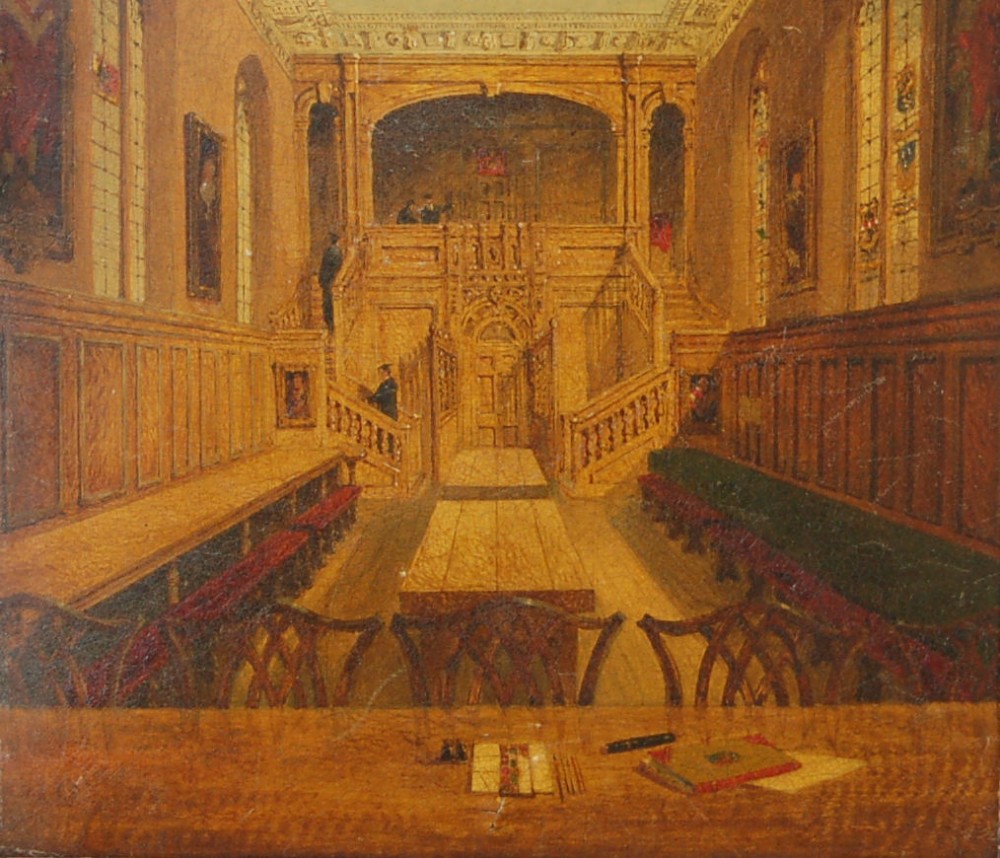
fig 1. An architectural oil painting depicting the perspective view of the panelled interior hall of Magdalene College, Cambridge, rendered in warm brown tones.
fig 1. Joseph Murray Ince, 1806 - 1859 Interior of the Formal Hall of Magdalene College, Cambridge

The college's most famous alumnus is Samuel Pepys, whose papers and books were donated to the college upon his death, and are now housed in the Pepys Building. The college boasts a portrait of the famous diarist by Peter Lely, which hangs in the Hall.

fig 2. An architectural oil painting depicting the perspective view of the panelled interior hall of Magdalene College, Cambridge, rendered in warm brown tones.
fig 2. Joseph Murray Ince, 1806 - 1859 Interior of the Formal Hall of Magdalene College, Cambridge

Magdalene is noted for its 'traditional' style: it boasts a well-regarded candlelit formal hall (held every evening) and was the last all-male college in Oxford or Cambridge to admit women in 1988 (Oriel College was the last in Oxford, admitting women in 1985). This change resulted in protests by some male undergraduates, including the wearing of black armbands and flying the college flag at half-mast.

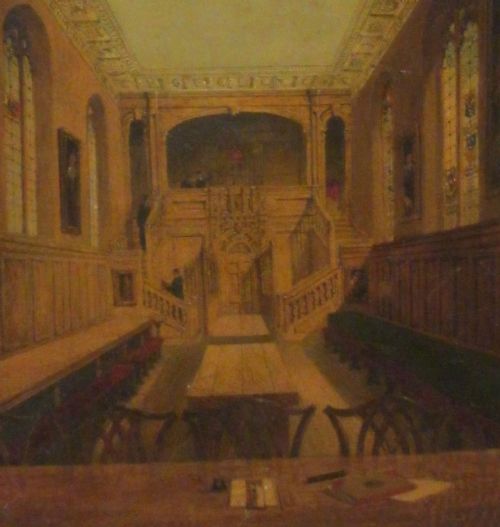
fig 3. An architectural oil painting depicting the perspective view of the panelled interior hall of Magdalene College, Cambridge, rendered in warm brown tones.
fig 3. Joseph Murray Ince, 1806 - 1859 Interior of the Formal Hall of Magdalene College, Cambridge

Magdalene's old buildings are representative of the college's ramshackle growth from a monks' foundation into a centre of education. It is also distinctive in that most of the old buildings are in brick rather than stone (save for the frontage of the Pepys Building). Magdalene Street divides the most ancient courts from more recent developments. One of the accommodation blocks in the newer part of the college was built by Edwin Lutyens in the early 1930s. Opened in 2005, Cripps Court, on Chesterton Road, features new undergraduate rooms and conference facilities.

fig 4. An architectural oil painting depicting the perspective view of the panelled interior hall of Magdalene College, Cambridge, rendered in warm brown tones.
fig 4. Joseph Murray Ince, 1806 - 1859 Interior of the Formal Hall of Magdalene College, Cambridge

Magdalene remains, despite this 20th-century expansion, one of the smaller colleges within the University, numbering some 300 undergraduates and an expanding postgraduate community.

The hall dates from 1519 but was greatly altered in 1714, when the walls were rewainscotted and the original timber roof concealed by a plaster ceiling; the gallery, with its double staircase, was constructed, incorporating a good deal of earlier woodwork, and over the dais was painted a remarkable group of heraldic 'achievements' which, having become almost invisible, were brought vividly to life again by a very careful process of cleaning in 1949.

Artist Biography

Joseph Murray Ince was born in 1806 (some say in London) and he spent his childhood in Presteigne in Radnorshire. Ince was certain of his career and as a career choice took immediately to painting. Joseph Murray Ince was born in London in April 1806 and christened Josef-Marie Ince. His father was Dr Henry Robert Ince, who came from a family of skilled craftsmen, though he trained as a doctor and worked as a military surgeon; while his mother was Anne-Elisabeth, daughter of Comte le Jeune, an émigré from Revolutionary Paris. At the time of his birth, the family was living at Upper Grafton Street. Soon after Ince was born, his father was invited by an old friend to set up as a general practitioner in Presteign, Radnorshire, Wales. The family rented Roseland, Broad Street, and Ince attended John Beddoes Free Grammar School. During his childhood, he befriended John Scarlett Davis of Leominster who, like him, shared his passions f

Date of Manufacture

Artware Fineart has dated this Victorian Architectural Interior Painting to the 1800s.

Reference Numbers
Sellingantiques Ref
SA398276
Dealers Internal Ref
3737
Artware Fineart
Sellingantiques verified Since Sep 2008
Dealer Profile

You can view the stock and full dealer information on the Artware Fineart Profile Page

PDF SHARE
SAVE
An architectural oil painting depicting the perspective view of the panelled interior hall of Magdalene College, Cambridge, rendered in warm brown tones.
1 / 5
Archive I An architectural oil painting depicting the perspective view of the panelled interior hall of Magdalene College, Cambridge, rendered in warm brown tones.

Joseph Murray Ince, 1806 - 1859 Interior of the Formal Hall of Magdalene College, Cambridge

Archive II An architectural oil painting depicting the perspective view of the panelled interior hall of Magdalene College, Cambridge, rendered in warm brown tones. View II
Archive III An architectural oil painting depicting the perspective view of the panelled interior hall of Magdalene College, Cambridge, rendered in warm brown tones. View III
Archive IV An architectural oil painting depicting the perspective view of the panelled interior hall of Magdalene College, Cambridge, rendered in warm brown tones. View IV
Archive V An architectural oil painting depicting the perspective view of the panelled interior hall of Magdalene College, Cambridge, rendered in warm brown tones. View V
Enlarged Archival View
Telephone 07958 699 645
Location
18 La Gare
51 Surrey Row
London
SE1 0BZ
United Kingdom
Verified Since Sep 2008
Items For Sale 243
Items Sold 223
Artware Fineart
Verified Since Sep 2008
View Dealer Info
Location: 18 La Gare , 51 Surrey Row , London , SE1 0BZ , United Kingdom
Verified
Sep 2008
For Sale
243
Sold
223
An architectural oil painting depicting the perspective view of the panelled interior hall of Magdalene College, Cambridge, rendered in warm brown tones.
Joseph Murray Ince, 1806 - 1859 Interior of the Formal Hall of Magdalene College, Cambridge
Ref: SA398276
An architectural oil painting depicting the perspective view of the panelled interior hall of Magdalene College, Cambridge, rendered in warm brown tones.
Detail View 1
Detail View 2
Detail View 3
Detail View 4
Archival Detail
Every single antique dealer on our platform is individually approved by our internal team. We verify their professional trade history, ethical standards, and photographic quality to ensure a secure, high-standard buying environment. Upon joining, every dealer agrees to a strict 9-point code of conduct. While issues can occasionally arise, our dealers typically resolve them swiftly and directly with the buyer. In fact, since our founding in 2002, Sellingantiques has only had to step in to help resolve an issue on roughly five occasions—a true testament to the quality of our dealers and their dedication to your happiness.
Our dealers are highly experienced in packing and shipping fragile, high-value antiques. Because you are in direct contact with the dealer, you will be able to easily go through all available shipping and insurance options together to ensure your item arrives safely.
Antiques are the ultimate green purchase. By choosing historical pieces over newly manufactured goods, you completely eliminate the carbon footprint of modern mass production while preserving exceptional, timeless craftsmanship.

Nineteenth-century British architectural interior paintings are distinguished by precise linear perspective, rigorous draughtsmanship, and realistic depictions of historic institutional, ecclesiastical, or domestic spaces. Artists often focused on light play across wood panelling, stone floors, and architectural ceiling details.

Paintings from this era were typically created using oil paints mixed with natural tree resins or linseed oil binders, applied to linen canvas or wooden panels. Artists used mineral pigments and earth tones to replicate timber finishes and structural stone.

Authentic artworks exhibit age-appropriate craquelure patterns across the paint film, natural surface oxidisation, and period stretchers or panel backings. Provenance markings, artist inscriptions, and contemporary gallery labels on the reverse also assist identification.

These structured compositions serve as excellent focal points above a sideboard, fireplace mantel, or desk in a home office or library. Pairing architectural art with clean-lined modern furniture provides an effective contrast in traditional or contemporary settings.

Display oil paintings away from direct sunlight, heating vents, and areas of high humidity to prevent paint flaking and canvas warping. Dust gently with a clean, soft camel-hair brush and consult a professional conservator for cleaning or varnish restoration.
items
Add keywords to the filter
Price
£100
£250000
Era
Movements
Material
Origin
Stock Location
Freshness
Online Payments
Categories