John Raphael Smith, 1752 - 1812
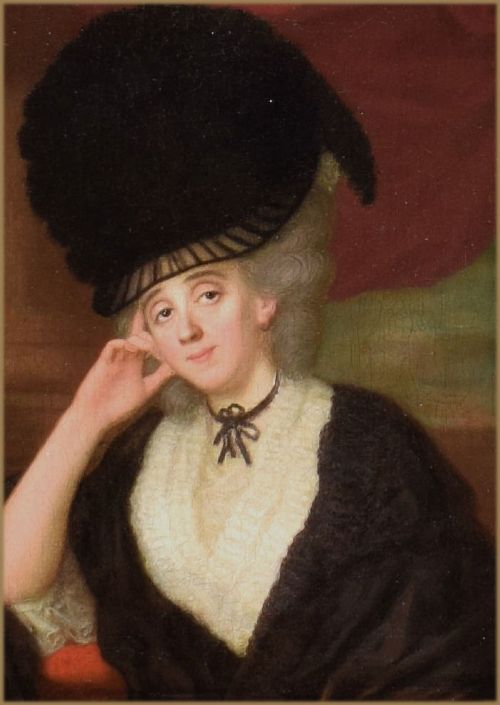
Portrait of Mrs. Elizabeth Draper , (née Sclater )1744 - 1778
oil on canvas
15 x 12 in. (38 x 30 cm.) overall (with frame): 19.75''h x 15.75''w
Eliza was born on 5 April 1744, at Angengo, Malabar, a British trading post in Travancore country on the Arabian Sea coast. She was daughter of May Sclater, secretary of Angengo Fort, and Judith Whitehill, daughter of the fort’s chief, Charles Whitehill. After a brief married life, Judith lost her husband in 1746. She herself died two years later, leaving her three daughters in the care of their grandparents. Angengo was a small coastal piece of land that came into the possession of the East India Company in 1694 through a grant from the Queen of Attingal. It was a curious place where females were not allowed to cover their breasts. A number of Eliza’s letters remain, all lively epistles addressed to her cousins, uncles, sisters and friends, written from various places such as Bombay, Tellicherry and
... Surat. They reveal a frank, witty, playful and observant person in the midst of a chaotic period in India, writing about her personal affairs, passions, matters of the heart, the life of the English in Indian forts, their relations with natives, their curious customs and practices.
Her letters, preserved in the private collection of Lord Basing, were collected into a book, Sterne’s Eliza, published in London in 1922. She was a great writer of letters as ‘Yorick’ – the pseudonym Sterne adopts in his passionate notes to Eliza – points out. In one he writes: “Who taught you the art of writing so sweetly, Eliza? You have exalted it to the level of science…their sense, natural ease, and spirit, is not to be equall’d, I believe, in this section of the globe; nor, by any of your country women in yours…” Theirs was a brief and passionate relationship that lasted just three months. Eliza happened to meet Sterne at the place of Commodore William James, an old India hand, at London’s Gerrard Street in early 1767, three months before her return to India. She had reached England with her husband and two children in 1764 in search of a better climate for her husband, who suffered various illnesses, and to make arrangements for her children’s education. The concerns of a young mother and wife were heavy and pressing: “I really my dear cousin, am so much altered with breeding, suckling and other dangerous illnesses, that I appear ten years older than I am…” she complains to Elizabeth Sclater on the eve of her departure for London. Her husband having returned to India in 1765, and her children sent to boarding schools, Eliza finally got some respite from her cares, and it was towards the end of this period she came to know Sterne. He made every effort to woo this fine young woman. When he realised she would soon leave England to join her husband who had sent strict instructions for her to return, he wrote: “But Eliza, if thou are so very ill, still put off all thoughts of returning to India this year – write to your husband – tell him the truth of your case – if he is the generous humane man you describe him to be, he cannot but applaud your conduct…” He goes on, critical of her husband: “I am credibly informed, that his repugnance to your living in England arises only from the dread which has enter’d his brain, that thou mayest run him in debt, beyond thy appointments, and that he must discharge them – That such a creature should be sacrificed, for the paultry consideration of a few hundreds, is too, too hard!” -
Despite Sterne’s entreaties and offers, Eliza left on the Earl of Chatham, which set sail from the Downs on 3 April 1767, on a voyage lasting nine months. Sterne, consumptive and dejected, returned to the writing of A Sentimental Journey, in which he makes reference to his passionate love for Eliza, published early the following year. He was soon to
Internal Reference: 3844
Antique ID Number (AIDN): SA388321
Dateline of this antique is Select




Thank you.
Your comment has been sent to Sellingantiques.