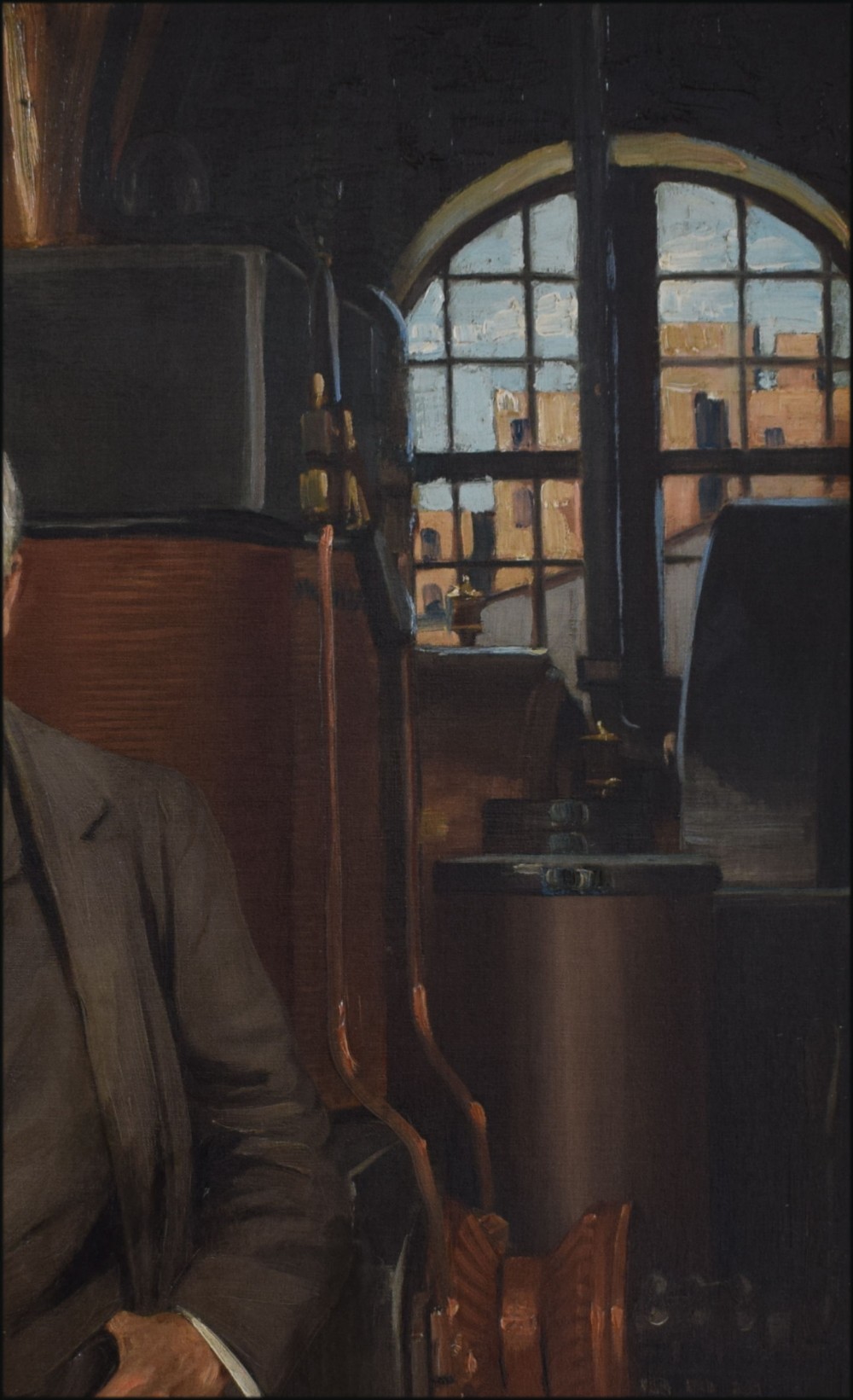
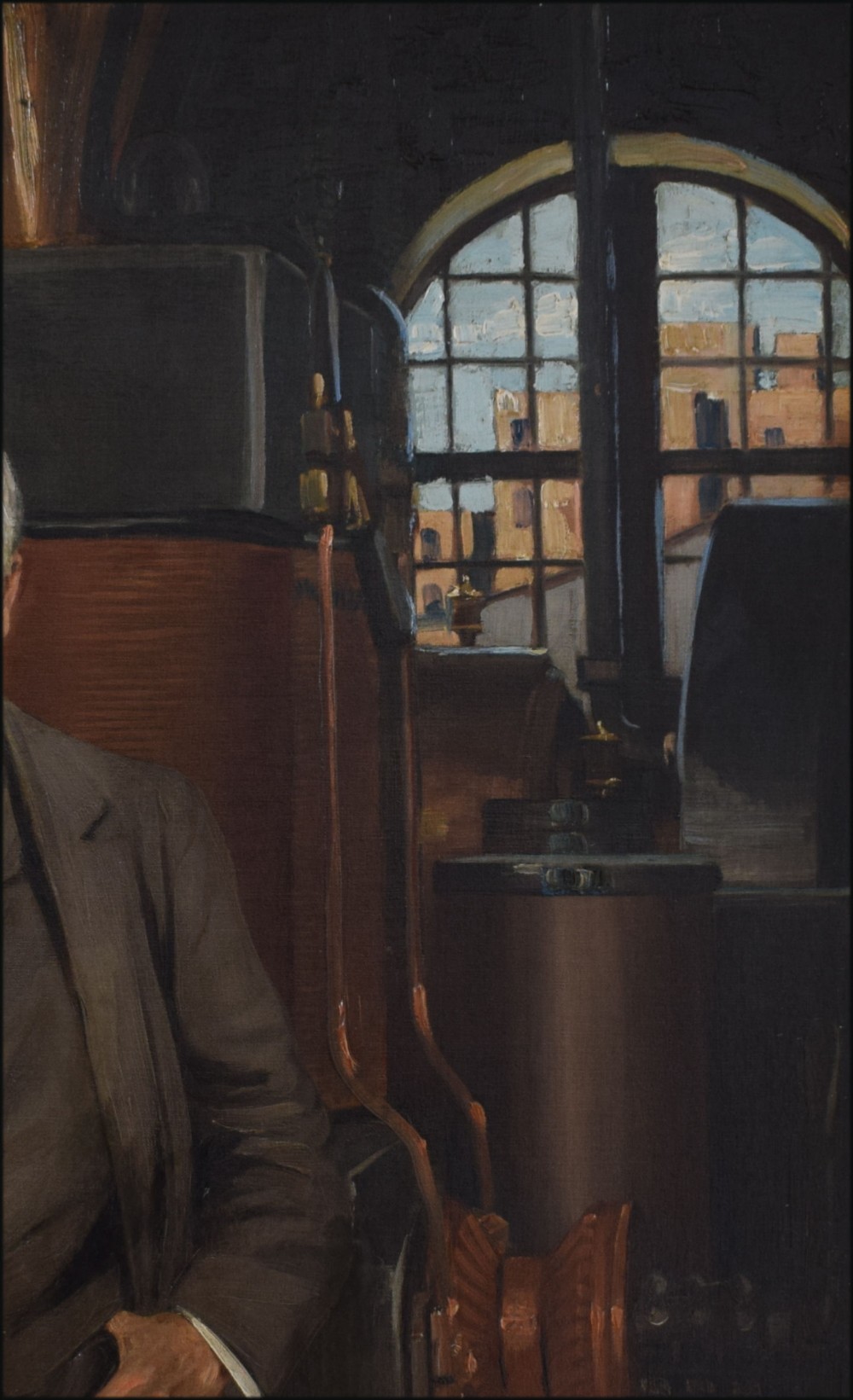
Artware Fineart has dated this Thomas Edison Oil Painting to the 1950s.
Oil on Canvas
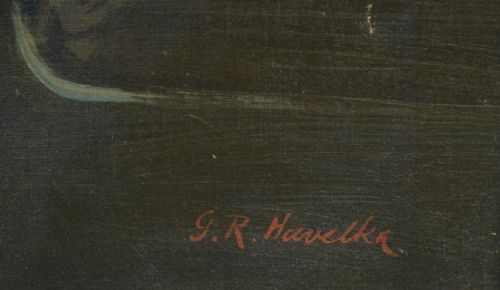
signed
36 x 25 in. (92 x 64 cm.)
Provenance : Elli Buck, Science and Technology Collection, USA
Thomas Alva Edison (February 11, 1847 – October 18, 1931) was an American inventor and businessman.
Dubbed "The Wizard of Menlo Park", he was one of the first inventors to apply the principles of mass production and large-scale teamwork to the process of invention, and because of that, he is often credited with the creation of the first industrial research laboratory. Edison is the fourth most prolific inventor in history, holding 1,093 US patents in his name, as well as many patents in the United Kingdom, France, and Germany. He is credited with numerous inventions that contributed to mass communication and, in particular, telecommunications. These included a stock ticker, a mechanical vote recorder, a battery for an electric car, electrical power, recorded music and motion pictures. His advanced work in these fields was an outgrowth of his early career as a telegraph operator. Edison developed a system of electric-power generation and distribution to homes, businesses, and factories – a crucial development in the modern industrialized world. His first power station was on Pearl Street in Manhattan, New York. Thomas Edison was born in Milan, Ohio, and grew up in Port Huron, Michigan. He was the seventh and last child of Samuel Ogden Edison, Jr. (1804–96, born in Marshalltown, Nova Scotia, Canada) and Nancy Matthews Elliott (1810–1871, born in Chenango County, New York).[4] His father had to escape from Canada because he took part in the unsuccessful Mackenzie Rebellion of 1837 Edison reported being of Dutch ancestry.In school, the young Edison's mind often wandered, and his teacher, the Reverend Engle, was overheard calling him "addled". This ended Edison's three months of official schooling. Edison recalled later, "My mother was the making of me. She was so true, so sure of me; and I felt I had something to live for, someone I must not disappoint." His mother taught him at home. Much of his education came from reading R.G. Parker's School of Natural Philosophy.Edison developed hearing problems at an early age. The cause of his deafness has been attributed to a bout of scarlet fever during childhood and recurring untreated middle-ear infections. Around the middle of his career, Edison attributed the hearing impairment to being struck on the ears by a train conductor when his chemical laboratory in a boxcar caught fire and he was thrown off the train in Smiths Creek, Michigan, along with his apparatus and chemicals. In his later years, he modified the story to say the injury occurred when the conductor, in helping him onto a moving train, lifted him by the ears. Edison's family moved to Port Huron, Michigan, after the railroad bypassed Milan in 1854 and business declined;[10] his life there was bittersweet. Edison sold candy and newspapers on trains running from Port Huron to Detroit, and sold vegetables to supplement his income. He also studied qualitative analysis, and conducted chemical experiments on the train until an accident prohibited further work of the kind. Edison obtained the exclusive right to sell newspapers on the road, and, with the aid of four assistants, he set in type and printed the Grand Trunk Herald, which he sold with his other papers.[11] This began Edison's long streak of entrepreneurial ventures, as he discovered his talents as a businessman. These talents eventually led him to found 14 companies, including General Electric, which is still one of the largest publicly traded companies in the world. Edison became a telegraph operator a
Artware Fineart has dated this Thomas Edison Oil Painting to the 1950s.
You can view the stock and full dealer information on the Artware Fineart Profile Page

George R Havelka 1924 - 1988 Portrait of Thomas Alva Edison 1847-1931