
This sensitive portrait of a gentleman, perhaps a nobleman, is typical of Johnson's best work.
The sitter has a pensive appearance...looking at the artist, but his thoughts seem far away.
Born in London but of Flemish and German extraction, he is thought to have trained as an artist in the northern Netherlands before establishing himself in England around 1618. This portrait was painted about 1635, at the height of his popularity, and three years after he was appointed as ‘his Majesty’s servant in ye quality of Picture drawer’ to Charles I. It is a compelling example of Johnson’s restrained, intimate portrayals for which he was renowned, and shows characteristic attention to detail in a style and pattern that Johnson had perfected by the 1630s for his half-length portraits.
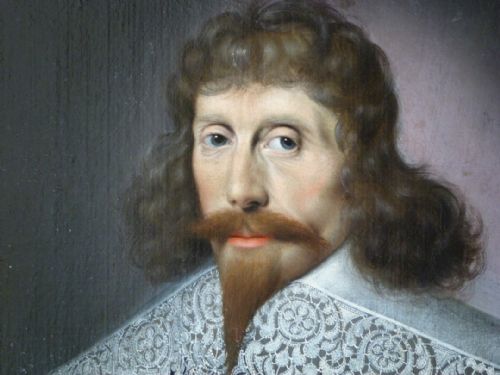
His portraits are very sensitive to character, beautifully drawn and meticulously painted.
Johnson always preferred the feigned oval, suggestive of miniatures, of which his own began in 1625.
In a period when black clothing was the fashion (a dense black being very expensive to obtain) artists strove to depict the different nuances and textures of the fabrics as convincingly as possible.
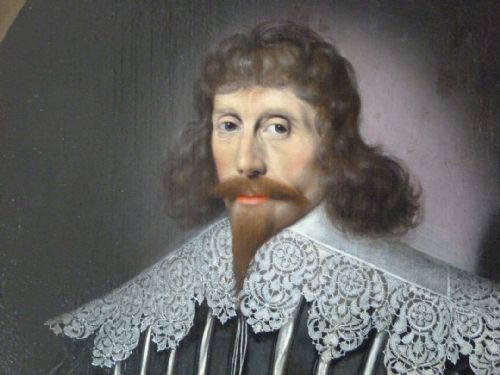
They found that black is an ideal background with which to contrast the crisp white linen and rich lace and this dramatically accentuates the face and hand gestures. This extreme opposition between black and white is both austere and exciting, and is a characteristic feature of portraiture of this period.
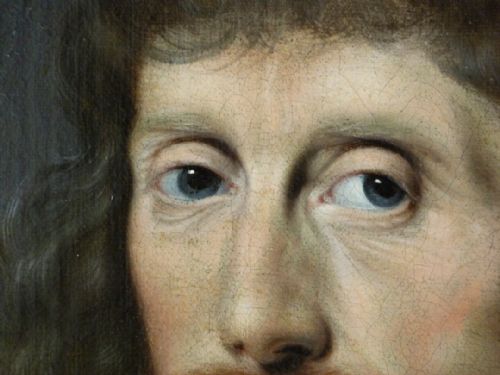
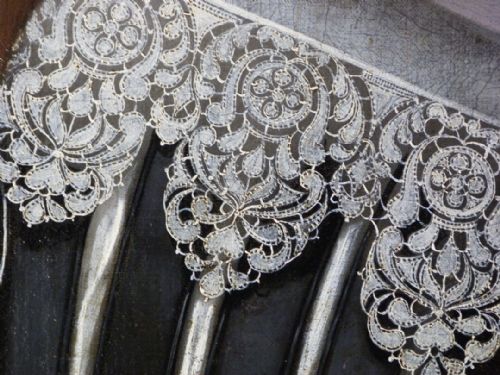
Typical of Johnson is the attention he pays to the detail of his sitter's costly garments; in Image 5
his detail on this close up is almost photographic. It shows how fine the lace and linen of the falling band actually is and an indication that the slashes have been finished off with very small hems by the tailor to avoid fraying.
Johnson is the most satisfying and 'English' of the portraitists working in England in the 1620s and 30s. He has a fine technique with a restrained and introspective style, with careful attention to the costume details.
His accurate portraits are never flattering but a sober and objective portrayal of his usual sitters: the gentry and lesser nobility. His style is easily identified by its coolness and restraint.
In 1632 he was made Painter to the King, but his wife's fears of the approaching Civil War caused him to retire to Holland in 1643. He continued to paint for the rest of his life, but was reportedly ruined by the extravagance of his second wife and died a poor man in Utrecht in 1661.
SIZE:34 x 29 inches inc. frame.
PROVENANCE:
Christie's, London, 27 May 1988, Lot 98 (as Circle of Cornelis Jonson van Ceulen).
Private Collection.
Verso: damaged old label "140. C....... Portrait of a noblema.."
Roy and nadine precious: specialists in portraiture from the 16th to the 20th century. Established in 1972.
You can view the stock and full dealer information on the Roy Precious - Antiques & Fine Art Profile Page
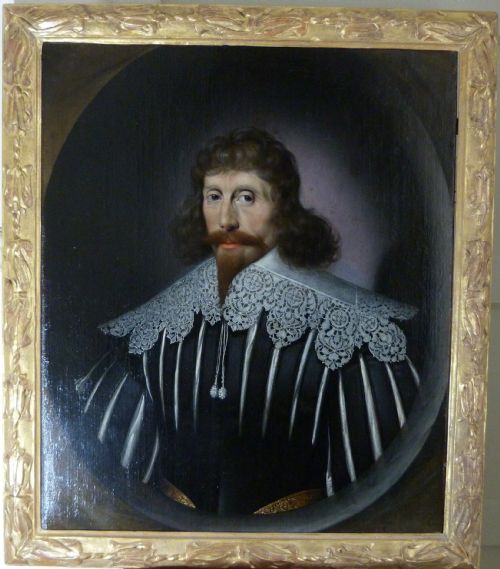
Portrait of a Nobleman C. 1635; Attributed to Cornelius Johnson.
