12,749  PAGES BROWSED TODAY PAGES TODAY 36  ANTIQUES UPLOADED TODAY NEW ARRIVALS
ID #SA217392
FOR SALE
£2,500
Email
Save
Circle of Thomas Jones 1742-1803 an Extensive Italianate Landscape with a Distant Villa
Artware Fineart
for sale €2,925     $3,175
£2,500

Artware Fineart

Sellingantiques Verified Since Sep 2008
View Dealers Stock Page
Id #SA217392
PDF SHARE
SAVE

Circle of Thomas Jones 1742-1803 an Extensive Italianate Landscape with a Distant Villa

18th century
For Sale by Artware Fineart
Description

Circle of Thomas Jones 1742-1803

An extensive Italianate landscape with a distant Villa

oil on canvas

9 x 12 inches (23 x 30.5 cm.)

Thomas Jones (26 September 1742 – 29 April 1803) was a British landscape painter. He was a pupil of Richard Wilson and was best known in his lifetime as a painter of Welsh and Italian landscapes in the style of his master. However, Jones's reputation grew in the 20th century when more unconventional works by him, ones not been intended for public consumption, came to light. Most notable among these is a series of views of Naples which he painted from 1782 to 1783. By breaking with the conventions of classical landscape painting in favour of direct observation, they look forward to the work of Camille Corot and the Barbizon School in the 19th century. His autobiography, Memoirs of Thomas Jones of Penkerrig, went unpublished until 1951 but is now recognised as an important source of information on the 18th-century art world.
Thomas Jones was born in Trefonnen in Cefnllys, Radnorshire, the second of sixteen children to the landowner Thomas Jones of Trefonnen and his wife, Hannah. His formative years were spent on his father's estate at Pencerrig near Builth Wells; thus he is often referred to as Thomas Jones of Pencerrig to differentiate him from others of the same name. He was educated at Christ College, Brecon, and later at a school kept by Jenkin Jenkins at Llanfyllin in Montgomeryshire, before going to Oxford in 1759 to study at Jesus College. His university education was funded by a maternal uncle who, contrary to Jones's own wishes, hoped for him to enter the church. Jones dropped out of Oxford after this uncle’s death in 1761 and began to pursue his preferred career as an artist.

Jones moved to London and enrolled at William Shipley's drawing school in November 1761. Despite attending the life class at St Martin's Lane Academy, he remained unconfident of his ability to draw figures convincingly, and in 1763 he persuaded the leading landscape painter of the day (and fellow Welshman) Richard Wilson to take him on as a pupil. A high-spirited youth, Jones recorded in his journal that he and two rowdy fellow pupils were once rebuked by their master with the words, "Gentlemen, this is not the way to rival Claude".

In 1765 Jones began to exhibit at the Society of Artists (the forerunner of the Royal Academy). From 1769 onwards his landscapes began to adopt the "grand manner", becoming settings for scenes in history, literature or mythology. His frequent collaborator on these works was John Hamilton Mortimer, who painted the figures. One of his best-known works from this period is The Bard (Cardiff), based on the poem by Thomas Gray. The 1770s were a successful period for Jones; he was elected a fellow of the Society of Artists in 1771 and served as the society’s director in 1773–4. This period also saw the beginning of Jones’s unconventional habit of producing small landscape sketches in oils on paper for his own amusement.

Jones embarked on an eagerly anticipated trip to Italy in September 1776. The works produced there departed significantly from the example of his master, particularly in his watercolour paintings, where he developed a distinctive palette of varying shades of blue. Jacob More, John Robert Cozens and Thomas Banks were among the fellow expatriate artists with whom Jones was friendly. His first commission in Italy was a landscape entitled Lake Albano – Sunset for the Earl-Bishop of Derry, who became Jones's most important patron.

Jones made his first visit to Naples in September 1778, staying there for five months. He returned to Rome for a time, living in a house near the Spanish Steps built by Salvator Rosa. He took on a Danish widow called Maria Moncke as his "Maid Servant" in April 1779, eloping with her to Naples a year later. Then the largest city in I

Physical Dimensions
Height
32cm (12.60")
Width
40cm (15.75")
Depth
3cm (1.18")
Declaration

Artware Fineart has dated this Italianate Landscape Oil Painting to the 1750s.

Reference Numbers
Sellingantiques Reference
SA217392
Dealers Internal Reference
3575
Description
Circle of Thomas Jones 1742-1803

An extensive Italianate landscape with a distant Villa

oil on canvas

9 x 12 inches (23 x 30.5 cm.)

Thomas Jones (26 September 1742 – 29 April 1803) was a British landscape painter.

He was a pupil of Richard Wilson and was best known in his lifetime as a painter of Welsh and Italian landscapes in the style of his master.
Artware Fineart

However, Jones's reputation grew in the 20th century when more unconventional works by him, ones not been intended for public consumption, came to light. Most notable among these is a series of views of Naples which he painted from 1782 to 1783. By breaking with the conventions of classical landscape painting in favour of direct observation, they look forward to the work of Camille Corot and the Barbizon School in the 19th century. His autobiography, Memoirs of Thomas Jones of Penkerrig, went unpublished until 1951 but is now recognised as an important source of information on the 18th-century art world.

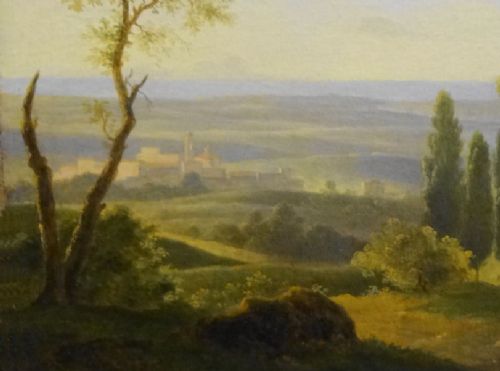
fig 1. An 18th-century style oil painting depicting an extensive Italianate landscape with cypress trees, rolling hills, and a distant villa under a light blue sky.
fig 1. Circle of Thomas Jones 1742-1803 an Extensive Italianate Landscape with a Distant Villa

Thomas Jones was born in Trefonnen in Cefnllys, Radnorshire, the second of sixteen children to the landowner Thomas Jones of Trefonnen and his wife, Hannah. His formative years were spent on his father's estate at Pencerrig near Builth Wells; thus he is often referred to as Thomas Jones of Pencerrig to differentiate him from others of the same name. He was educated at Christ College, Brecon, and later at a school kept by Jenkin Jenkins at Llanfyllin in Montgomeryshire, before going to Oxford in 1759 to study at Jesus College. His university education was funded by a maternal uncle who, contrary to Jones's own wishes, hoped for him to enter the church. Jones dropped out of Oxford after this uncle’s death in 1761 and began to pursue his preferred career as an artist.

Jones moved to London and enrolled at William Shipley's drawing school in November 1761. Despite attending the life class at St Martin's Lane Academy, he remained unconfident of his ability to draw figures convincingly, and in 1763 he persuaded the leading landscape painter of the day (and fellow Welshman) Richard Wilson to take him on as a pupil. A high-spirited youth, Jones recorded in his journal that he and two rowdy fellow pupils were once rebuked by their master with the words, "Gentlemen, this is not the way to rival Claude".

In 1765 Jones began to exhibit at the Society of Artists (the forerunner of the Royal Academy). From 1769 onwards his landscapes began to adopt the "grand manner", becoming settings for scenes in history, literature or mythology. His frequent collaborator on these works was John Hamilton Mortimer, who painted the figures. One of his best-known works from this period is The Bard (Cardiff), based on the poem by Thomas Gray. The 1770s were a successful period for Jones; he was elected a fellow of the Society of Artists in 1771 and served as the society’s director in 1773–4. This period also saw the beginning of Jones’s unconventional habit of producing small landscape sketches in oils on paper for his own amusement.

Jones embarked on an eagerly anticipated trip to Italy in September 1776. The works produced there departed significantly from the example of his master, particularly in his watercolour paintings, where he developed a distinctive palette of varying shades of blue. Jacob More, John Robert Cozens and Thomas Banks were among the fellow expatriate artists with whom Jones was friendly. His first commission in Italy was a landscape entitled Lake Albano – Sunset for the Earl-Bishop of Derry, who became Jones's most important patron.

Jones made his first visit to Naples in September 1778, staying there for five months. He returned to Rome for a time, living in a house near the Spanish Steps built by Salvator Rosa. He took on a Danish widow called Maria Moncke as his "Maid Servant" in April 1779, eloping with her to Naples a year later. Then the largest city in I

Height
32cm (12.60")
Width
40cm (15.75")
Depth
3cm (1.18")
Date of Manufacture

Artware Fineart has dated this Italianate Landscape Oil Painting to the 1750s.

Reference Numbers
Sellingantiques Ref
SA217392
Dealers Internal Ref
3575
Artware Fineart
Sellingantiques verified Since Sep 2008
Dealer Profile

You can view the stock and full dealer information on the Artware Fineart Profile Page

PDF SHARE
SAVE
An 18th-century style oil painting depicting an extensive Italianate landscape with cypress trees, rolling hills, and a distant villa under a light blue sky.
1 / 2
Archive I An 18th-century style oil painting depicting an extensive Italianate landscape with cypress trees, rolling hills, and a distant villa under a light blue sky.

Circle of Thomas Jones 1742-1803 an Extensive Italianate Landscape with a Distant Villa

Archive II An 18th-century style oil painting depicting an extensive Italianate landscape with cypress trees, rolling hills, and a distant villa under a light blue sky. View II
Enlarged Archival View
Telephone 07958 699 645
Location
18 La Gare
51 Surrey Row
London
SE1 0BZ
United Kingdom
Verified Since Sep 2008
Items For Sale 243
Items Sold 223
Artware Fineart
Verified Since Sep 2008
View Dealer Info
Location: 18 La Gare , 51 Surrey Row , London , SE1 0BZ , United Kingdom
Verified
Sep 2008
For Sale
243
Sold
223
An 18th-century style oil painting depicting an extensive Italianate landscape with cypress trees, rolling hills, and a distant villa under a light blue sky.
Circle of Thomas Jones 1742-1803 An extensive Italianate landscape with a distant Villa
Ref: SA217392
An 18th-century style oil painting depicting an extensive Italianate landscape with cypress trees, rolling hills, and a distant villa under a light blue sky.
Detail View 1
Archival Detail
Every single antique dealer on our platform is individually approved by our internal team. We verify their professional trade history, ethical standards, and photographic quality to ensure a secure, high-standard buying environment. Upon joining, every dealer agrees to a strict 9-point code of conduct. While issues can occasionally arise, our dealers typically resolve them swiftly and directly with the buyer. In fact, since our founding in 2002, Sellingantiques has only had to step in to help resolve an issue on roughly five occasions—a true testament to the quality of our dealers and their dedication to your happiness.
Our dealers are highly experienced in packing and shipping fragile, high-value antiques. Because you are in direct contact with the dealer, you will be able to easily go through all available shipping and insurance options together to ensure your item arrives safely.
Antiques are the ultimate green purchase. By choosing historical pieces over newly manufactured goods, you completely eliminate the carbon footprint of modern mass production while preserving exceptional, timeless craftsmanship.

Italianate landscape paintings are works created predominantly by Northern European artist-travelers during the 17th and 18th centuries, inspired by the light and terrain of Italy. These compositions typically feature idealised rural views, classical architecture or distant villas, cypress trees, and a warm, atmospheric glow.

Paintings from this period were created using hand-ground mineral and organic pigments mixed with linseed or walnut oil. These were applied onto natural linen canvases stretched over wooden frames, or onto solid hardwood panels.

Authenticity is evaluated by studying age-appropriate craquelure patterns in the paint layer, natural oxidisation on the reverse of the canvas, original hand-forged canvas tacks, and traditional joinery on the wooden stretcher.

An antique landscape artwork works exceptionally well as a focal point above a mantelpiece or sideboard. Incorporating classical art into modern or transitional spaces adds visual history and pairs effectively with modern minimalist decor or traditional dark timber furniture.

Keep the painting away from direct sunlight, humid areas, and heat sources to prevent cracking or warping. Dust gently with a dry, soft-bristled brush, and avoid using household liquids or water; consult a professional conservator for deep cleaning.
items
Add keywords to the filter
Price
£100
£250000
Era
Movements
Material
Origin
Stock Location
Freshness
Online Payments
Categories