
Roy Precious - Antiques & Fine Art has dated this piece to the 1750s.
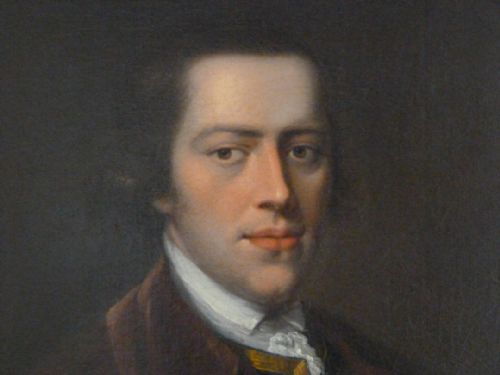
ROGER SIMPKINSON, born 1732.
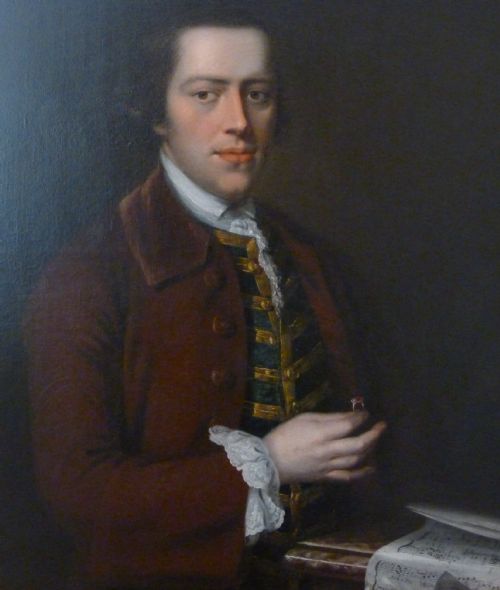
Simpinkson married Elizabeth King and in 1766 they had a son, James.
Intriguingly, the sitter holds a cameo ring; at this time a typical Grand Tour ring such as this marked the wearer as a man of culture and discernment.
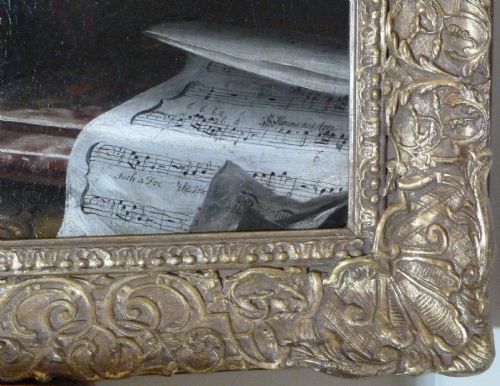
Below his hand part of a musical score is seen, resting on an expensive and fashionable marble topped stand or table.
The words 'Honor and Arm.......Such a Foe' are visible; this is part of Handel's lyric sung by the giant Harapha in the the oratorio 'Samson' based on Milton's work 'Samson Agonistes' of 1671. Handel's oratorio was premiered at Covent Garden in 1743. "Honor and Arms scorn such a foe" says the giant as he refuses to fight the blinded Samson.
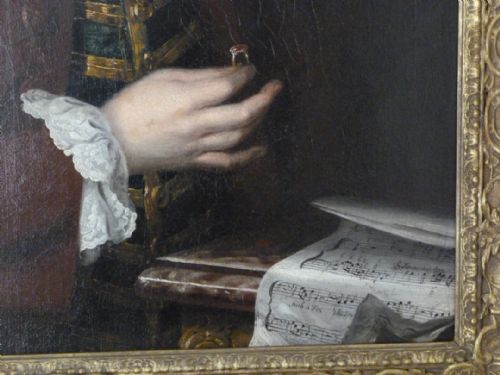
Clearly there is a message here, but what it said and to whom and for what purpose is not known.
SIR GEORGE CHALMERS, (c 1720-1791) was born in Edinburgh. His grandfather, Charles Chalmers, was killed at the battle of Sherriffmuir in 1715, fighting on the side of the Pretender, thus forfeiting the family estates.His father, Roderick, who died in 1746, was Ross Herald to the Lyon Court and a heraldic painter. George studied painting under his father and Alan Ramsay.
In 1751 he went to Rome, where he mixed with the expatriate Jacobites, and he went on from there to Florence and Minorca, where he painted the governor general, Baron William Blakeney. A mezzotint of this painting is in the National Portrait Gallery.
About 1760 George returned to Edinburgh, where he assumed the baronetcy in 1764. Sir George Chalmers became the 4th holder of the title in 1764, on the death of a relative of the same name.
In June 1768, Sir George married Isabella, daughter of the painter John Alexander and sister of his painter friend Cosmo John Alexander (1724-1772), whom George had met in Italy. Sir George and Isabella had one child, also named Isabella, who became a nun. In 1778 they moved from Edinburgh to Hull and from there, in 1784, to London, where Sir George died in 1791
He exhibited 24 works at the Royal Academy between 1775 and 1790.
Sir George’s best known painting is The Captain of the Honourable Company of Edinburgh Golfers William St Clair of Roslin (1771), which now hangs in the hall of the Royal Company of Archers in Edinburgh. Other works are in the National Gallery, the National Portrait Gallery, the National Gallery of Scotland, the Scottish National Portrait Gallery, the City of Edinburgh Collection, and at Drum Castle and Fyvie Castle (National Trust of Scotland).
SIZE: 36 x 31 inches inc. frame.
Old labels verso identifying the sitter.
PROVENANCE: Sussex Private Collection.
Roy Precious - Antiques & Fine Art has dated this piece to the 1750s.
Roy and nadine precious: specialists in portraiture from the 16th to the 20th century. Established in 1972.
You can view the stock and full dealer information on the Roy Precious - Antiques & Fine Art Profile Page
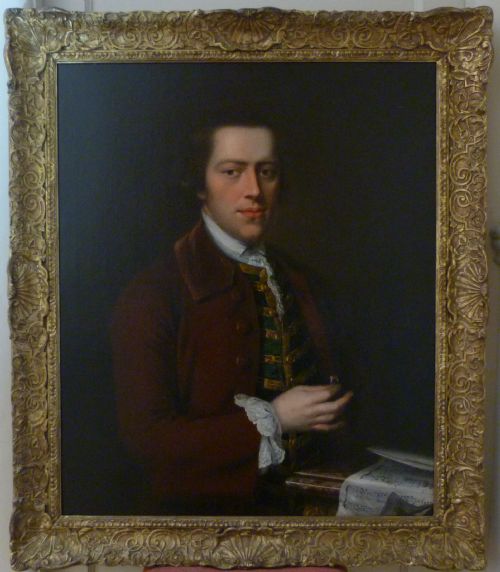
Sold....portrait of Roger Simpinkson C.1760, by Sir George Chalmers.
