

Patrick Moorhead Antiques has dated this piece to the 18th Century.

The Cumaean Sibyl, depicted on the left, is portrayed with an air of mystique, holding a scroll that signifies her prophetic wisdom. Her flowing garments and expressive features embody the grace and intensity of her character.

In contrast, the Persian Sibyl on the right exudes authority, adorned in regal attire that highlights her status. She is often depicted with a staff, symbolizing her role as a seer.
Both paintings are framed in their original hand-carved and gilded frame, enhancing their grandeur and historical significance, making them not only artworks but also treasures of cultural heritage. The craftsmanship and artistry reflect the opulence of the 18th century.

These paintings are from a set of nine, all of which can be purchased as a set or pairs.
https://www.patrickmoorhead.co.uk/object-details-page/854276/0/set-of-nine-large-early-18th-century
The Nine Sibyls each represent a distinct prophetic figure from various regions, often tied to ancient mythologies and religious traditions. Their history is woven into the fabric of classical literature, art, and spiritual belief.

1. Cumaean Sibyl: Residing near Naples, she was one of the most famous Sibyls, known for her prophecies recorded by Virgil in the Aeneid.
2. Persian Sibyl: Associated with Zoroastrianism, she is often depicted as a foreseer of events in the Persian Empire.

3. Delphic Sibyl: Linked to the oracle of Delphi, she is known for her cryptic prophecies, influencing Greek mythology and philosophy.
4. Sibyl of Erythraea: From the region of Erythrae in Asia Minor, her prophecies were reputedly recorded by various ancient writers.
5. Sibyl of Samos: This Sibyl is connected to the island of Samos and is known for her wisdom and prophetic insights.
6. Sibyl of Tibur (Tivoli): An important figure in Roman culture, she was said to have foretold the coming of Christ.
7. Sibyl of the Hellespont: Associated with the region near the Dardanelles, her prophecies were sought after by many.
8. Sibyl of Libya: Known for her mystical insights, she is often depicted in art as a wise woman.
9. Sibyl of Phrygia: Linked to the Phrygian region, her prophecies were influential in ancient times.
These Sibyls played crucial roles in ancient cultures, often serving as intermediaries between the divine and humanity. Their depictions in art, particularly during the Renaissance, reflect their significance as symbols of wisdom and foresight. Artists often portrayed them with scrolls or books, representing their prophetic messages, and they became iconic figures in various religious contexts, including Christianity, where they were sometimes viewed as foretelling the coming of Christ.
Patrick Moorhead Antiques has dated this piece to the 18th Century.
Patrick moorhead has been one of the uk's finest trade-only antique furniture and art dealers for over 30 years.
You can view the stock and full dealer information on the Patrick Moorhead Antiques Profile Page
Patrick Moorhead Antiques is a registered member of LAPADA
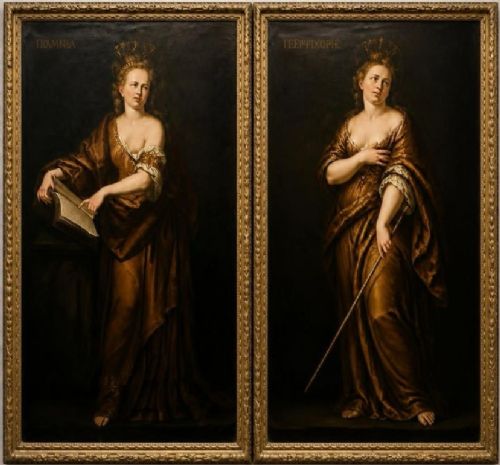

Specatular pair C18th oil on canvas painting of Cumaean + Persian Sibyls. 182cm high


