16,740  PAGES BROWSED TODAY PAGES TODAY 25  ANTIQUES UPLOADED TODAY NEW ARRIVALS
ID #SA1228417
FOR SALE
£880
Email
Save
Early Eightheenth Century Northern European School Drawing - Equestrian Study
The English Interior
for sale €1,030     $1,118
£880
The English Interior

The English Interior

Sellingantiques Verified Since Jul 2023
View Dealers Stock Page
  • About Us
    Specialist dealer in 17th century to the 20th century fine art, furniture and decorative antiques for your home.
Id #SA1228417
PDF SHARE
SAVE

Early Eightheenth Century Northern European School Drawing - Equestrian Study

18th century
Description

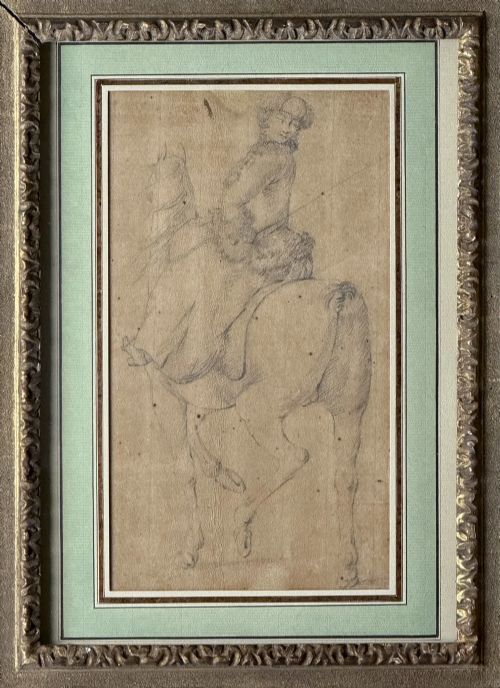
Early eighteenth-century northern European school - Equestrian portrait of a fashionably dressed young woman, black chalk on paper with prominent chain lines; stray marks of brown ink.

Our drawing is fluently executed in black chalk, the horse seen from the rear, the woman turning backwards to reveal a gentle smile. Her status is conveyed by the groomed horse that she commands with a thin whip held confidently against her hip; her fashionability is shown by her hat and riding habit trimmed with fur, its back riding up over the saddle. A high-heeled boot pushes against a stirrup. The horse’s mane streams to the left, blown by a gust coming from the direction to which the woman turns - her attention caught, perhaps, by a shout carried on the wind. Our drawing is not without wit: the horse’s rear with cut and bound tail displays that the young woman is astride a stallion.
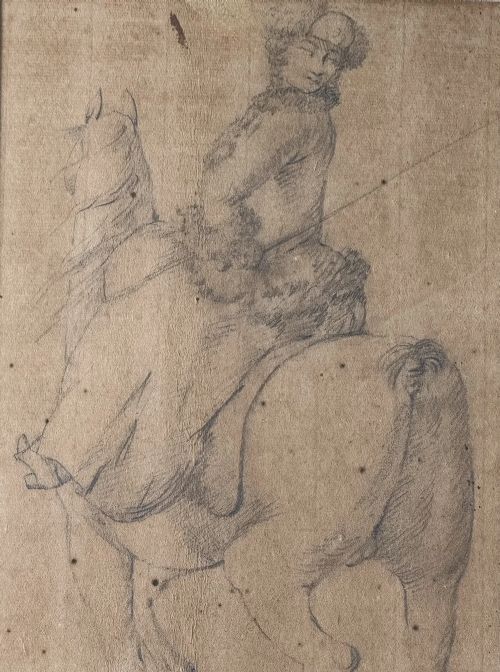
The sole focus on the horse and rider in our drawing, made without visible corrections, strongly suggests that it served as a study for another medium, either a painting or a print. The contours around the woman’s boot appear to have been strengthened, perhaps to transfer the composition. Eighteenth-century artists would frequently provide print studies in black or red chalk to be translated into the more graphic style of prints.
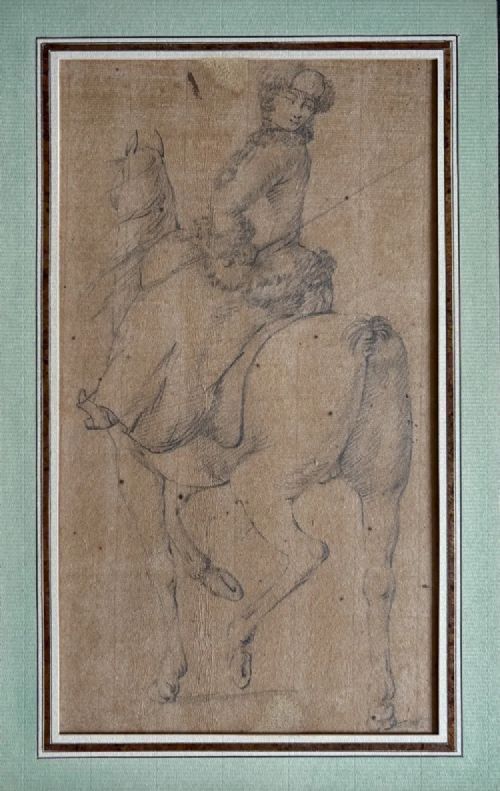
In terms of attribution our drawing is likely to derive from a north European, French or German artistic milieu. German artists such as Johann Elias Ridinger (1698-1767) and Wilhelm Kobell (1766-1855) who were famous for their equestrian portrayals, disseminating their compositions in prints that frequently showed single horses in wide varieties of settings with and without riders and with and without saddlery. A French eighteenth-century artist similarly renowned for his equestrian subjects is the battle painter Charles Parrocel (1688-1752), seen in his etching of a cavalry rider of 1737 (British Museum, inv.no. 1861,1012.107). Our artist
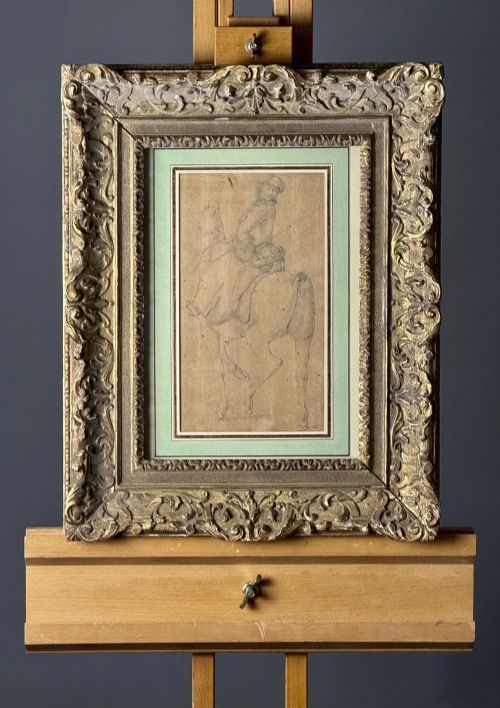
The quality of our drawing ensured its survival as a stand alone object beyond its immediate use as a study of either a painting or print (or both). It also clearly demonstrates the eighteenth-century interest in fashion and horses, the contemporary viewer alert to the details of the woman’s dress and the calibre of her steed.
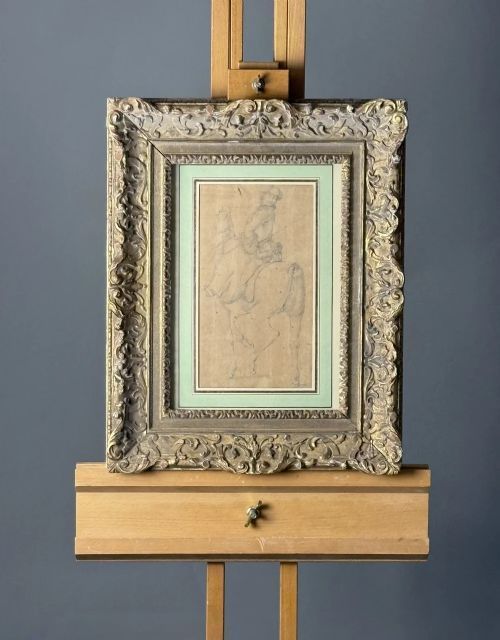
This fine drawing is ready to hang and enjoy within a very attractive lined mound and within aa hand carved and glued 18th century fame which is itself a work of art.

https://www.britishmuseum.org/collection/object/P_1861-1012-107

Dimensions sheet: 27cm x 16cm.

Dimensions framed: 48cm x 38cm.

Physical Dimensions
Height
48cm (18.90")
Width
38cm (14.96")
Depth
4cm (1.57")
Declaration

The English Interior has dated this 18th Century Equestrian Drawing to the 18th Century.

Reference Numbers
Sellingantiques Reference
SA1228417
Description
Early eighteenth-century northern European school - Equestrian portrait of a fashionably dressed young woman, black chalk on paper with prominent chain lines; stray marks of brown ink.
Our drawing is fluently executed in black chalk, the horse seen from the rear, the woman turning backwards to reveal a gentle smile.
The English Interior

Her status is conveyed by the groomed horse that she commands with a thin whip held confidently against her hip; her fashionability is shown by her hat and riding habit trimmed with fur, its back riding up over the saddle. A high-heeled boot pushes against a stirrup. The horse’s mane streams to the left, blown by a gust coming from the direction to which the woman turns - her attention caught, perhaps, by a shout carried on the wind. Our drawing is not without wit: the horse’s rear with cut and bound tail displays that the young woman is astride a stallion.

fig 1. An early eighteenth-century framed drawing on paper depicting a rider mounted on a horse, set within a sage green mount and a carved gilded frame.
fig 1. Early Eightheenth Century Northern European School Drawing - Equestrian Study

The sole focus on the horse and rider in our drawing, made without visible corrections, strongly suggests that it served as a study for another medium, either a painting or a print. The contours around the woman’s boot appear to have been strengthened, perhaps to transfer the composition. Eighteenth-century artists would frequently provide print studies in black or red chalk to be translated into the more graphic style of prints.

fig 2. An early eighteenth-century framed drawing on paper depicting a rider mounted on a horse, set within a sage green mount and a carved gilded frame.
fig 2. Early Eightheenth Century Northern European School Drawing - Equestrian Study

In terms of attribution our drawing is likely to derive from a north European, French or German artistic milieu. German artists such as Johann Elias Ridinger (1698-1767) and Wilhelm Kobell (1766-1855) who were famous for their equestrian portrayals, disseminating their compositions in prints that frequently showed single horses in wide varieties of settings with and without riders and with and without saddlery. A French eighteenth-century artist similarly renowned for his equestrian subjects is the battle painter Charles Parrocel (1688-1752), seen in his etching of a cavalry rider of 1737 (British Museum, inv.no. 1861,1012.107). Our artist

fig 3. An early eighteenth-century framed drawing on paper depicting a rider mounted on a horse, set within a sage green mount and a carved gilded frame.
fig 3. Early Eightheenth Century Northern European School Drawing - Equestrian Study

The quality of our drawing ensured its survival as a stand alone object beyond its immediate use as a study of either a painting or print (or both). It also clearly demonstrates the eighteenth-century interest in fashion and horses, the contemporary viewer alert to the details of the woman’s dress and the calibre of her steed.

fig 4. An early eighteenth-century framed drawing on paper depicting a rider mounted on a horse, set within a sage green mount and a carved gilded frame.
fig 4. Early Eightheenth Century Northern European School Drawing - Equestrian Study

This fine drawing is ready to hang and enjoy within a very attractive lined mound and within aa hand carved and glued 18th century fame which is itself a work of art.

https://www.britishmuseum.org/collection/object/P_1861-1012-107

Dimensions sheet: 27cm x 16cm.

Dimensions framed: 48cm x 38cm.

Height
48cm (18.90")
Width
38cm (14.96")
Depth
4cm (1.57")
Date of Manufacture

The English Interior has dated this 18th Century Equestrian Drawing to the 18th Century.

Reference Numbers
Sellingantiques Ref
SA1228417
The English Interior
Sellingantiques verified Since Jul 2023

Specialist dealer in 17th century to the 20th century fine art, furniture and decorative antiques for your home.

Dealer Profile

You can view the stock and full dealer information on the The English Interior Profile Page
PDF SHARE
SAVE
An early eighteenth-century framed drawing on paper depicting a rider mounted on a horse, set within a sage green mount and a carved gilded frame.
1 / 5
Archive I An early eighteenth-century framed drawing on paper depicting a rider mounted on a horse, set within a sage green mount and a carved gilded frame.

EARLY EIGHTHEENTH CENTURY NORTHERN EUROPEAN SCHOOL DRAWING - EQUESTRIAN STUDY

Archive II An early eighteenth-century framed drawing on paper depicting a rider mounted on a horse, set within a sage green mount and a carved gilded frame. View II
Archive III An early eighteenth-century framed drawing on paper depicting a rider mounted on a horse, set within a sage green mount and a carved gilded frame. View III
Archive IV An early eighteenth-century framed drawing on paper depicting a rider mounted on a horse, set within a sage green mount and a carved gilded frame. View IV
Archive V An early eighteenth-century framed drawing on paper depicting a rider mounted on a horse, set within a sage green mount and a carved gilded frame. View V
Enlarged Archival View
Telephone 07860 363 882
Location
The Duke of Somersets House
Kirkgate
Tadcaster
North Yorkshire
LS24 9AD
United Kingdom

By appointment only.
Verified Since Jul 2023
Items For Sale 75
Items Sold 62
The English Interior
Verified Since Jul 2023
View Dealer Info
Location: The Duke of Somersets House, Kirkgate, Tadcaster, North Yorkshire, LS24 9AD , United Kingdom, , By appointment only.
Verified
Jul 2023
For Sale
75
Sold
62
An early eighteenth-century framed drawing on paper depicting a rider mounted on a horse, set within a sage green mount and a carved gilded frame.
EARLY EIGHTHEENTH CENTURY NORTHERN EUROPEAN SCHOOL DRAWING - EQUESTRIAN STUDY
Ref: SA1228417
An early eighteenth-century framed drawing on paper depicting a rider mounted on a horse, set within a sage green mount and a carved gilded frame.
Detail View 1
Detail View 2
Detail View 3
Detail View 4
Archival Detail
Every single antique dealer on our platform is individually approved by our internal team. We verify their professional trade history, ethical standards, and photographic quality to ensure a secure, high-standard buying environment. Upon joining, every dealer agrees to a strict 9-point code of conduct. While issues can occasionally arise, our dealers typically resolve them swiftly and directly with the buyer. In fact, since our founding in 2002, Sellingantiques has only had to step in to help resolve an issue on roughly five occasions—a true testament to the quality of our dealers and their dedication to your happiness.
Our dealers are highly experienced in packing and shipping fragile, high-value antiques. Because you are in direct contact with the dealer, you will be able to easily go through all available shipping and insurance options together to ensure your item arrives safely.
Antiques are the ultimate green purchase. By choosing historical pieces over newly manufactured goods, you completely eliminate the carbon footprint of modern mass production while preserving exceptional, timeless craftsmanship.

Equestrian studies from 18th-century Northern Europe typically depict horses and riders with a focus on anatomical precision, movement, and classical horsemanship. These works were commonly created as preparatory sketches or formal academic studies using ink, chalk, or graphite on paper.

Artists during the early 18th century predominantly used handmade rag paper alongside iron gall ink, natural chalks, or graphite. Framed works of the period frequently incorporated carved timber frames treated with gesso and gold leaf.

Authentic 18th-century drawings display characteristics of handmade paper, such as chain and laid lines or watermarks visible under light. Genuine pieces show natural ageing signs such as foxing, paper oxidation, and drawn line work rather than modern print dots.

An antique drawing can serve as a focal point when hung in a hallway, home library, or positioned above a sideboard. Pairing historic framed works with contemporary furniture creates a layered, curated aesthetic.

Antique paper drawings should be kept away from direct sunlight, high humidity, and direct heat to prevent fading and deterioration. Framing with acid-free archival mounts and UV-filtering glass ensures long-term protection.
items
Add keywords to the filter
Price
£100
£250000
Era
Movements
Material
Origin
Stock Location
Freshness
Online Payments
Categories