27,235  PAGES BROWSED TODAY PAGES TODAY 74  ANTIQUES UPLOADED TODAY NEW ARRIVALS
ID #SA1227279
FOR SALE
£44,000
Email Buy
Save
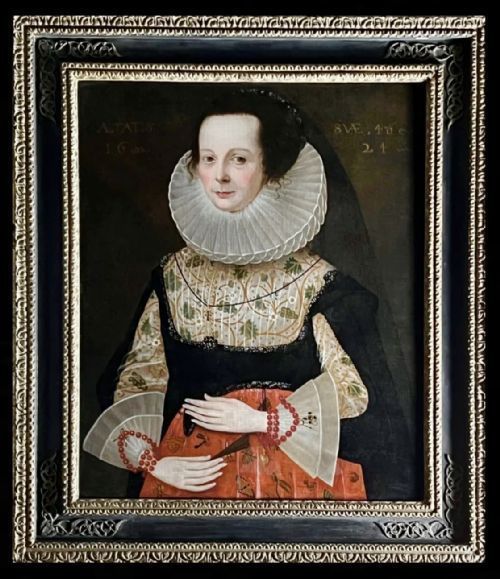
17th Century English School - Portrait of a Noblewoman in Elaborate Costume Dated 1624
Period Portraits
for sale €51,480     $55,880
£44,000
Period Portraits

Period Portraits

Sellingantiques Verified Since Jan 2017
View Dealers Stock Page
  • About Us
    Specialist dealer in portraits from the 17th century to the 20th century. Our stock includes quality oil paintings, drawings, and mezzotints
Id #SA1227279
PDF SHARE
SAVE

17th Century English School - Portrait of a Noblewoman in Elaborate Costume Dated 1624

17th century
For Sale by Period Portraits
Description

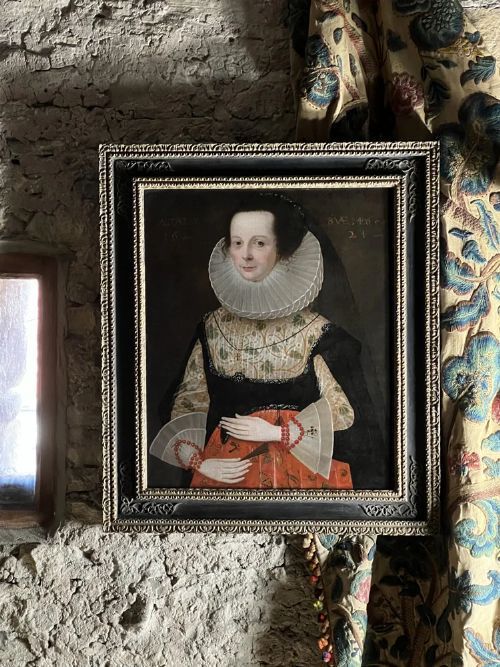
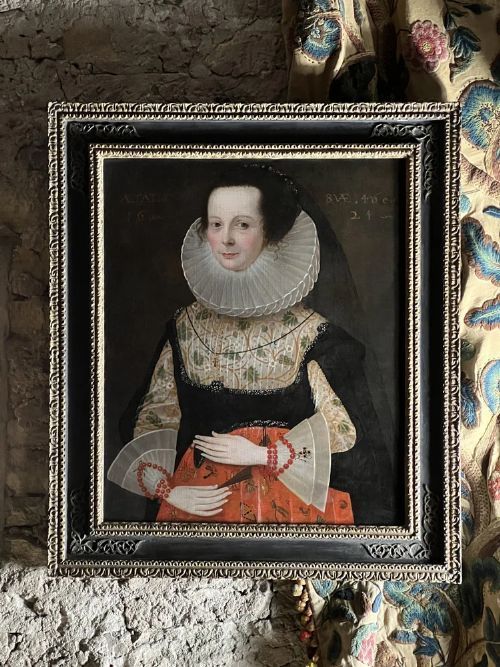
A sumptuous and highly detailed 17th century Jacobean oil on canvas portrait of a lady of significant wealth and status. She wears her finery, reveals her most virtuous characteristics and gazes at us with an air of confidence befitting her 46 years. A latin inscription gives us her age and the date (1624) and conveys with it the notion that the sitter is well read, and both her clothing and deportment tell us that she is well-bred.
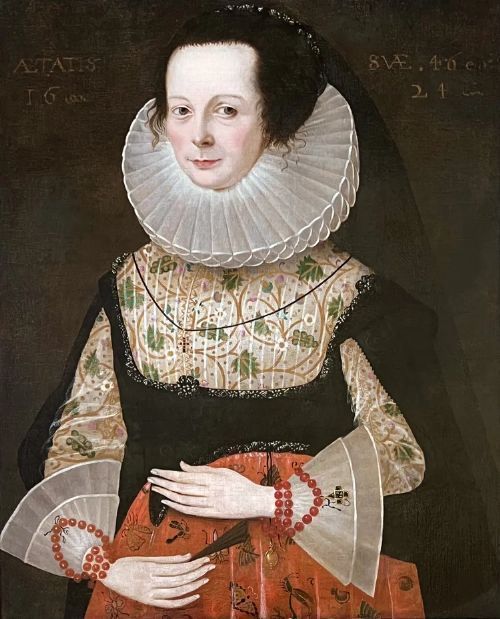
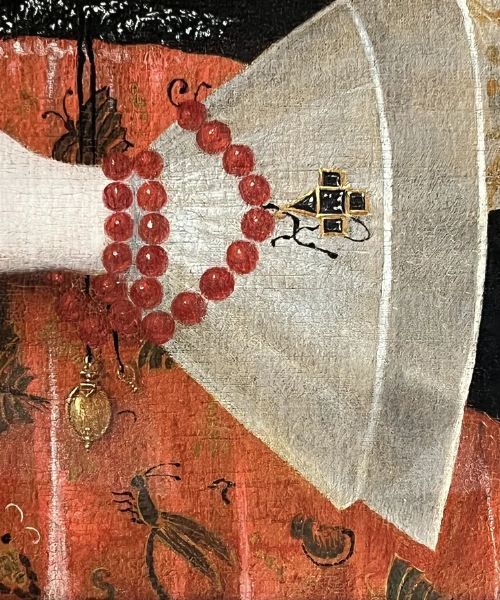
Display is evidently important to this sitter. Her wealth and power are revealed in her choice of colours – red and black were both extremely expensive dyes. Many women would have worn black silk twists of ribbon at the wrist (and perhaps one beaded bracelet) to set off the desired pale complexion. This lady’s show of red beaded bracelets is ostentatious and they would have been heavy and difficult to keep in the desired position. They are secured to stiffened starched linen cuffs with black silk ‘twists’ to decorate and disguise the pin.
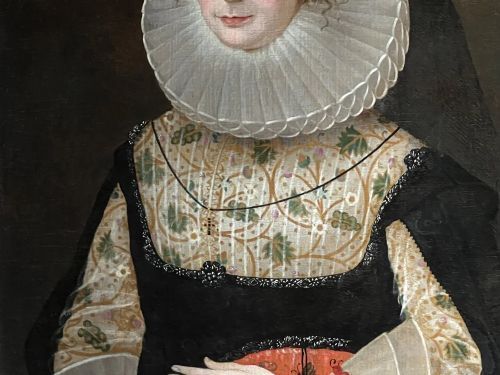
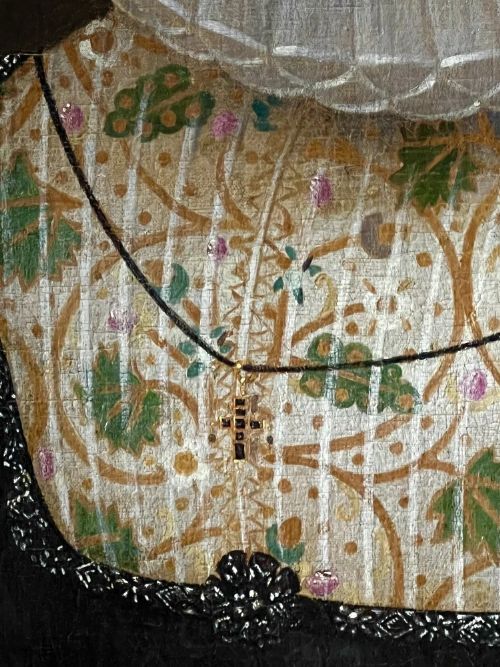
She invites us to admire her piety with a cross-shaped brooch, and perhaps the plainness of her linen (in place of very costly lace). Don’t be fooled however as the black stones that glisten from her wrist are in fact diamonds. With her golden locket, and another diamond cross round her neck, it is clear that she has worldly wealth in abundance.
The fashionable silhouette that she exhibits is consistent with the 1620’s – namely a hairstyle that is broad rather than high, with little straggles of hair – called ‘lovelocks’ spilling onto her ruff. The ruff is full and closed – i.e. not open at the front – and is raised up at the back. This would be supported by a stiffened pasteboard collar called a ‘pickadil’ or ‘underpropper’ or perhaps a wired contraption (a ‘supportasse’) that would keep the starched linen elevated.
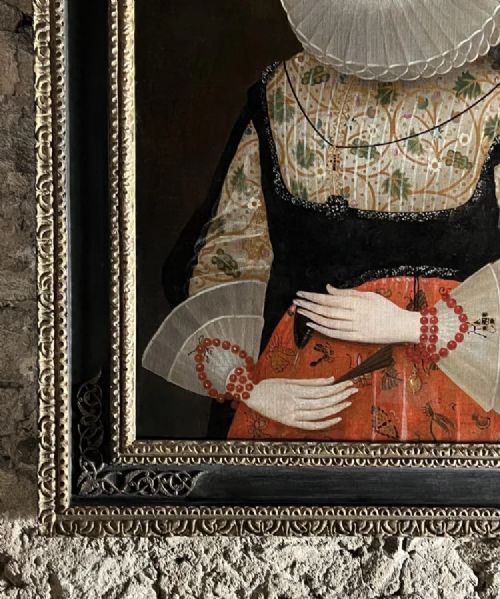
Her natural/high waistline is consistent with this period, as is the amount of wrist showing and the fullness of the sleeves. By the late 1620’s to 1630 sleeves would be full and would have shrunk to reveal the forearm, thus giving poets another area of the body to praise in poetry, and for moralists to condemn as sinfully and shamelessly displayed.
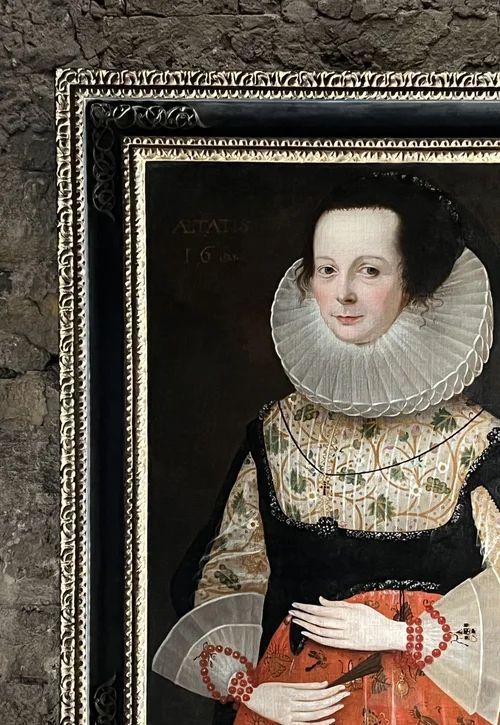
The use of polychrome embroidery - adorning her waistcoat and petticoat - is typical of the Jacobean era (the age of James I (1603-1625). The fashionable silhouette that she exhibits is consistent with the 1620’s – namely a hairstyle that is broad rather than high, with little straggles of hair – called ‘lovelocks’ spilling onto her ruff. The ruff is full and closed – i.e. not open at the front – and is raised up at the back. This would be supported by a stiffened pasteboard collar called a ‘pickadil’ or ‘underpropper’ or perhaps a wired contraption (a ‘supportasse’) that would keep the starched linen elevated.
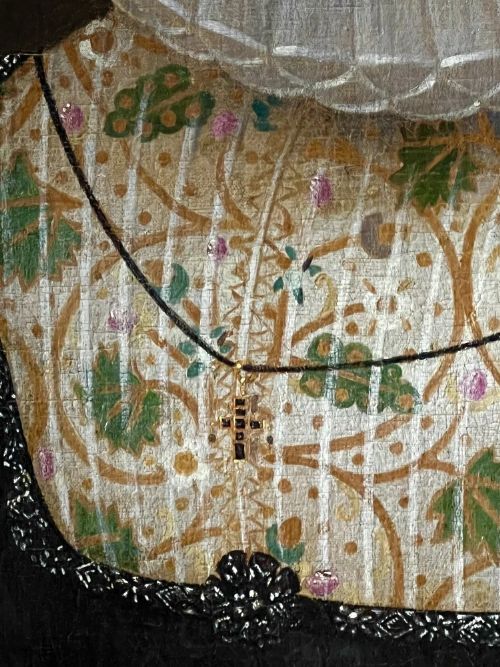
The most striking feature of the sitters costume is undoubtedly the wealth of embroidery on display . This could have been the work of a professional embroiderer or created by the lady of the house herself as a demonstration of her skills.The polychrome patterns that adorn her high-necked waistcoat had been in fashion since the end of the Elizabethan era. There is a beautifully worked linen waistcoat from the Burrell Collection, Glasgow which exhibits a very similar scrolling pattern of gold, enclosing strawberry flowers and oak leaves. It can also be seen in the remarkable portrait by Marcus Gheerearts the Younger of Margaret Layton in the V&A - where the real jacket worn in the portrait also survives...

SEE MORE AT PERIODPORTRAITS.COM

Physical Dimensions
Height
98cm (38.58")
Width
89cm (35.04")
Depth
3cm (1.18")
Declaration

Period Portraits has dated this Jacobean Noblewoman Oil Portrait to the 17th Century.

Reference Numbers
Sellingantiques Reference
SA1227279
Description
A sumptuous and highly detailed 17th century Jacobean oil on canvas portrait of a lady of significant wealth and status.
She wears her finery, reveals her most virtuous characteristics and gazes at us with an air of confidence befitting her 46 years.
Period Portraits

A latin inscription gives us her age and the date (1624) and conveys with it the notion that the sitter is well read, and both her clothing and deportment tell us that she is well-bred.

fig 1. A 17th-century oil painting depicting a noblewoman wearing a large white cartwheel ruff collar, embroidered floral bodice, black gown, and red coral bead bracelets.
fig 1. 17th Century English School - Portrait of a Noblewoman in Elaborate Costume Dated 1624

Display is evidently important to this sitter. Her wealth and power are revealed in her choice of colours – red and black were both extremely expensive dyes. Many women would have worn black silk twists of ribbon at the wrist (and perhaps one beaded bracelet) to set off the desired pale complexion. This lady’s show of red beaded bracelets is ostentatious and they would have been heavy and difficult to keep in the desired position. They are secured to stiffened starched linen cuffs with black silk ‘twists’ to decorate and disguise the pin.

fig 2. A 17th-century oil painting depicting a noblewoman wearing a large white cartwheel ruff collar, embroidered floral bodice, black gown, and red coral bead bracelets.
fig 2. 17th Century English School - Portrait of a Noblewoman in Elaborate Costume Dated 1624

She invites us to admire her piety with a cross-shaped brooch, and perhaps the plainness of her linen (in place of very costly lace). Don’t be fooled however as the black stones that glisten from her wrist are in fact diamonds. With her golden locket, and another diamond cross round her neck, it is clear that she has worldly wealth in abundance.

fig 3. A 17th-century oil painting depicting a noblewoman wearing a large white cartwheel ruff collar, embroidered floral bodice, black gown, and red coral bead bracelets.
fig 3. 17th Century English School - Portrait of a Noblewoman in Elaborate Costume Dated 1624

The fashionable silhouette that she exhibits is consistent with the 1620’s – namely a hairstyle that is broad rather than high, with little straggles of hair – called ‘lovelocks’ spilling onto her ruff. The ruff is full and closed – i.e. not open at the front – and is raised up at the back. This would be supported by a stiffened pasteboard collar called a ‘pickadil’ or ‘underpropper’ or perhaps a wired contraption (a ‘supportasse’) that would keep the starched linen elevated.

fig 4. A 17th-century oil painting depicting a noblewoman wearing a large white cartwheel ruff collar, embroidered floral bodice, black gown, and red coral bead bracelets.
fig 4. 17th Century English School - Portrait of a Noblewoman in Elaborate Costume Dated 1624

Her natural/high waistline is consistent with this period, as is the amount of wrist showing and the fullness of the sleeves. By the late 1620’s to 1630 sleeves would be full and would have shrunk to reveal the forearm, thus giving poets another area of the body to praise in poetry, and for moralists to condemn as sinfully and shamelessly displayed.

fig 5. A 17th-century oil painting depicting a noblewoman wearing a large white cartwheel ruff collar, embroidered floral bodice, black gown, and red coral bead bracelets.
fig 5. 17th Century English School - Portrait of a Noblewoman in Elaborate Costume Dated 1624

The use of polychrome embroidery - adorning her waistcoat and petticoat - is typical of the Jacobean era (the age of James I (1603-1625). The fashionable silhouette that she exhibits is consistent with the 1620’s – namely a hairstyle that is broad rather than high, with little straggles of hair – called ‘lovelocks’ spilling onto her ruff. The ruff is full and closed – i.e. not open at the front – and is raised up at the back. This would be supported by a stiffened pasteboard collar called a ‘pickadil’ or ‘underpropper’ or perhaps a wired contraption (a ‘supportasse’) that would keep the starched linen elevated.

fig 6. A 17th-century oil painting depicting a noblewoman wearing a large white cartwheel ruff collar, embroidered floral bodice, black gown, and red coral bead bracelets.
fig 6. 17th Century English School - Portrait of a Noblewoman in Elaborate Costume Dated 1624

The most striking feature of the sitters costume is undoubtedly the wealth of embroidery on display . This could have been the work of a professional embroiderer or created by the lady of the house herself as a demonstration of her skills.The polychrome patterns that adorn her high-necked waistcoat had been in fashion since the end of the Elizabethan era. There is a beautifully worked linen waistcoat from the Burrell Collection, Glasgow which exhibits a very similar scrolling pattern of gold, enclosing strawberry flowers and oak leaves. It can also be seen in the remarkable portrait by Marcus Gheerearts the Younger of Margaret Layton in the V&A - where the real jacket worn in the portrait also survives...

SEE MORE AT PERIODPORTRAITS.COM

Height
98cm (38.58")
Width
89cm (35.04")
Depth
3cm (1.18")
Date of Manufacture

Period Portraits has dated this Jacobean Noblewoman Oil Portrait to the 17th Century.

Reference Numbers
Sellingantiques Ref
SA1227279
Period Portraits
Period Portraits
Sellingantiques verified Since Jan 2017

Specialist dealer in portraits from the 17th century to the 20th century. Our stock includes quality oil paintings, drawings, and mezzotints

Dealer Profile

You can view the stock and full dealer information on the Period Portraits Profile Page
PDF SHARE
SAVE
A 17th-century oil painting depicting a noblewoman wearing a large white cartwheel ruff collar, embroidered floral bodice, black gown, and red coral bead bracelets.
1 / 10
Archive I A 17th-century oil painting depicting a noblewoman wearing a large white cartwheel ruff collar, embroidered floral bodice, black gown, and red coral bead bracelets.

17th Century English School - Portrait of a Noblewoman in Elaborate Costume Dated 1624
Archive II A 17th-century oil painting depicting a noblewoman wearing a large white cartwheel ruff collar, embroidered floral bodice, black gown, and red coral bead bracelets. View II
Archive III A 17th-century oil painting depicting a noblewoman wearing a large white cartwheel ruff collar, embroidered floral bodice, black gown, and red coral bead bracelets. View III
Archive IV A 17th-century oil painting depicting a noblewoman wearing a large white cartwheel ruff collar, embroidered floral bodice, black gown, and red coral bead bracelets. View IV
Archive V A 17th-century oil painting depicting a noblewoman wearing a large white cartwheel ruff collar, embroidered floral bodice, black gown, and red coral bead bracelets. View V
Archive VI A 17th-century oil painting depicting a noblewoman wearing a large white cartwheel ruff collar, embroidered floral bodice, black gown, and red coral bead bracelets. View VI
Archive VII A 17th-century oil painting depicting a noblewoman wearing a large white cartwheel ruff collar, embroidered floral bodice, black gown, and red coral bead bracelets. View VII
Archive VIII A 17th-century oil painting depicting a noblewoman wearing a large white cartwheel ruff collar, embroidered floral bodice, black gown, and red coral bead bracelets. View VIII
Archive IX A 17th-century oil painting depicting a noblewoman wearing a large white cartwheel ruff collar, embroidered floral bodice, black gown, and red coral bead bracelets. View IX
Archive X A 17th-century oil painting depicting a noblewoman wearing a large white cartwheel ruff collar, embroidered floral bodice, black gown, and red coral bead bracelets. View X
Enlarged Archival View
Telephone 07889 859729
Location
North Yorkshire
United Kingdom
Verified Since Jan 2017
Items For Sale 47
Items Sold 61
Period Portraits
Period Portraits
Verified Since Jan 2017
View Dealer Info
Location: North Yorkshire, United Kingdom
Verified
Jan 2017
For Sale
47
Sold
61
A 17th-century oil painting depicting a noblewoman wearing a large white cartwheel ruff collar, embroidered floral bodice, black gown, and red coral bead bracelets.
17TH CENTURY ENGLISH SCHOOL - PORTRAIT OF A NOBLEWOMAN IN ELABORATE COSTUME DATED 1624
Ref: SA1227279
A 17th-century oil painting depicting a noblewoman wearing a large white cartwheel ruff collar, embroidered floral bodice, black gown, and red coral bead bracelets.
Detail View 1
Detail View 2
Detail View 3
Detail View 4
Detail View 5
Detail View 6
Detail View 7
Detail View 8
Detail View 9
Archival Detail
Every single antique dealer on our platform is individually approved by our internal team. We verify their professional trade history, ethical standards, and photographic quality to ensure a secure, high-standard buying environment. Upon joining, every dealer agrees to a strict 9-point code of conduct. While issues can occasionally arise, our dealers typically resolve them swiftly and directly with the buyer. In fact, since our founding in 2002, Sellingantiques has only had to step in to help resolve an issue on roughly five occasions—a true testament to the quality of our dealers and their dedication to your happiness.
Our dealers are highly experienced in packing and shipping fragile, high-value antiques. Because you are in direct contact with the dealer, you will be able to easily go through all available shipping and insurance options together to ensure your item arrives safely.
Antiques are the ultimate green purchase. By choosing historical pieces over newly manufactured goods, you completely eliminate the carbon footprint of modern mass production while preserving exceptional, timeless craftsmanship.

Portraits from this era, particularly during the Jacobean period, typically feature formal posing, intricate depictions of elaborate costume, detailed linen ruffs, and Latin inscriptions stating the sitters age and date of execution.

Artists during this period prepared stretched linen canvases or wooden panels with chalk grounds, applying hand-ground mineral and organic pigments bound in linseed or walnut oil.

Authentic period works display age-appropriate craquelure patterns, original wood or canvas supports, period-accurate costume elements like stiffened ruffs, and traditional inscription conventions such as Aetatis Suae.

A historical portrait works as an anchor visual when placed above a fireplace mantel, within a dark academia library, or contrasting with minimalist contemporary furniture.

Keep the painting away from direct sunlight and fluctuating humidity, maintain a stable indoor environment, and engage a professional conservator for surface cleaning or varnish restoration.
items
Add keywords to the filter
Price
£100
£250000
Era
Movements
Material
Origin
Stock Location
Freshness
Online Payments
Categories