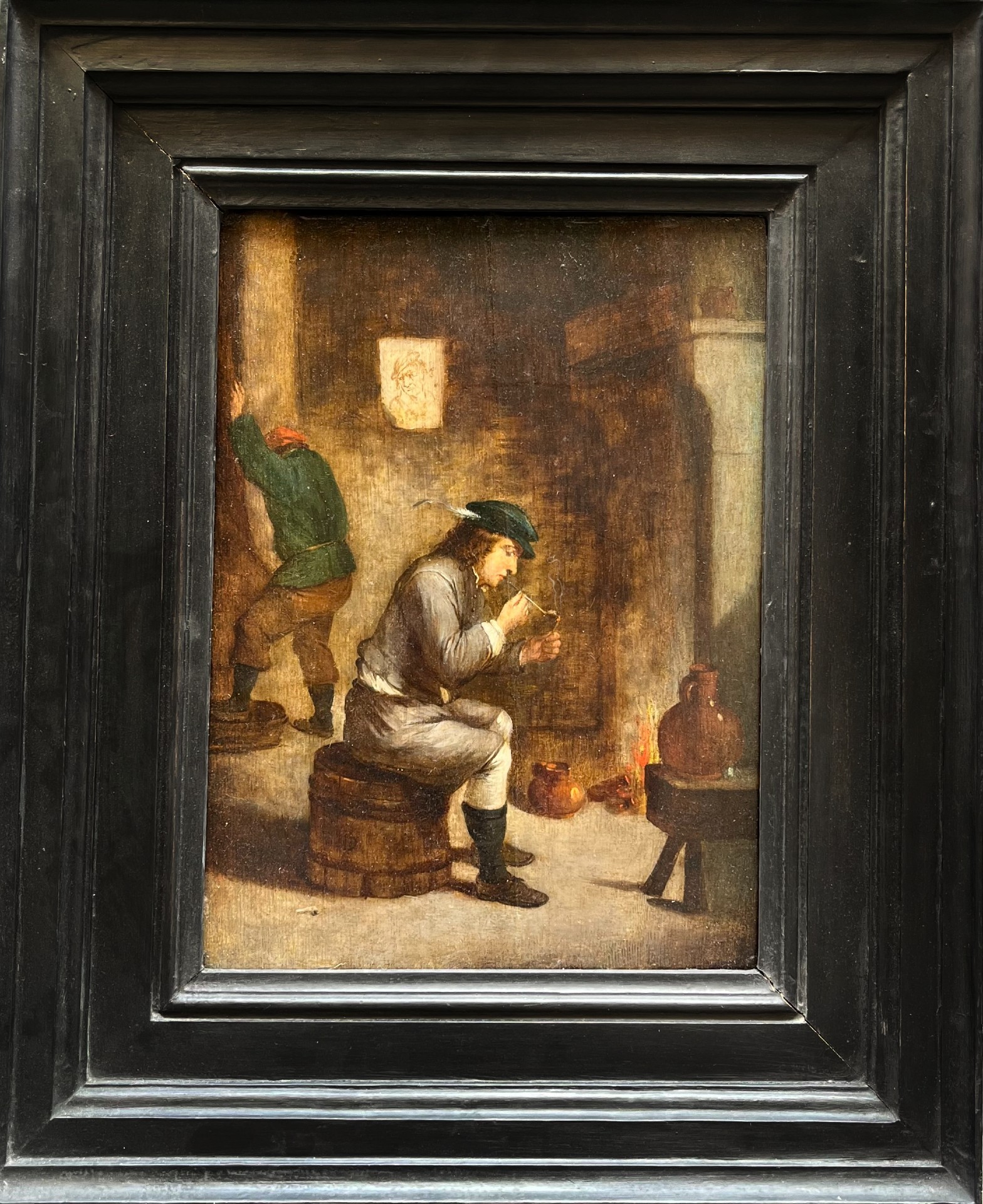
Darnley Fine Art has dated this Flemish Genre Oil Painting to the 17th Century.
Image size: 9 1/2 x12 1/2 inches (23.5 x 32 cm)
Handmade contemporary frame
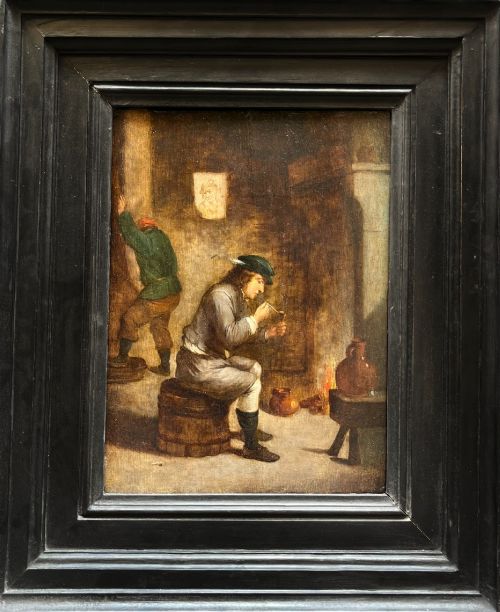
In the background, another man is seen leaning against the wall to stabilise himself. The earthy toned room exudes a cold and dreary ambience, with details obscured by the hazy brown hue of the walls. In the lower right of the background, a lit fire flickers, casting a warm glow, its weak force failing to reach the rest of the room. Jugs are scattered on the table and the floor besides the fire adding to the tavern setting. On the back wall a sketch of a man stands out on cream paper, stark against the dark walls. The sketched figure gazes down at the man leaning against the wall, in the melancholy scene.
David Teniers the Younger
Born in Antwerp, Teniers was a Flemish Baroque painter, printmaker, draughtsman, copyist and art curator. Son of David Teniers the Elder, an altarpiece painter, he had three brothers who were also painters. He studied under his father with the two collaborating to create a series of twelve panels recounting stories from Torquato Tasso’s epic Gerusalemme Liberata. After the Arrest of his father due to debts, Teniers became a copyist to support the family and between 1632-1633 he was registered as the son of a master in the Antwerp guild of Saint Luke. He was best known for his peasant genre where he captured tavern scenes as well as alchemists and physicians, he was also known for his miniaturist and staffage paintings.
In 1636, Teniers was invited to participate as an assistant to Rubens following a commission from King Philip IV of Spain to create a series of mythological paintings to decorate the Torre de la Parada, a hunting lodge near Madrid.
Teniers was also commissioned to make a picture after Ruben’s design but this painting is lost. Teniers married into the famous Brueghel artist family, marrying Anna Brueghel, daughter of Jan Brueghel the Elder in July 1637. Rubens, who had been her guardian after her fathers death, witnessed the wedding. Through this marriage Teniers created a close relationship with Rubens and Rubens second wife Helene Fourment became godmother to their first child.
Teniers later became a court painter and curator of the collection of Archduke Leopold Wilhelm, moving to Brussels. He collected a large amount of works for the Archduke’s collection including many that had been confiscated from Charles I of England and his Jacobite supporters including around 400 works previously owned by James Hamilton, 1st Duke of Hamilton. Teniers collected works from Titian, Raphael, Giorgione as well as Northern artists such as Hans Holbein the Younger and Pieter Bruegel the Elder. The collection formed the foundation of the Kunsthistorisches Museum in Vienna.
Teniers played an important role in developing of the genre of gallery paintings and his mid-17th century gallery paintings of Archduke Leopold Wilhelm' collection are among the most famous examples of the genre. During his time with the Archduke, Teniers created and published the first illustrated catalogue of old master paintings. Additionally, he contributed to the spread of the genre of the ‘monkey scene’ also known as ‘singerie’ which were comical scenes of monkeys in human clothes and environments that became popular in the 16th and 17th century throughout the Netherlands.
Teniers founded the Antwerp Academy, where young artists trained to draw and sculpt in the hope of reviving Flemish art after its decline following the death of the leading Flemish artists Rubens and Anthony van Dyck in the early 1640s. He influenced the next generation of Northern genre painters as well as French Rococo painters such as Antione Watteau.
Museums
Hermitage Museum
National Gallery, London
British Museum, London
Museo del Prado, Madrid
The Metropolitan Museum of Art, New York
The Courtauld, London
Darnley Fine Art has dated this Flemish Genre Oil Painting to the 17th Century.
You can view the stock and full dealer information on the Darnley Fine Art Profile Page
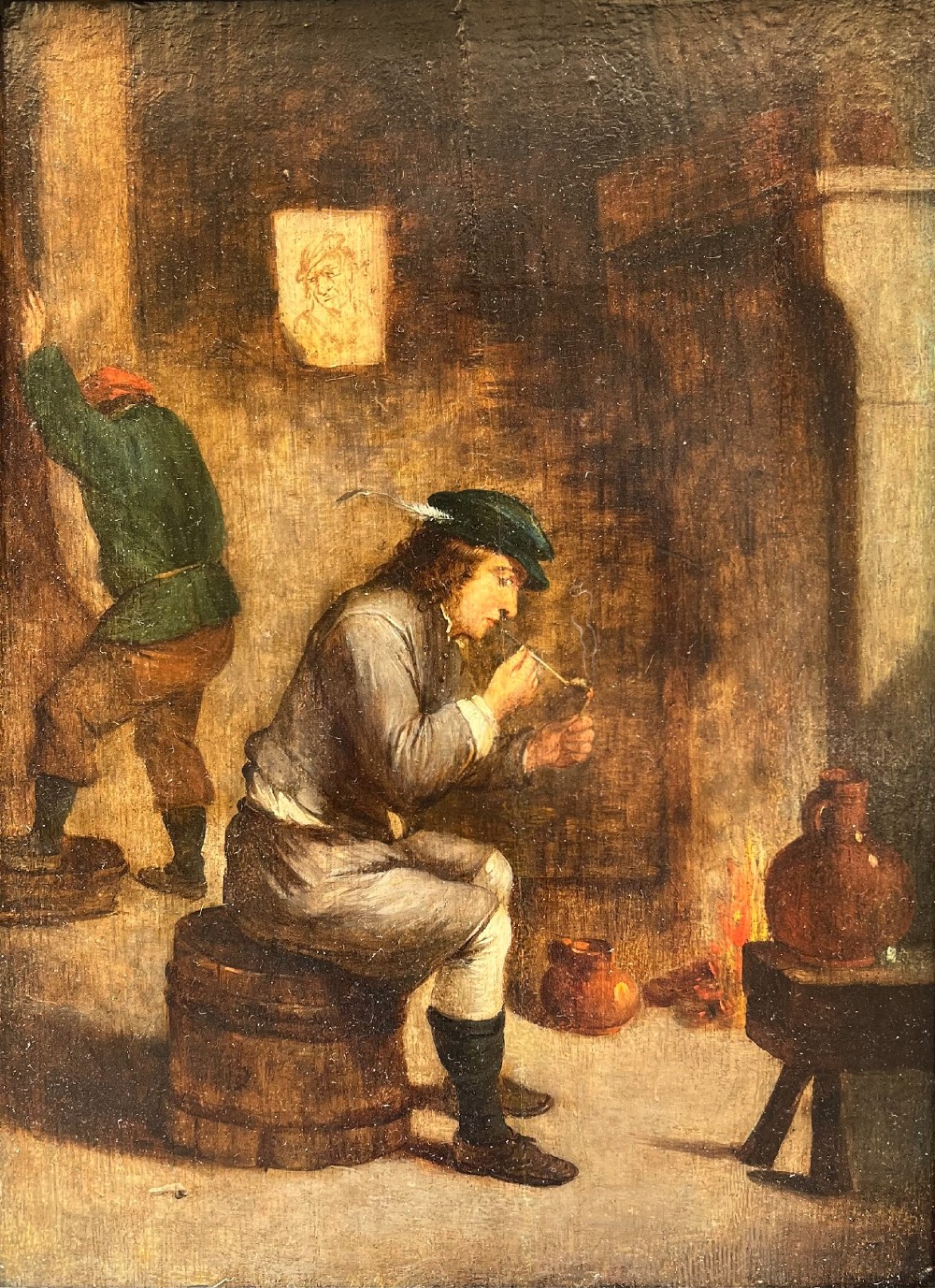
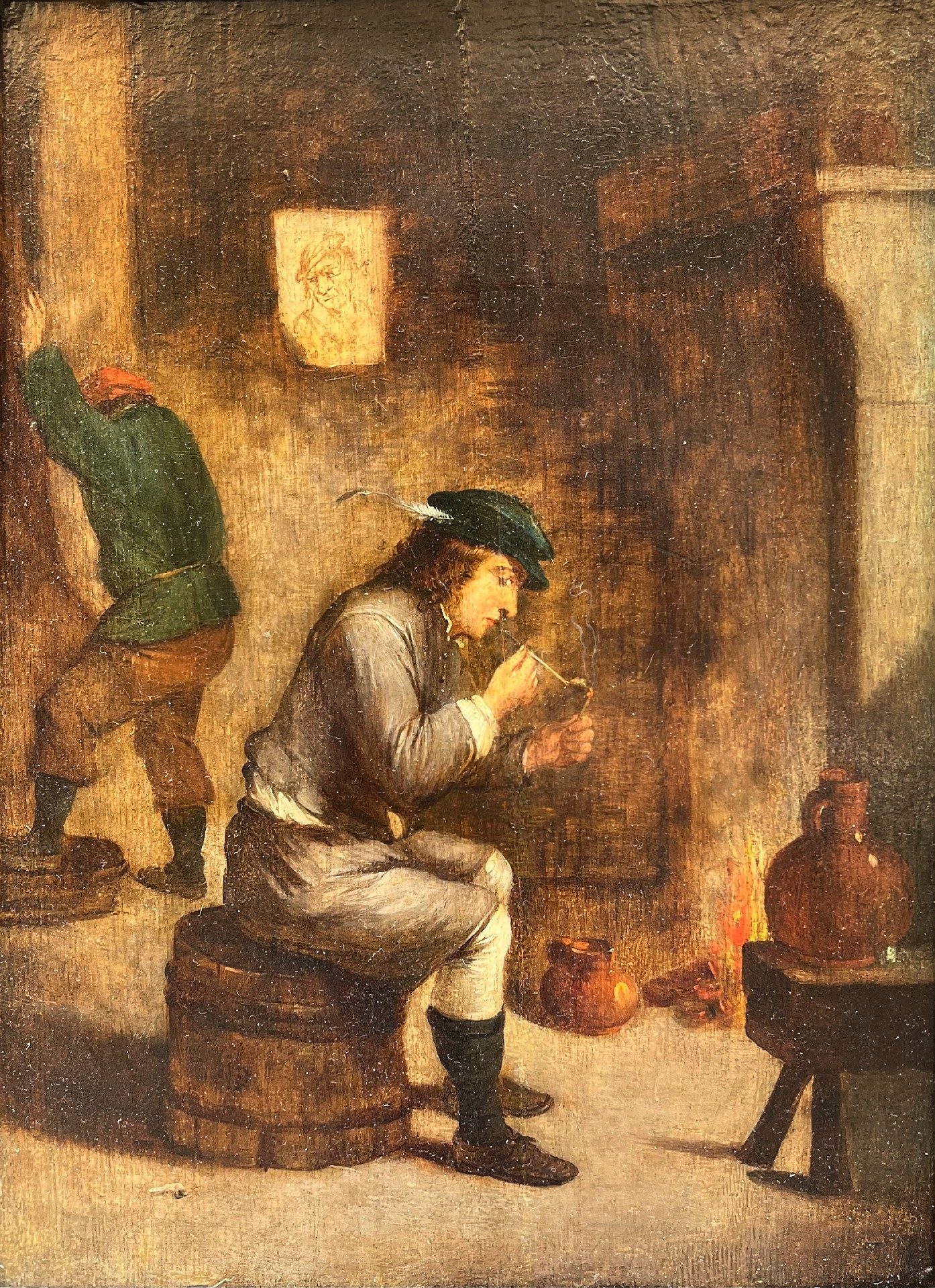
David Teniers Man Smoking on a Barrel