Henrietta Rae
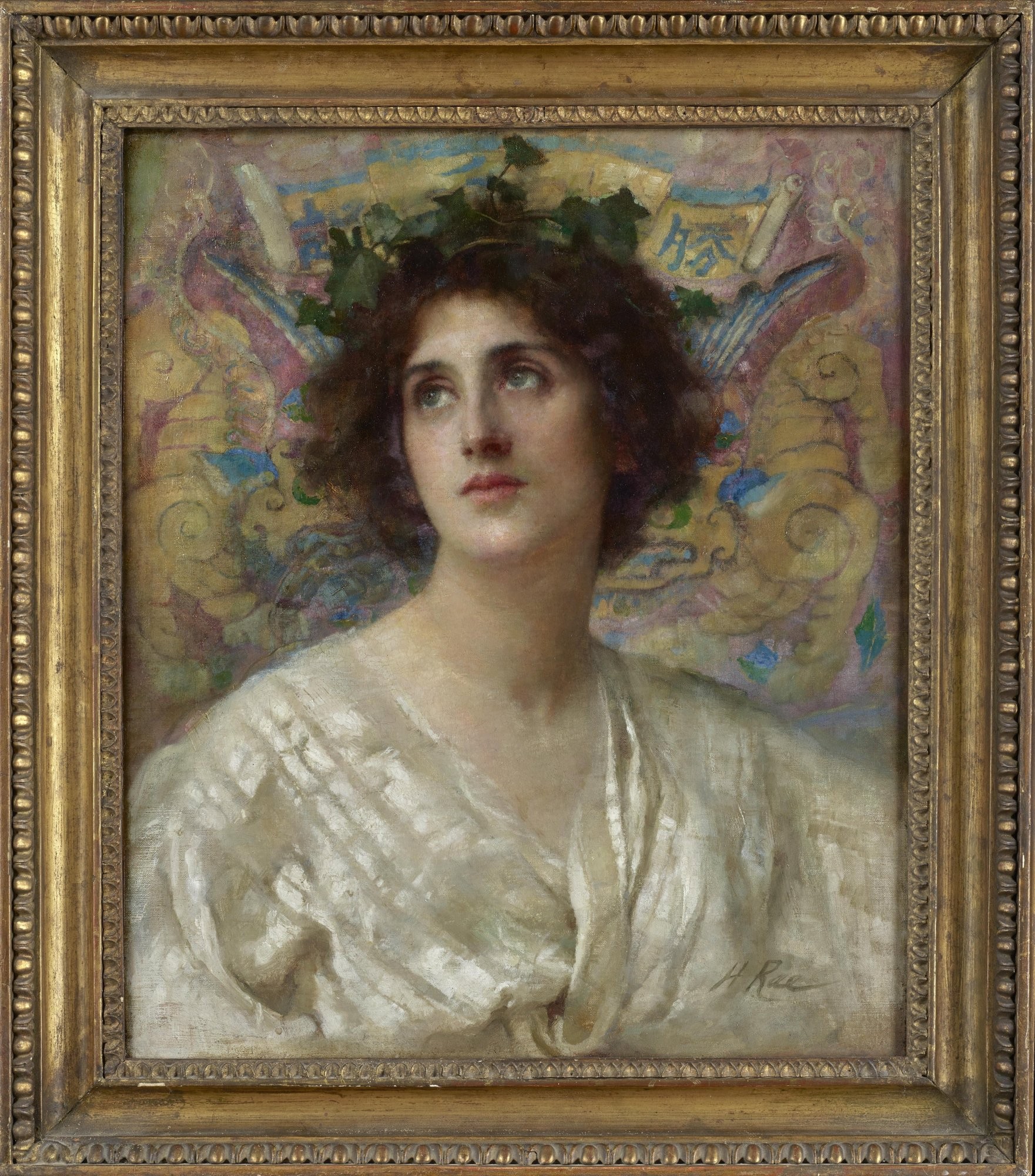
Her Eyes are Homes of Silent Prayer
1828-1928
Oil on canvas, signed lower right
Image size: 24 x 20 inches (61 x 51cm)
Original gilt frame
Literature
Fish, Arthur. Henrietta Rae (Mrs. Ernest Normand). Cassell and Company, 1905
Henrietta Rae’s painting Her Eyes are Homes of Silent Prayer takes its title from a famous line in Section XXXII of Alfred, Lord Tennyson''s elegiac poem In Memoriam A.H.H. (1850). It describes Mary of Bethany''s profound faith and love for Jesus, highlighting her silent, intense devotion after her brother Lazarus''s resurrection. The line signifies deep love surpassing words, focusing on inner spirituality and divine reverence.
The work depicts the head and shoulders of a woman in white, turning to look gently up top left of the canvas, her head crowned with ivy and set against a background of Chinese-style inspired motifs. The serene and pensive expression on the woman’s face reflects the subject of devotion described by
... Tennyson’s poem. Rae often depicted literary figures and this is not the only work by Rae that drew inspiration from Tennyson, with her painting Elaine Guarding the Shield of Lancelot based on the poem Lancelot and Elaine. However, other than the title and the sitter being lost in thought, there is little to identify the subject as one from literature. Victorian art frequently merged with literature to highlight moral, social and emotional themes, however, artists such as Leighton, with whom Rae was acquainted, chose to move away from narrative and design works based purely on aesthetic appeal. Here we see the same focus on beauty over the narrative of religious devotion on which Tennyson’s poem is based.
The background of the work is based on Chinese paintings with auspicious clouds (Xiangyun ??; ??) scrolls with Chinese-esque characters and two Chinese lion dogs (shíshi ??) flanking the woman’s head. In keeping with Chinese tradition, the shíshi are painted as a pair, symbolising the harmony of Yin and Yang. Chinese art had a significant impact on Victorian art, developing from the 18th Century ‘Chinoiserie’. Here, this is combined with ‘Japonisme’, a trend that had been growing from the 1850s, with its influence from Japanese woodblock prints in the flat pattern and vibrant colours. Rae was also influenced by Chinese and Japanese in her earlier work Azaleas (1895), similarly showing the head and shoulders of a woman, gazing up to the left, dressed in a kimono and holding a fan, against a background of an embroidered Chinese dragon.
Antique ID Number (AIDN): SA1226098
Dateline of this antique is 19th Century
Height is 61cm (24.0inches)Width is 51cm (20.1inches)Depth is 5cm (2.0inches)




Thank you.
Your comment has been sent to Sellingantiques.