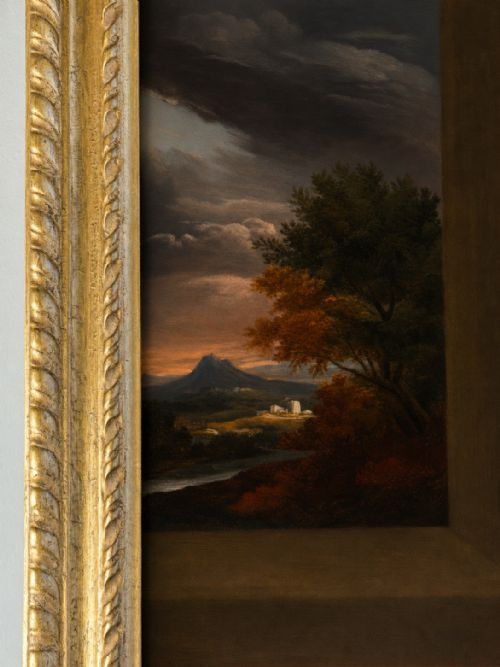
A fine and sensitively rendered 17th century portrait of a lady by Gerard Lanscroon, signed bottom right. The noble sitter depicted three-quarter length seated leaning upon a cloth covered table in front of drapery. Through an open window an extensive landscape can be glimpsed.
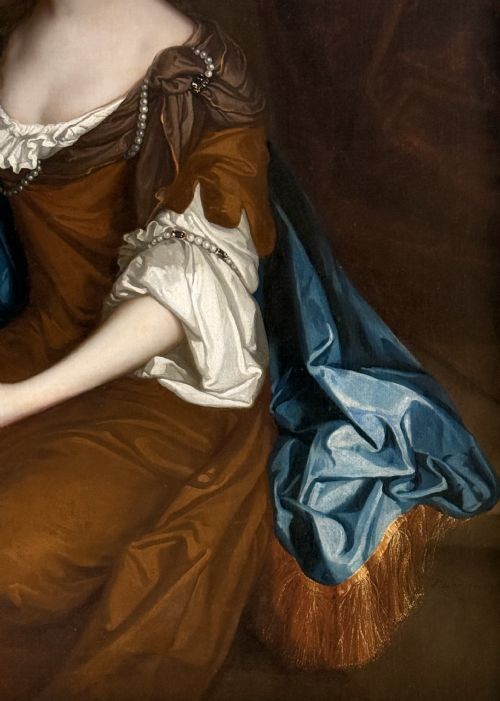
The sitter (a member of the Markham family) is expensively dressed in the idealized state of casual undress which was pioneered by court painter Sir Peter Lely and followed by Mary Beale. Instead of stiff, heavily structured court gowns with strict boning, garments were pinned loosely to look effortless, sensual, and timeless.
Our sitters low-cut, fitted bodice features a deep, rounded neckline that accentuates the decolletage. Under this is a white linen or silk chemise (shift) visible at the neckline, which is gathered into crisp, delicate ruffles.
The deep, saturated coloured fabrics in this portrait would have required expensive, natural organic matter and complex chemical fixatives (mordants).
...r>The rich bronze hue of the sitters dress was typically achieved using a base of madder root (for the warm reddish undertone) combined with walnut hulls or oak galls. To get the deep, dark metallic depth, dyers used iron sulfate as a mordant, which ''saddened'' or darkened the vegetable dyes into a regal bronze.
A brilliant blue shade such as the one seen on the sitters gold fringed wrap was a major status symbol. It was derived from imported indigo or high-grade woad and to achieve such a bright, reflective shade on silk, the fabric had to be dipped multiple times in a specialized fermenting vat. This was a labour-intensive process that heavily inflated the price of the textile.
Our sitter also holds a spray of white jasmine flowers. In 17th-century portraits, this flower was a potent botanical symbol representing purity, divine love, and spiritual grace. Because of its star-like white blossoms and sweet fragrance, artists frequently used it to denote the sitter’s virtue, nobility, and modesty.
Gerard Lanscroon (1655-1737)
Lanscroon was a Flemish baroque artist who worked in England who is recorded as assistant to Verrio in 1678 at Windsor, and later at Hampton Court and who specialised in history paintings and portraits.
His father was the sculptor Valentin Lanscroon, who worked as a carver at Chatsworth House in 1695–96. Gerard completed work at Drayton House in Northamptonshire, and murals at Arnos Grove house, Southgate, London and on the staircase at Broomfield House in Palmers Green, London.
Antique ID Number (AIDN): SA1222731
Dateline of this antique is 17th Century
Height is 148cm (58.3inches)Width is 122cm (48.0inches)Depth is 6cm (2.4inches)




Thank you.
Your comment has been sent to Sellingantiques.