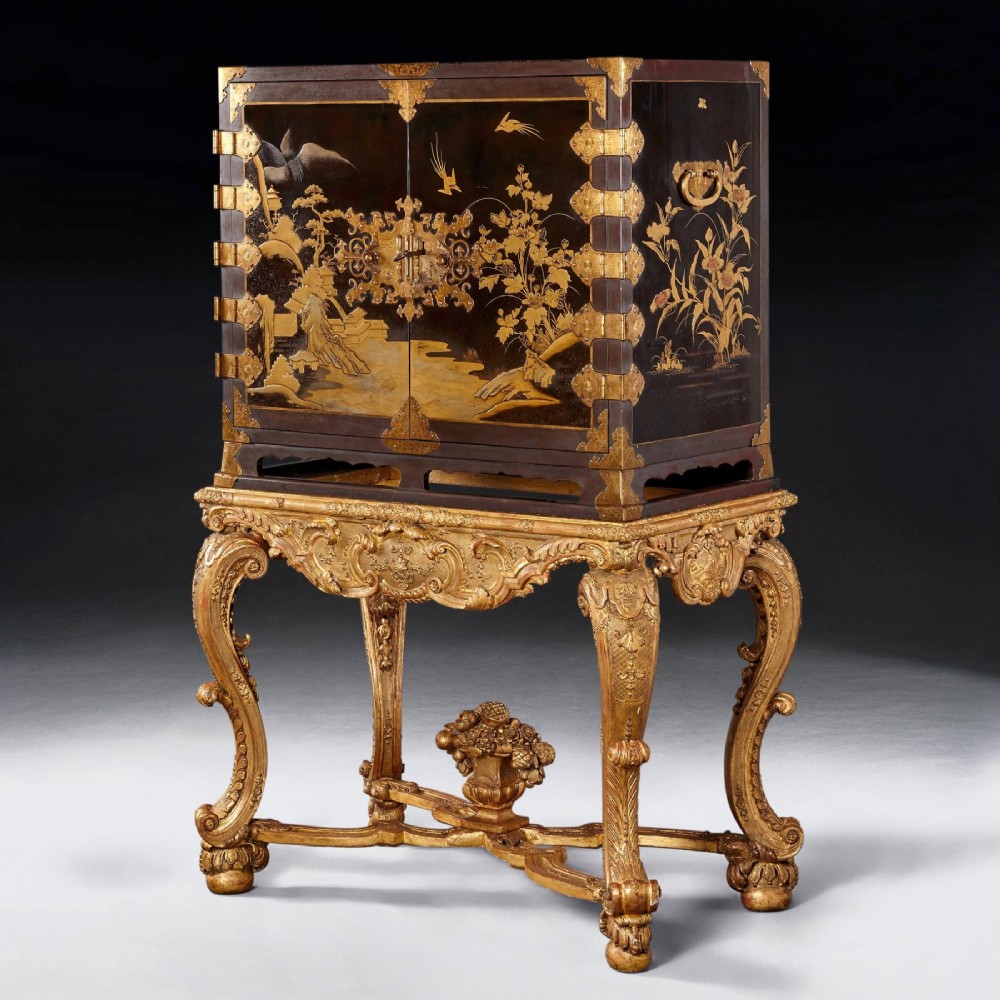
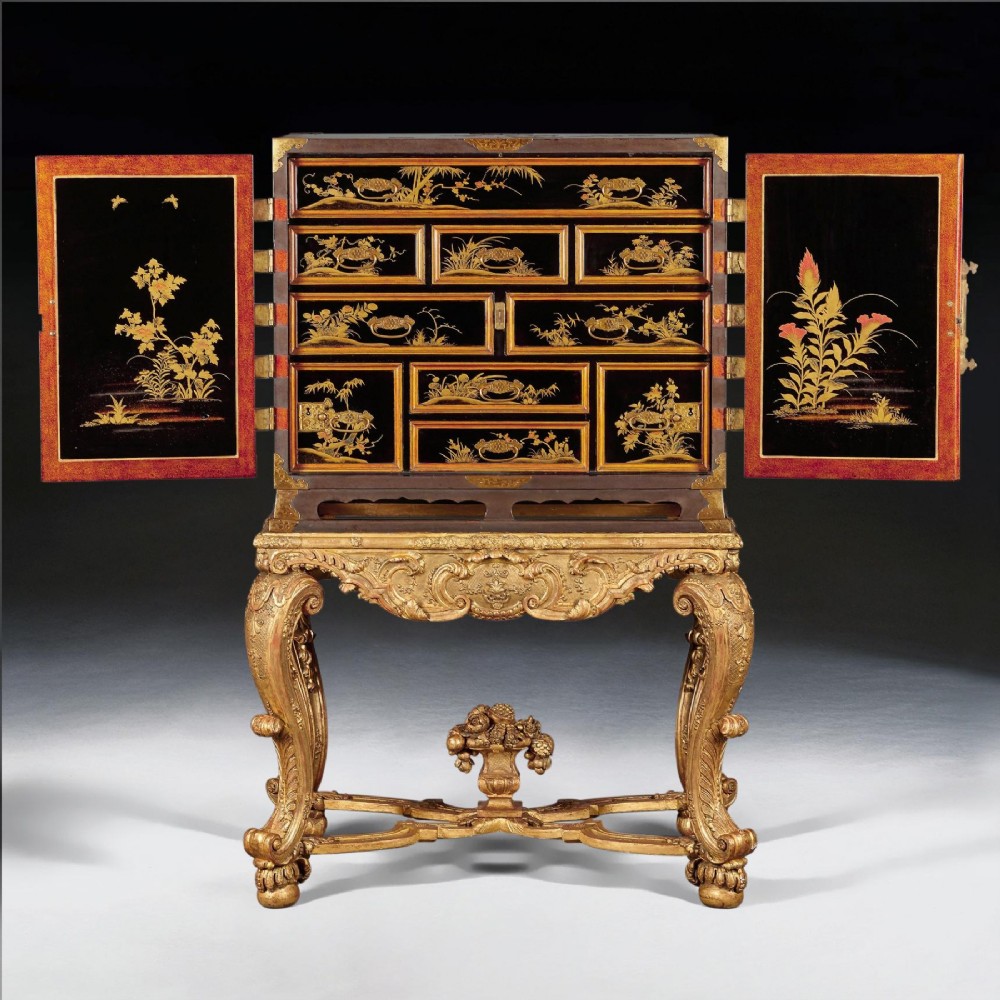
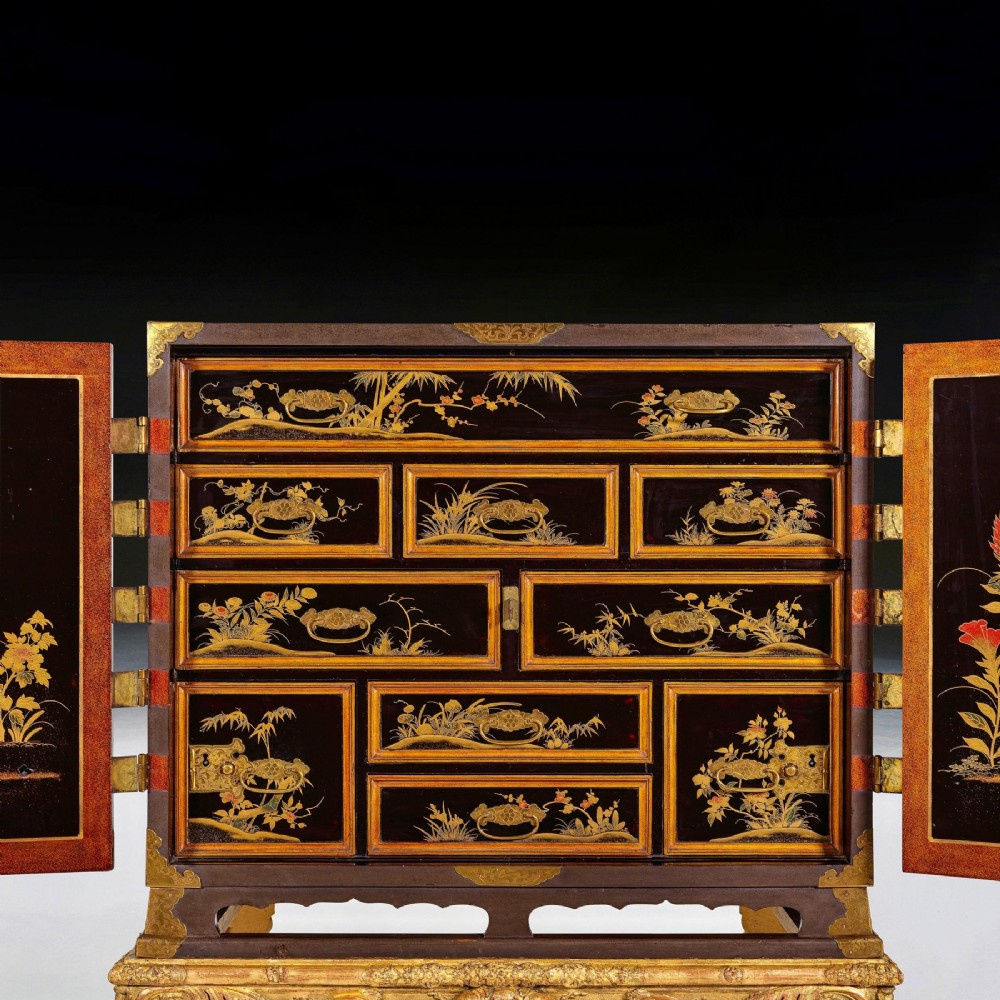
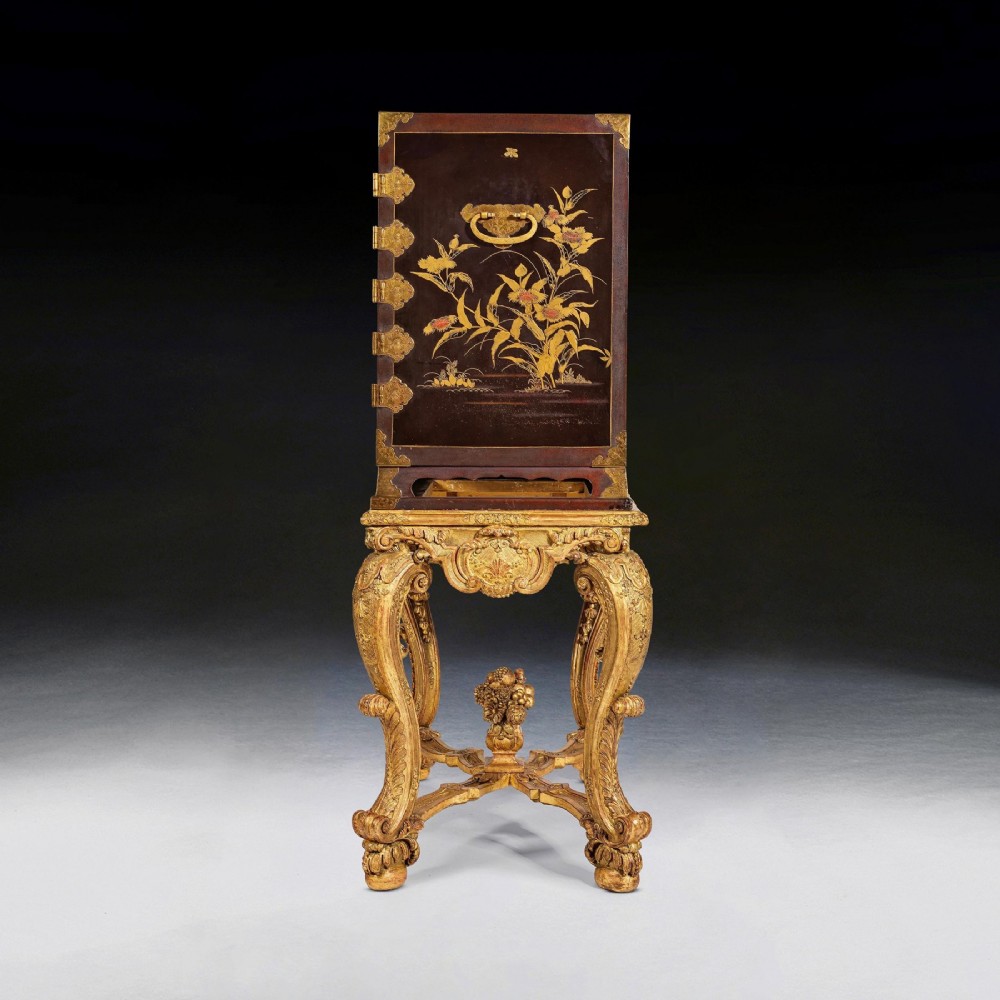
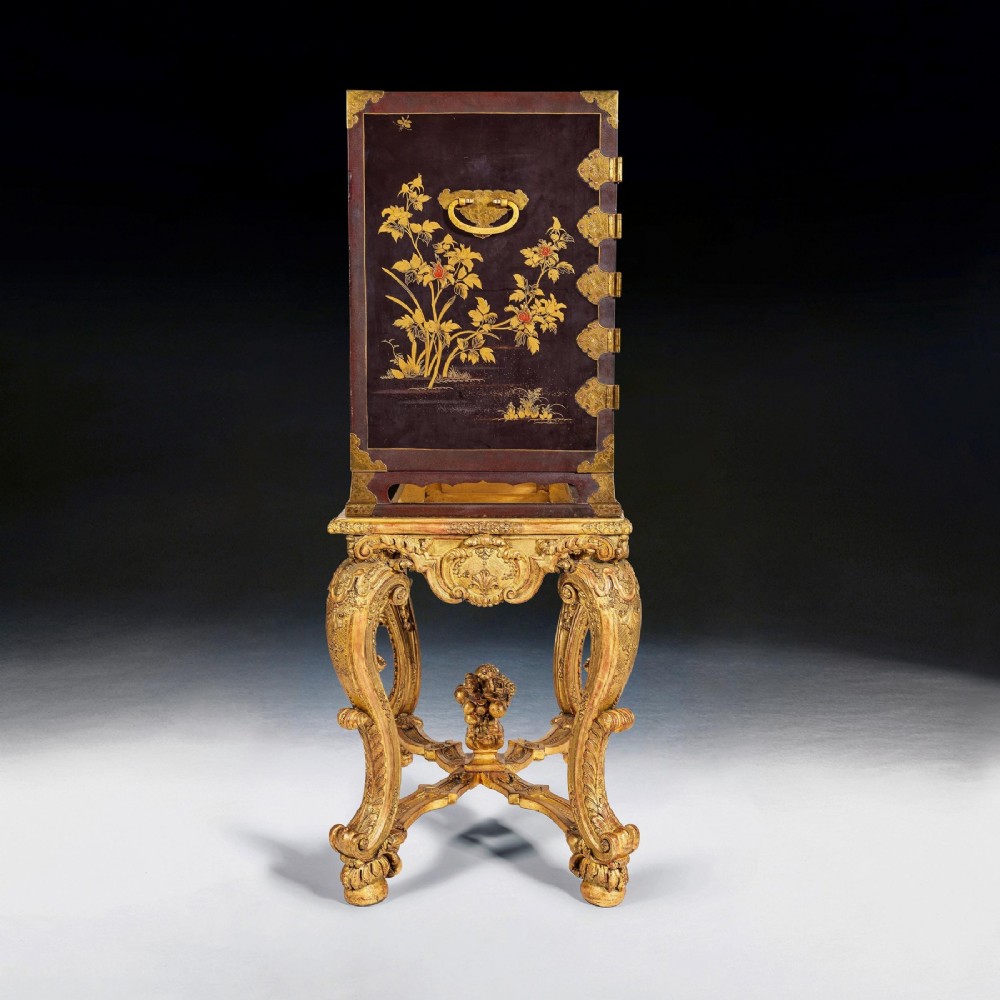
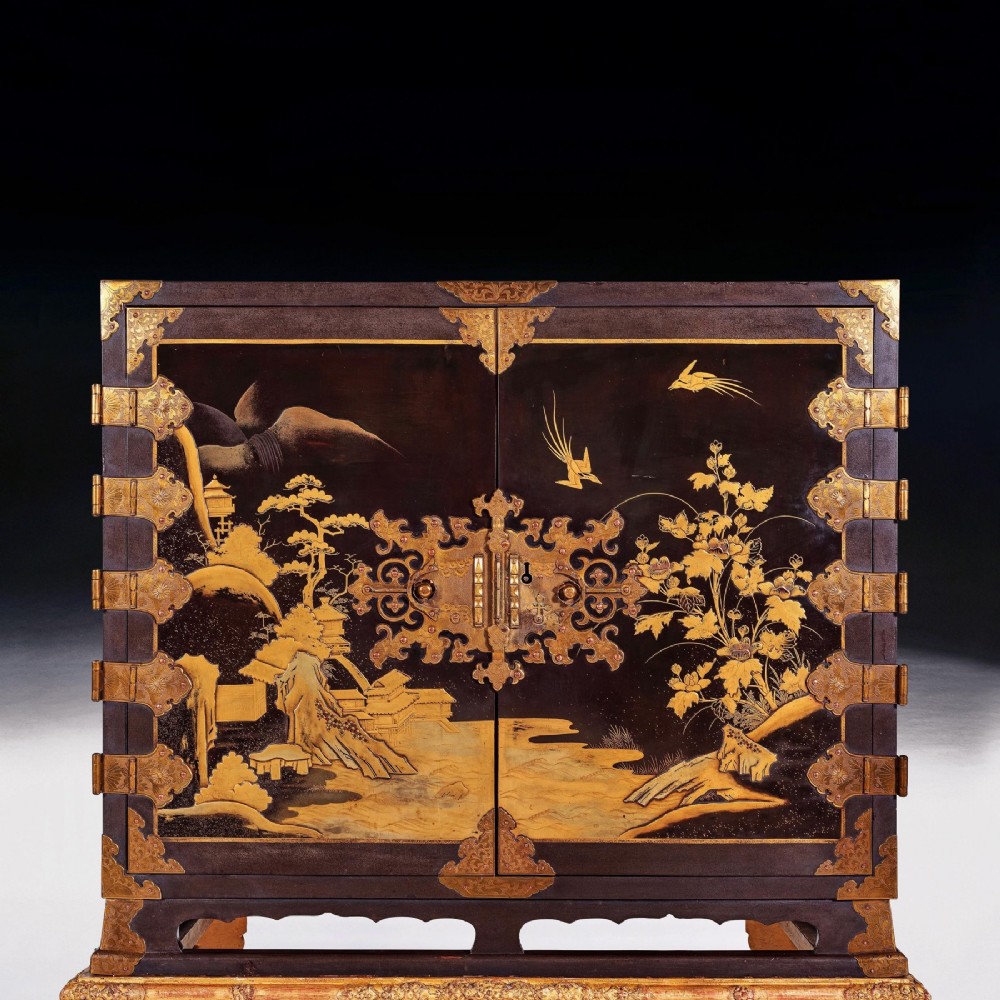
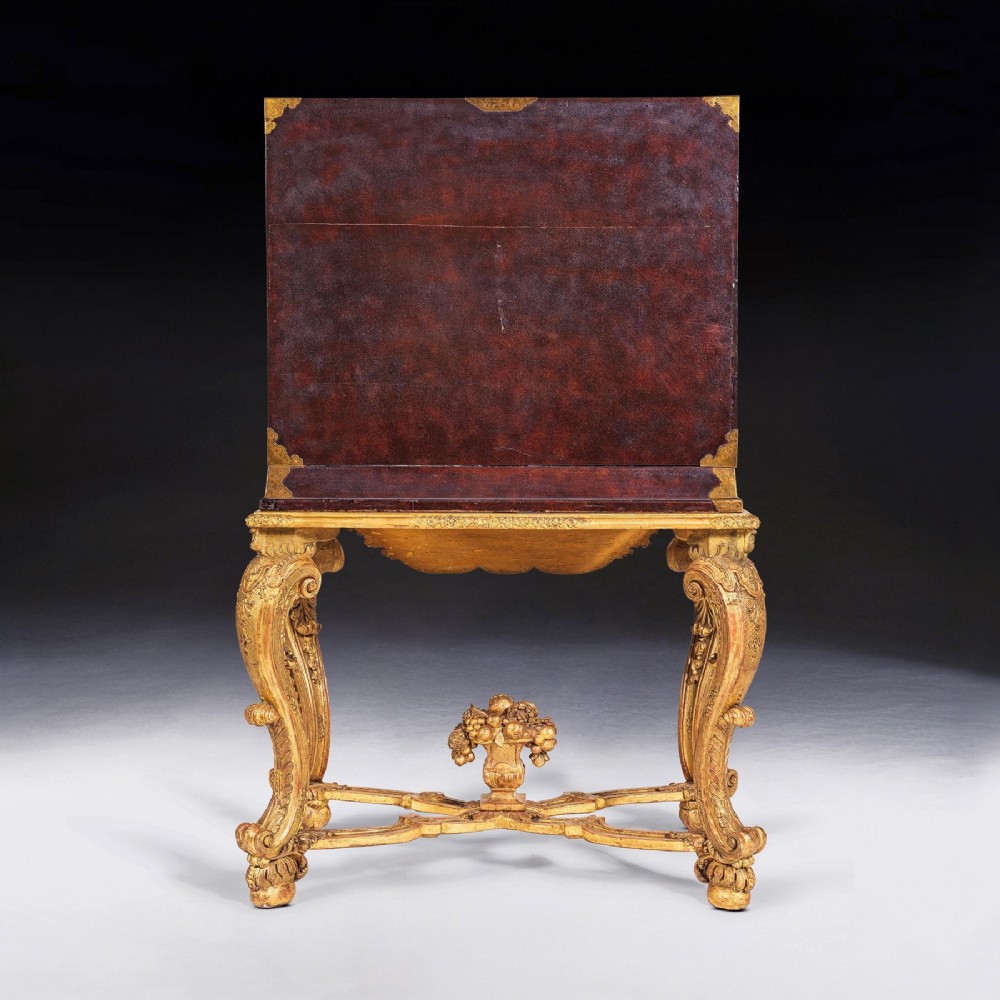
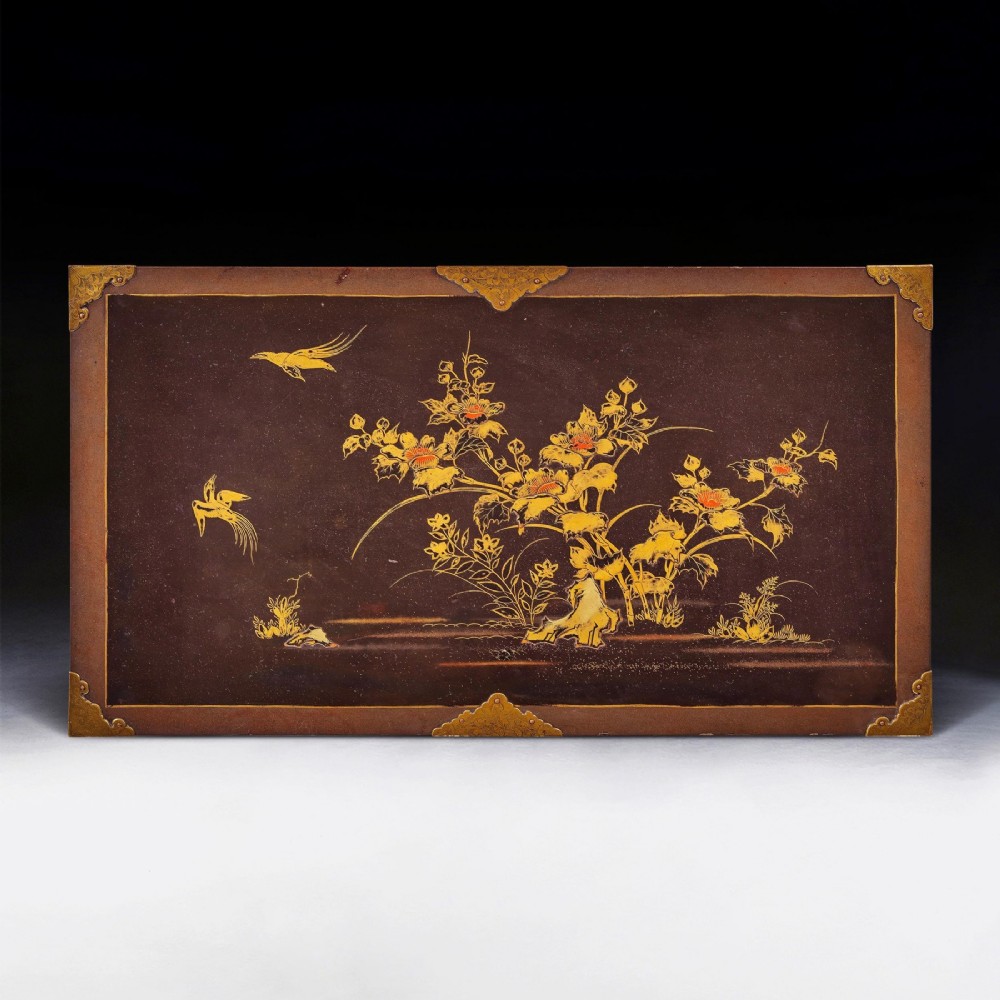
Loveday Antiques has dated this Japanese Lacquer Cabinet Stand to the 17th Century.
Provenance
Likely acquired by Herman Willem Daendels (1762-1818)
Mr. Herman August Daendels (1918-2000), Amsterdam
Eurasia Antiques, Amsterdam
Biënnale des Antiquairs, Paris, 1998
Private Collection, Belgium
A Private European collection
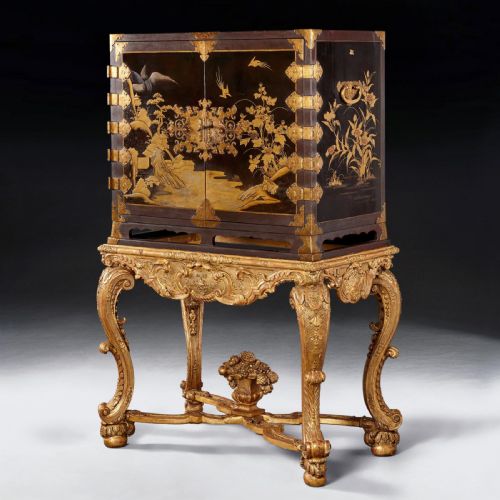
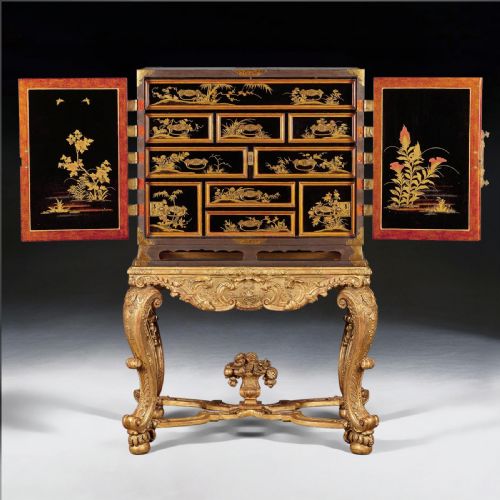
This fine Japanese lacquer cabinet or ‘Cantoor’ was presumably originally acquired by a French connoisseur due to the French Regence period base it sit upon. The craze for lacquer in the west from the 16th century onwards has been extensively documented and it is generally accepted that the finest of all lacquers, technically speaking, were those produced in Japan rather than China. This cabinet is one of the best examples of Japanese export lacquer.
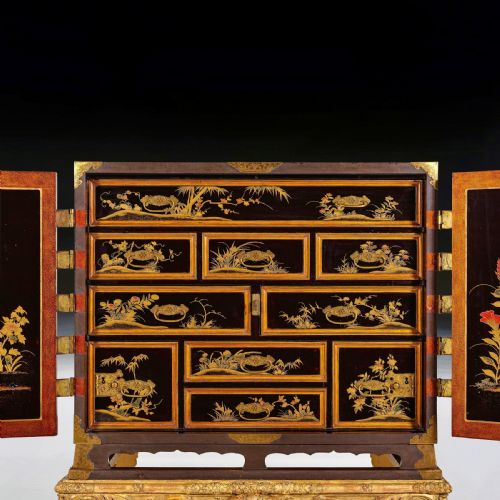
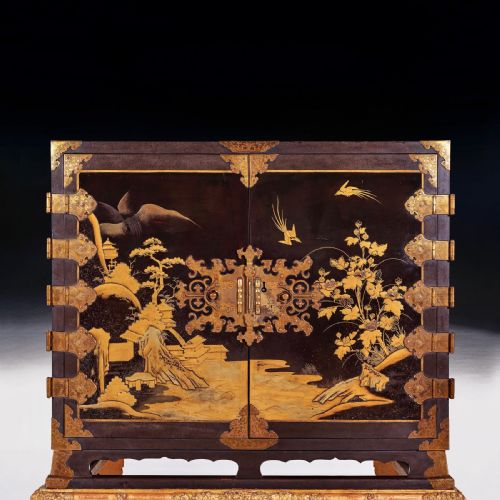
The lacquer work on the cabinet, executed in a variety of techniques including Maki-e, is exquisite and survives in amazing condition. The front depicts a landscape with mountains, temples, trees and a river with flying phoenixes, the lacquered boarders are more of a powdered effect. Each door has five gilt metal engraved brass hinges with further engraved gilt metal mounts to protect the corners of the doors and the outer carcase. There is a two part gilt metal lock plate to the centre of elaborate design that is particularly finely executed.
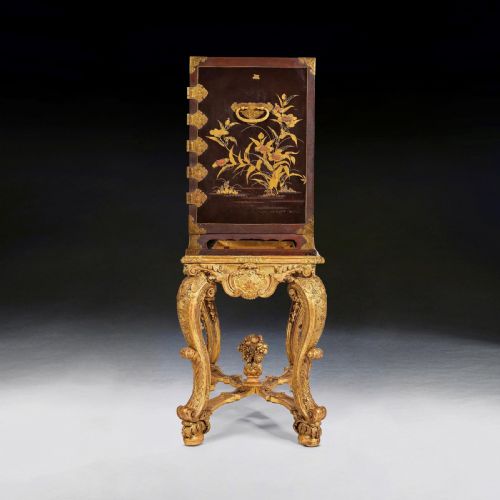
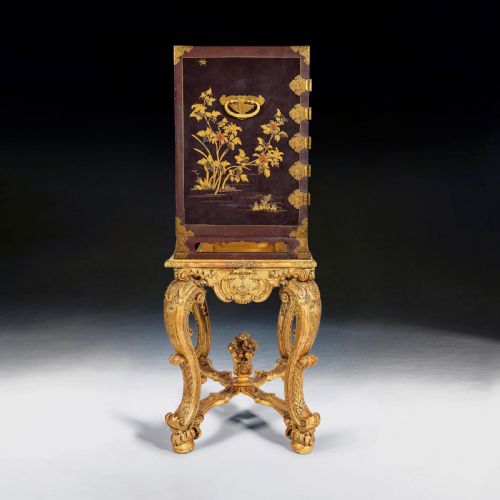
The sides being decorated with feature scenes of flowers and insects, with large and impressive engraved gilt brass handles. Like all of the finest lacquer, the decoration is executed in a variety of levels of relief, making the scene much more three dimensional as a result.
With Japanese export lacquer there was a evolutionary sequence to stylistic change that can be traced back with some accuracy during the 16th and 17th centuries. The Namban lacquer of the late 16th century relied on highly wrought mother of pearl inlay and gold lacquer on a black ground. As the 17th century unfolded, there was progression towards a generally finer lacquer without the use of mother of pearl coupled with this was an increased interest in a more pictorial style with landscapes being used more extensively initially within boarders. Gradually by 1690’s the borders began to disappear from export lacquer work, so the fact that borders are still in evidence on our piece is further proof of being earlier than 1690 in date for the lacquer work.
Most early Japanese lacquer arrived in the west through the Portuguese mercantile companies but this changed by around 1630 when most of the trade between Europe and Japan was conducted through the Dutch East India Company, as is almost certainly the case with the present piece.
The so-called "pictorial style" of Japanese lacquer work was developed around c.1630 specifically to suit the taste of the new Dutch market for such pieces and, as such, this became highly influential throughout the rest of Europe. Lacquer work required painstaking is built up of many layers of the prepared sap of thelacquer tree Rhus vernicifera. After applying each layer, the object is dried in a room with a high humidity and then sanded. The effects of relief are achieved by mixing lime through the lower layers of paint. For the decoration in gold, the maki-e technique is applied, whereby gold powder is strewn or gold foil is placed onto the wet varnish. The gold then sinks somewhat into the lacquer. After the lacquer layer has dried, it can be polished.. As such, pieces like the present cabinet would take a very long time to produce and this was also a factor in the high prices attached to goods of this sort in both the export and domestic Japanese markets.
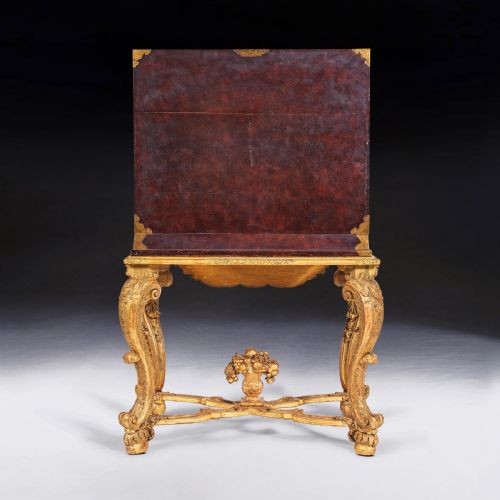
The cabinet is supported on an exuberan
Loveday Antiques has dated this Japanese Lacquer Cabinet Stand to the 17th Century.
Specialist furniture dealers 18th-20th century
You can view the stock and full dealer information on the Loveday Antiques Profile Page
Loveday Antiques is a registered member of LAPADA BADA CINOA
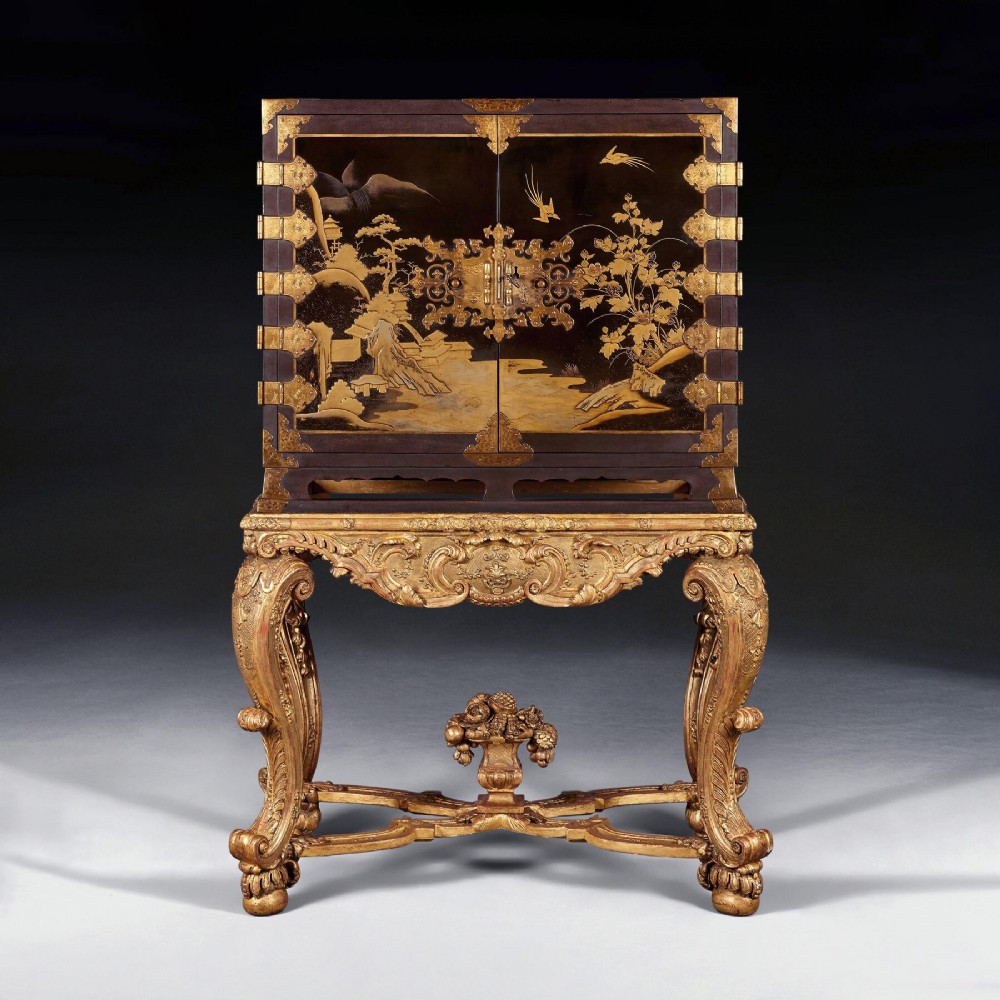
17th Century Japanese Lacquer Cabinet On French Giltwood Regence Stand