13,055  PAGES BROWSED TODAY PAGES TODAY 36  ANTIQUES UPLOADED TODAY NEW ARRIVALS
ID #SA1212621
FOR SALE
£3,400
Email
Save
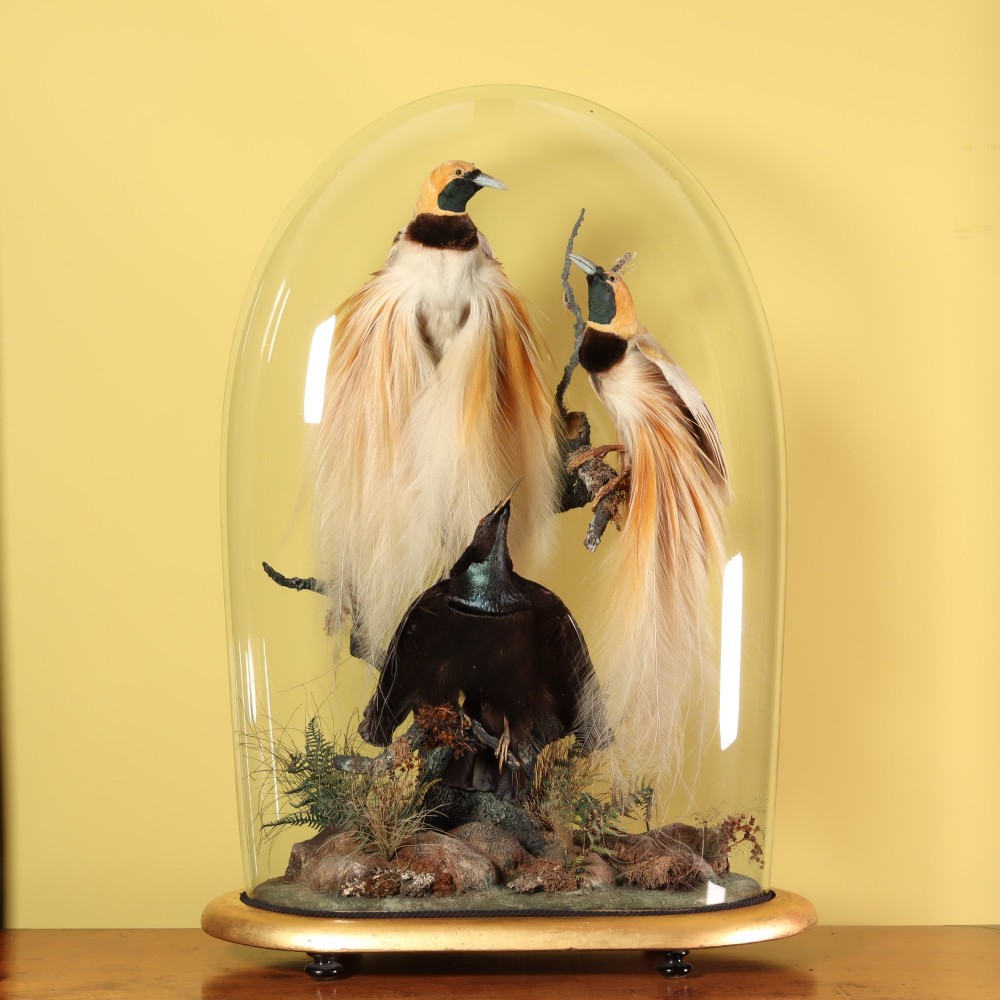
Victorian Taxidermy – Pair of Count Raggi’s Bird of Paradise and a Magnificent Riflebird in a Spectacular Dome. Attributed to Henry Ward London. Circa 1870.
Kendall House Antiques Ltd.
for sale €3,978     $4,318
£3,400
Kendall House Antiques Ltd.

Kendall House Antiques Ltd.

Sellingantiques Verified Since May 2022
View Dealers Stock Page
  • About Us
    Kendall house antiques a traditional shop in the north cotswold’s market town of chipping campden.
Id #SA1212621
PDF SHARE
SAVE

Victorian Taxidermy – Pair of Count Raggi’s Bird of Paradise and a Magnificent Riflebird in a Spectacular Dome. Attributed to Henry Ward London. Circa 1870.

19th century
Description

A large and important dome that would have been pride of place in a fine Victorian home. The birds of paradise mounted above a much-coveted Magnificent Riflebird (this bird hardly ever turns up for sale, and is far more elusive than the more popular Paradise Rifle bird which is what normally turns up in a Victorian case of taxidermy). Unlabeled.

79cm High x 55cm Wide.

Condition: To be fair the Count Raggi’s birds of paradise are not perfect and are slightly faded, but never the less this is still an important and spectacular example of Victorian taxidermy. The gilded base still retains its original gilt finish and ceramic bun feet. The dome spectacular in size and presence, is original and still in one piece.

The Raggiana Bird of Paradise is the national bird of Papua New Guinea and is included on the national flag. The Raggiana Bird of Paradise (Paradisaea raggiana), also known as Count Raggi's bird-of-paradise, is a large bird in the bird-of-paradise family Paradisaeidae. It is distributed widely in southern and northeastern New Guinea, where its known colloquially as kumul. As requested by Count Luigi Maria D'Albertis, the epithet raggiana commemorates the Marquis Francesco Raggi of Genoa.

The Magnificent Riflebird (Ptiloris magnificus) is also in the birds-of-paradise family Paradisaeidae. They are widely distributed throughout lowland rainforests of western New Guinea and the northern Cape York Peninsula of Australia. The Magnificent Riflebird was formally described in 1819 by the French ornithologist Louis Vieillot under the binomial name Falcinellus magnificus. It is now placed in the genus Ptiloris that was introduced in 1825 by the English naturalist William Swainson. The common name "riflebird" comes from the likeness of their black velvety plumage to the uniform of the British Army Rifle Brigade.

For more information on Birds of Paradise see ‘Drawn from Paradises’ by David Attenborough & Errol Fuller illustrated by Ray Ching. Published 2012.

Physical Dimensions
Height
79cm (31.10")
Width
55cm (21.65")
Declaration

Kendall House Antiques Ltd. has dated this Victorian Taxidermy Glass Dome to the 1870s.

Reference Numbers
Sellingantiques Reference
SA1212621
Dealers Internal Reference
26788
Dealers Notes

-------------------

Please also check spam for our email replies.

-------------------

Shop Opening Hours: Thursday – Sunday 10:00am – 4:00pm

Out of hours appointments can be arranged just give us a call.

-------------------

Follow us on instagram

https://www.instagram.com/kendallhouseantiques/

-------------------

We offer a professional and prompt delivery service within the UK using our own van and driver.

Please contact us for delivery options, plus any shipping enquires.

-------------------

Description
A large and important dome that would have been pride of place in a fine Victorian home. The birds of paradise mounted above a much-coveted Magnificent Riflebird (this bird hardly ever turns up for sale, and is far more elusive than the more popular Paradise Rifle bird which is what normally turns up in a Victorian case of taxidermy). Unlabeled.
fig 1. An antique Victorian taxidermy arrangement featuring two Count Raggis Birds of Paradise and a Magnificent Riflebird mounted on branches inside a glass dome with a gilt wood base.
fig 1. Victorian Taxidermy – Pair of Count Raggi’s Bird of Paradise and a Magnificent Riflebird in a Spectacular Dome. Attributed to Henry Ward London. Circa 1870.

79cm High x 55cm Wide.

Condition: To be fair the Count Raggi’s birds of paradise are not perfect and are slightly faded, but never the less this is still an important and spectacular example of Victorian taxidermy.
Kendall House Antiques Ltd.

The gilded base still retains its original gilt finish and ceramic bun feet. The dome spectacular in size and presence, is original and still in one piece.

fig 2. An antique Victorian taxidermy arrangement featuring two Count Raggis Birds of Paradise and a Magnificent Riflebird mounted on branches inside a glass dome with a gilt wood base.
fig 2. Victorian Taxidermy – Pair of Count Raggi’s Bird of Paradise and a Magnificent Riflebird in a Spectacular Dome. Attributed to Henry Ward London. Circa 1870.

The Raggiana Bird of Paradise is the national bird of Papua New Guinea and is included on the national flag. The Raggiana Bird of Paradise (Paradisaea raggiana), also known as Count Raggi's bird-of-paradise, is a large bird in the bird-of-paradise family Paradisaeidae. It is distributed widely in southern and northeastern New Guinea, where its known colloquially as kumul. As requested by Count Luigi Maria D'Albertis, the epithet raggiana commemorates the Marquis Francesco Raggi of Genoa.

fig 3. An antique Victorian taxidermy arrangement featuring two Count Raggis Birds of Paradise and a Magnificent Riflebird mounted on branches inside a glass dome with a gilt wood base.
fig 3. Victorian Taxidermy – Pair of Count Raggi’s Bird of Paradise and a Magnificent Riflebird in a Spectacular Dome. Attributed to Henry Ward London. Circa 1870.

The Magnificent Riflebird (Ptiloris magnificus) is also in the birds-of-paradise family Paradisaeidae. They are widely distributed throughout lowland rainforests of western New Guinea and the northern Cape York Peninsula of Australia. The Magnificent Riflebird was formally described in 1819 by the French ornithologist Louis Vieillot under the binomial name Falcinellus magnificus. It is now placed in the genus Ptiloris that was introduced in 1825 by the English naturalist William Swainson. The common name "riflebird" comes from the likeness of their black velvety plumage to the uniform of the British Army Rifle Brigade.

For more information on Birds of Paradise see ‘Drawn from Paradises’ by David Attenborough & Errol Fuller illustrated by Ray Ching. Published 2012.

Height
79cm (31.10")
Width
55cm (21.65")
Date of Manufacture

Kendall House Antiques Ltd. has dated this Victorian Taxidermy Glass Dome to the 1870s.

Reference Numbers
Sellingantiques Ref
SA1212621
Dealers Internal Ref
26788
Kendall House Antiques Ltd.
Sellingantiques verified Since May 2022

Kendall house antiques a traditional shop in the north cotswold’s market town of chipping campden.

Dealer Profile

You can view the stock and full dealer information on the Kendall House Antiques Ltd. Profile Page
PDF SHARE
SAVE
An antique Victorian taxidermy arrangement featuring two Count Raggis Birds of Paradise and a Magnificent Riflebird mounted on branches inside a glass dome with a gilt wood base.
1 / 7
Archive I An antique Victorian taxidermy arrangement featuring two Count Raggis Birds of Paradise and a Magnificent Riflebird mounted on branches inside a glass dome with a gilt wood base.

Victorian Taxidermy – Pair of Count Raggi’s Bird of Paradise and a Magnificent Riflebird in a Spectacular Dome. Attributed to Henry Ward London. Circa 1870.

Archive II An antique Victorian taxidermy arrangement featuring two Count Raggis Birds of Paradise and a Magnificent Riflebird mounted on branches inside a glass dome with a gilt wood base. View II
Archive III An antique Victorian taxidermy arrangement featuring two Count Raggis Birds of Paradise and a Magnificent Riflebird mounted on branches inside a glass dome with a gilt wood base. View III
Archive IV An antique Victorian taxidermy arrangement featuring two Count Raggis Birds of Paradise and a Magnificent Riflebird mounted on branches inside a glass dome with a gilt wood base. View IV
Archive V An antique Victorian taxidermy arrangement featuring two Count Raggis Birds of Paradise and a Magnificent Riflebird mounted on branches inside a glass dome with a gilt wood base. View V
Archive VI An antique Victorian taxidermy arrangement featuring two Count Raggis Birds of Paradise and a Magnificent Riflebird mounted on branches inside a glass dome with a gilt wood base. View VI
Archive VII An antique Victorian taxidermy arrangement featuring two Count Raggis Birds of Paradise and a Magnificent Riflebird mounted on branches inside a glass dome with a gilt wood base. View VII
Enlarged Archival View
Telephone 07880 602715
Location
Kendall House
High Street
Chipping Campden
Gloucestershire
GL55 6AG 7
United Kingdom
Verified Since May 2022
Items For Sale 140
Items Sold 449
Kendall House Antiques Ltd.
Verified Since May 2022
View Dealer Info
Location: Kendall House, High Street, Chipping Campden, Gloucestershire, GL55 6AG 7, United Kingdom
Verified
May 2022
For Sale
140
Sold
449
An antique Victorian taxidermy arrangement featuring two Count Raggis Birds of Paradise and a Magnificent Riflebird mounted on branches inside a glass dome with a gilt wood base.
Victorian taxidermy – Pair of Count Raggi’s Bird of Paradise and a Magnificent Riflebird in a spectacular dome. Attributed to Henry Ward London. Circa 1870.
Ref: SA1212621
An antique Victorian taxidermy arrangement featuring two Count Raggis Birds of Paradise and a Magnificent Riflebird mounted on branches inside a glass dome with a gilt wood base.
Detail View 1
Detail View 2
Detail View 3
Detail View 4
Detail View 5
Detail View 6
Archival Detail
Every single antique dealer on our platform is individually approved by our internal team. We verify their professional trade history, ethical standards, and photographic quality to ensure a secure, high-standard buying environment. Upon joining, every dealer agrees to a strict 9-point code of conduct. While issues can occasionally arise, our dealers typically resolve them swiftly and directly with the buyer. In fact, since our founding in 2002, Sellingantiques has only had to step in to help resolve an issue on roughly five occasions—a true testament to the quality of our dealers and their dedication to your happiness.
Our dealers are highly experienced in packing and shipping fragile, high-value antiques. Because you are in direct contact with the dealer, you will be able to easily go through all available shipping and insurance options together to ensure your item arrives safely.
Antiques are the ultimate green purchase. By choosing historical pieces over newly manufactured goods, you completely eliminate the carbon footprint of modern mass production while preserving exceptional, timeless craftsmanship.

Victorian taxidermy gained popularity during the 19th century as interest in natural history, exploration, and scientific classification grew. Glass domes were developed to protect delicate preserved bird specimens from dust, light degradation, and humidity while allowing full visual inspection in private homes and museum collections.

Traditional Victorian taxidermy incorporated preserved bird skins, glass eyes, wrapped wire armatures, and wood carving. The mounts were arranged with naturalistic elements such as dried moss, ferns, and branches, secured onto a painted or gilt timber base beneath a hand-blown glass dome.

Authentic pieces typically feature mouth-blown glass domes with characteristic air bubbles or subtle ripples, original plaster or wood bases with turned feet, and period-specific taxidermist trade labels attached to the underside. The internal flora, paper groundwork, and aged patina on the wire support structure also indicate age.

A taxidermy glass dome functions as a focal natural history specimen in contemporary interiors. Interior designers frequently place these domes on sideboards, dark timber bookcases, or console tables to create a striking focal point alongside botanical prints, brass accessories, and leather-bound books.

To preserve taxidermy, keep the item out of direct sunlight and away from heat sources to prevent feather fading and organic deterioration. Ensure the glass dome remains sealed to protect the specimens from dust and insects, cleaning only the exterior glass surface with a soft, dry cloth.
items
Add keywords to the filter
Price
£100
£250000
Era
Movements
Material
Origin
Stock Location
Freshness
Online Payments
Categories