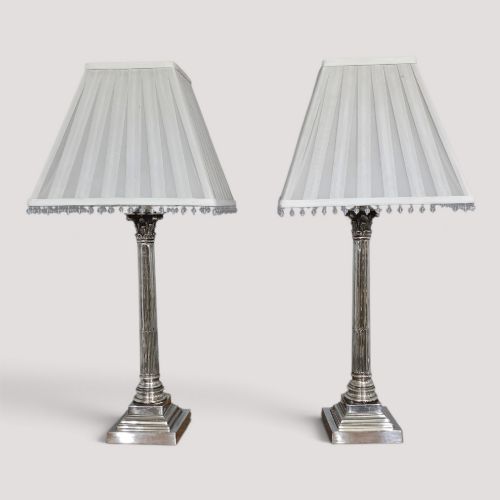
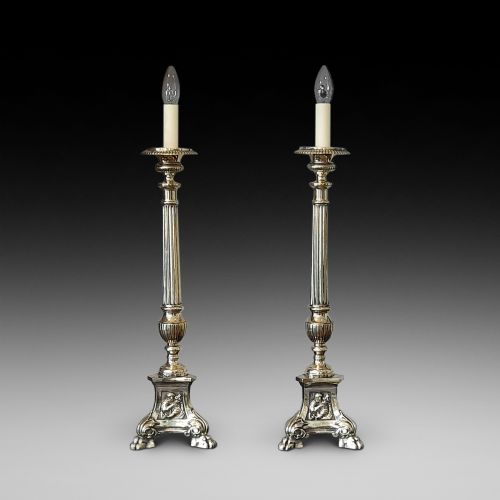
Regent Antiques has dated these Silver Corinthian Table Lamps to the 1920s.

Add an element of pure luxury to your home with superb this pair of antique silver plated table lamps.
Condition:
In working condition. As antique items, the lamps show signs of use commensurate with age, these condition issues are mentioned for accuracy and, as seen in the accompanying photographs, they display beautifully..

Dimensions in cm:
Height 60 cm x Width 15.5 cm x Depth 15.5 cm
Dimensions in inches:
Height 2 feet x Width 6 inches x Depth 6 inches
Corinthian capital
It has been suggested that the foliage of the Greek Corinthian capital was based on the Acanthus spinosus, that of the Roman on the Acanthus mollis. The leaves are generally carved in two "ranks" or bands, like one leafy cup set within another. One of the most beautiful Corinthian capitals is that from the Tholos of Epidaurus (400 BC); it illustrates the transition between the earlier Greek capital, as at Bassae, and the Roman version that Renaissance and modern architects inherited and refined.

In Roman architectural practice, capitals are briefly treated in their proper context among the detailing proper to each of the "Orders", in the only complete architectural textbook to have survived from classical times, the Ten Books on Architecture, by Marcus Vitruvius Pollio, better known just as Vitruvius, dedicated to the emperor Augustus. The various orders are discussed in Vitruvius' books iii and iv. Vitruvius describes Roman practice in a practical fashion. He gives some tales about the invention of each of the Orders, but he does not give a hard and fast set of canonical rules for the execution of capitals.

Two further, specifically Roman orders of architecture have their characteristic capitals, the sturdy and primitive Tuscan capitals, typically used in military buildings, similar to Greek Doric, but with fewer small moldings in its profile, and the invented Composite capitals not even mentioned by Vitruvius, which combined Ionic volutes and Corinthian acanthus capitals, in an order that was otherwise quite similar in proportions to the Corinthian, itself an order that Romans employed much more often than Greeks.
Our reference: A5017
Regent Antiques has dated these Silver Corinthian Table Lamps to the 1920s.
We specialise in english and continental furniture, silver, porcelain and decorative items.
You can view the stock and full dealer information on the Regent Antiques Profile Page
Regent Antiques is a registered member of LAPADA CINOA

Antique Pair 2ft Silver Plated Corinthian Column Table Lamps 20th C