8,400  PAGES BROWSED TODAY PAGES TODAY 36  ANTIQUES UPLOADED TODAY NEW ARRIVALS
ID #SA1192400
FOR SALE
£1,250
Email
Save
19th Century English Theatre Scenery Boards
The House of Antiques
for sale €1,463     $1,588
£1,250
The House of Antiques

The House of Antiques

Sellingantiques Verified Since Nov 2022
View Dealers Stock Page
Id #SA1192400
PDF SHARE
SAVE

19th Century English Theatre Scenery Boards

19th century
Description

Rare Late 19th century English theatre scenery boards

Dimensions in inches: H 30” x W 36” x D 0.5” (both opened 72” width)

Age: 1880

Origin: United Kingdom

Condition: Worn

Overview

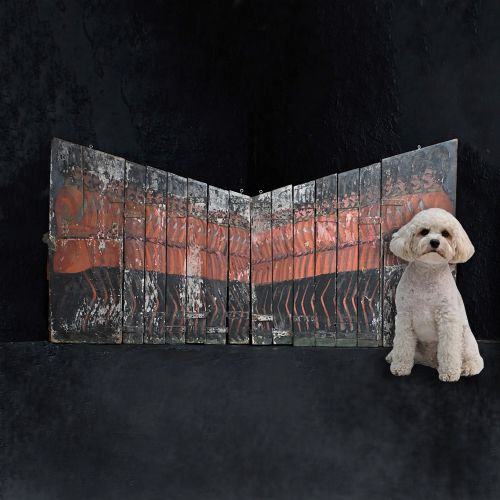
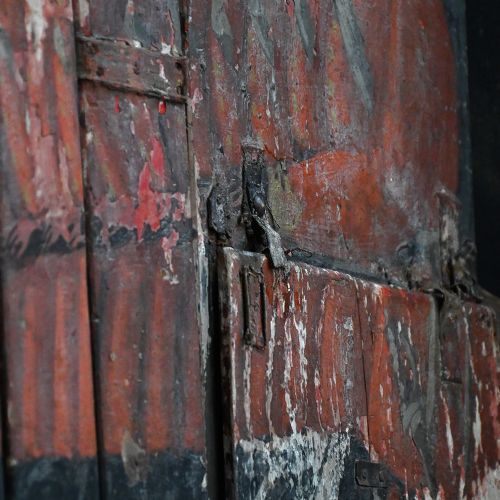
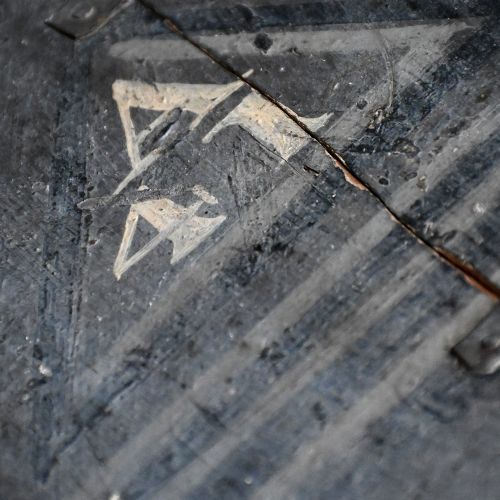
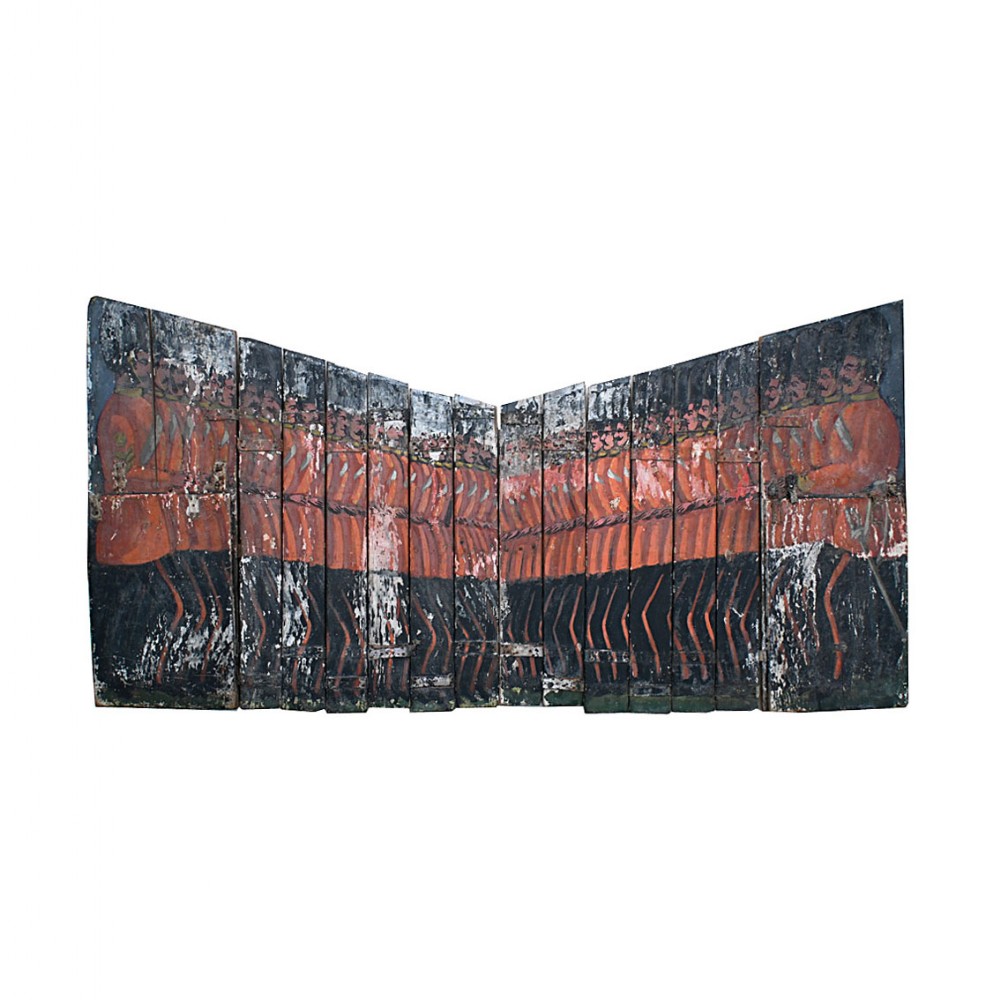
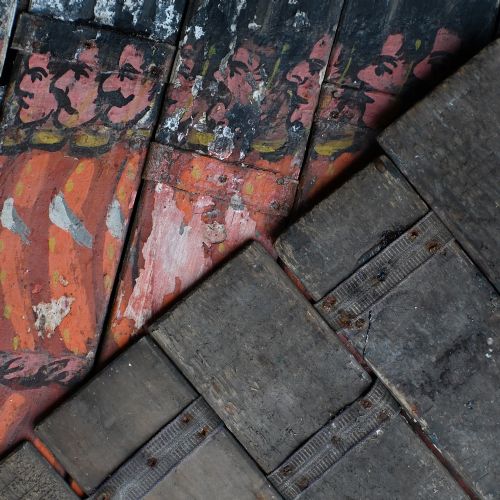
The very rare pair of metamorphic trick scenery boards each hinged and hand-painted to wood and canvas, comprising of two rows of the Queen’s guard appearing from their guard houses, sign written with the numbers B42 and A41, the soldiers appearing to emerge by un-folding into a two rows of twenty five soldiers each, in their distinctive red tunics, on the march, surviving from the latter part of the nineteenth century and from the renowned collection of John Michael Blundall (1937-2014).

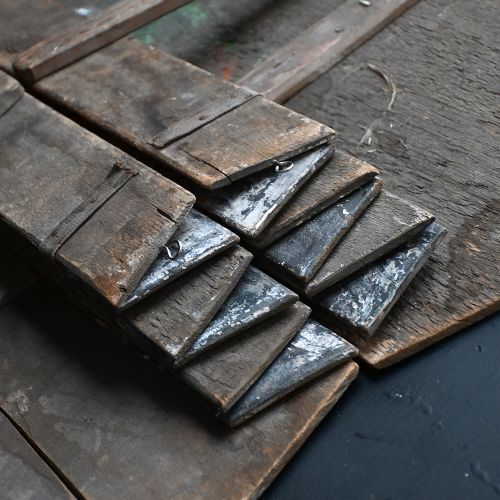
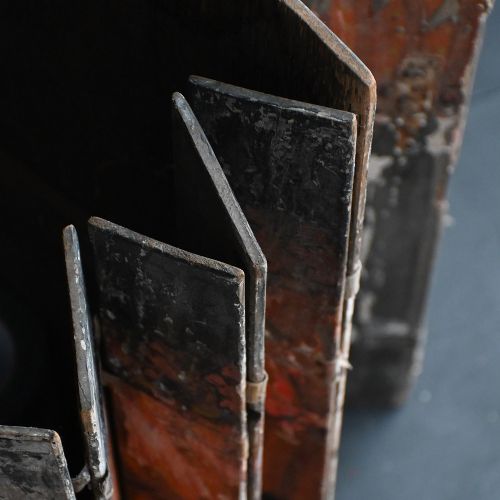
The condition of the scenery boards is totally un-meddled with and there have been no attempts to restore the flaking to the original paintwork (only natural wax has been applied to keep things tight on the surface). They are relatively fragile having been well used in performance and the canvas hinges are delicate with some lacking. We have added small hooks for wall hanging but they could be removed. The original tactile wooden handles are all present.
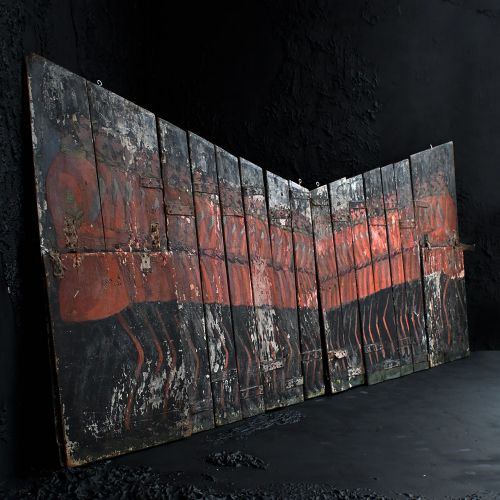
The popular pantomime required frequent and smooth trick scenery changes for spectacular and magical effects such as trees growing out of rocks, burning palaces which collapsed, earthquakes, thunder and lightning. Waves were turned on spindles and mechanical soldiers such as these marched across the stage, which 'was adapted for scenic processions leaving an extraordinary depth in the rear, as likewise large spaces on the sides’.
Theatre of objects is a theatre where the human figure (under the guise of an actor, a puppet or another representation) is not present, and where objects, in a broad way, are favoured by the dramaturgy to the detriment of the verbal aspect. It is predominantly a visual theatre, having more in common with the figurative arts than other forms of theatre. The actor, when he is present, assimilates himself to the space, sometimes through the use of stage elements or costume, and he does not necessarily portray a character. The human being can be reduced to an object or merely be a pure scenic presence among others next to objects which acquire their own existence by the artistic dignity that is given to them. Mobile wings, masks, figures, mechanical constructions, motorised backdrops, light and visual effects in motion are the protagonists of the scenic event and not (as is often the case with live theatre) just simple elements that complement the play.

Examples of scenic or theatrical objects with symbolic functions can certainly be found in all eras and cultures in the history of theatre, whether they were specifically written as part of the dramaturgy or not, but these meaningful objects did not truly have the status of a character. Starting from the end of the 19th century when staging took a leading role, prescribing a framework of unity where each element served the play, objects and actors played side by side and became essential in expressing the meaning of the play.

One of the world’s leading puppet masters John Blundall (1937-2014) amassed a superlative collection, both in qualitative and quantitative terms spanning centuries and countries of puppetry traditions across the globe. One of the country’s, if not the world’s leading designers, makers and performers of puppet theatre Blundall made characters not only for television but also for his own theatre in Birmingham.
A highly respected figure on an international stage he had access to some of the world’s best known puppeteers and collectors allowing him to build up an enormous international archive of puppets and puppet theatre-related material. Nearly four years after his untimely death in Glasgow this pair of boards are offered for sale after many a year in his private collection. Blundall also managed

Physical Dimensions
Height
76.2cm (30.00")
Width
182.9cm (72.01")
Depth
1.3cm (0.51")
Declaration

The House of Antiques has dated this Antique Painted Scenery Board to the 19th Century.

Reference Numbers
Sellingantiques Reference
SA1192400
Dealers Internal Reference
soldiers march
Description
Rare Late 19th century English theatre scenery boards

Dimensions in inches: H 30” x W 36” x D 0.5” (both opened 72” width)

Age: 1880

Origin: United Kingdom

Condition: Worn

Overview

The very rare pair of metamorphic trick scenery boards each hinged and hand-painted to wood and canvas, comprising of two rows of the Queen’s guard appearing from their guard houses, sign written with the numbers B42 and A41, the soldiers appearing to emerge by un-folding into a two rows of twenty five soldiers each, in their distinctive red tunics, on the march, surviving from the latter part of the nineteenth century and from the renowned collection of John Michael Blundall (1937-2014).

The condition of the scenery boards is totally un-meddled with and there have been no attempts to restore the flaking to the original paintwork (only natural wax has been applied to keep things tight on the surface).

They are relatively fragile having been well used in performance and the canvas hinges are delicate with some lacking.
The House of Antiques

We have added small hooks for wall hanging but they could be removed. The original tactile wooden handles are all present.

fig 1. A nineteenth-century painted wooden theatre scenery board depicting a row of uniformed soldiers in red coats and black hats on joined timber panels.
fig 1. 19th Century English Theatre Scenery Boards

The popular pantomime required frequent and smooth trick scenery changes for spectacular and magical effects such as trees growing out of rocks, burning palaces which collapsed, earthquakes, thunder and lightning. Waves were turned on spindles and mechanical soldiers such as these marched across the stage, which 'was adapted for scenic processions leaving an extraordinary depth in the rear, as likewise large spaces on the sides’.

fig 2. A nineteenth-century painted wooden theatre scenery board depicting a row of uniformed soldiers in red coats and black hats on joined timber panels.
fig 2. 19th Century English Theatre Scenery Boards

Theatre of objects is a theatre where the human figure (under the guise of an actor, a puppet or another representation) is not present, and where objects, in a broad way, are favoured by the dramaturgy to the detriment of the verbal aspect. It is predominantly a visual theatre, having more in common with the figurative arts than other forms of theatre. The actor, when he is present, assimilates himself to the space, sometimes through the use of stage elements or costume, and he does not necessarily portray a character. The human being can be reduced to an object or merely be a pure scenic presence among others next to objects which acquire their own existence by the artistic dignity that is given to them. Mobile wings, masks, figures, mechanical constructions, motorised backdrops, light and visual effects in motion are the protagonists of the scenic event and not (as is often the case with live theatre) just simple elements that complement the play.

fig 3. A nineteenth-century painted wooden theatre scenery board depicting a row of uniformed soldiers in red coats and black hats on joined timber panels.
fig 3. 19th Century English Theatre Scenery Boards

Examples of scenic or theatrical objects with symbolic functions can certainly be found in all eras and cultures in the history of theatre, whether they were specifically written as part of the dramaturgy or not, but these meaningful objects did not truly have the status of a character. Starting from the end of the 19th century when staging took a leading role, prescribing a framework of unity where each element served the play, objects and actors played side by side and became essential in expressing the meaning of the play.

fig 4. A nineteenth-century painted wooden theatre scenery board depicting a row of uniformed soldiers in red coats and black hats on joined timber panels.
fig 4. 19th Century English Theatre Scenery Boards

One of the world’s leading puppet masters John Blundall (1937-2014) amassed a superlative collection, both in qualitative and quantitative terms spanning centuries and countries of puppetry traditions across the globe. One of the country’s, if not the world’s leading designers, makers and performers of puppet theatre Blundall made characters not only for television but also for his own theatre in Birmingham.

fig 5. A nineteenth-century painted wooden theatre scenery board depicting a row of uniformed soldiers in red coats and black hats on joined timber panels.
fig 5. 19th Century English Theatre Scenery Boards

A highly respected figure on an international stage he had access to some of the world’s best known puppeteers and collectors allowing him to build up an enormous international archive of puppets and puppet theatre-related material. Nearly four years after his untimely death in Glasgow this pair of boards are offered for sale after many a year in his private collection. Blundall also managed

Height
76.2cm (30.00")
Width
182.9cm (72.01")
Depth
1.3cm (0.51")
Date of Manufacture

The House of Antiques has dated this Antique Painted Scenery Board to the 19th Century.

Reference Numbers
Sellingantiques Ref
SA1192400
Dealers Internal Ref
soldiers march
The House of Antiques
Sellingantiques verified Since Nov 2022
Dealer Profile

You can view the stock and full dealer information on the The House of Antiques Profile Page
PDF SHARE
SAVE
A nineteenth-century painted wooden theatre scenery board depicting a row of uniformed soldiers in red coats and black hats on joined timber panels.
1 / 15
Archive I A nineteenth-century painted wooden theatre scenery board depicting a row of uniformed soldiers in red coats and black hats on joined timber panels.

19th century English theatre scenery boards
Archive II A nineteenth-century painted wooden theatre scenery board depicting a row of uniformed soldiers in red coats and black hats on joined timber panels. View II
Archive III A nineteenth-century painted wooden theatre scenery board depicting a row of uniformed soldiers in red coats and black hats on joined timber panels. View III
Archive IV A nineteenth-century painted wooden theatre scenery board depicting a row of uniformed soldiers in red coats and black hats on joined timber panels. View IV
Archive V A nineteenth-century painted wooden theatre scenery board depicting a row of uniformed soldiers in red coats and black hats on joined timber panels. View V
Archive VI A nineteenth-century painted wooden theatre scenery board depicting a row of uniformed soldiers in red coats and black hats on joined timber panels. View VI
Archive VII A nineteenth-century painted wooden theatre scenery board depicting a row of uniformed soldiers in red coats and black hats on joined timber panels. View VII
Archive VIII A nineteenth-century painted wooden theatre scenery board depicting a row of uniformed soldiers in red coats and black hats on joined timber panels. View VIII
Archive IX A nineteenth-century painted wooden theatre scenery board depicting a row of uniformed soldiers in red coats and black hats on joined timber panels. View IX
Archive X A nineteenth-century painted wooden theatre scenery board depicting a row of uniformed soldiers in red coats and black hats on joined timber panels. View X
Archive XI A nineteenth-century painted wooden theatre scenery board depicting a row of uniformed soldiers in red coats and black hats on joined timber panels. View XI
Archive XII A nineteenth-century painted wooden theatre scenery board depicting a row of uniformed soldiers in red coats and black hats on joined timber panels. View XII
Archive XIII A nineteenth-century painted wooden theatre scenery board depicting a row of uniformed soldiers in red coats and black hats on joined timber panels. View XIII
Archive XIV A nineteenth-century painted wooden theatre scenery board depicting a row of uniformed soldiers in red coats and black hats on joined timber panels. View XIV
Archive XV A nineteenth-century painted wooden theatre scenery board depicting a row of uniformed soldiers in red coats and black hats on joined timber panels. View XV
Enlarged Archival View
Telephone 07568 151 752
Location
22 Goodmayes Lane
Ilford
Essex
IG3 9NZ
United Kingdom
Verified Since Nov 2022
Items For Sale 141
Items Sold 11
The House of Antiques
Verified Since Nov 2022
View Dealer Info
Location: 22 Goodmayes Lane, Ilford, Essex, IG3 9NZ, United Kingdom
Verified
Nov 2022
For Sale
141
Sold
11
A nineteenth-century painted wooden theatre scenery board depicting a row of uniformed soldiers in red coats and black hats on joined timber panels.
19th century English theatre scenery boards
Ref: SA1192400
A nineteenth-century painted wooden theatre scenery board depicting a row of uniformed soldiers in red coats and black hats on joined timber panels.
Detail View 1
Detail View 2
Detail View 3
Detail View 4
Detail View 5
Detail View 6
Detail View 7
Detail View 8
Detail View 9
Detail View 10
Detail View 11
Detail View 12
Detail View 13
Detail View 14
Archival Detail
Every single antique dealer on our platform is individually approved by our internal team. We verify their professional trade history, ethical standards, and photographic quality to ensure a secure, high-standard buying environment. Upon joining, every dealer agrees to a strict 9-point code of conduct. While issues can occasionally arise, our dealers typically resolve them swiftly and directly with the buyer. In fact, since our founding in 2002, Sellingantiques has only had to step in to help resolve an issue on roughly five occasions—a true testament to the quality of our dealers and their dedication to your happiness.
Our dealers are highly experienced in packing and shipping fragile, high-value antiques. Because you are in direct contact with the dealer, you will be able to easily go through all available shipping and insurance options together to ensure your item arrives safely.
Antiques are the ultimate green purchase. By choosing historical pieces over newly manufactured goods, you completely eliminate the carbon footprint of modern mass production while preserving exceptional, timeless craftsmanship.

Theatre scenery boards are painted wooden flats or backdrops constructed for stage productions in the nineteenth century to depict architectural, natural, or figurative scenes.

These flats were typically crafted from softwood timber planks, such as pine or fir, joined together and painted using distemper, tempera, or oil-based pigments.

Authentic pieces feature signs of practical stage use, including iron hinges, mounting brackets, multi-slat construction, and layered paintwork showing historic wear.

These panels function as graphic wall art above sideboards, decorative backdrop screens in open-plan spaces, or architectural features in hallways.

Dust gently with a soft dry brush, avoid moisture or chemical cleaners, and position the wood away from direct sunlight and heat sources to prevent flaking paint.
items
Add keywords to the filter
Price
£100
£250000
Era
Movements
Material
Origin
Stock Location
Freshness
Online Payments
Categories