17,191  PAGES BROWSED TODAY PAGES TODAY 25  ANTIQUES UPLOADED TODAY NEW ARRIVALS
ID #SA1187210
FOR SALE
£2,750
Email
Save
Antique Pair Swedish Biedermeier Birchwood Ebonized Armchairs 19th Century
Regent Antiques
for sale €3,218     $3,493
£2,750
Regent Antiques

Regent Antiques

Sellingantiques Verified Since Sep 2016
View Dealers Stock Page
  • About Us
    We specialise in english and continental furniture, silver, porcelain and decorative items.
  • Trade Associations
    Regent Antiques is a registered member of LAPADA  CINOA
Id #SA1187210
PDF SHARE
SAVE

Antique Pair Swedish Biedermeier Birchwood Ebonized Armchairs 19th Century

19th century
For Sale by Regent Antiques
Description

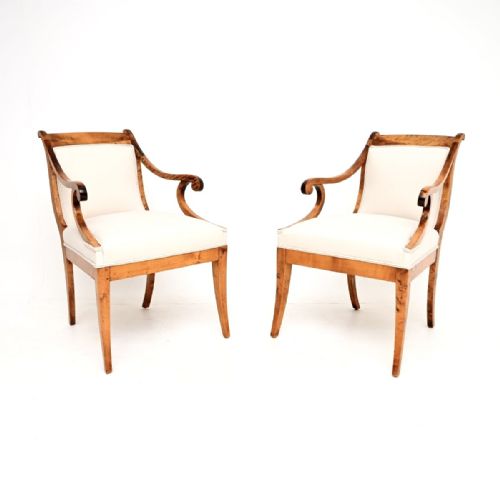
This is an elegant antique pair of Swedish Biedermeier figured birchwood open armchairs, circa 1880 in date.

The chairs feature hand-carved diamond back supports with ebonized aligned slats framing a band united with elaborate scroll arms.

They have been reupholstered in striking Italian black leather with silvered brass studs.

There is no mistaking their beautiful and stylish design, which is certain to make them a treasured addition to one of the rooms in your home.

Condition:

In excellent condition, please see photos for confirmation.

Dimensions in cm:

Height 91.5 cm x Width 60 cm x Depth 61 cm

Height 46 cm  - Seat height

Dimensions in inches:

Height 3 foot x Width 2 feet x Depth 2 foot

Height 1 foot, 6 inches - Seat height

Biedermeier period,

refers to an era in Central Europe during which arts appealed to common sensibilities in the historical period between 1815, the year of the Congress of Vienna at the end of the Napoleonic Wars, and 1848, the year of the European revolutions.

Although the term itself is a historical reference, it is predominantly used to denote the artistic styles that flourished in the fields of literature, music, the visual arts and interior design.

Biedermeier was an influential style of furniture design from Germany during the years 1815–1848, based on utilitarian principles. The period extended into Austria and Scandinavia.

Throughout the period, emphasis was kept upon clean lines and minimal ornamentation. As the period progressed, however, the style moved from the early rebellion against Romantic-era fussiness to increasingly ornate commissions by a rising middle class, eager to show their newfound wealth.

The idea of clean lines and utilitarian postures would resurface in the 20th century, continuing into the present day. The Biedermeier style was a simplified interpretation of the influential French Empire Style of Napoleon I, which introduced the romance of ancient Roman Empire styles, adapting these to modern early 19th century households. Biedermeier furniture used locally available materials such as cherry, ash and oak woods.

Biedermeier furniture and lifestyle was a focus on exhibitions at the Vienna applied arts museum in 1896. The many visitors to this exhibition were so influenced by this fantasy style and its elegance that a new resurgence or revival period became popular amongst European cabinetmakers.

This revival period lasted up until the Art Deco style was taken up. Biedermeier also influenced the various Bauhaus styles through their truth in material philosophy.

Karelian Birch

Karelian Burr Birch Wood is is found between Finland and Russia in the region of Karelia. This wood can create an absolutely stunning, one of a kind piece of furniture. It is a very pretty wood which is similar to Birdseye Maple.

Mostly used for highly decorative furniture and historically the Tsars furniture " The Imperial Furniture" was made in Karelian Birch Burr.

Our reference: A4777

Physical Dimensions
Height
91.5cm (36.02")
Width
60cm (23.62")
Depth
61cm (24.02")
Declaration

Regent Antiques has dated these Swedish Biedermeier Birch Armchairs to the 1880s.

Reference Numbers
Sellingantiques Reference
SA1187210
Dealers Internal Reference
A4777
Description
This is an elegant antique pair of Swedish Biedermeier figured birchwood open armchairs, circa 1880 in date.
The chairs feature hand-carved diamond back supports with ebonized aligned slats framing a band united with elaborate scroll arms.
Regent Antiques
fig 1. A pair of 19th-century Swedish Biedermeier armchairs crafted from light honey birch with ebonised back splats and black leather seats.
fig 1. Antique Pair Swedish Biedermeier Birchwood Ebonized Armchairs 19th Century

They have been reupholstered in striking Italian black leather with silvered brass studs.

There is no mistaking their beautiful and stylish design, which is certain to make them a treasured addition to one of the rooms in your home.

fig 2. A pair of 19th-century Swedish Biedermeier armchairs crafted from light honey birch with ebonised back splats and black leather seats.
fig 2. Antique Pair Swedish Biedermeier Birchwood Ebonized Armchairs 19th Century

Condition:

In excellent condition, please see photos for confirmation.

Dimensions in cm:

Height 91.5 cm x Width 60 cm x Depth 61 cm

Height 46 cm  - Seat height

Dimensions in inches:

Height 3 foot x Width 2 feet x Depth 2 foot

fig 3. A pair of 19th-century Swedish Biedermeier armchairs crafted from light honey birch with ebonised back splats and black leather seats.
fig 3. Antique Pair Swedish Biedermeier Birchwood Ebonized Armchairs 19th Century

Height 1 foot, 6 inches - Seat height

Biedermeier period,

refers to an era in Central Europe during which arts appealed to common sensibilities in the historical period between 1815, the year of the Congress of Vienna at the end of the Napoleonic Wars, and 1848, the year of the European revolutions.

fig 4. A pair of 19th-century Swedish Biedermeier armchairs crafted from light honey birch with ebonised back splats and black leather seats.
fig 4. Antique Pair Swedish Biedermeier Birchwood Ebonized Armchairs 19th Century

Although the term itself is a historical reference, it is predominantly used to denote the artistic styles that flourished in the fields of literature, music, the visual arts and interior design.

Biedermeier was an influential style of furniture design from Germany during the years 1815–1848, based on utilitarian principles. The period extended into Austria and Scandinavia.

fig 5. A pair of 19th-century Swedish Biedermeier armchairs crafted from light honey birch with ebonised back splats and black leather seats.
fig 5. Antique Pair Swedish Biedermeier Birchwood Ebonized Armchairs 19th Century

Throughout the period, emphasis was kept upon clean lines and minimal ornamentation. As the period progressed, however, the style moved from the early rebellion against Romantic-era fussiness to increasingly ornate commissions by a rising middle class, eager to show their newfound wealth.

fig 6. A pair of 19th-century Swedish Biedermeier armchairs crafted from light honey birch with ebonised back splats and black leather seats.
fig 6. Antique Pair Swedish Biedermeier Birchwood Ebonized Armchairs 19th Century

The idea of clean lines and utilitarian postures would resurface in the 20th century, continuing into the present day. The Biedermeier style was a simplified interpretation of the influential French Empire Style of Napoleon I, which introduced the romance of ancient Roman Empire styles, adapting these to modern early 19th century households. Biedermeier furniture used locally available materials such as cherry, ash and oak woods.

fig 7. A pair of 19th-century Swedish Biedermeier armchairs crafted from light honey birch with ebonised back splats and black leather seats.
fig 7. Antique Pair Swedish Biedermeier Birchwood Ebonized Armchairs 19th Century

Biedermeier furniture and lifestyle was a focus on exhibitions at the Vienna applied arts museum in 1896. The many visitors to this exhibition were so influenced by this fantasy style and its elegance that a new resurgence or revival period became popular amongst European cabinetmakers.

fig 8. A pair of 19th-century Swedish Biedermeier armchairs crafted from light honey birch with ebonised back splats and black leather seats.
fig 8. Antique Pair Swedish Biedermeier Birchwood Ebonized Armchairs 19th Century

This revival period lasted up until the Art Deco style was taken up. Biedermeier also influenced the various Bauhaus styles through their truth in material philosophy.

Karelian Birch

Karelian Burr Birch Wood is is found between Finland and Russia in the region of Karelia. This wood can create an absolutely stunning, one of a kind piece of furniture. It is a very pretty wood which is similar to Birdseye Maple.

Mostly used for highly decorative furniture and historically the Tsars furniture " The Imperial Furniture" was made in Karelian Birch Burr.

Our reference: A4777

Height
91.5cm (36.02")
Width
60cm (23.62")
Depth
61cm (24.02")
Date of Manufacture

Regent Antiques has dated these Swedish Biedermeier Birch Armchairs to the 1880s.

Reference Numbers
Sellingantiques Ref
SA1187210
Dealers Internal Ref
A4777
Regent Antiques
Regent Antiques
Sellingantiques verified Since Sep 2016

We specialise in english and continental furniture, silver, porcelain and decorative items.

Dealer Profile

You can view the stock and full dealer information on the Regent Antiques Profile Page

Trade Associations

Regent Antiques is a registered member of LAPADA  CINOA

PDF SHARE
SAVE
A pair of 19th-century Swedish Biedermeier armchairs crafted from light honey birch with ebonised back splats and black leather seats.
1 / 12
Archive I A pair of 19th-century Swedish Biedermeier armchairs crafted from light honey birch with ebonised back splats and black leather seats.

Antique Pair Swedish Biedermeier Birchwood Ebonized Armchairs 19th Century

Archive II A pair of 19th-century Swedish Biedermeier armchairs crafted from light honey birch with ebonised back splats and black leather seats. View II
Archive III A pair of 19th-century Swedish Biedermeier armchairs crafted from light honey birch with ebonised back splats and black leather seats. View III
Archive IV A pair of 19th-century Swedish Biedermeier armchairs crafted from light honey birch with ebonised back splats and black leather seats. View IV
Archive V A pair of 19th-century Swedish Biedermeier armchairs crafted from light honey birch with ebonised back splats and black leather seats. View V
Archive VI A pair of 19th-century Swedish Biedermeier armchairs crafted from light honey birch with ebonised back splats and black leather seats. View VI
Archive VII A pair of 19th-century Swedish Biedermeier armchairs crafted from light honey birch with ebonised back splats and black leather seats. View VII
Archive VIII A pair of 19th-century Swedish Biedermeier armchairs crafted from light honey birch with ebonised back splats and black leather seats. View VIII
Archive IX A pair of 19th-century Swedish Biedermeier armchairs crafted from light honey birch with ebonised back splats and black leather seats. View IX
Archive X A pair of 19th-century Swedish Biedermeier armchairs crafted from light honey birch with ebonised back splats and black leather seats. View X
Archive XI A pair of 19th-century Swedish Biedermeier armchairs crafted from light honey birch with ebonised back splats and black leather seats. View XI
Archive XII A pair of 19th-century Swedish Biedermeier armchairs crafted from light honey birch with ebonised back splats and black leather seats. View XII
FURTHER BROWSING

Visitors also looked at these ⇣

Enlarged Archival View
Location
Manor Warehouse
318 Green Lanes
London
N4 1BX
United Kingdom
Verified Since Sep 2016
Items For Sale 661
Items Sold 2,601
Regent Antiques
Regent Antiques
Verified Since Sep 2016
View Dealer Info
Location: Manor Warehouse, 318 Green Lanes, London, N4 1BX, United Kingdom
Verified
Sep 2016
For Sale
661
Sold
2,601
A pair of 19th-century Swedish Biedermeier armchairs crafted from light honey birch with ebonised back splats and black leather seats.
Antique Pair Swedish Biedermeier Birchwood Ebonized Armchairs 19th Century
Ref: SA1187210
A pair of 19th-century Swedish Biedermeier armchairs crafted from light honey birch with ebonised back splats and black leather seats.
Detail View 1
Detail View 2
Detail View 3
Detail View 4
Detail View 5
Detail View 6
Detail View 7
Detail View 8
Detail View 9
Detail View 10
Detail View 11
Archival Detail
Every single antique dealer on our platform is individually approved by our internal team. We verify their professional trade history, ethical standards, and photographic quality to ensure a secure, high-standard buying environment. Upon joining, every dealer agrees to a strict 9-point code of conduct. While issues can occasionally arise, our dealers typically resolve them swiftly and directly with the buyer. In fact, since our founding in 2002, Sellingantiques has only had to step in to help resolve an issue on roughly five occasions—a true testament to the quality of our dealers and their dedication to your happiness.
Our dealers are highly experienced in packing and shipping fragile, high-value antiques. Because you are in direct contact with the dealer, you will be able to easily go through all available shipping and insurance options together to ensure your item arrives safely.
Antiques are the ultimate green purchase. By choosing historical pieces over newly manufactured goods, you completely eliminate the carbon footprint of modern mass production while preserving exceptional, timeless craftsmanship.

Swedish Biedermeier furniture developed in the early to mid-19th century, combining clean neoclassical forms with light-coloured native woods such as satin birch and honey-toned pine. The aesthetic emphasises geometric silhouettes, highly figured grain patterns, and subtle dark accent elements like ebonised trims.

Craftsmen typically used locally sourced blonde timbers including satin birch, alder, and ash for the primary framing and veneers. Accent details often featured ebonised hardwoods, while seat upholstery utilised traditional materials like horsehair padding, leather, or woven fabrics secured with brass upholstery tacks.

Authentic pieces feature hand-cut joinery, book-matched timber veneers, and natural wear patterns along touchpoints such as the armrests. Look for traditional construction signs underneath the frame, including hand-sawn timber blocks, pegged joints, and original upholstery hand-nailing.

The warm timber tones and architectural lines of Biedermeier armchairs complement modern minimal or classic contemporary spaces. Placing them as a paired focal point in a seating arrangement or as desk chairs alongside contemporary art creates visual balance between historic craftsmanship and modern design.

Timber surfaces should be dusted regularly with a dry microfibre cloth and treated periodically with a clear beeswax polish to protect the veneer finish. Leather seats require gentle cleaning with a dedicated leather conditioner to maintain flexibility and prevent drying or cracking.
items
Add keywords to the filter
Price
£100
£250000
Era
Movements
Material
Origin
Stock Location
Freshness
Online Payments
Categories