49,426  PAGES BROWSED TODAY PAGES TODAY 184  ANTIQUES UPLOADED TODAY NEW ARRIVALS
ID #SA1179270
FOR SALE
£1,350
Email
Save
Antique Art Deco Burr Walnut Coffee Table Circa 1920
Regent Antiques
for sale €1,580     $1,715
£1,350
Regent Antiques

Regent Antiques

Sellingantiques Verified Since Sep 2016
View Dealers Stock Page
  • About Us
    We specialise in english and continental furniture, silver, porcelain and decorative items.
  • Trade Associations
    Regent Antiques is a registered member of LAPADA  CINOA
Id #SA1179270
PDF SHARE
SAVE

Antique Art Deco Burr Walnut Coffee Table Circa 1920

1900 - 1920
For Sale by Regent Antiques
Description

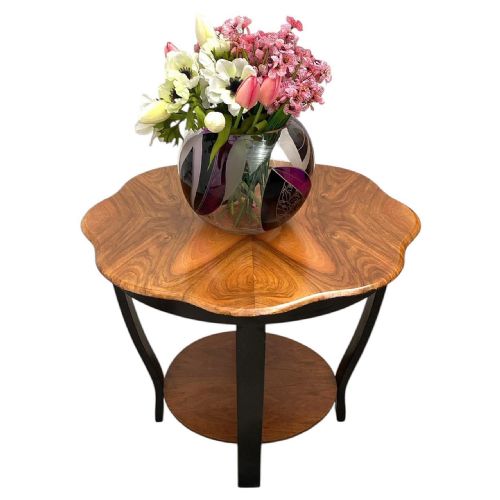
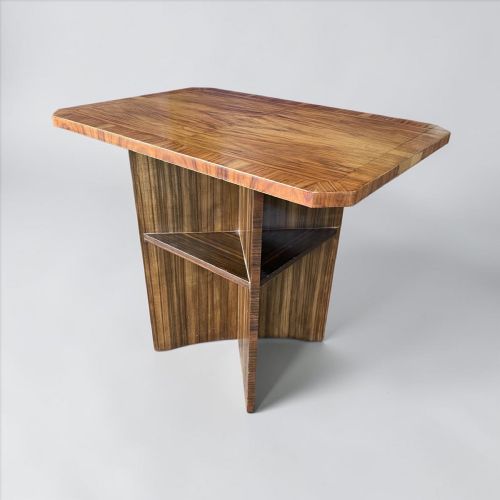
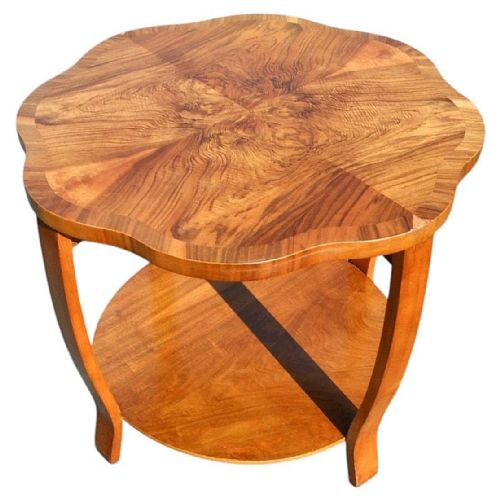
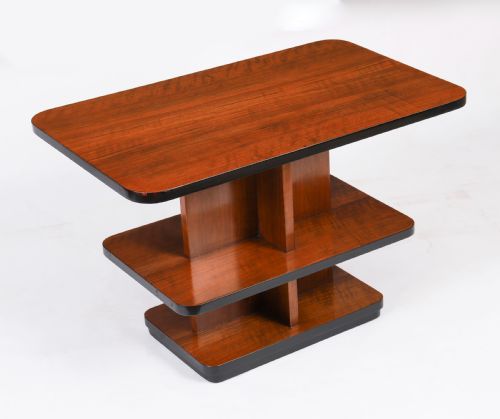
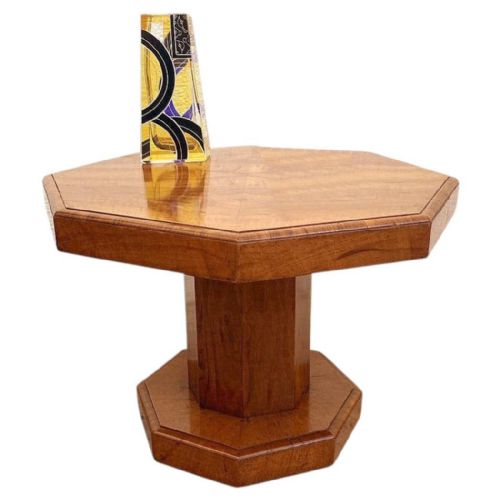
This is a superb antique Art Deco burr walnut coffee table, circa 1920 in date.

It has a wonderful square shaped top with cut off corners and is raised on four arched supports on a shaped base, typical of the best items of the Art Deco period.

There is no mistaking the unique quality and elaborate design, which is certain to make it a talking point in your home and a fine embellishment to your reception room.

Condition:

In excellent condition having only been beautifully cleaned and waxed in our workshops, please see photos for confirmation.

Dimensions in cm:

Height 50 cm x Width 51 cm x Depth 61 cm

Dimensions in inches:

Height 1 foot, 8 inches x Width 1 foot, 8 inches x Depth 2 foot

Walnut & Burr Walnut

Walnut is a hard, dense, tight- grained wood that polishes to a very smooth finish. It is a popular and attractive wood whose colour ranges from near white in the sapwood to a dark hew in the heartwood. When dried in a kiln, walnut wood tends to develop a dull brown colour, but when air-dried can become a rich purplish-brown. Because of its colour, hardness and grain, it is a prized furniture and carving wood. Walnut veneer was highly priced and the cost would reflect the ‘fanciness’ of the veneer – the more decorative, then the more expensive and desirable.

Burr walnut refers to the swirling figure present in nearly all walnut when cut and polished, and especially in the wood taken from the base of the tree where it joins the roots. However the true burr is a rare growth on the tree where hundreds of tiny branches have started to grow. Burr walnut produces some of the most complex and beautiful figuring you can find.

Walnut "burrs" were often used to make fabulous furniture.  Veneer sliced from walnut burl is one of the most valuable and highly prized by cabinet makers and prestige car manufacturers and is also a favourite material for shotgun stocks.

Inlay was commonly used in the production of decorative burr walnut furniture, where pieces of coloured veneers are inlaid into the surface of the walnut, adding delicate or intricate patterns and designs. Inlays normally use various exotic veneers, but other materials such as  mother-of-pearl, brass or bone were  also be used.

Art Deco or Deco,

is an influential visual arts design style which first appeared in France during the 1920s, flourished internationally during the 30s and 40s.

It is an eclectic style that combines traditional craft motifs with Machine Ageimagery and materials. The style is often characterized by rich colours, bold geometric shapes, and lavish ornamentation.

Deco emerged from the Interwar period when rapid industrialization was transforming culture. One of its major attributes is an embrace of technology. This distinguishes Deco from the organic motifs favored by its predecessor Art Nouveau.

Historian Bevis Hillier defined Art Deco as "an assertively modern style...[that] ran to symmetry rather than asymmetry, and to the rectilinear rather than the curvilinear; it responded to the demands of the machine and of new material...[and] the requirements of mass production".

During its heyday Art Deco represented luxury, glamour, exuberance, and faith in social and technological progress.

Our reference: A4797

Physical Dimensions
Height
50cm (19.69")
Width
51cm (20.08")
Depth
61cm (24.02")
Declaration

Regent Antiques has dated this Art Deco Coffee Table to the 1920s.

Reference Numbers
Sellingantiques Reference
SA1179270
Dealers Internal Reference
A4797
Description
This is a superb antique Art Deco burr walnut coffee table, circa 1920 in date.
It has a wonderful square shaped top with cut off corners and is raised on four arched supports on a shaped base, typical of the best items of the Art Deco period.
Regent Antiques
fig 1. An octagonal Art Deco burr walnut coffee table featuring sweeping curved leg supports and a matching lower plinth base.
fig 1. Antique Art Deco Burr Walnut Coffee Table Circa 1920

There is no mistaking the unique quality and elaborate design, which is certain to make it a talking point in your home and a fine embellishment to your reception room.

Condition:

In excellent condition having only been beautifully cleaned and waxed in our workshops, please see photos for confirmation.

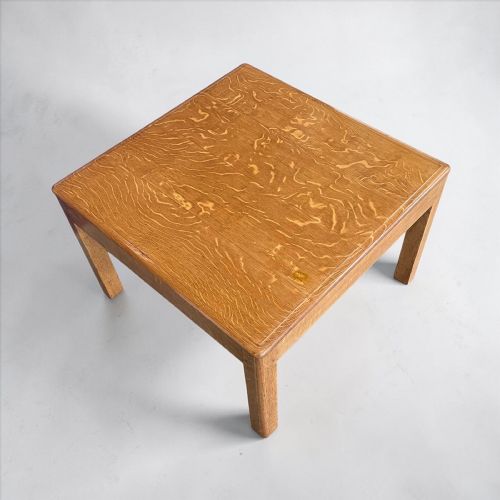
fig 2. An octagonal Art Deco burr walnut coffee table featuring sweeping curved leg supports and a matching lower plinth base.
fig 2. Antique Art Deco Burr Walnut Coffee Table Circa 1920

Dimensions in cm:

Height 50 cm x Width 51 cm x Depth 61 cm

Dimensions in inches:

Height 1 foot, 8 inches x Width 1 foot, 8 inches x Depth 2 foot

Walnut & Burr Walnut

Walnut is a hard, dense, tight- grained wood that polishes to a very smooth finish. It is a popular and attractive wood whose colour ranges from near white in the sapwood to a dark hew in the heartwood. When dried in a kiln, walnut wood tends to develop a dull brown colour, but when air-dried can become a rich purplish-brown. Because of its colour, hardness and grain, it is a prized furniture and carving wood. Walnut veneer was highly priced and the cost would reflect the ‘fanciness’ of the veneer – the more decorative, then the more expensive and desirable.

fig 3. An octagonal Art Deco burr walnut coffee table featuring sweeping curved leg supports and a matching lower plinth base.
fig 3. Antique Art Deco Burr Walnut Coffee Table Circa 1920

Burr walnut refers to the swirling figure present in nearly all walnut when cut and polished, and especially in the wood taken from the base of the tree where it joins the roots. However the true burr is a rare growth on the tree where hundreds of tiny branches have started to grow. Burr walnut produces some of the most complex and beautiful figuring you can find.

fig 4. An octagonal Art Deco burr walnut coffee table featuring sweeping curved leg supports and a matching lower plinth base.
fig 4. Antique Art Deco Burr Walnut Coffee Table Circa 1920

Walnut "burrs" were often used to make fabulous furniture.  Veneer sliced from walnut burl is one of the most valuable and highly prized by cabinet makers and prestige car manufacturers and is also a favourite material for shotgun stocks.

fig 5. An octagonal Art Deco burr walnut coffee table featuring sweeping curved leg supports and a matching lower plinth base.
fig 5. Antique Art Deco Burr Walnut Coffee Table Circa 1920

Inlay was commonly used in the production of decorative burr walnut furniture, where pieces of coloured veneers are inlaid into the surface of the walnut, adding delicate or intricate patterns and designs. Inlays normally use various exotic veneers, but other materials such as  mother-of-pearl, brass or bone were  also be used.

fig 6. An octagonal Art Deco burr walnut coffee table featuring sweeping curved leg supports and a matching lower plinth base.
fig 6. Antique Art Deco Burr Walnut Coffee Table Circa 1920

Art Deco or Deco,

is an influential visual arts design style which first appeared in France during the 1920s, flourished internationally during the 30s and 40s.

It is an eclectic style that combines traditional craft motifs with Machine Ageimagery and materials. The style is often characterized by rich colours, bold geometric shapes, and lavish ornamentation.

fig 7. An octagonal Art Deco burr walnut coffee table featuring sweeping curved leg supports and a matching lower plinth base.
fig 7. Antique Art Deco Burr Walnut Coffee Table Circa 1920

Deco emerged from the Interwar period when rapid industrialization was transforming culture. One of its major attributes is an embrace of technology. This distinguishes Deco from the organic motifs favored by its predecessor Art Nouveau.

fig 8. An octagonal Art Deco burr walnut coffee table featuring sweeping curved leg supports and a matching lower plinth base.
fig 8. Antique Art Deco Burr Walnut Coffee Table Circa 1920

Historian Bevis Hillier defined Art Deco as "an assertively modern style...[that] ran to symmetry rather than asymmetry, and to the rectilinear rather than the curvilinear; it responded to the demands of the machine and of new material...[and] the requirements of mass production".

During its heyday Art Deco represented luxury, glamour, exuberance, and faith in social and technological progress.

Our reference: A4797

Height
50cm (19.69")
Width
51cm (20.08")
Depth
61cm (24.02")
Date of Manufacture

Regent Antiques has dated this Art Deco Coffee Table to the 1920s.

Reference Numbers
Sellingantiques Ref
SA1179270
Dealers Internal Ref
A4797
Regent Antiques
Regent Antiques
Sellingantiques verified Since Sep 2016

We specialise in english and continental furniture, silver, porcelain and decorative items.

Dealer Profile

You can view the stock and full dealer information on the Regent Antiques Profile Page

Trade Associations

Regent Antiques is a registered member of LAPADA  CINOA

PDF SHARE
SAVE
An octagonal Art Deco burr walnut coffee table featuring sweeping curved leg supports and a matching lower plinth base.
1 / 12
Archive I An octagonal Art Deco burr walnut coffee table featuring sweeping curved leg supports and a matching lower plinth base.

Antique Art Deco Burr Walnut Coffee Table Circa 1920

Archive II An octagonal Art Deco burr walnut coffee table featuring sweeping curved leg supports and a matching lower plinth base. View II
Archive III An octagonal Art Deco burr walnut coffee table featuring sweeping curved leg supports and a matching lower plinth base. View III
Archive IV Scale Reference for An octagonal Art Deco burr walnut coffee table featuring sweeping curved leg supports and a matching lower plinth base.
Archive V An octagonal Art Deco burr walnut coffee table featuring sweeping curved leg supports and a matching lower plinth base. View V
Archive VI An octagonal Art Deco burr walnut coffee table featuring sweeping curved leg supports and a matching lower plinth base. View VI
Archive VII An octagonal Art Deco burr walnut coffee table featuring sweeping curved leg supports and a matching lower plinth base. View VII
Archive VIII An octagonal Art Deco burr walnut coffee table featuring sweeping curved leg supports and a matching lower plinth base. View VIII
Archive IX An octagonal Art Deco burr walnut coffee table featuring sweeping curved leg supports and a matching lower plinth base. View IX
Archive X An octagonal Art Deco burr walnut coffee table featuring sweeping curved leg supports and a matching lower plinth base. View X
Archive XI An octagonal Art Deco burr walnut coffee table featuring sweeping curved leg supports and a matching lower plinth base. View XI
Archive XII An octagonal Art Deco burr walnut coffee table featuring sweeping curved leg supports and a matching lower plinth base. View XII
FURTHER BROWSING

Visitors also looked at these ⇣

Enlarged Archival View
Location
Manor Warehouse
318 Green Lanes
London
N4 1BX
United Kingdom
Verified Since Sep 2016
Items For Sale 659
Items Sold 2,603
Regent Antiques
Regent Antiques
Verified Since Sep 2016
View Dealer Info
Location: Manor Warehouse, 318 Green Lanes, London, N4 1BX, United Kingdom
Verified
Sep 2016
For Sale
659
Sold
2,603
An octagonal Art Deco burr walnut coffee table featuring sweeping curved leg supports and a matching lower plinth base.
Antique Art Deco Burr Walnut Coffee Table Circa 1920
Ref: SA1179270
An octagonal Art Deco burr walnut coffee table featuring sweeping curved leg supports and a matching lower plinth base.
Detail View 1
Detail View 2
Detail View 3
Detail View 4
Detail View 5
Detail View 6
Detail View 7
Detail View 8
Detail View 9
Detail View 10
Scale Reference
Archival Detail
Every single antique dealer on our platform is individually approved by our internal team. We verify their professional trade history, ethical standards, and photographic quality to ensure a secure, high-standard buying environment. Upon joining, every dealer agrees to a strict 9-point code of conduct. While issues can occasionally arise, our dealers typically resolve them swiftly and directly with the buyer. In fact, since our founding in 2002, Sellingantiques has only had to step in to help resolve an issue on roughly five occasions—a true testament to the quality of our dealers and their dedication to your happiness.
Our dealers are highly experienced in packing and shipping fragile, high-value antiques. Because you are in direct contact with the dealer, you will be able to easily go through all available shipping and insurance options together to ensure your item arrives safely.
Antiques are the ultimate green purchase. By choosing historical pieces over newly manufactured goods, you completely eliminate the carbon footprint of modern mass production while preserving exceptional, timeless craftsmanship.

Art Deco furniture from the 1920s is characterised by geometric shapes, streamlined contours, and exotic wood veneers. The movement emphasised modernism, symmetrical forms, and high-contrast figure patterns in timbers like burr walnut and rosewood.

Pieces from this era commonly feature solid hardwood frames wrapped in decorative veneers such as burr walnut, maple, or macassar ebony. High-gloss lacquer finishes and curved timber supports were frequently incorporated into the construction.

Authentic pieces exhibit hand-cut veneers, traditional joinery techniques beneath the surface, and natural wood aging. Look for geometric proportions, heavy plinth bases, and distinctive curved or stepped leg constructions characteristic of early 20th-century design.

Position the table centrally in a living space surrounded by contemporary seating to showcase its geometric profile. Keep tabletop decoration minimal, using subtle ceramics or books to avoid obscuring the figured wood grain.

Dust surfaces regularly with a soft, dry microfibre cloth and apply high-quality beeswax periodically to preserve the veneer. Avoid placing the table in direct sunlight or near heat sources to prevent cracking and discolouration.
items
Add keywords to the filter
Price
£100
£250000
Era
Movements
Material
Origin
Stock Location
Freshness
Online Payments
Categories