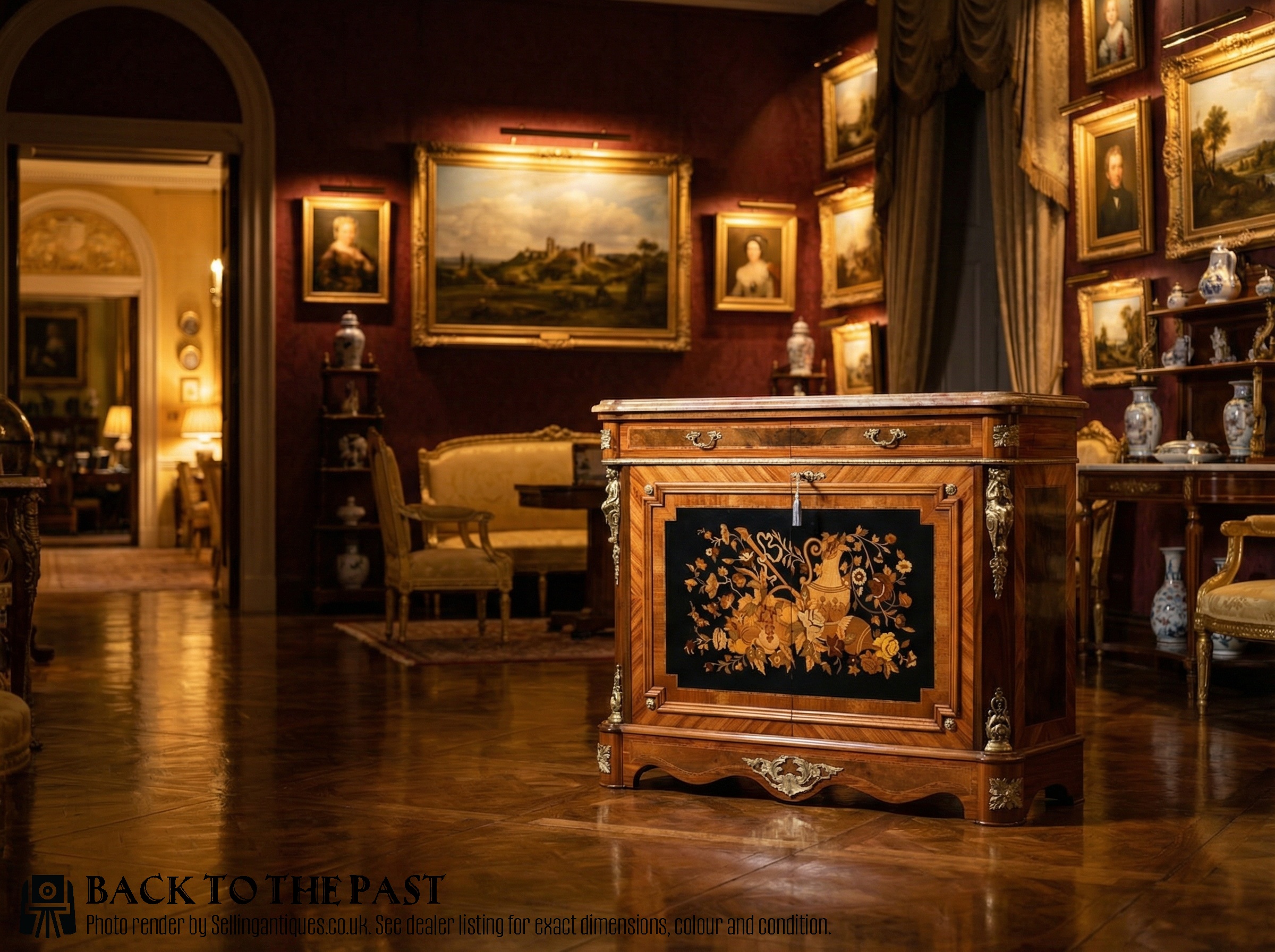
Regent Antiques has dated this French Marquetry Side Cabinet to the 1900s.
With a shaped marble top over a pair of frieze drawers and a cupboard doors inlaid with floral marquetry on an ebonised ground, flanked by ormolu mounts in the form of classical figures, the sides with contrasting veneers, raised on a shaped plinth base with further ormolu mounts

The entire piece highlights the unique and truly exceptional pattern of the floral marquetry which is set into the ebonised ground with stunning king wood banding, and this is further complimented by the plethora of exquisite gilded ormolu mounts that decorate this incredible piece.

With original working lock and key.
Oozing sophistication and charm, this cabinet is the absolute epitome of French high society.

Condition:
In really excellent condition having been beautifully cleaned, polished and waxed in our workshops, please see photos for confirmation.
Dimensions in cm:
Height 102 cm x Width 119 cm x Depth 42 cm

Dimensions in inches:
Height 3 foot, 4 inches x Width 3 foot, 11 inches x Depth 1 foot, 4 inches
Marquetry is decorative artistry where pieces of material (such as wood, brass silver or shell) of different colors are inserted into surface wood veneer to form intricate patterns such as scrolls or flowers.

Ormolu
(from French 'or moulu', signifying ground or pounded gold) is an 18th-century English term for applying finely ground, high-carat gold in a mercury amalgam to an object of bronze.The mercury is driven off in a kiln leaving behind a gold-coloured veneer known as 'gilt bronze'.

The manufacture of true ormolu employs a process known as mercury-gilding or fire-gilding, in which a solution of nitrate of mercury is applied to a piece of copper, brass, or bronze, followed by the application of an amalgam of gold and mercury. The item was then exposed to extreme heat until the mercury burned off and the gold remained, adhered to the metal object.

Walnut & Burr Walnut
Walnut is a hard, dense, tight- grained wood that polishes to a very smooth finish. It is a popular and attractive wood whose colour ranges from near white in the sapwood to a dark hew in the heartwood. When dried in a kiln, walnut wood tends to develop a dull brown colour, but when air-dried can become a rich purplish-brown. Because of its colour, hardness and grain, it is a prized furniture and carving wood. Walnut veneer was highly priced and the cost would reflect the ‘fanciness’ of the veneer – the more decorative, then the more expensive and desirable.

Burr walnut refers to the swirling figure present in nearly all walnut when cut and polished, and especially in the wood taken from the base of the tree where it joins the roots. However the true burr is a rare growth on the tree where hundreds of tiny branches have started to grow. Burr walnut produces some of the most complex and beautiful figuring you can find.

Walnut "burrs" were often used to make fabulous furniture. Veneer sliced from walnut burl is one of the most valuable and highly prized by cabinet makers and prestige car manufacturers and is also a favourite material for shotgun stocks.
Our reference: A4636
Regent Antiques has dated this French Marquetry Side Cabinet to the 1900s.
We specialise in english and continental furniture, silver, porcelain and decorative items.
You can view the stock and full dealer information on the Regent Antiques Profile Page
Regent Antiques is a registered member of LAPADA CINOA

Antique French Floral Marquetry Marble Topped Side Cabinet Circa 1900