

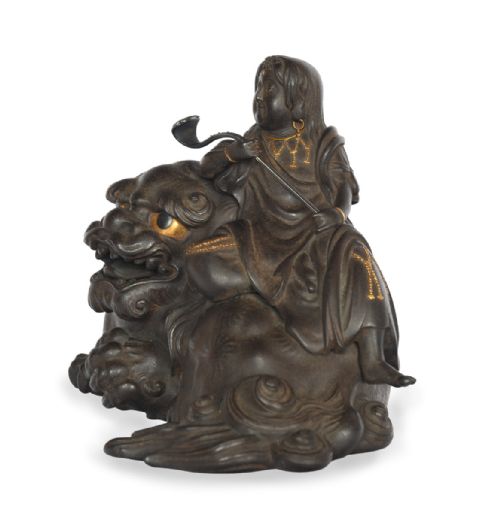
Steve Sly Japanese Works of Art has dated this Japanese Iron Shishi Okimono to the 19th Century.
Literature :
Unno Shomin is perhaps the most famous of the generation of metaworkers who started their careers in the sword-fitting workshops of the Mito fief; he moved to nearby Tokyo in the early Meiji era, changing his name from Motohira to Shomin. He showed great promise from an early age, studying calligraphy and painting in addition to chiseling, and was soon awarded the art-name Shomin, "superior to [So]min," in the expectation that his work would one day excel even that of Yokoya Somin (1670–1733), a famed mid-Edo-period master. After the samurai privilege of wearing two swords was revoked in 1876 he threw himself into the development of new types of products for both Japanese and international customers, exhibited frequently at expositions inside and outside Japan, served as a professor at Tokyo Art School, and in 1896 was appointed to the order of Teishitsu Gigeiin (Artist-Craftsman to the Imperial Household).
54–55). Toyokawa Mitsunaga II (1851-1923) was a Tokyo metal-worker who excelled at making kozuka and menuki using the takabori technique.

Provenance :
Recent Japanese collection .
Previously see: Bonhams London, Fine Japanese art, 14th May 2015 - Lot 448.
Condition report :
Lovely original condition throughout.
Approximate Sizes :
Length : 7" 17.7 cm
Height : 5 1/2" 14 cm
Free worldwide delivery and a certificate of authenticity are included within the price of this item.
Steve Sly Japanese Works of Art has dated this Japanese Iron Shishi Okimono to the 19th Century.
Specialists in japanese works of art from the meiji period 1868-1912
You can view the stock and full dealer information on the Steve Sly Japanese Works of Art Profile Page
Steve Sly Japanese Works of Art is a registered member of BADA

Important Japanese Iron Okimono - Unno Shomin 1844-1915


