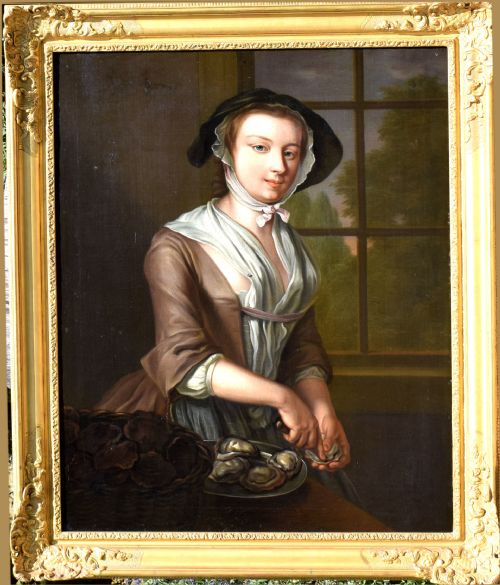
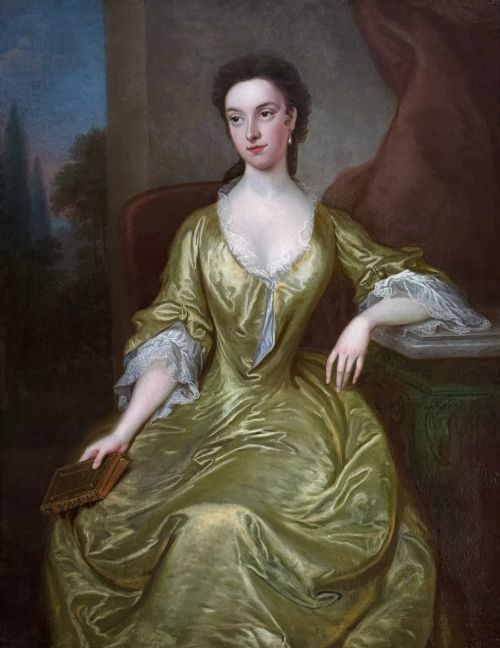
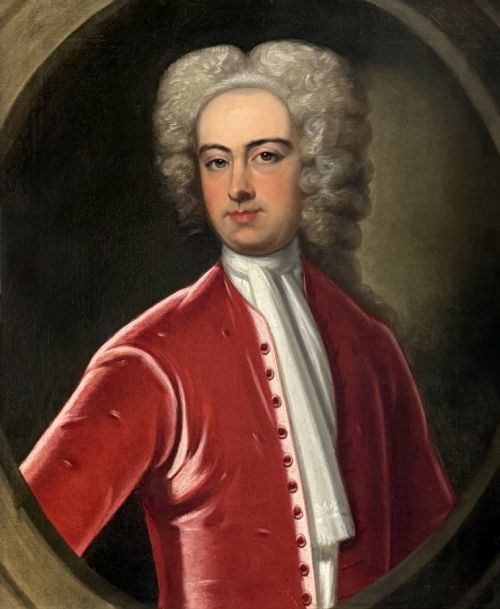
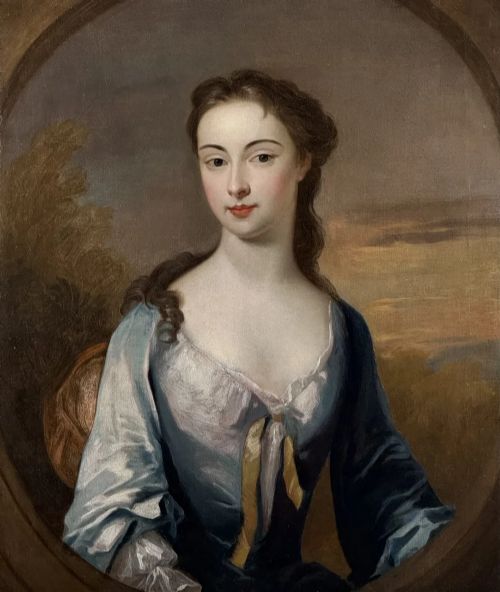
Period Portraits has dated this Georgian Oil Portrait Painting to the 18th Century.
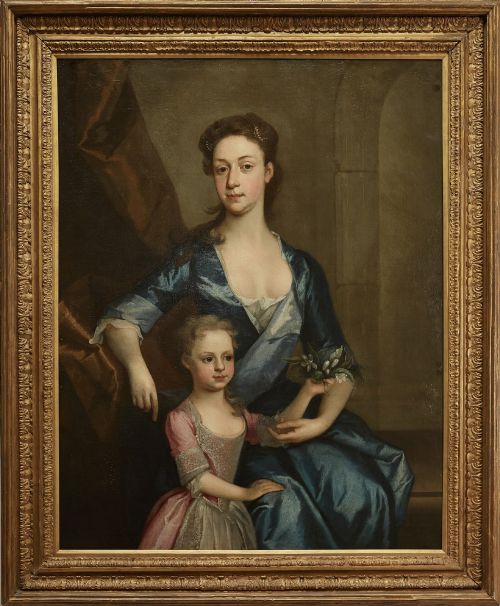
This evocative portrayal of a mothers love is in an excellent state of conservation and is ready to hang an enjoy in its original elaborately carved swept frame with floral cartouches and sanded slip.

The sitter is dressed in the frothy frills and soft pastel colours which typify the Rococo style. The foundation of her outfit is a silvery gown with a loose pleated back of the French ‘Saque-back’ style. Also called a ‘Watteau Pleat’ – after the work of the famous Rococo master – the wide fold of fabric falling free from her shoulders can be glimpsed as it passes in front of the vase-shaped splat of her Chippendale-style chair. Her gown is similar to that worn by Ann Ford in the famous portrait by Gainsborough from 1760 – which is embellished (as is this one) by narrow strips of fabric that are gently gathered and sewn in meandering curves over its surface. The ruched robings (fabric strips) that edge her gown can be glimpsed descending in a V-shape from breast to waist as the gown is pinned to the stomacher. These are matched by horizontal bands of curvilinear form that embellish the skirt and can be glimpsed as the light falls on her lap and reveals the complex sheen and texture of the silk fabric.

The pearly white of the gown – and of the lady’s complexion - is set off by the string of pearls that encircle her neck. These are matched by large clip-on earrings of flat, round style – known as ‘snaps’ – which are embellished with beautifully-matched pearls (surrounded by seed pearls) in a stylised flower form. Similar earrings are worn by many of Gainsborough’s female sitters from the late 1750s to mid 1760s (see his portrait of Lady Mostyn from 1759 for comparison). We can see the large pink bow that fastens the string of pearls around our sitter’s neck, peeping out from behind her. Similarly lavish pink ribbon bows adorn her stomacher, and elbow, providing a fresh, feminine (and fashionable) contrast with the white gown.

At her elbow we see a frilled cuff (typical of the 1750s and 1760s – in contrast to the stiff ‘wing’ cuff that preceded it). The layers of lace that cascade from the cuff are termed ‘engageants’ – and are an expensive and showy status symbol. Like the sacque-backed dress they are a fashion imported from France (see them in Boucher’s 1759 portrait of Madame de Pompadour from the Wallace Collection for example). The pretty pink rose pinned at the centre of the breast is a typical feature of female fashion c1760 and was possibly scented. The winged cap that adorns this lady’s head is also a typical accessory for indoor wear. The emphasis on the width of the head and hair, rather than the height, denotes a dating for this portrait of early to mid 1760s (as after that hair began a rise from the crown, and would reach preposterous hights by the late 1770s).

To set off the pink details with which her dress is bedecked she wears a pink damask garment over her shoulders. This is triangular in form and generally called a ‘fichu’. These were often made of delicate lace but this example is sturdier – perhaps warmer – but ostentatious none the less.
see more details at periodportraits.com
Period Portraits has dated this Georgian Oil Portrait Painting to the 18th Century.
Specialist dealer in portraits from the 17th century to the 20th century. Our stock includes quality oil paintings, drawings, and mezzotints
You can view the stock and full dealer information on the Period Portraits Profile Page

STUDIO OF SIR ALLAN RAMSAY (1713-1784) - PORTRAIT OF A LADY AND HER CHILD c.1760 - BRITISH SCHOOL OIL PAINTING