21,483  PAGES BROWSED TODAY PAGES TODAY 98  ANTIQUES UPLOADED TODAY NEW ARRIVALS
Sort Order
Items Per Page
ID #SA1154399
FOR SALE
£6,000
Email
Save
A 16th Century German Armorial Tapestry Cushion Cover
Textile Antiques
for sale €7,020     $7,620
£6,000
Textile Antiques

Textile Antiques

Sellingantiques Verified Since Jul 2025
View Dealers Stock Page
  • About Us
    Fine european textiles and tapestries of the period spanning the 15th century to the early 20th century.
Id #SA1154399
PDF SHARE
SAVE

A 16th Century German Armorial Tapestry Cushion Cover

16th century
For Sale by Textile Antiques
Description

Circa 1530-1550. Perhaps woven in Nuremburg.

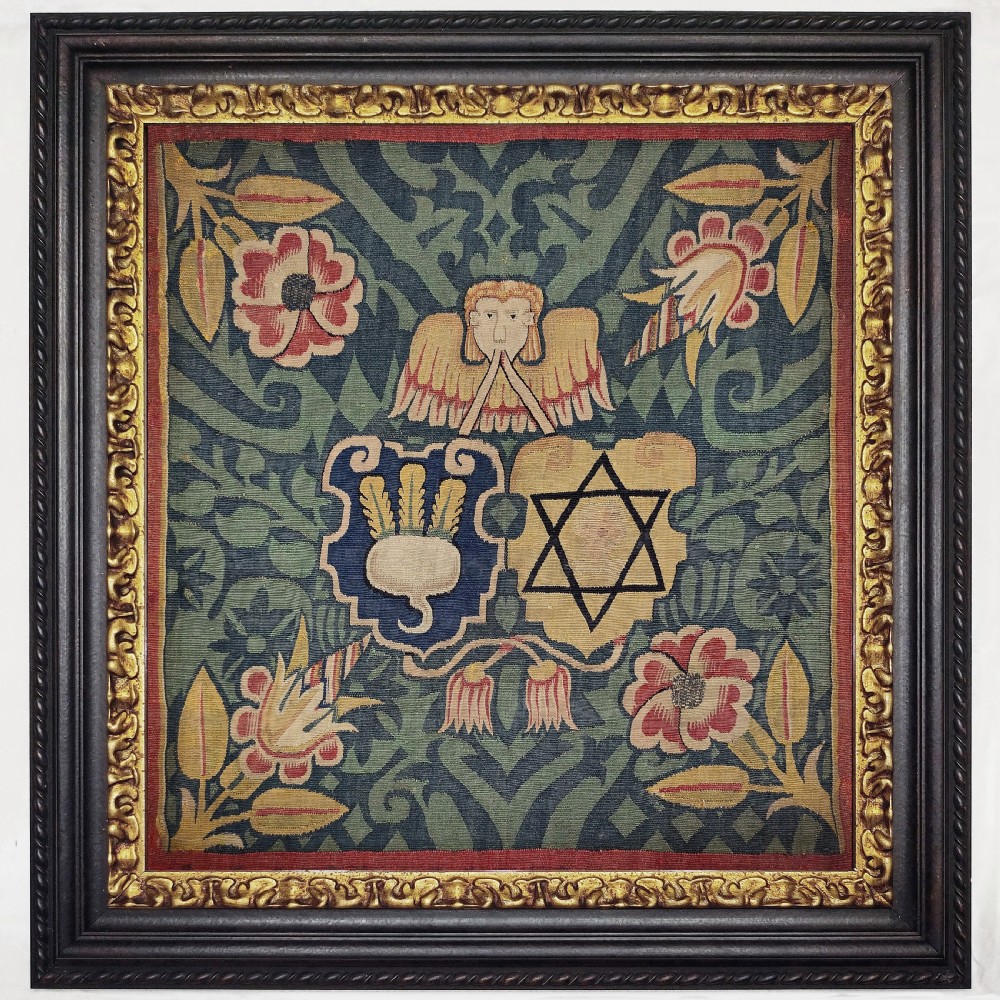
Woven in wool, silk and metal thread on linen warp threads, with two escutcheons below a seraph with an aulos, or double flute, that below the shields becomes two tasselled cords, on a ground imitative of a 16th century Italian green silk damask or cut and uncut figured velvet, with two roses and two ‘water flowers’ to the corners, within a red border.

The left hand escutcheon bears the Keutschach arms of a turnip on a blue ground, and the right hand has a flower and a chalice within a hexagram.

The Keutschach family had their seat in the Carinthian district of Klagenfurt-Land, on the banks of the Keutschacher See, their wealth owed primarily to agriculture , and this fundamental reason for the use of the turnip on their coat of arms was later embellished with variations of a legend involving the most celebrated member of the family, Leonhard von Keutschach (1442(?)-8th June 1519). Elected Prince-Archbishop of Salzburg in 1495, von Keutschach ruled successfully until his death, reconciling an internally riven Salzburg, reforming and greatly enriching the economy, and fortifying its defences, with the result that under his authority the principality became one of the richest in the Holy Roman Empire, and an environment within which art and culture began to flourish. The tradition later arose that, when still a schoolboy, Leonhard had visited his uncle who admonished him for either his scholarly ineptitude and apathy, or for his reluctance to work the fields. An impertinent reply provoked the uncle to hurl an uprooted turnip at the departing child and to warn him that a lack of application would lead to his ostracism from the family, and this episode proved the spring for his future diligence and ultimate success.

The chalice and flower within a six pointed star is perhaps the emblem of a brewers' guild, the hexagram being the brewers’ alchemical symbol. One of the oldest guild emblems of brewers and maltsters, it was prevalent in Nuremburg and other areas of southern Germany from the later Middle Ages. The presence of a chalice behind the flower would serve to reinforce this assumption. It was not commonly recognised as representative of Judaism prior to its use in 17th century Prague, and was not widely adopted as such until the 19th century.

In this context, Leonhard von Keutschach's abortive attempt to impose a ban on the production of good quality beer by private breweries in Salzburg so that the production and sale of beer from his own breweries should prosper is compelling, but it is more likely that this tapestry cushion cover was commissioned to commemorate the marriage of a member of the Keutschach family to the scion of a family whose wealth may have derived initially from brewing.

A silk of the first half of the 16th century in the collection of the Metropolitan Museum of Art, object number: 46.156.116, has a version of the design reproduced in tapestry here as the background. Interestingly, the cataloguing of this silk postulates that this pattern was widely used in the context of matrimony.

The two flowers alternating as decoration to the corners, a wild, or dog, rose and a flower reminiscent of the ‘water flower’ found in 15th century opus anglicanum embroidery, perhaps also connote marriage, the first epitomizing the female partner, the second the male. As Frank & Peter Rhodes stated in the article ‘Medieval Embroidered ‘Water Flowers’’ (2016, Textile History, 47:2, 243-248, DOI: 10.1080/00404969.2016.1211441) “The tall central cones… (of these latter) …owe more to the idea of the sword than to elongated iris stems”.

The aulos, a wind instrument of ancient origin with two pipes that is sometimes termed a double flute or double oboe and is held here in the mouth of the presiding seraph, is mentioned in fragment 44 of Sappho’s poetry as accompanyi

Physical Dimensions
Height
77.5cm (30.51")
Width
74.6cm (29.37")
Declaration

Textile Antiques has dated this German Armorial Tapestry Fragment to the 16th Century.

Reference Numbers
Sellingantiques Reference
SA1154399
Dealers Internal Reference
79
Description
Circa 1530-1550. Perhaps woven in Nuremburg.

Woven in wool, silk and metal thread on linen warp threads, with two escutcheons below a seraph with an aulos, or double flute, that below the shields becomes two tasselled cords, on a ground imitative of a 16th century Italian green silk damask or cut and uncut figured velvet, with two roses and two ‘water flowers’ to the corners, within a red border.

The left hand escutcheon bears the Keutschach arms of a turnip on a blue ground, and the right hand has a flower and a chalice within a hexagram.
Textile Antiques
fig 1. A square 16th-century style woven textile fragment displaying heraldic shields, an angel figure, and floral motifs within a dark wooden frame featuring a gilded inner border.
fig 1. A 16th Century German Armorial Tapestry Cushion Cover

The Keutschach family had their seat in the Carinthian district of Klagenfurt-Land, on the banks of the Keutschacher See, their wealth owed primarily to agriculture , and this fundamental reason for the use of the turnip on their coat of arms was later embellished with variations of a legend involving the most celebrated member of the family, Leonhard von Keutschach (1442(?)-8th June 1519). Elected Prince-Archbishop of Salzburg in 1495, von Keutschach ruled successfully until his death, reconciling an internally riven Salzburg, reforming and greatly enriching the economy, and fortifying its defences, with the result that under his authority the principality became one of the richest in the Holy Roman Empire, and an environment within which art and culture began to flourish. The tradition later arose that, when still a schoolboy, Leonhard had visited his uncle who admonished him for either his scholarly ineptitude and apathy, or for his reluctance to work the fields. An impertinent reply provoked the uncle to hurl an uprooted turnip at the departing child and to warn him that a lack of application would lead to his ostracism from the family, and this episode proved the spring for his future diligence and ultimate success.

fig 2. A square 16th-century style woven textile fragment displaying heraldic shields, an angel figure, and floral motifs within a dark wooden frame featuring a gilded inner border.
fig 2. A 16th Century German Armorial Tapestry Cushion Cover

The chalice and flower within a six pointed star is perhaps the emblem of a brewers' guild, the hexagram being the brewers’ alchemical symbol. One of the oldest guild emblems of brewers and maltsters, it was prevalent in Nuremburg and other areas of southern Germany from the later Middle Ages. The presence of a chalice behind the flower would serve to reinforce this assumption. It was not commonly recognised as representative of Judaism prior to its use in 17th century Prague, and was not widely adopted as such until the 19th century.

fig 3. A square 16th-century style woven textile fragment displaying heraldic shields, an angel figure, and floral motifs within a dark wooden frame featuring a gilded inner border.
fig 3. A 16th Century German Armorial Tapestry Cushion Cover

In this context, Leonhard von Keutschach's abortive attempt to impose a ban on the production of good quality beer by private breweries in Salzburg so that the production and sale of beer from his own breweries should prosper is compelling, but it is more likely that this tapestry cushion cover was commissioned to commemorate the marriage of a member of the Keutschach family to the scion of a family whose wealth may have derived initially from brewing.

fig 4. A square 16th-century style woven textile fragment displaying heraldic shields, an angel figure, and floral motifs within a dark wooden frame featuring a gilded inner border.
fig 4. A 16th Century German Armorial Tapestry Cushion Cover

A silk of the first half of the 16th century in the collection of the Metropolitan Museum of Art, object number: 46.156.116, has a version of the design reproduced in tapestry here as the background. Interestingly, the cataloguing of this silk postulates that this pattern was widely used in the context of matrimony.

fig 5. A square 16th-century style woven textile fragment displaying heraldic shields, an angel figure, and floral motifs within a dark wooden frame featuring a gilded inner border.
fig 5. A 16th Century German Armorial Tapestry Cushion Cover

The two flowers alternating as decoration to the corners, a wild, or dog, rose and a flower reminiscent of the ‘water flower’ found in 15th century opus anglicanum embroidery, perhaps also connote marriage, the first epitomizing the female partner, the second the male. As Frank & Peter Rhodes stated in the article ‘Medieval Embroidered ‘Water Flowers’’ (2016, Textile History, 47:2, 243-248, DOI: 10.1080/00404969.2016.1211441) “The tall central cones… (of these latter) …owe more to the idea of the sword than to elongated iris stems”.

fig 6. A square 16th-century style woven textile fragment displaying heraldic shields, an angel figure, and floral motifs within a dark wooden frame featuring a gilded inner border.
fig 6. A 16th Century German Armorial Tapestry Cushion Cover

The aulos, a wind instrument of ancient origin with two pipes that is sometimes termed a double flute or double oboe and is held here in the mouth of the presiding seraph, is mentioned in fragment 44 of Sappho’s poetry as accompanyi

Height
77.5cm (30.51")
Width
74.6cm (29.37")
Date of Manufacture

Textile Antiques has dated this German Armorial Tapestry Fragment to the 16th Century.

Reference Numbers
Sellingantiques Ref
SA1154399
Dealers Internal Ref
79
Textile Antiques
Textile Antiques
Sellingantiques verified Since Jul 2025

Fine european textiles and tapestries of the period spanning the 15th century to the early 20th century.

Dealer Profile

You can view the stock and full dealer information on the Textile Antiques Profile Page
PDF SHARE
SAVE
A square 16th-century style woven textile fragment displaying heraldic shields, an angel figure, and floral motifs within a dark wooden frame featuring a gilded inner border.
1 / 7
Archive I A square 16th-century style woven textile fragment displaying heraldic shields, an angel figure, and floral motifs within a dark wooden frame featuring a gilded inner border.

A 16th Century German Armorial Tapestry Cushion Cover

Archive II A square 16th-century style woven textile fragment displaying heraldic shields, an angel figure, and floral motifs within a dark wooden frame featuring a gilded inner border. View II
Archive III A square 16th-century style woven textile fragment displaying heraldic shields, an angel figure, and floral motifs within a dark wooden frame featuring a gilded inner border. View III
Archive IV A square 16th-century style woven textile fragment displaying heraldic shields, an angel figure, and floral motifs within a dark wooden frame featuring a gilded inner border. View IV
Archive V A square 16th-century style woven textile fragment displaying heraldic shields, an angel figure, and floral motifs within a dark wooden frame featuring a gilded inner border. View V
Archive VI A square 16th-century style woven textile fragment displaying heraldic shields, an angel figure, and floral motifs within a dark wooden frame featuring a gilded inner border. View VI
Archive VII A square 16th-century style woven textile fragment displaying heraldic shields, an angel figure, and floral motifs within a dark wooden frame featuring a gilded inner border. View VII
Enlarged Archival View
Telephone 01279 816 869
Location
Stansted Mountfitchet
Essex
United Kingdom
Verified Since Jul 2025
Items For Sale 45
Items Sold 10
Textile Antiques
Textile Antiques
Verified Since Jul 2025
View Dealer Info
Location: Stansted Mountfitchet, Essex, United Kingdom
Verified
Jul 2025
For Sale
45
Sold
10
A square 16th-century style woven textile fragment displaying heraldic shields, an angel figure, and floral motifs within a dark wooden frame featuring a gilded inner border.
A 16th century German armorial tapestry cushion cover
Ref: SA1154399
A square 16th-century style woven textile fragment displaying heraldic shields, an angel figure, and floral motifs within a dark wooden frame featuring a gilded inner border.
Detail View 1
Detail View 2
Detail View 3
Detail View 4
Detail View 5
Detail View 6
Archival Detail
Every single antique dealer on our platform is individually approved by our internal team. We verify their professional trade history, ethical standards, and photographic quality to ensure a secure, high-standard buying environment. Upon joining, every dealer agrees to a strict 9-point code of conduct. While issues can occasionally arise, our dealers typically resolve them swiftly and directly with the buyer. In fact, since our founding in 2002, Sellingantiques has only had to step in to help resolve an issue on roughly five occasions—a true testament to the quality of our dealers and their dedication to your happiness.
Our dealers are highly experienced in packing and shipping fragile, high-value antiques. Because you are in direct contact with the dealer, you will be able to easily go through all available shipping and insurance options together to ensure your item arrives safely.
Antiques are the ultimate green purchase. By choosing historical pieces over newly manufactured goods, you completely eliminate the carbon footprint of modern mass production while preserving exceptional, timeless craftsmanship.

Armorial tapestries are woven textiles incorporating coats of arms or heraldic insignia, commissioned during the Medieval and Renaissance periods to denote lineage, status, or territorial alliance.

Tapestries from this period were hand-woven using wool and linen yarns, occasionally incorporating silk or metallic threads to accentuate finer details and embellishments.

Authentic period textiles exhibit irregular hand-spun threads, natural vegetable dye fading, evidence of hand-stitched historic repairs, and structural wear consistent with centuries of age.

Framed tapestry fragments can be mounted above sideboards, consoles, or mantels to introduce rich texture, historic depth, and graphic interest to modern or classic room arrangements.

Keep antique textiles out of direct sunlight, ensure framing incorporates UV-protective glass, and maintain a stable, climate-controlled environment to protect delicate fibres from degradation.
items
Add keywords to the filter
Price
£100
£250000
Era
Movements
Material
Origin
Stock Location
Freshness
Online Payments
Categories