56,346  PAGES BROWSED TODAY PAGES TODAY 192  ANTIQUES UPLOADED TODAY NEW ARRIVALS
ID #SA1135695
FOR SALE
£15,000
Email
Save
George III Mahogany Longcase Clock
W.R. Harvey & Co. (Antiques) Ltd
for sale €17,550     $19,050
£15,000
W.R. Harvey & Co. (Antiques) Ltd

W.R. Harvey & Co. (Antiques) Ltd

Sellingantiques Verified Since Sep 2016
View Dealers Stock Page
  • About Us
    Specialists in 17th-18th and early 19th century fine english furniture, art, clocks and other objets d'art
  • Trade Associations
    W.R. Harvey & Co. (Antiques) Ltd is a registered member of LAPADA 
Id #SA1135695
PDF SHARE
SAVE

George III Mahogany Longcase Clock

18th century
Description

No:11036

George III Mahogany longcase Clock with 2 finials and central gilt eagle with 8 day, hour striking and Lunar Calendar movement with pull repeat by Robert Bolton of Wigan, the arched dial with a silvered plaque above the lunar calendar inscribed “He appointed the moon for seasons” and two silvered scrolls beneath inscribed “Time is….Valuable”, silvered chapter rings, the minutes engraved in Arabic numerals, the hours in Roman numerals and the inner band with the normal calendar in Arabic Numerals with a gilt hand. The subsidiary seconds dial below the 12 also has the original hand and the dial centre is silvered with engraved Rococo decoration which ties in with the Rococo gilt corner spandrels.

Circa 1790

Price: £15,000-00p.

Height: 95.5”h Width: 21”w Depth:10.5”

Provenance: Harry Furness,

Growing up in a working-class family in Manchester, Harry Furness joined the army in 1939 at the age of 16. Having always been captivated by the stories of First World War snipers, he immediately volunteered for sniper training when the army began to recruit soldiers in 1941. He did exceptionally well, qualifying as a marksman whilst a pre-war army cadet and was quickly promoted to lance corporal.

Just prior to D-Day, he was promoted to corporal in the Green Howards Regiment and landed at Gold Beach on 6th June 1944. Together, he and his comrades began a hard fight across North-West Europe, gradually moving through Northern France, Belgium, Holland and eventually into Germany as they pushed the Germans back towards the Rhine.

The manifold dangers and occasional humour of Harry Furness’s experiences of war come across in a very matter-of-fact but compelling way in the dozens of previously unpublished letters, personal interviews and images that make up Martin Pegler’s fascinating, moving biography of Furness and his extraordinary life. “ The Solitary War of a Sniper” The Authorised Biography of Britain's Most Successful World War II Sniper

Notes: The history of this clock is interesting and typically somewhat romantic. During the 18th century Wigan continued to be an important market town and its population grew rapidly.(6000 in ca. 1700 to 32,000 by 1850) Clock makers made clocks in Wigan and whitesmiths made pewter goods. Then in 1779 the Leeds and Liverpool Canal was completed as far as Wigan and from the end of the 18th century coal mining around Wigan vastly increased and at one point there were over 1000 pits within five miles of the town centre. By 1790 Wigan also had its own iron works and during the last quarter of the century the cotton weaving industry boomed as well.

In 1764 a waterworks was created in Wigan and in 1798 a dispensary opened where the poor could obtain free medicines. Like many other towns in the north of England Wigan was transformed by the industrial revolution from the end of the 18th century onwards.

Wigan had always been a clockmaking centre and all the wealth and industry rushing into this area helped to sustain this as well.

There were three outstanding clockmakers in Wigan during the second half of the 18th. century, Peter Fearnley, Robert Bolton and William Barker. There was very keen competition between these three, two of them, Fearnley and Barker made a wide range of clocks to suit various market prices but they were also anxious to demonstrate that they were able to produce timepieces to match any others in the land so each of them made a “masterpiece” to prove it.

Bolton on the other hand was already wealthy from making fine guns and as he also owned the main brass foundry in Wigan he made the brass dials for most of the clockmakers in that region. He was also Mayor of Wigan. The example he made for his own home has survived intact. William Barker’s “Astronomical Masterpiece” made during the 1780’s was highly acclaimed and was sold in London during the 1970’s. When

Physical Dimensions
Height
242cm (95.28")
Width
53.5cm (21.06")
Depth
27cm (10.63")
Declaration

W.R. Harvey & Co. (Antiques) Ltd has dated this George III Mahogany Longcase Clock to the 18th Century.

Reference Numbers
Sellingantiques Reference
SA1135695
Dealers Internal Reference
11036
Dealers Notes

We offer free delivery within the UK. For deliveries Worldwide, please contact us for a quote and we will get back to you within 12 hours.

If you would like to view the item in person, our showrooms are open Monday to Saturday 9.30 - 5.30 and by appointment on Sunday.

Any questions, please contact us as soon as possible. We will endeavour to get you an answer within 24 hours - and hopefully much quicker!

Description
No:11036

George III Mahogany longcase Clock with 2 finials and central gilt eagle with 8 day, hour striking and Lunar Calendar movement with pull repeat by Robert Bolton of Wigan, the arched dial with a silvered plaque above the lunar calendar inscribed “He appointed the moon for seasons” and two silvered scrolls beneath inscribed “Time is….

Valuable”, silvered chapter rings, the minutes engraved in Arabic numerals, the hours in Roman numerals and the inner band with the normal calendar in Arabic Numerals with a gilt hand.
W.R. Harvey & Co. (Antiques) Ltd

The subsidiary seconds dial below the 12 also has the original hand and the dial centre is silvered with engraved Rococo decoration which ties in with the Rococo gilt corner spandrels.

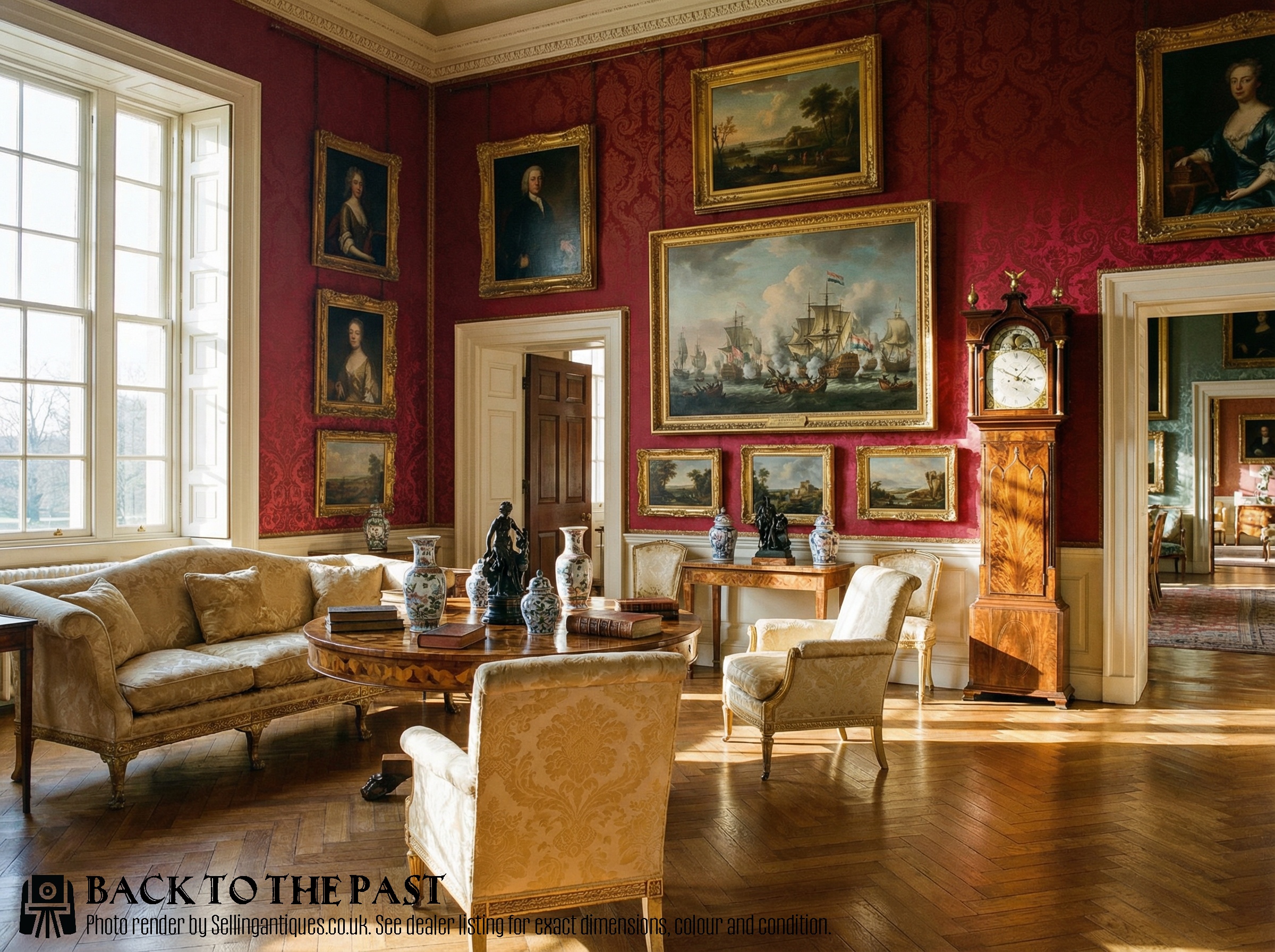
fig 1. A George III mahogany longcase clock featuring a swan-neck pediment with brass eagle finial, an arched dial, and a flame mahogany trunk door.
fig 1. George III Mahogany Longcase Clock

Circa 1790

Price: £15,000-00p.

Height: 95.5”h Width: 21”w Depth:10.5”

Provenance: Harry Furness,

Growing up in a working-class family in Manchester, Harry Furness joined the army in 1939 at the age of 16. Having always been captivated by the stories of First World War snipers, he immediately volunteered for sniper training when the army began to recruit soldiers in 1941. He did exceptionally well, qualifying as a marksman whilst a pre-war army cadet and was quickly promoted to lance corporal.

fig 2. A George III mahogany longcase clock featuring a swan-neck pediment with brass eagle finial, an arched dial, and a flame mahogany trunk door.
fig 2. George III Mahogany Longcase Clock

Just prior to D-Day, he was promoted to corporal in the Green Howards Regiment and landed at Gold Beach on 6th June 1944. Together, he and his comrades began a hard fight across North-West Europe, gradually moving through Northern France, Belgium, Holland and eventually into Germany as they pushed the Germans back towards the Rhine.

fig 3. A George III mahogany longcase clock featuring a swan-neck pediment with brass eagle finial, an arched dial, and a flame mahogany trunk door.
fig 3. George III Mahogany Longcase Clock

The manifold dangers and occasional humour of Harry Furness’s experiences of war come across in a very matter-of-fact but compelling way in the dozens of previously unpublished letters, personal interviews and images that make up Martin Pegler’s fascinating, moving biography of Furness and his extraordinary life. “ The Solitary War of a Sniper” The Authorised Biography of Britain's Most Successful World War II Sniper

fig 4. A George III mahogany longcase clock featuring a swan-neck pediment with brass eagle finial, an arched dial, and a flame mahogany trunk door.
fig 4. George III Mahogany Longcase Clock

Notes: The history of this clock is interesting and typically somewhat romantic. During the 18th century Wigan continued to be an important market town and its population grew rapidly.(6000 in ca. 1700 to 32,000 by 1850) Clock makers made clocks in Wigan and whitesmiths made pewter goods. Then in 1779 the Leeds and Liverpool Canal was completed as far as Wigan and from the end of the 18th century coal mining around Wigan vastly increased and at one point there were over 1000 pits within five miles of the town centre. By 1790 Wigan also had its own iron works and during the last quarter of the century the cotton weaving industry boomed as well.

fig 5. A George III mahogany longcase clock featuring a swan-neck pediment with brass eagle finial, an arched dial, and a flame mahogany trunk door.
fig 5. George III Mahogany Longcase Clock

In 1764 a waterworks was created in Wigan and in 1798 a dispensary opened where the poor could obtain free medicines. Like many other towns in the north of England Wigan was transformed by the industrial revolution from the end of the 18th century onwards.

Wigan had always been a clockmaking centre and all the wealth and industry rushing into this area helped to sustain this as well.

There were three outstanding clockmakers in Wigan during the second half of the 18th. century, Peter Fearnley, Robert Bolton and William Barker. There was very keen competition between these three, two of them, Fearnley and Barker made a wide range of clocks to suit various market prices but they were also anxious to demonstrate that they were able to produce timepieces to match any others in the land so each of them made a “masterpiece” to prove it.

Bolton on the other hand was already wealthy from making fine guns and as he also owned the main brass foundry in Wigan he made the brass dials for most of the clockmakers in that region. He was also Mayor of Wigan. The example he made for his own home has survived intact. William Barker’s “Astronomical Masterpiece” made during the 1780’s was highly acclaimed and was sold in London during the 1970’s. When

Height
242cm (95.28")
Width
53.5cm (21.06")
Depth
27cm (10.63")
Date of Manufacture

W.R. Harvey & Co. (Antiques) Ltd has dated this George III Mahogany Longcase Clock to the 18th Century.

Reference Numbers
Sellingantiques Ref
SA1135695
Dealers Internal Ref
11036
W.R. Harvey & Co. (Antiques) Ltd
Sellingantiques verified Since Sep 2016

Specialists in 17th-18th and early 19th century fine english furniture, art, clocks and other objets d'art

Dealer Profile

You can view the stock and full dealer information on the W.R. Harvey & Co. (Antiques) Ltd Profile Page

Trade Associations

W.R. Harvey & Co. (Antiques) Ltd is a registered member of LAPADA 

PDF SHARE
SAVE
A George III mahogany longcase clock featuring a swan-neck pediment with brass eagle finial, an arched dial, and a flame mahogany trunk door.
1 / 7
Archive I A George III mahogany longcase clock featuring a swan-neck pediment with brass eagle finial, an arched dial, and a flame mahogany trunk door.

George III Mahogany Longcase Clock

Archive II A George III mahogany longcase clock featuring a swan-neck pediment with brass eagle finial, an arched dial, and a flame mahogany trunk door. View II
Archive III A George III mahogany longcase clock featuring a swan-neck pediment with brass eagle finial, an arched dial, and a flame mahogany trunk door. View III
Archive IV Scale Reference for A George III mahogany longcase clock featuring a swan-neck pediment with brass eagle finial, an arched dial, and a flame mahogany trunk door.
Archive V A George III mahogany longcase clock featuring a swan-neck pediment with brass eagle finial, an arched dial, and a flame mahogany trunk door. View V
Archive VI A George III mahogany longcase clock featuring a swan-neck pediment with brass eagle finial, an arched dial, and a flame mahogany trunk door. View VI
Archive VII A George III mahogany longcase clock featuring a swan-neck pediment with brass eagle finial, an arched dial, and a flame mahogany trunk door. View VII
FURTHER BROWSING

Visitors also looked at these ⇣

Enlarged Archival View
Telephone 01993 706501
Location
86 Corn Street
Witney
Oxfordshire
OX28 6BU
United Kingdom
Verified Since Sep 2016
Items For Sale 113
Items Sold 542
W.R. Harvey & Co. (Antiques) Ltd
Verified Since Sep 2016
View Dealer Info
Location: 86 Corn Street, Witney, Oxfordshire, OX28 6BU, United Kingdom
Verified
Sep 2016
For Sale
113
Sold
542
A George III mahogany longcase clock featuring a swan-neck pediment with brass eagle finial, an arched dial, and a flame mahogany trunk door.
George III Mahogany Longcase Clock
Ref: SA1135695
A George III mahogany longcase clock featuring a swan-neck pediment with brass eagle finial, an arched dial, and a flame mahogany trunk door.
Detail View 1
Detail View 2
Detail View 3
Detail View 4
Detail View 5
Scale Reference
Archival Detail
Every single antique dealer on our platform is individually approved by our internal team. We verify their professional trade history, ethical standards, and photographic quality to ensure a secure, high-standard buying environment. Upon joining, every dealer agrees to a strict 9-point code of conduct. While issues can occasionally arise, our dealers typically resolve them swiftly and directly with the buyer. In fact, since our founding in 2002, Sellingantiques has only had to step in to help resolve an issue on roughly five occasions—a true testament to the quality of our dealers and their dedication to your happiness.
Our dealers are highly experienced in packing and shipping fragile, high-value antiques. Because you are in direct contact with the dealer, you will be able to easily go through all available shipping and insurance options together to ensure your item arrives safely.
Antiques are the ultimate green purchase. By choosing historical pieces over newly manufactured goods, you completely eliminate the carbon footprint of modern mass production while preserving exceptional, timeless craftsmanship.

A George III longcase clock, also known as a tall-case or grandfather clock, was produced in Britain during the reign of King George III between 1760 and 1820. Characterised by classical proportions, flame mahogany veneers, and pendulum-driven mechanical movements, these clocks functioned as both accurate timekeepers and high-status household furnishings.

These clocks typically feature cabinets constructed from solid oak or pine secondary woods veneered with figured mahogany or walnut. Movement components were engineered from cast brass gears and steel arbors, while the clock face was executed in brass or painted enamel with silvered chapter rings.

Period features include hand-cut dovetail cabinet joinery, original weight-driven eight-day or thirty-hour movements, and period horological details such as brass spandrels, painted arch dials, swan-neck pediments, and hand-carved flame mahogany trunk doors.

Position the clock as a focal point in an entry hall, stairwell, or formal dining space to introduce vertical scale and historic contrast. Set against neutral wall finishes, the rich grain of the mahogany provides visual warmth that bridges classic and modern aesthetics.

Position the clock away from direct sunlight, radiators, and fluctuating humidity to prevent wood movement and veneer lifting. The mechanical movement requires periodic lubrication and servicing by a professional horologist every five to seven years.
items
Add keywords to the filter
Price
£100
£250000
Era
Movements
Material
Origin
Stock Location
Freshness
Online Payments
Categories