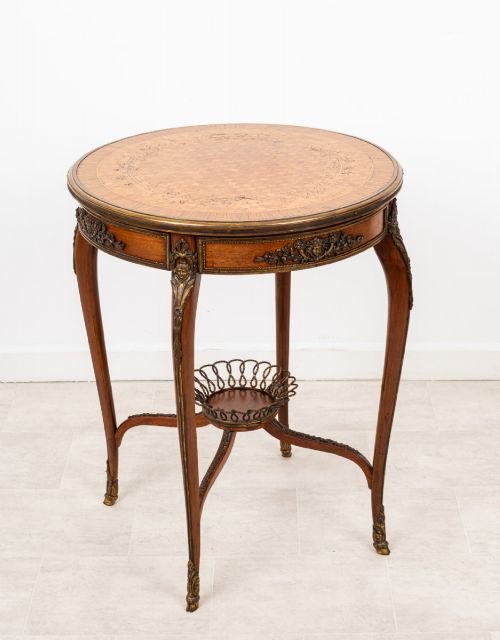
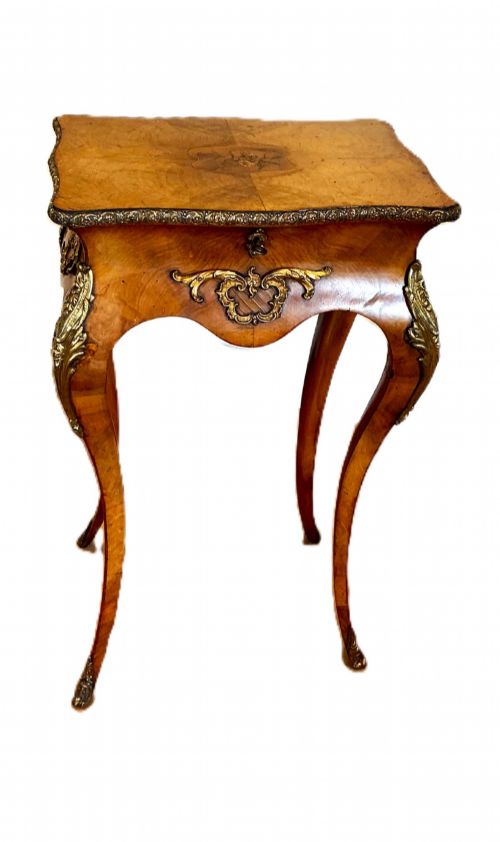
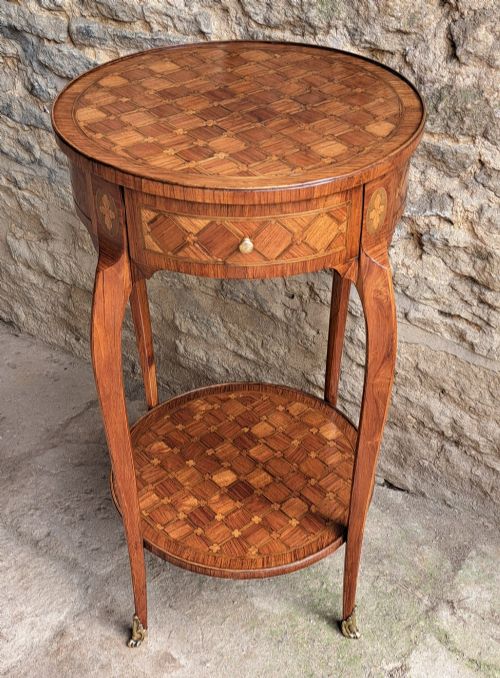
Regent Antiques has dated this French Marquetry Occasional Table to the 1850s.
The beautiful shaped marquetry top is framed with an ormolu border.

There is no mistaking the unique quality and elaborate design, which is certain to make it a talking point in your home and a fine embellishment to your reception room.
Condition:
In really excellent condition having been beautifully cleaned, polished and waxed in our workshops, please see photos for confirmation.

Dimensions in cm:
Height 79 cm x Width 51 cm x Depth 39 cm
Dimensions in inches:
Height 2 foot, 7 inches x Width 1 foot, 8 inches x Depth 1 foot, 3 inches
Marquetry
is decorative artistry where pieces of material of different colours are inserted into surface wood veneer to form intricate patterns such as scrolls or flowers.

The technique of veneered marquetry had its inspiration in 16th century Florence. Marquetry elaborated upon Florentine techniques of inlaying solid marble slabs with designs formed of fitted marbles, jaspers and semi-precious stones. This work, called opere di commessi, has medieval parallels in Central Italian "Cosmati"-work of inlaid marble floors, altars and columns. The technique is known in English as pietra dura, for the "hardstones" used: onyx, jasper, cornelian, lapis lazuli and colored marbles. In Florence, the Chapel of the Medici at San Lorenzo is completely covered in a colored marble facing using this demanding jig-sawn technique.

Techniques of wood marquetry were developed in Antwerp and other Flemish centers of luxury cabinet-making during the early 16th century. The craft was imported full-blown to France after the mid-seventeenth century, to create furniture of unprecedented luxury being made at the royal manufactory of the Gobelins, charged with providing furnishings to decorate Versailles and the other royal residences of Louis XIV. Early masters of French marquetry were the Fleming Pierre Golle and his son-in-law, André-Charles Boulle, who founded a dynasty of royal and Parisian cabinet-makers (ébénistes) and gave his name to a technique of marquetry employing brass with pewter in arabesque or intricately foliate designs.

King wood
is a classic furniture wood, almost exclusively used for inlays on very fine furniture. Occasionally it is used in the solid for small items and turned work, including parts of billiard cues, e.g., those made by John Parris. It is brownish-purple with many fine darker stripes and occasional irregular swirls. Occasionally it contains pale streaks of a similar colour to sapwood.

The wood is very dense and hard and can be brought to a spectacular finish. it turns well but due to its density and hardness can be difficult to work with hand tools. It also has a tendency to blunt the tools due to its abrasive properties.
Our reference: A4320
Regent Antiques has dated this French Marquetry Occasional Table to the 1850s.
We specialise in english and continental furniture, silver, porcelain and decorative items.
You can view the stock and full dealer information on the Regent Antiques Profile Page
Regent Antiques is a registered member of LAPADA CINOA

Antique French Louis Revival Marqutry Ormolu Occasional Table C.1850