

Fine Antique English Porcelain has dated these Regency Porcelain Ice Pails to the Regency era.
Landscapes such as the ones on this pair of Ice Pails, were a fashionable design of decoration made for customers who selected the views to be painted on their services or individual pieces. Prints of customers’ houses or castles, beauty spots and landmarks were copied by the Flight & Barr painters.

Each Cooler with a pair of highly detailed Satyr head handles and complete with original liners and lids.
Impressed crowned FBB marks, script marks in red referring to royal patronage and London House Coventry Street address, along with the titles of the views on each pail.

Condition: Generally in very good condition apart from some old restoration to a chip of the rim of one lid, the finial has been re-stuck and re-gilded, restoration to the rim of one liner and the horns of the Satyr handles.

The Ice Pail, is one of the rarest and most coveted tableware pieces amongst antique porcelain.
The first record of ice cream in Britain is 1671 on the menu of a feast for the Knights of the Garter held in St. George's Hall at Windsor Castle. At this time it was considered such an exclusive dish that it appeared only on the king's tableThe earliest printed recipe appeared in Mrs Eale's Receipts, a work on confectionary which was published in London, 1718. It was not until the second half of the 18th century that ices became more readily available from confectioner's shops, and these pails were commonly found on upper class homes' sideboards to be used for a dessert of ice cream with cut fruit. If ice alone is used to fill the cover and the bucket, the ice cream melts very quickly. Although there is nothing recorded in literature, it is almost certain that a little salt was sprinkled on the ice. Porcelain is the ideal material for ice cream pails as it is impervious to salt which improves the refrigerant effect. Experiments has shown that ice cream will remain in a frozen state for up to four hours in these ice pails if salt is added to both containers. After a time, a small amount of ice eventually forms on the exterior of the pail - usually causing condensation, and possible adhesion to the table cloth. It is therefore likely that these early pails would have been placed on a plate or stand. Later designs of these pails often had feet to prevent them freezing to the table, and these objects were rarely made beyond the year 1830.
For more images, please visit: www.fineantiqueenglishporcelain.co.uk
Fine Antique English Porcelain has dated these Regency Porcelain Ice Pails to the Regency era.
Jonathan purt is a specialist in fine antique english porcelain
You can view the stock and full dealer information on the Fine Antique English Porcelain Profile Page
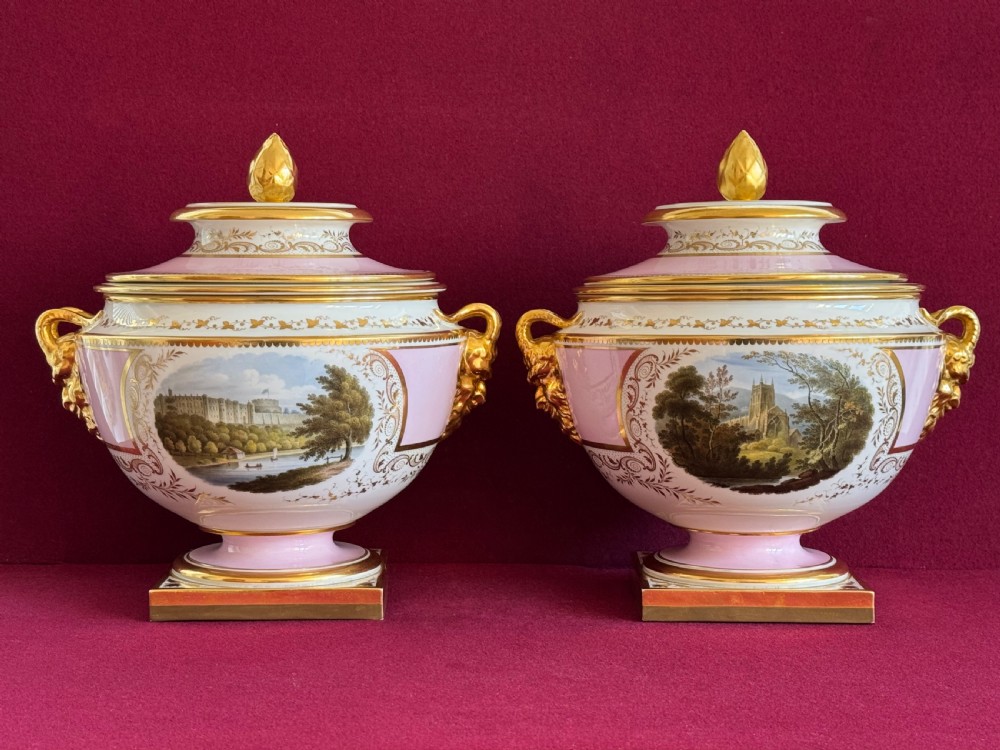

A magnificent pair of Flight, Barr & Barr Worcester Ice Pails c.1813


