18,834  PAGES BROWSED TODAY PAGES TODAY 70  ANTIQUES UPLOADED TODAY NEW ARRIVALS
ID #SA1124958
RESERVED
Email
Save
Exemplary George I Mulberry Bureau Bookcase C. 1720
Webberley Antiques
reserved SA1124958
RESERVED
Webberley Antiques

Webberley Antiques

Sellingantiques Verified Since Nov 2008
View Dealers Stock Page
  • About Us
    Specialists in 18th century and earlier furniture for more than 45 years
Id #SA1124958
PDF SHARE
SAVE

Exemplary George I Mulberry Bureau Bookcase C. 1720

18th century
For Sale by Webberley Antiques (Reserved for a buyer)
Description

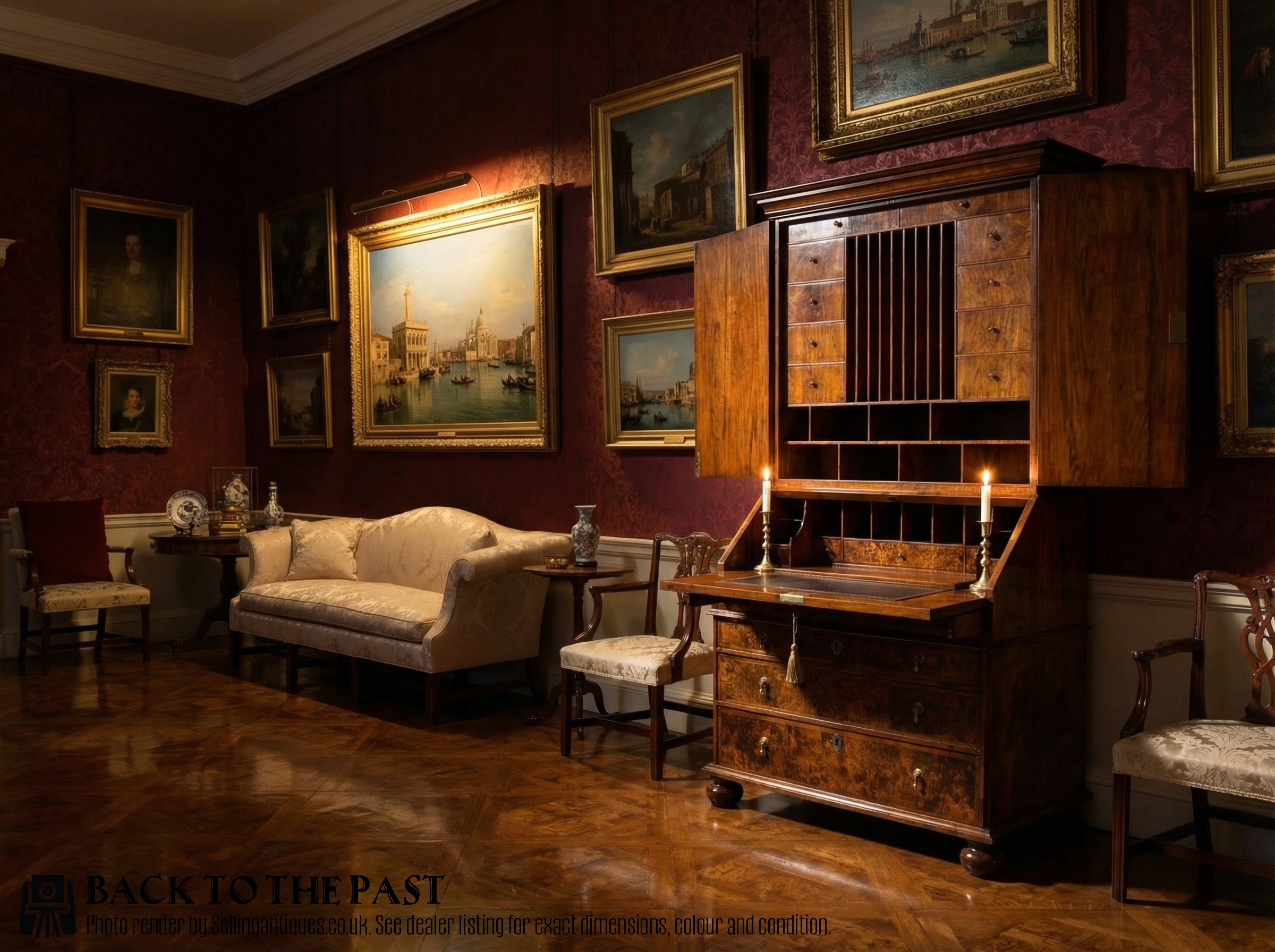
An extremely rare piece of early 18th century English furniture made in mulberry wood and with a fitted upper case retaining its original pigeon hole divisions and its full set of graduated oak lined drawers.

.

The well fitted interior of the bureau with mulberry faced drawers and original well with two secret oak drawers hidden within the well’s inner framework.

.

The upper doors with three bookmatched panels of mulberry on each, set within a beautiful and fine featherbanded border. The front of the bureau fall with four bookmatched panels again set within a fine featherbanded border. And the front of each principal drawer beneath the fall with the same mulberry bookmatched panelling within featherbanded borders.

.

The small drawers within the bureau have incredibly slender and fine oak linings with tiny dovetails. One drawer has a replacement lining but all others are original as are all of the oak linings to the drawers in the upper case and the to the principal drawers. Original backboards, original bun feet with some wear and old worm holes but long since dead. Both locks original and with the same working key.

.

Mulberry is a very rare timber. It is not taken from a Mulberry bush or tree, it is a thickly cut veneer (usually field maple or sycamore) stained and then washed in an acid which has had copper and other metals dissolved in it. This creates beautiful highlights and contrasts in the wood to make it resemble tortoiseshell.

.

The necessity within the British Isles in the late 1600s and early 1700s to create a tortoiseshell appearance was driven by work of the French cabinet maker Andre-Charles Boulle who used polished tortoiseshell inlaid with brass scroll work to create ‘boulle work’. Such pieces selling for huge sums and being highly favoured and collected by the British Royalty and aristocracy.

.

It is believed that very few British cabinet makers knew how to create this mulberry wood and that the staining process was hotly guarded. Prominent exponents were Coxed and Woster - their mulberry-wood work usually inlaid with pewter stringing and mounts.

.

Very few mulberry wood pieces have ever come to the market. This is a superb quality example from a private estate where it has been in the same family for many generations. The cabinet work is exceptional and the whole is in very original condition. The well developed colour and patina are glorious.

.

Made by hand in c. 1720 and of small elegant proportions, this is one of the finest pieces of furniture I have had the pleasure of getting to know and it is an extremely important and rare early 17th century bureau bookcase with a sound and long provenance.

.

The condition, colour and patination is unsurpassed.

.

.

Dimensions are:

.

39 inches wide, 24.5 inches deep and 75 inches high.

.

When the fall is open the max depth is 36 inches. The height from the floor to the writing surface is 29 inches.

.

For metric please multiply by 2.5

Declaration

Webberley Antiques has dated this George I Bureau Bookcase to the Georgian era.

Reference Numbers
Sellingantiques Reference
SA1124958
Dealers Notes

I describe and photograph my pieces accurately and with the aim that on arrival each will exceed your expectations.

I operate a full refund guarantee and am always happy to give free, honest and friendly advice.

Description
An extremely rare piece of early 18th century English furniture made in mulberry wood and with a fitted upper case retaining its original pigeon hole divisions and its full set of graduated oak lined drawers.
The well fitted interior of the bureau with mulberry faced drawers and original well with two secret oak drawers hidden within the well’s inner framework.
Webberley Antiques
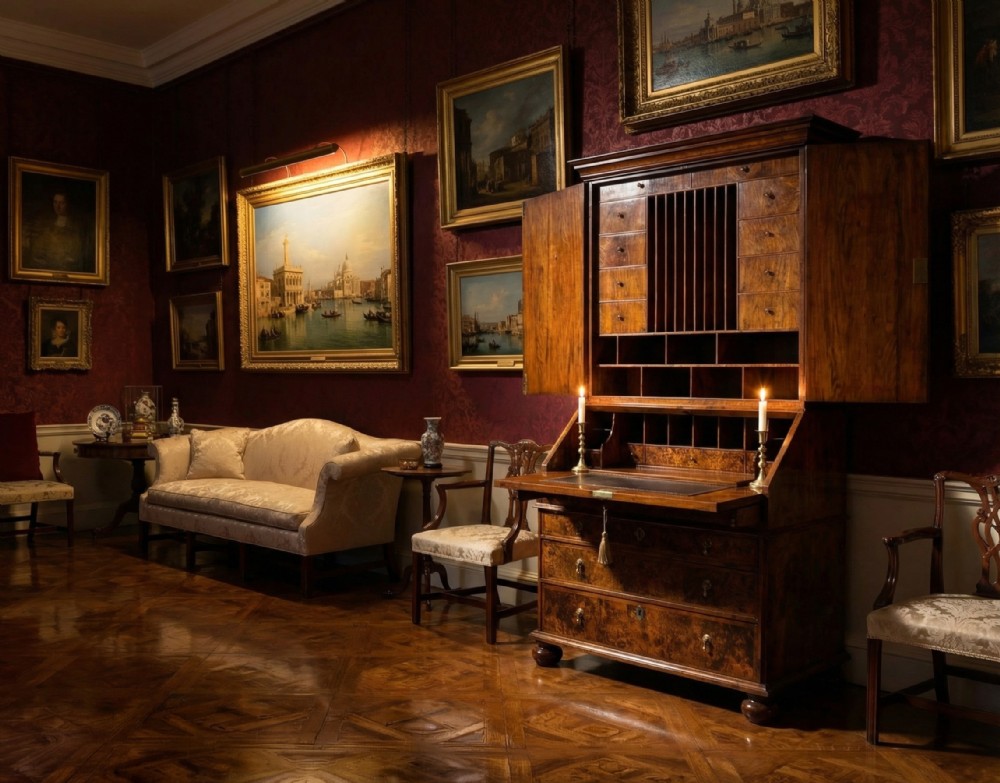
fig 1. A George I mulberry bureau bookcase featuring double doors opening to a fitted interior of drawers and pigeonholes above a fall-front writing slope and three drawers.
fig 1. Exemplary George I Mulberry Bureau Bookcase C. 1720

The upper doors with three bookmatched panels of mulberry on each, set within a beautiful and fine featherbanded border. The front of the bureau fall with four bookmatched panels again set within a fine featherbanded border. And the front of each principal drawer beneath the fall with the same mulberry bookmatched panelling within featherbanded borders.

fig 2. A George I mulberry bureau bookcase featuring double doors opening to a fitted interior of drawers and pigeonholes above a fall-front writing slope and three drawers.
fig 2. Exemplary George I Mulberry Bureau Bookcase C. 1720

The small drawers within the bureau have incredibly slender and fine oak linings with tiny dovetails. One drawer has a replacement lining but all others are original as are all of the oak linings to the drawers in the upper case and the to the principal drawers. Original backboards, original bun feet with some wear and old worm holes but long since dead. Both locks original and with the same working key.

fig 3. A George I mulberry bureau bookcase featuring double doors opening to a fitted interior of drawers and pigeonholes above a fall-front writing slope and three drawers.
fig 3. Exemplary George I Mulberry Bureau Bookcase C. 1720

Mulberry is a very rare timber. It is not taken from a Mulberry bush or tree, it is a thickly cut veneer (usually field maple or sycamore) stained and then washed in an acid which has had copper and other metals dissolved in it. This creates beautiful highlights and contrasts in the wood to make it resemble tortoiseshell.

fig 4. A George I mulberry bureau bookcase featuring double doors opening to a fitted interior of drawers and pigeonholes above a fall-front writing slope and three drawers.
fig 4. Exemplary George I Mulberry Bureau Bookcase C. 1720

The necessity within the British Isles in the late 1600s and early 1700s to create a tortoiseshell appearance was driven by work of the French cabinet maker Andre-Charles Boulle who used polished tortoiseshell inlaid with brass scroll work to create ‘boulle work’. Such pieces selling for huge sums and being highly favoured and collected by the British Royalty and aristocracy.
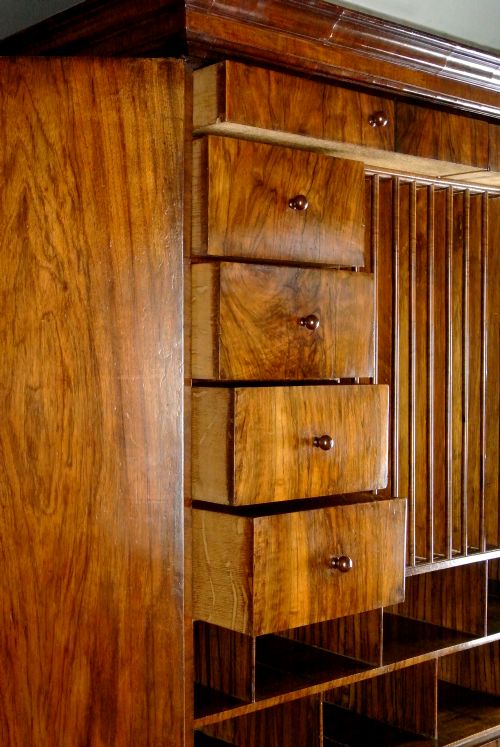
fig 5. A George I mulberry bureau bookcase featuring double doors opening to a fitted interior of drawers and pigeonholes above a fall-front writing slope and three drawers.
fig 5. Exemplary George I Mulberry Bureau Bookcase C. 1720

It is believed that very few British cabinet makers knew how to create this mulberry wood and that the staining process was hotly guarded. Prominent exponents were Coxed and Woster - their mulberry-wood work usually inlaid with pewter stringing and mounts.

fig 6. A George I mulberry bureau bookcase featuring double doors opening to a fitted interior of drawers and pigeonholes above a fall-front writing slope and three drawers.
fig 6. Exemplary George I Mulberry Bureau Bookcase C. 1720

Very few mulberry wood pieces have ever come to the market. This is a superb quality example from a private estate where it has been in the same family for many generations. The cabinet work is exceptional and the whole is in very original condition. The well developed colour and patina are glorious.

fig 7. A George I mulberry bureau bookcase featuring double doors opening to a fitted interior of drawers and pigeonholes above a fall-front writing slope and three drawers.
fig 7. Exemplary George I Mulberry Bureau Bookcase C. 1720

Made by hand in c. 1720 and of small elegant proportions, this is one of the finest pieces of furniture I have had the pleasure of getting to know and it is an extremely important and rare early 17th century bureau bookcase with a sound and long provenance.

fig 8. A George I mulberry bureau bookcase featuring double doors opening to a fitted interior of drawers and pigeonholes above a fall-front writing slope and three drawers.
fig 8. Exemplary George I Mulberry Bureau Bookcase C. 1720

The condition, colour and patination is unsurpassed.

Dimensions are:

39 inches wide, 24.5 inches deep and 75 inches high.

When the fall is open the max depth is 36 inches. The height from the floor to the writing surface is 29 inches.

For metric please multiply by 2.5

Date of Manufacture

Webberley Antiques has dated this George I Bureau Bookcase to the Georgian era.

Reference Numbers
Sellingantiques Ref
SA1124958
Webberley Antiques
Webberley Antiques
Sellingantiques verified Since Nov 2008

Specialists in 18th century and earlier furniture for more than 45 years

Dealer Profile

You can view the stock and full dealer information on the Webberley Antiques Profile Page

PDF SHARE
SAVE
A George I mulberry bureau bookcase featuring double doors opening to a fitted interior of drawers and pigeonholes above a fall-front writing slope and three drawers.
1 / 14
Archive I A George I mulberry bureau bookcase featuring double doors opening to a fitted interior of drawers and pigeonholes above a fall-front writing slope and three drawers.

Exemplary George I Mulberry Bureau Bookcase c. 1720

Archive II A George I mulberry bureau bookcase featuring double doors opening to a fitted interior of drawers and pigeonholes above a fall-front writing slope and three drawers. View II
Archive III A George I mulberry bureau bookcase featuring double doors opening to a fitted interior of drawers and pigeonholes above a fall-front writing slope and three drawers. View III
Archive IV Scale Reference for A George I mulberry bureau bookcase featuring double doors opening to a fitted interior of drawers and pigeonholes above a fall-front writing slope and three drawers.
Archive V A George I mulberry bureau bookcase featuring double doors opening to a fitted interior of drawers and pigeonholes above a fall-front writing slope and three drawers. View V
Archive VI A George I mulberry bureau bookcase featuring double doors opening to a fitted interior of drawers and pigeonholes above a fall-front writing slope and three drawers. View VI
Archive VII A George I mulberry bureau bookcase featuring double doors opening to a fitted interior of drawers and pigeonholes above a fall-front writing slope and three drawers. View VII
Archive VIII A George I mulberry bureau bookcase featuring double doors opening to a fitted interior of drawers and pigeonholes above a fall-front writing slope and three drawers. View VIII
Archive IX A George I mulberry bureau bookcase featuring double doors opening to a fitted interior of drawers and pigeonholes above a fall-front writing slope and three drawers. View IX
Archive X A George I mulberry bureau bookcase featuring double doors opening to a fitted interior of drawers and pigeonholes above a fall-front writing slope and three drawers. View X
Archive XI A George I mulberry bureau bookcase featuring double doors opening to a fitted interior of drawers and pigeonholes above a fall-front writing slope and three drawers. View XI
Archive XII A George I mulberry bureau bookcase featuring double doors opening to a fitted interior of drawers and pigeonholes above a fall-front writing slope and three drawers. View XII
Archive XIII A George I mulberry bureau bookcase featuring double doors opening to a fitted interior of drawers and pigeonholes above a fall-front writing slope and three drawers. View XIII
Archive XIV A George I mulberry bureau bookcase featuring double doors opening to a fitted interior of drawers and pigeonholes above a fall-front writing slope and three drawers. View XIV
FURTHER BROWSING

Visitors also looked at these ⇣

Enlarged Archival View
Telephone 07765 233266
Location
East Sussex
United Kingdom

By appointment only.
Verified Since Nov 2008
Items For Sale 75
Items Sold 415
Webberley Antiques
Webberley Antiques
Verified Since Nov 2008
View Dealer Info
Location: East Sussex, United Kingdom, , By appointment only.
Verified
Nov 2008
For Sale
75
Sold
415
A George I mulberry bureau bookcase featuring double doors opening to a fitted interior of drawers and pigeonholes above a fall-front writing slope and three drawers.
Exemplary George I Mulberry Bureau Bookcase c. 1720
Ref: SA1124958
A George I mulberry bureau bookcase featuring double doors opening to a fitted interior of drawers and pigeonholes above a fall-front writing slope and three drawers.
Detail View 1
Detail View 2
Detail View 3
Detail View 4
Detail View 5
Detail View 6
Detail View 7
Detail View 8
Detail View 9
Detail View 10
Detail View 11
Detail View 12
Scale Reference
Archival Detail
Every single antique dealer on our platform is individually approved by our internal team. We verify their professional trade history, ethical standards, and photographic quality to ensure a secure, high-standard buying environment. Upon joining, every dealer agrees to a strict 9-point code of conduct. While issues can occasionally arise, our dealers typically resolve them swiftly and directly with the buyer. In fact, since our founding in 2002, Sellingantiques has only had to step in to help resolve an issue on roughly five occasions—a true testament to the quality of our dealers and their dedication to your happiness.
Our dealers are highly experienced in packing and shipping fragile, high-value antiques. Because you are in direct contact with the dealer, you will be able to easily go through all available shipping and insurance options together to ensure your item arrives safely.
Antiques are the ultimate green purchase. By choosing historical pieces over newly manufactured goods, you completely eliminate the carbon footprint of modern mass production while preserving exceptional, timeless craftsmanship.

Emerging during the reign of King George I in the early 18th century, a bureau bookcase is a dual-section architectural piece combining a lower slant-front writing bureau with an upper cabinet fitted for document or book storage.

Pieces from this period were crafted using native hardwoods such as walnut, oak, and mulberry veneer, complemented by pine or oak drawer linings, hand-cut dovetail joints, and cast brass fittings.

Authentic items feature period-correct physical markers including hand-sawn secondary timber, thick hand-cut veneers, split-pin attachment on original brass handles, and natural surface patination around working areas.

Position the piece as a focal architectural feature in a study or living area, leaving the slant front down to display curated stationery and books illuminated by task lighting.

Maintain the original finish by placing the cabinet away from direct sunlight and artificial heat sources, dusting with a dry microfibre cloth, and applying a thin coat of natural beeswax paste annually.
items
Add keywords to the filter
Price
£100
£250000
Era
Movements
Material
Origin
Stock Location
Freshness
Online Payments
Categories