27,526  PAGES BROWSED TODAY PAGES TODAY 74  ANTIQUES UPLOADED TODAY NEW ARRIVALS
ID #SA1121214
FOR SALE
£2,000
Email
Save
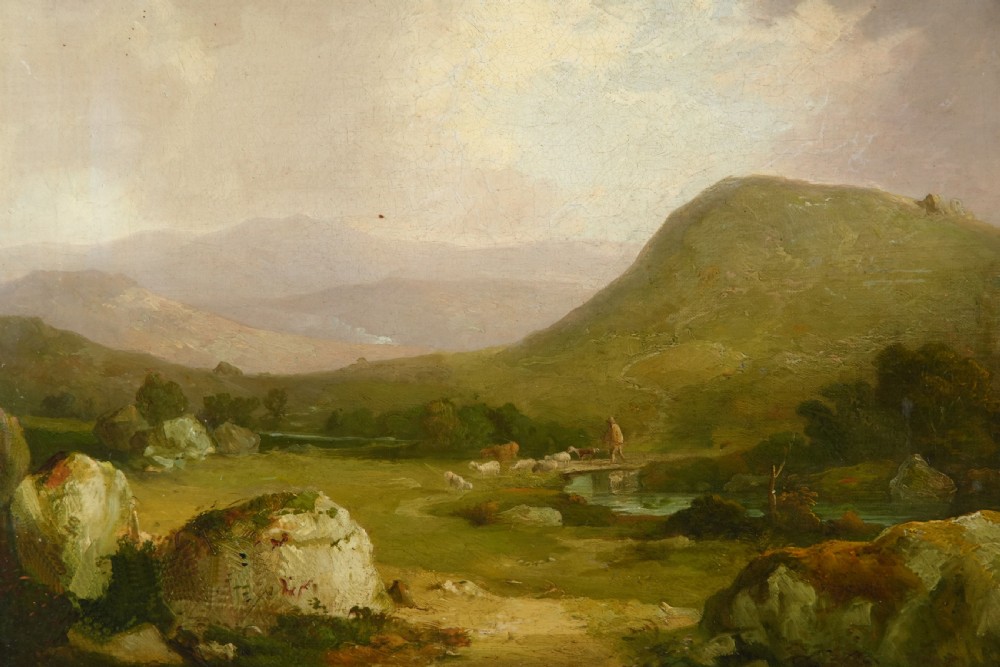
William Traies 1789-1872 A Drover Crossing the First Bridge on the Dart, Dartmoor 1857 Inscribed on the Stretcher "William Traies 1857 the First Bridge on the Dart Devon" oil on Canvas 33 X 45 Cm.
Artware Fineart
for sale €2,340     $2,540
£2,000

Artware Fineart

Sellingantiques Verified Since Sep 2008
View Dealers Stock Page
Id #SA1121214
PDF SHARE
SAVE

William Traies 1789-1872 A Drover Crossing the First Bridge on the Dart, Dartmoor 1857 Inscribed on the Stretcher "William Traies 1857 the First Bridge on the Dart Devon" oil on Canvas 33 X 45 Cm.

19th century
For Sale by Artware Fineart
Description

William Traies 1789-1872

A Drover Crossing The First Bridge on the Dart, Dartmoor 1857

inscribed on the stretcher "William Traies 1857 The First Bridge on the Dart Devon"

oil on canvas

33 x 45 cm.

Notes

It is difficult to be precise in locating this view on Dartmoor. It could be one of many locations but two locations where Clapper Bridges can be found on Dartmoor are possibilities.

Dartmeet is a popular tourist spot in the centre of Dartmoor, Devon, England at grid reference SX672731.

It lies at the end of the B3357 road, about 4.5 miles (7.2 km) east of Two Bridges. From here, the road continues eastwards as a minor road with restrictions on the size of vehicles, past Poundsgate and over Holne Bridge and New Bridge to Ashburton on the edge of the moor. Immediately east of the river crossing, this road ascends Dartmeet Hill, a long steep hill that climbs 130 metres (430 ft) up the valley side. As the name suggests, Dartmeet is the meeting point of the two major tributaries of the River Dart: the East Dart and West Dart. The road bridge, built in 1792, spans the East Dart; just above it, at the side of the large carpark is an earlier, possibly medieval, clapper bridge, now partially collapsed. The actual confluence of the two rivers is just downstream of the bridge. Dartmeet is the official put in for the Upper Dart section of the River Dart for whitewater kayakers and canoeists.

Dartmeet is at the centre of an internationally important archaeological landscape mainly due to its prehistoric field systems, delineated by reaves, which are among the best preserved in north west Europe.

Dartmeet was one of the boundary points mentioned (though not by name) in the 1240 Perambulation of the Forest of Dartmoor, the boundary coming down the East Dart from the Wallabrook, and continuing up the West Dart to the foot of the O Brook. The first documentary reference to the name (as Dartameet) was in a Duchy of Cornwall document dated 1616. Halfway up Dartmeet Hill, close to the road, lies the Coffin Stone on which coffins would be placed to allow the bearers to take a rest on the way to taking bodies for burial at Widecombe-in-the-Moor. The rock is split in two, along its length. Local legend has it that the body of a particularly wicked man was laid there. God took exception to this, and struck the stone with a thunderbolt, destroying the coffin and splitting the stone in two.

Postbridge is a hamlet in the heart of Dartmoor in the English county of Devon. It lies on the B3212, roughly midway between Princetown and Moretonhampstead. Postbridge is on the East Dart river, one of two main tributaries of the River Dart, and consists of a few houses, a shop, a pub and hotel, and a national park tourist information centre. Postbridge is best known for its fine example of an ancient clapper bridge over the river. First recorded in the 14th century, the bridge is believed to have been built in the 13th century to enable pack horses to cross, carrying tin to the stannary town of Tavistock. The clapper bridge, a Grade II* listed structure, stands alongside a Grade II-listed bridge built in the 1780s.The settlement is also infamous for the ghost story of the Hairy Hands, which supposedly manifest themselves on a road near the village.

A clapper bridge is an ancient form of bridge found on the moors of the English West Country (Bodmin Moor, Dartmoor and Exmoor) and in other upland areas of the United KingdomIt is formed by large flat slabs of stone, often granite or schist. These can be supported on stone piers across rivers, or rest on the banks of streams. The slabs can be quite large. The ones at Postbridge (see image above) are over four metres long and each slab has a weight of over 8 tonnes. And others are tiny leading across small streams or leats (see below). The clapper bridges are mainly found on Dartmoor, where t

Physical Dimensions
Height
33cm (12.99")
Width
45cm (17.72")
Depth
1cm (0.39")
Declaration

Artware Fineart has dated this Victorian Landscape Oil Painting to the 19th Century.

Reference Numbers
Sellingantiques Reference
SA1121214
Dealers Internal Reference
5155
Description
William Traies 1789-1872

A Drover Crossing The First Bridge on the Dart, Dartmoor 1857

inscribed on the stretcher "William Traies 1857 The First Bridge on the Dart Devon"

oil on canvas

33 x 45 cm.

Notes

It is difficult to be precise in locating this view on Dartmoor.

It could be one of many locations but two locations where Clapper Bridges can be found on Dartmoor are possibilities.
Artware Fineart
fig 1. A nineteenth-century oil painting depicts a drover and livestock crossing a small stone bridge over a river in a rugged Dartmoor landscape under an overcast sky.
fig 1. William Traies 1789-1872 A Drover Crossing the First Bridge on the Dart, Dartmoor 1857 Inscribed on the Stretcher "William Traies 1857 the First Bridge on the Dart Devon" oil on Canvas 33 X 45 Cm.

Dartmeet is a popular tourist spot in the centre of Dartmoor, Devon, England at grid reference SX672731.

It lies at the end of the B3357 road, about 4.5 miles (7.2 km) east of Two Bridges. From here, the road continues eastwards as a minor road with restrictions on the size of vehicles, past Poundsgate and over Holne Bridge and New Bridge to Ashburton on the edge of the moor. Immediately east of the river crossing, this road ascends Dartmeet Hill, a long steep hill that climbs 130 metres (430 ft) up the valley side. As the name suggests, Dartmeet is the meeting point of the two major tributaries of the River Dart: the East Dart and West Dart. The road bridge, built in 1792, spans the East Dart; just above it, at the side of the large carpark is an earlier, possibly medieval, clapper bridge, now partially collapsed. The actual confluence of the two rivers is just downstream of the bridge. Dartmeet is the official put in for the Upper Dart section of the River Dart for whitewater kayakers and canoeists.

fig 2. A nineteenth-century oil painting depicts a drover and livestock crossing a small stone bridge over a river in a rugged Dartmoor landscape under an overcast sky.
fig 2. William Traies 1789-1872 A Drover Crossing the First Bridge on the Dart, Dartmoor 1857 Inscribed on the Stretcher "William Traies 1857 the First Bridge on the Dart Devon" oil on Canvas 33 X 45 Cm.

Dartmeet is at the centre of an internationally important archaeological landscape mainly due to its prehistoric field systems, delineated by reaves, which are among the best preserved in north west Europe.

fig 3. A nineteenth-century oil painting depicts a drover and livestock crossing a small stone bridge over a river in a rugged Dartmoor landscape under an overcast sky.
fig 3. William Traies 1789-1872 A Drover Crossing the First Bridge on the Dart, Dartmoor 1857 Inscribed on the Stretcher "William Traies 1857 the First Bridge on the Dart Devon" oil on Canvas 33 X 45 Cm.

Dartmeet was one of the boundary points mentioned (though not by name) in the 1240 Perambulation of the Forest of Dartmoor, the boundary coming down the East Dart from the Wallabrook, and continuing up the West Dart to the foot of the O Brook. The first documentary reference to the name (as Dartameet) was in a Duchy of Cornwall document dated 1616. Halfway up Dartmeet Hill, close to the road, lies the Coffin Stone on which coffins would be placed to allow the bearers to take a rest on the way to taking bodies for burial at Widecombe-in-the-Moor. The rock is split in two, along its length. Local legend has it that the body of a particularly wicked man was laid there. God took exception to this, and struck the stone with a thunderbolt, destroying the coffin and splitting the stone in two.

fig 4. A nineteenth-century oil painting depicts a drover and livestock crossing a small stone bridge over a river in a rugged Dartmoor landscape under an overcast sky.
fig 4. William Traies 1789-1872 A Drover Crossing the First Bridge on the Dart, Dartmoor 1857 Inscribed on the Stretcher "William Traies 1857 the First Bridge on the Dart Devon" oil on Canvas 33 X 45 Cm.

Postbridge is a hamlet in the heart of Dartmoor in the English county of Devon. It lies on the B3212, roughly midway between Princetown and Moretonhampstead. Postbridge is on the East Dart river, one of two main tributaries of the River Dart, and consists of a few houses, a shop, a pub and hotel, and a national park tourist information centre. Postbridge is best known for its fine example of an ancient clapper bridge over the river. First recorded in the 14th century, the bridge is believed to have been built in the 13th century to enable pack horses to cross, carrying tin to the stannary town of Tavistock. The clapper bridge, a Grade II* listed structure, stands alongside a Grade II-listed bridge built in the 1780s.The settlement is also infamous for the ghost story of the Hairy Hands, which supposedly manifest themselves on a road near the village.

fig 5. A nineteenth-century oil painting depicts a drover and livestock crossing a small stone bridge over a river in a rugged Dartmoor landscape under an overcast sky.
fig 5. William Traies 1789-1872 A Drover Crossing the First Bridge on the Dart, Dartmoor 1857 Inscribed on the Stretcher "William Traies 1857 the First Bridge on the Dart Devon" oil on Canvas 33 X 45 Cm.

A clapper bridge is an ancient form of bridge found on the moors of the English West Country (Bodmin Moor, Dartmoor and Exmoor) and in other upland areas of the United KingdomIt is formed by large flat slabs of stone, often granite or schist. These can be supported on stone piers across rivers, or rest on the banks of streams. The slabs can be quite large. The ones at Postbridge (see image above) are over four metres long and each slab has a weight of over 8 tonnes. And others are tiny leading across small streams or leats (see below). The clapper bridges are mainly found on Dartmoor, where t

Height
33cm (12.99")
Width
45cm (17.72")
Depth
1cm (0.39")
Date of Manufacture

Artware Fineart has dated this Victorian Landscape Oil Painting to the 19th Century.

Reference Numbers
Sellingantiques Ref
SA1121214
Dealers Internal Ref
5155
Artware Fineart
Sellingantiques verified Since Sep 2008
Dealer Profile

You can view the stock and full dealer information on the Artware Fineart Profile Page
PDF SHARE
SAVE
A nineteenth-century oil painting depicts a drover and livestock crossing a small stone bridge over a river in a rugged Dartmoor landscape under an overcast sky.
1 / 6
Archive I A nineteenth-century oil painting depicts a drover and livestock crossing a small stone bridge over a river in a rugged Dartmoor landscape under an overcast sky.

William Traies 1789-1872 A Drover Crossing the First Bridge on the Dart, Dartmoor 1857 Inscribed on the Stretcher "William Traies 1857 the First Bridge on the Dart Devon" oil on Canvas 33 X 45 Cm.

Archive II A nineteenth-century oil painting depicts a drover and livestock crossing a small stone bridge over a river in a rugged Dartmoor landscape under an overcast sky. View II
Archive III A nineteenth-century oil painting depicts a drover and livestock crossing a small stone bridge over a river in a rugged Dartmoor landscape under an overcast sky. View III
Archive IV A nineteenth-century oil painting depicts a drover and livestock crossing a small stone bridge over a river in a rugged Dartmoor landscape under an overcast sky. View IV
Archive V A nineteenth-century oil painting depicts a drover and livestock crossing a small stone bridge over a river in a rugged Dartmoor landscape under an overcast sky. View V
Archive VI A nineteenth-century oil painting depicts a drover and livestock crossing a small stone bridge over a river in a rugged Dartmoor landscape under an overcast sky. View VI
FURTHER BROWSING

Visitors also looked at these ⇣

Enlarged Archival View
Telephone 07958 699 645
Location
18 La Gare
51 Surrey Row
London
SE1 0BZ
United Kingdom
Verified Since Sep 2008
Items For Sale 243
Items Sold 223
Artware Fineart
Verified Since Sep 2008
View Dealer Info
Location: 18 La Gare , 51 Surrey Row , London , SE1 0BZ , United Kingdom
Verified
Sep 2008
For Sale
243
Sold
223
A nineteenth-century oil painting depicts a drover and livestock crossing a small stone bridge over a river in a rugged Dartmoor landscape under an overcast sky.
William Traies 1789-1872 A Drover Crossing The First Bridge on the Dart, Dartmoor 1857 inscribed on the stretcher "William Traies 1857 The First Bridge on the Dart Devon" oil on canvas 33 x 45 cm.
Ref: SA1121214
A nineteenth-century oil painting depicts a drover and livestock crossing a small stone bridge over a river in a rugged Dartmoor landscape under an overcast sky.
Detail View 1
Detail View 2
Detail View 3
Detail View 4
Detail View 5
Archival Detail
Every single antique dealer on our platform is individually approved by our internal team. We verify their professional trade history, ethical standards, and photographic quality to ensure a secure, high-standard buying environment. Upon joining, every dealer agrees to a strict 9-point code of conduct. While issues can occasionally arise, our dealers typically resolve them swiftly and directly with the buyer. In fact, since our founding in 2002, Sellingantiques has only had to step in to help resolve an issue on roughly five occasions—a true testament to the quality of our dealers and their dedication to your happiness.
Our dealers are highly experienced in packing and shipping fragile, high-value antiques. Because you are in direct contact with the dealer, you will be able to easily go through all available shipping and insurance options together to ensure your item arrives safely.
Antiques are the ultimate green purchase. By choosing historical pieces over newly manufactured goods, you completely eliminate the carbon footprint of modern mass production while preserving exceptional, timeless craftsmanship.

Mid-19th century British landscape painting focused on capturing the topography, natural atmosphere, and rural heritage of the countryside. Artists often rendered specific locations with accurate geological features, natural light, and scenes of rustic agrarian life.

Paintings from this era were typically executed using natural mineral pigments bound in linseed oil, applied onto stretched cotton or linen canvas. Canvas stretchers were joined with wooden keys to maintain tension over time.

Authenticity is assessed through natural age-related varnish oxidisation, stable craquelure patterns across the paint surface, and Period-accurate wooden stretchers or inscriptions on the reverse.

A classic oil landscape can act as a subtle focal point when positioned above a mantlepiece, sideboard, or integrated into a gallery wall alongside contrasting modern frames.

Oil paintings should be kept in a stable climate away from direct sunlight, excess humidity, and direct heat sources to prevent cracking, paint flaking, or warping of the wooden stretcher.
items
Add keywords to the filter
Price
£100
£250000
Era
Movements
Material
Origin
Stock Location
Freshness
Online Payments
Categories