37,006  PAGES BROWSED TODAY PAGES TODAY 90  ANTIQUES UPLOADED TODAY NEW ARRIVALS
ID #SA1120825
FOR SALE
£2,450
Email
Save
Early 20th Century Art Deco Glass Car Mascot Entitled "Faucon" by René Lalique
Hickmet Fine Arts
for sale €2,867     $3,112
£2,450
Hickmet Fine Arts

Hickmet Fine Arts

Sellingantiques Verified Since Apr 2012
View Dealers Stock Page
  • About Us
    Established in 1936, hickmet fine arts is an international family run antiques business
  • Trade Associations
    Hickmet Fine Arts is a registered member of LAPADA  BADA  CINOA
Id #SA1120825
PDF SHARE
SAVE

Early 20th Century Art Deco Glass Car Mascot Entitled "Faucon" by René Lalique

1920 - 1940
Description

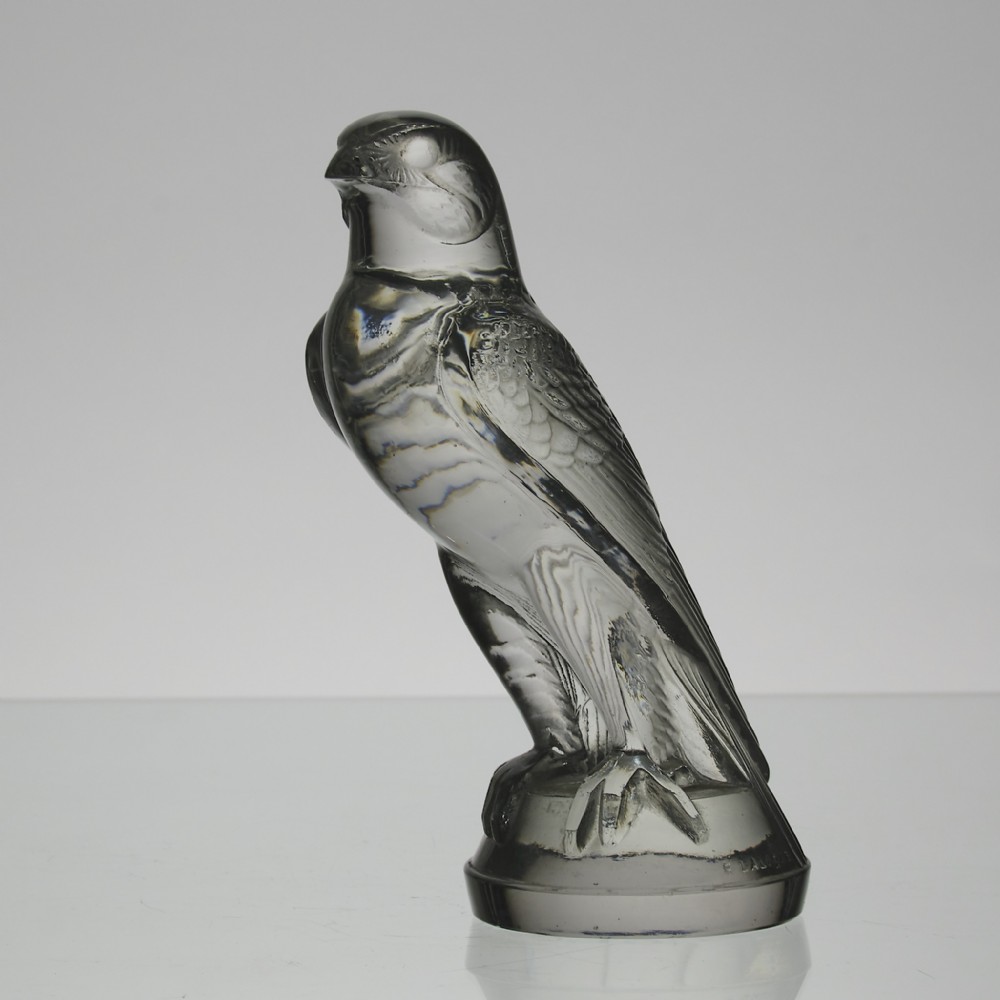
Dramatic early 20th Century French Art Deco clear glass car mascot modelled as a standing falcon with good hand finished detail, signed R Lalique and France

'Faucon' Bouchon de Radiateur

Catalogue Number: 1124

Signature Identification: “R. Lalique” Molded signature to side of base

Date Introduced: 5th August 1925

Dimensions: 15 cm Height

Felix Marcilhac Catalogue Raisonné Page 427

ADDITIONAL INFORMATION

Height: 15 cm

Condition: Excellent Original Condition

Circa: 1930

Materials: Clear Glass

Book Ref: R.Lalique – Catalogue Raisonné by Felix Marcilhac

Page No. 427

SKU: 6688

ABOUT

René Lalique Faucon

Lalique Glass

René Lalique (1860-1945) began his career as a jewellery apprentice at the age of 16, and by 1881 he was a freelance designer for many of the best-known Parisian jewellers. In 1885, he opened his own workshop on Place Gaillon in Paris, the former workshop of Jules Destape. In 1887, Lalique opened a business on Rue du Quatre-Septembre, and registered the "RL" mark the following year. In 1890, he opened a shop in the Opera District of Paris. Within a decade, Lalique was amongst the best-known Parisian jewellers.
Oiseau de Feu (Firebird), 1922

In 1905, Lalique opened a new shop at Place Vendôme which exhibited not only jewellery, but glass works as well. It was close to the shop of renowned perfumer François Coty; in 1907, Lalique began producing ornate perfume bottles for Coty. The production of glass objects began at his country villa in 1902, and continued there until at least 1912. The first Lalique glassworks opened in 1909 in a rented facility in Combs-la-Ville, which Lalique later purchased in 1913. In December 1912, Lalique hosted an exhibition of Lalique Glass—as his glass would come to be known—at the Place Vendôme shop. During the First World War, the glassworks produced mundane items in support of the war effort. In 1919, work began on a new production facility in Wingen-sur-Moder, which opened in 1921. From 1925-1931, Lalique produced 29 models of hood ornaments; a mermaid statuette first produced in 1920 was also later sold as a hood ornament. During the 1920s and 1930s, Lalique was amongst the world's most renowned glassmakers.

René Lalique died in 1945. His son Marc Lalique took over the business, operating initially as "M.Lalique" and later as "Cristal Lalique". Under Marc's leadership, the company transitioned from producing its famous Lalique Glass to producing lead glass, commonly known as crystal. Marie-Claude Lalique took control of the company following Marc's death in 1977. It was sold to Pochet in 1994 and to a partnership of Art & Fragrance and the holding company Financière Saint-Germain in 2008. Since 2010, Cristal Lalique has been wholly owned by Art & Fragrance.

Physical Dimensions
Height
15cm (5.91")
Width
12cm (4.72")
Depth
8cm (3.15")
Declaration

Hickmet Fine Arts has dated this Lalique Glass Car Mascot to the 1930s.

Reference Numbers
Sellingantiques Reference
SA1120825
Dealers Internal Reference
6688
Dealers Notes

Please contact us for a shipping quotes.

Viewing can be arranged at our gallery and everything sold by Hickmet Fine Arts comes with a full certificate of Authenticity and Valuation.

If you have enjoyed seeing this item and wish to see more quality pieces please visit our website www.hickmet.com

Description
Dramatic early 20th Century French Art Deco clear glass car mascot modelled as a standing falcon with good hand finished detail, signed R Lalique and France

'Faucon' Bouchon de Radiateur

Catalogue Number: 1124

fig 1. A clear moulded Art Deco glass car mascot depicting a falcon perched on a thick circular base.
fig 1. Early 20th Century Art Deco Glass Car Mascot Entitled "Faucon" by René Lalique

Signature Identification: “R. Lalique” Molded signature to side of base

Date Introduced: 5th August 1925

Dimensions: 15 cm Height

Felix Marcilhac Catalogue Raisonné Page 427

ADDITIONAL INFORMATION

Height: 15 cm

fig 2. A clear moulded Art Deco glass car mascot depicting a falcon perched on a thick circular base.
fig 2. Early 20th Century Art Deco Glass Car Mascot Entitled "Faucon" by René Lalique

Condition: Excellent Original Condition

Circa: 1930

Materials: Clear Glass

Book Ref: R.Lalique – Catalogue Raisonné by Felix Marcilhac

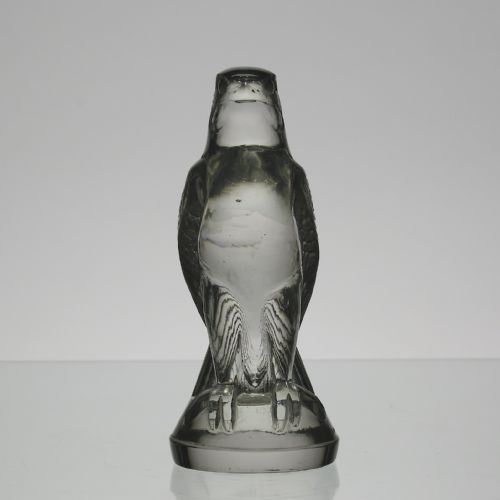
fig 3. A clear moulded Art Deco glass car mascot depicting a falcon perched on a thick circular base.
fig 3. Early 20th Century Art Deco Glass Car Mascot Entitled "Faucon" by René Lalique

Page No. 427

SKU: 6688

ABOUT

René Lalique Faucon

Lalique Glass

René Lalique (1860-1945) began his career as a jewellery apprentice at the age of 16, and by 1881 he was a freelance designer for many of the best-known Parisian jewellers.
Hickmet Fine Arts

In 1885, he opened his own workshop on Place Gaillon in Paris, the former workshop of Jules Destape. In 1887, Lalique opened a business on Rue du Quatre-Septembre, and registered the "RL" mark the following year. In 1890, he opened a shop in the Opera District of Paris. Within a decade, Lalique was amongst the best-known Parisian jewellers.

fig 4. A clear moulded Art Deco glass car mascot depicting a falcon perched on a thick circular base.
fig 4. Early 20th Century Art Deco Glass Car Mascot Entitled "Faucon" by René Lalique

Oiseau de Feu (Firebird), 1922

In 1905, Lalique opened a new shop at Place Vendôme which exhibited not only jewellery, but glass works as well. It was close to the shop of renowned perfumer François Coty; in 1907, Lalique began producing ornate perfume bottles for Coty. The production of glass objects began at his country villa in 1902, and continued there until at least 1912. The first Lalique glassworks opened in 1909 in a rented facility in Combs-la-Ville, which Lalique later purchased in 1913. In December 1912, Lalique hosted an exhibition of Lalique Glass—as his glass would come to be known—at the Place Vendôme shop. During the First World War, the glassworks produced mundane items in support of the war effort. In 1919, work began on a new production facility in Wingen-sur-Moder, which opened in 1921. From 1925-1931, Lalique produced 29 models of hood ornaments; a mermaid statuette first produced in 1920 was also later sold as a hood ornament. During the 1920s and 1930s, Lalique was amongst the world's most renowned glassmakers.

fig 5. A clear moulded Art Deco glass car mascot depicting a falcon perched on a thick circular base.
fig 5. Early 20th Century Art Deco Glass Car Mascot Entitled "Faucon" by René Lalique

René Lalique died in 1945. His son Marc Lalique took over the business, operating initially as "M.Lalique" and later as "Cristal Lalique". Under Marc's leadership, the company transitioned from producing its famous Lalique Glass to producing lead glass, commonly known as crystal. Marie-Claude Lalique took control of the company following Marc's death in 1977. It was sold to Pochet in 1994 and to a partnership of Art & Fragrance and the holding company Financière Saint-Germain in 2008. Since 2010, Cristal Lalique has been wholly owned by Art & Fragrance.

Height
15cm (5.91")
Width
12cm (4.72")
Depth
8cm (3.15")
Date of Manufacture

Hickmet Fine Arts has dated this Lalique Glass Car Mascot to the 1930s.

Reference Numbers
Sellingantiques Ref
SA1120825
Dealers Internal Ref
6688
Hickmet Fine Arts
Hickmet Fine Arts
Sellingantiques verified Since Apr 2012

Established in 1936, hickmet fine arts is an international family run antiques business

Dealer Profile

You can view the stock and full dealer information on the Hickmet Fine Arts Profile Page

Trade Associations

Hickmet Fine Arts is a registered member of LAPADA  BADA  CINOA

PDF SHARE
SAVE
A clear moulded Art Deco glass car mascot depicting a falcon perched on a thick circular base.
1 / 10
Archive I A clear moulded Art Deco glass car mascot depicting a falcon perched on a thick circular base.

Early 20th Century Art Deco Glass Car Mascot Entitled "Faucon" by René Lalique

Archive II A clear moulded Art Deco glass car mascot depicting a falcon perched on a thick circular base. View II
Archive III A clear moulded Art Deco glass car mascot depicting a falcon perched on a thick circular base. View III
Archive IV A clear moulded Art Deco glass car mascot depicting a falcon perched on a thick circular base. View IV
Archive V A clear moulded Art Deco glass car mascot depicting a falcon perched on a thick circular base. View V
Archive VI A clear moulded Art Deco glass car mascot depicting a falcon perched on a thick circular base. View VI
Archive VII A clear moulded Art Deco glass car mascot depicting a falcon perched on a thick circular base. View VII
Archive VIII A clear moulded Art Deco glass car mascot depicting a falcon perched on a thick circular base. View VIII
Archive IX A clear moulded Art Deco glass car mascot depicting a falcon perched on a thick circular base. View IX
Archive X A clear moulded Art Deco glass car mascot depicting a falcon perched on a thick circular base. View X
Enlarged Archival View
Telephone 07971 850405
Location
Gallery Eighty Five
85 Portobello Road
London
W11 2QB
United Kingdom
Verified Since Apr 2012
Items For Sale 112
Items Sold 6
Hickmet Fine Arts
Hickmet Fine Arts
Verified Since Apr 2012
View Dealer Info
Location: Gallery Eighty Five, 85 Portobello Road, London, W11 2QB, United Kingdom
Verified
Apr 2012
For Sale
112
Sold
6
A clear moulded Art Deco glass car mascot depicting a falcon perched on a thick circular base.
Early 20th Century Art Deco Glass Car Mascot entitled "Faucon" by René Lalique
Ref: SA1120825
A clear moulded Art Deco glass car mascot depicting a falcon perched on a thick circular base.
Detail View 1
Detail View 2
Detail View 3
Detail View 4
Detail View 5
Detail View 6
Detail View 7
Detail View 8
Detail View 9
Archival Detail
Every single antique dealer on our platform is individually approved by our internal team. We verify their professional trade history, ethical standards, and photographic quality to ensure a secure, high-standard buying environment. Upon joining, every dealer agrees to a strict 9-point code of conduct. While issues can occasionally arise, our dealers typically resolve them swiftly and directly with the buyer. In fact, since our founding in 2002, Sellingantiques has only had to step in to help resolve an issue on roughly five occasions—a true testament to the quality of our dealers and their dedication to your happiness.
Our dealers are highly experienced in packing and shipping fragile, high-value antiques. Because you are in direct contact with the dealer, you will be able to easily go through all available shipping and insurance options together to ensure your item arrives safely.
Antiques are the ultimate green purchase. By choosing historical pieces over newly manufactured goods, you completely eliminate the carbon footprint of modern mass production while preserving exceptional, timeless craftsmanship.

An Art Deco glass car mascot is a decorative ornament originally designed to sit atop an automobile radiator cap during the 1920s and 1930s, featuring aerodynamic, stylised forms, animals, or figures.

These mascots were produced using heavy moulded or pressed glass, frequently featuring a combination of polished areas and satin-finished frosted details produced via acid etching.

Authentic pieces generally display moulded or wheel-cut signatures such as R. LALIQUE, precise mould seams, high-density glass, and specific base dimensions designed for vehicle mounts.

A glass mascot can be displayed on an office desk, mantelpiece, or bookshelf, ideally illuminated by natural or direct spotlighting to accentuate the translucent glass details.

Dust regularly with a soft microfibre cloth and wash carefully with warm water and mild liquid soap, avoiding harsh chemicals, abrasives, or extreme temperature fluctuations.
items
Add keywords to the filter
Price
£100
£250000
Era
Movements
Material
Origin
Stock Location
Freshness
Online Payments
Categories