29,353  PAGES BROWSED TODAY PAGES TODAY 74  ANTIQUES UPLOADED TODAY NEW ARRIVALS
ID #SA1112407
FOR SALE
£550
Email
Save
Small Japanese Cloisonne Enamel 'Ho-o' Bird / Phoenix Charger. Circa 1870.
Dragoncharger Antiques
for sale €644     $699
£550

Dragoncharger Antiques

Sellingantiques Verified Since Aug 2024
View Dealers Stock Page
  • About Us
    Specialising in early japanese cloisonne, edo enamel artisan period.
Id #SA1112407
PDF SHARE
SAVE

Small Japanese Cloisonne Enamel 'Ho-o' Bird / Phoenix Charger. Circa 1870.

19th century
Description

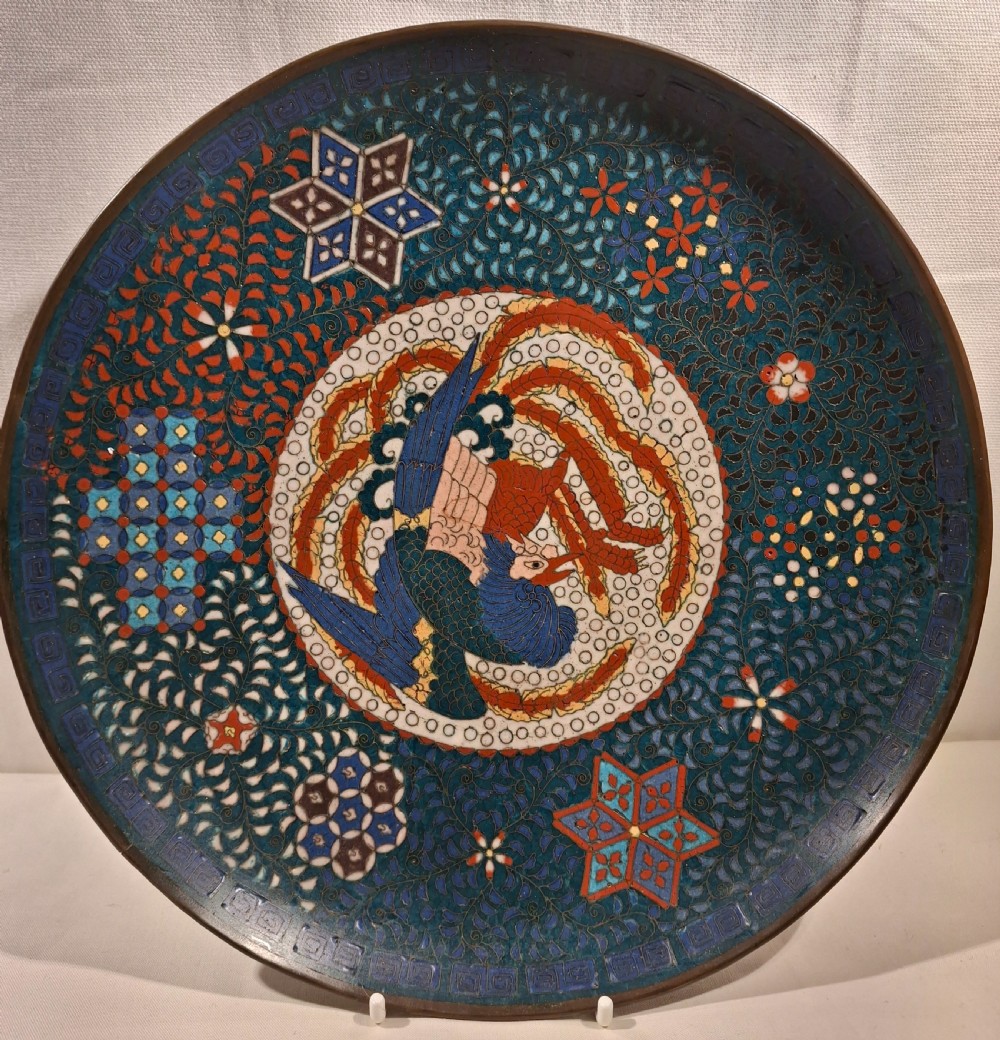
Small Japanese Cloisonne Enamel 'Ho-o' Bird / Phoenix charger. Circa 1870.

Superbly and finely decorated early Japanese cloisonne piece. Central decoration with Ho-o Bird within the clouds (of the heavens). Known in English as the hoho bird, is the Japanese pronunciation of the more common name, Fenghuang, a bird from East Asian mythology with similarities to the phoenix. Deep green enamel work typical of period and style. Decorated with brocade, stylised waves, mosaic panels and grasses. High-quality cloisonné with skilled brass wire work and multi- coloured enamels. Body is decorated with patterns of Karakusa flowers and geometrical patterns. Substantial use of wires, both decorative and functional in anchoring the enamel in early Japanese cloisonne work. Fine wire work and enamelling technique of the period, most likely from the Nagoya workshop.

Condition: Excellent condition and good circular shape. Some cloisonne losses to the rear in two places shown in photos (next to rim). [Display stand not part of Sale]

Dimensions: Height = 4cm; Diameter = 24.5cm (approx).

* The ho-o bird ( is a mythical creature adapted from Asian mythology that incorporates parts of several creatures such as the rooster, mandarin duck, peacock, crane, and pheasant. The bird was said to bring luck, symbolising good fortune; specifically longevity, fidelity and wisdom.

* In the 1830s, Kaji Tsunekichi of Nagoya obtained a piece of Cloisonné enamel and deconstructed it in order to examine how it had been made. He then reworked the piece to produce a small dish with wired enamel decoration. By the 1850s he had opened a workshop (Nagoya), taken on students and was appointed as the official maker of Cloisonné in the Owari Province.

Physical Dimensions
Height
4cm (1.57")
Width
24.5cm (9.65")
Depth
24.5cm (9.65")
Declaration

Dragoncharger Antiques has dated this Japanese Cloisonne Phoenix Charger to the 1870s.

Reference Numbers
Sellingantiques Reference
SA1112407
Dealers Internal Reference
D:22231 103
Description
Small Japanese Cloisonne Enamel 'Ho-o' Bird / Phoenix charger. Circa 1870.

Superbly and finely decorated early Japanese cloisonne piece. Central decoration with Ho-o Bird within the clouds (of the heavens).

Known in English as the hoho bird, is the Japanese pronunciation of the more common name, Fenghuang, a bird from East Asian mythology with similarities to the phoenix.
Dragoncharger Antiques

Deep green enamel work typical of period and style. Decorated with brocade, stylised waves, mosaic panels and grasses. High-quality cloisonné with skilled brass wire work and multi- coloured enamels. Body is decorated with patterns of Karakusa flowers and geometrical patterns. Substantial use of wires, both decorative and functional in anchoring the enamel in early Japanese cloisonne work. Fine wire work and enamelling technique of the period, most likely from the Nagoya workshop.

fig 1. A circular Japanese cloisonne enamel charger depicting a central blue and red phoenix surrounded by intricate geometric and floral patterns on a dark teal field.
fig 1. Small Japanese Cloisonne Enamel 'Ho-o' Bird / Phoenix Charger. Circa 1870.

Condition: Excellent condition and good circular shape. Some cloisonne losses to the rear in two places shown in photos (next to rim). [Display stand not part of Sale]

Dimensions: Height = 4cm; Diameter = 24.5cm (approx).

fig 2. A circular Japanese cloisonne enamel charger depicting a central blue and red phoenix surrounded by intricate geometric and floral patterns on a dark teal field.
fig 2. Small Japanese Cloisonne Enamel 'Ho-o' Bird / Phoenix Charger. Circa 1870.

The ho-o bird ( is a mythical creature adapted from Asian mythology that incorporates parts of several creatures such as the rooster, mandarin duck, peacock, crane, and pheasant. The bird was said to bring luck, symbolising good fortune; specifically longevity, fidelity and wisdom.

fig 3. A circular Japanese cloisonne enamel charger depicting a central blue and red phoenix surrounded by intricate geometric and floral patterns on a dark teal field.
fig 3. Small Japanese Cloisonne Enamel 'Ho-o' Bird / Phoenix Charger. Circa 1870.

In the 1830s, Kaji Tsunekichi of Nagoya obtained a piece of Cloisonné enamel and deconstructed it in order to examine how it had been made. He then reworked the piece to produce a small dish with wired enamel decoration. By the 1850s he had opened a workshop (Nagoya), taken on students and was appointed as the official maker of Cloisonné in the Owari Province.

Height
4cm (1.57")
Width
24.5cm (9.65")
Depth
24.5cm (9.65")
Date of Manufacture

Dragoncharger Antiques has dated this Japanese Cloisonne Phoenix Charger to the 1870s.

Reference Numbers
Sellingantiques Ref
SA1112407
Dealers Internal Ref
D:22231 103
Dragoncharger Antiques
Sellingantiques verified Since Aug 2024

Specialising in early japanese cloisonne, edo enamel artisan period.

Dealer Profile

You can view the stock and full dealer information on the Dragoncharger Antiques Profile Page
PDF SHARE
SAVE
A circular Japanese cloisonne enamel charger depicting a central blue and red phoenix surrounded by intricate geometric and floral patterns on a dark teal field.
1 / 9
Archive I A circular Japanese cloisonne enamel charger depicting a central blue and red phoenix surrounded by intricate geometric and floral patterns on a dark teal field.

Small Japanese Cloisonne Enamel 'Ho-o' Bird / Phoenix Charger. Circa 1870.

Archive II A circular Japanese cloisonne enamel charger depicting a central blue and red phoenix surrounded by intricate geometric and floral patterns on a dark teal field. View II
Archive III A circular Japanese cloisonne enamel charger depicting a central blue and red phoenix surrounded by intricate geometric and floral patterns on a dark teal field. View III
Archive IV A circular Japanese cloisonne enamel charger depicting a central blue and red phoenix surrounded by intricate geometric and floral patterns on a dark teal field. View IV
Archive V A circular Japanese cloisonne enamel charger depicting a central blue and red phoenix surrounded by intricate geometric and floral patterns on a dark teal field. View V
Archive VI A circular Japanese cloisonne enamel charger depicting a central blue and red phoenix surrounded by intricate geometric and floral patterns on a dark teal field. View VI
Archive VII A circular Japanese cloisonne enamel charger depicting a central blue and red phoenix surrounded by intricate geometric and floral patterns on a dark teal field. View VII
Archive VIII A circular Japanese cloisonne enamel charger depicting a central blue and red phoenix surrounded by intricate geometric and floral patterns on a dark teal field. View VIII
Archive IX A circular Japanese cloisonne enamel charger depicting a central blue and red phoenix surrounded by intricate geometric and floral patterns on a dark teal field. View IX
Enlarged Archival View
Telephone 07974 144321
Location
Bristol
United Kingdom
Verified Since Aug 2024
Items For Sale 150
Items Sold 17
Dragoncharger Antiques
Verified Since Aug 2024
View Dealer Info
Location: Bristol, United Kingdom
Verified
Aug 2024
For Sale
150
Sold
17
A circular Japanese cloisonne enamel charger depicting a central blue and red phoenix surrounded by intricate geometric and floral patterns on a dark teal field.
Small Japanese Cloisonne Enamel 'Ho-o' Bird / Phoenix Charger. Circa 1870.
Ref: SA1112407
A circular Japanese cloisonne enamel charger depicting a central blue and red phoenix surrounded by intricate geometric and floral patterns on a dark teal field.
Detail View 1
Detail View 2
Detail View 3
Detail View 4
Detail View 5
Detail View 6
Detail View 7
Detail View 8
Archival Detail
Every single antique dealer on our platform is individually approved by our internal team. We verify their professional trade history, ethical standards, and photographic quality to ensure a secure, high-standard buying environment. Upon joining, every dealer agrees to a strict 9-point code of conduct. While issues can occasionally arise, our dealers typically resolve them swiftly and directly with the buyer. In fact, since our founding in 2002, Sellingantiques has only had to step in to help resolve an issue on roughly five occasions—a true testament to the quality of our dealers and their dedication to your happiness.
Our dealers are highly experienced in packing and shipping fragile, high-value antiques. Because you are in direct contact with the dealer, you will be able to easily go through all available shipping and insurance options together to ensure your item arrives safely.
Antiques are the ultimate green purchase. By choosing historical pieces over newly manufactured goods, you completely eliminate the carbon footprint of modern mass production while preserving exceptional, timeless craftsmanship.

Cloisonne enamelware, known in Japan as shippo-yaki, involves applying enamel paste into cells formed by thin metal wires fixed onto a copper or bronze metal base. During the Meiji period (18681912), Japanese artisans refined this technique, creating detailed geometric patterns, naturalistic motifs, and complex colour palettes.

These decorative objects feature a copper or bronze base layered with fine brass, copper, or silver wires that delineate the design cells. Vitreous enamel pastes made of crushed glass and metallic oxide colourants were applied into the compartments before high-temperature firing and hand-polishing.

Authentic 19th-century Japanese cloisonne pieces generally feature precise wirework, dark background enamels, and a substantial weight relative to their size. Early Meiji examples often display subtle surface pinholes from the firing process alongside complex geometric borders surrounding central central motifs.

An antique cloisonne charger can be displayed upright on a dark wood plate stand situated on a sideboard or bookshelf. Alternatively, mounting the charger on a wall within an alcove or styled display case creates an engaging focal point.

Dust the surface regularly using a dry, soft microfibre cloth or a soft-bristled brush. Avoid using water, liquid chemical cleaners, or abrasive polishes, as moisture can penetrate hairline fractures in the enamel or cause oxidisation to exposed metal wires.
items
Add keywords to the filter
Price
£100
£250000
Era
Movements
Material
Origin
Stock Location
Freshness
Online Payments
Categories