57,141  PAGES BROWSED TODAY PAGES TODAY 103  ANTIQUES UPLOADED TODAY NEW ARRIVALS
ID #SA1108462
FOR SALE
£75,000
Email
Save
A Very Fine and Rare Walnut 8-Day Longcase Clock – Joseph Knibb
The Antique Clock Co.
for sale €87,750     $95,250
£75,000
The Antique Clock Co.

The Antique Clock Co.

Sellingantiques Verified Since Apr 2021
View Dealers Stock Page
Id #SA1108462
PDF SHARE
SAVE

A Very Fine and Rare Walnut 8-Day Longcase Clock – Joseph Knibb

17th century
Description

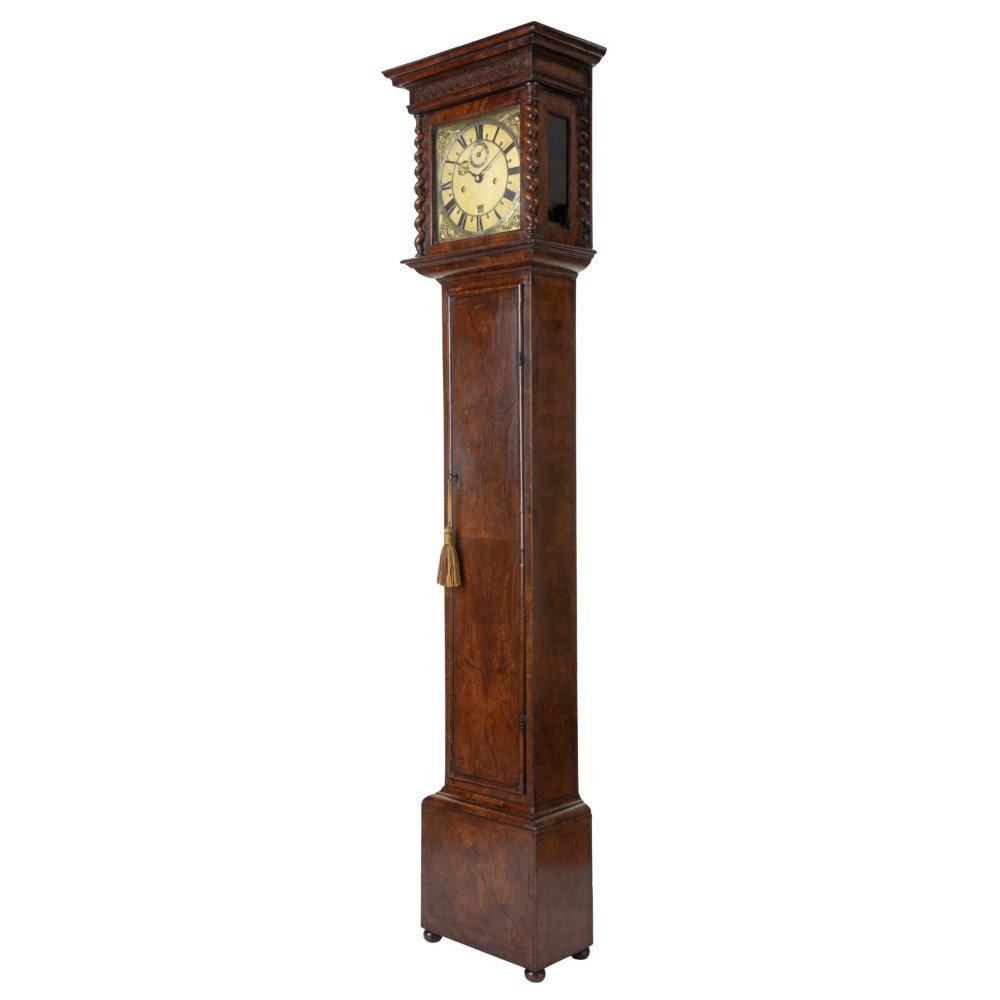
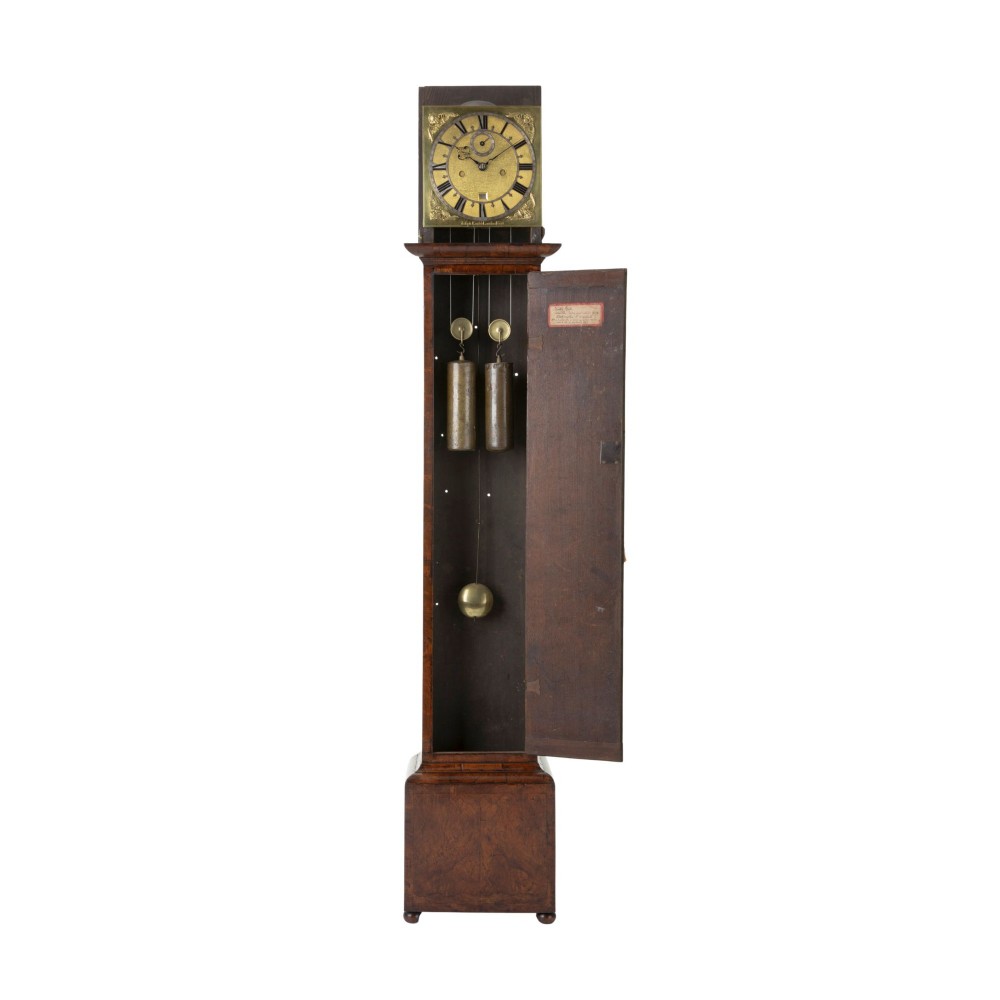
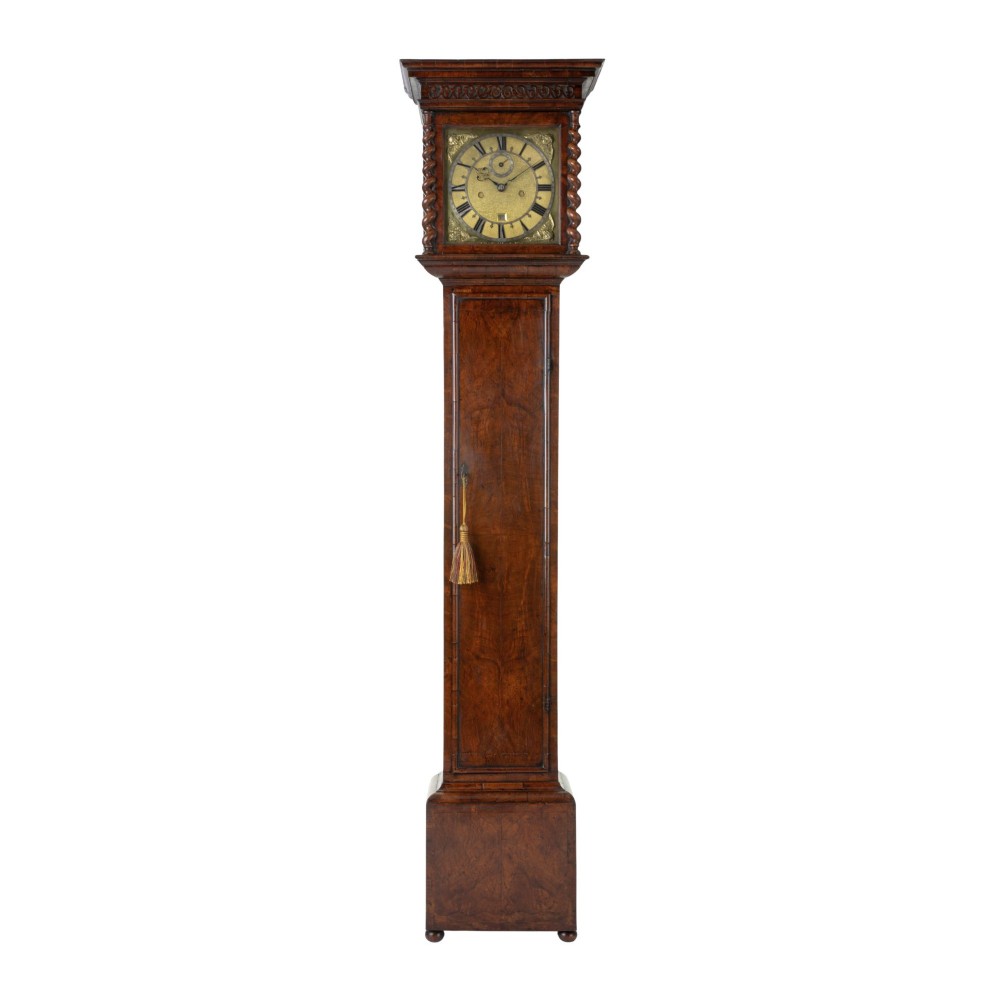
A true masterpiece of horological design and craftsmanship. The Walnut case is elegantly proportioned. It features a rectangular trunk door with its original reversed iron hinges and beautifully preserved original mouldings above the plinth, all raised on refined bun feet. The rising hood has since been converted and is enhanced with a convex throat moulding, twisted walnut columns, glazed sides, and a decorative pierced walnut sound fret atop the cornice, showcasing exquisite attention to detail.
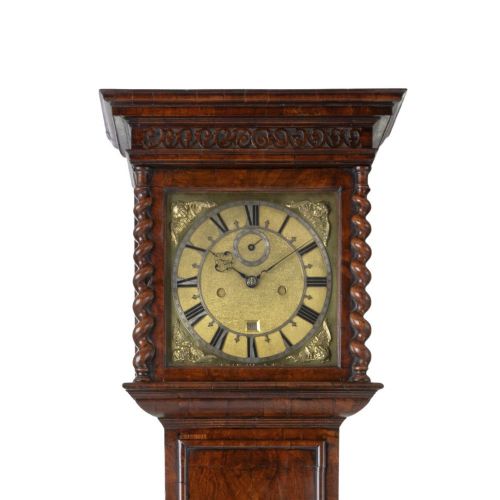
The clock’s 10-inch square gilt-brass dial, fully latched and signed “Joseph Knibb London,” displays a skeletonised silvered chapter ring engraved with Roman numerals, Arabic minute markers, and fleur-de-lis half-hour markers, characteristic of Knibb’s distinctive style. The expertly pierced blued steel hands are elegantly sculpted, and the finely matted centre is adorned with a calendar aperture above the VI, a subsidiary seconds ring. Corners are embellished with gilt-brass winged cherub spandrels.
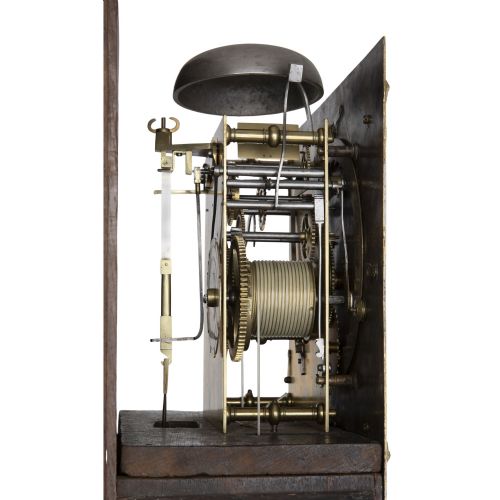
An exceptional eight-day, weight-driven movement secured to the backboard with an L-shaped retaining bracket for stability. The plates are connected by five latched, knopped, and ringed pillars, showcasing the quality of traditional craftsmanship. It operates with a refined anchor escapement driving a brass-faced pendulum, equipped with a butterfly suspension and bolt-and-shutter maintaining power with an outside countwheel on the backplate.
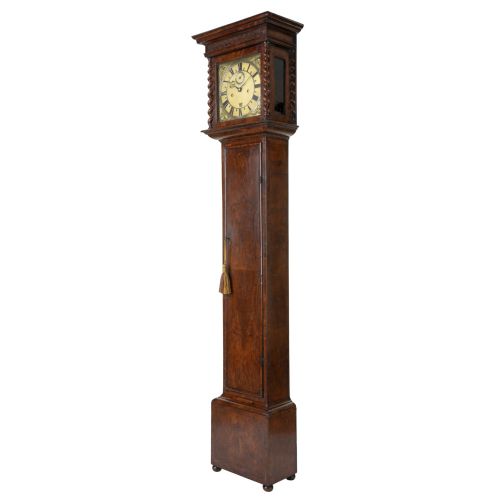
This clock promises both reliability and classic elegance and captures the essence of early English clockmaking, making it a prized addition for any horology enthusiast or collector.

Joseph Knibb (1640–1711) was one of the most distinguished English clockmakers of the late 17th century. Known for his precision and innovation, Knibb was part of the esteemed Knibb family of clockmakers and apprenticed under his cousin, Samuel Knibb. He began his own practice in Oxford and later moved to London around 1670, where he became well-regarded for both his artistic and technical contributions to horology.
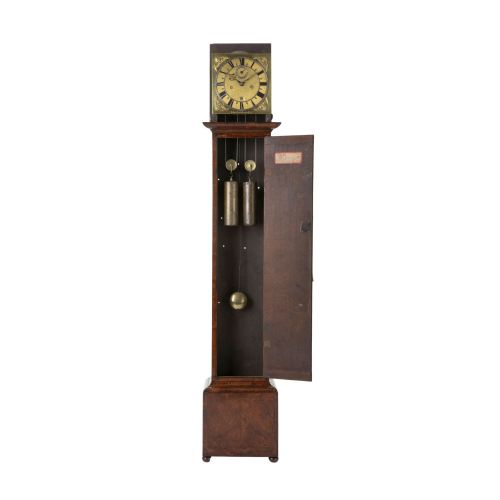
Knibb is celebrated for his advancements in clock mechanisms, notably his development of the anchor escapement and his early use of bolt-and-shutter maintaining power, allowing the clock to continue running while wound. These features marked a leap in timekeeping accuracy and reliability. Knibb’s clocks often include fine decorative touches, such as skeletonised chapter rings and fleur-de-lis half-hour markers. He is also known for the “Roman striking” system, which strikes the hours in a way that economises bell strikes for fewer disruptions.

A signature style of Knibb’s longcase clocks is their elegant walnut cases with architectural elements, including glazed panels and sound frets, which enhanced both their functionality and aesthetic appeal. Today, Joseph Knibb’s clocks are highly valued for their craftsmanship and are considered some of the finest examples of English clockmaking.

Serviced and guaranteed for 3 years.

Height: 74? or 188 cm

CIRCA. 1680

Provenance: Private collection, UK

Would you like to view this clock in your own home?

Contact us to arrange a viewing with our Homeview service.

(T&C’s apply.)

Physical Dimensions
Height
188cm (74.02")
Declaration

The Antique Clock Co. has dated this Antique Walnut Longcase Clock to the 17th Century.

Reference Numbers
Sellingantiques Reference
SA1108462
Description
A true masterpiece of horological design and craftsmanship. The Walnut case is elegantly proportioned.
It features a rectangular trunk door with its original reversed iron hinges and beautifully preserved original mouldings above the plinth, all raised on refined bun feet.
The Antique Clock Co.

The rising hood has since been converted and is enhanced with a convex throat moulding, twisted walnut columns, glazed sides, and a decorative pierced walnut sound fret atop the cornice, showcasing exquisite attention to detail.

fig 1. A slender late 17th-century walnut longcase clock featuring a square brass dial, barley twist hood columns, and rich figure-grained timber.
fig 1. A Very Fine and Rare Walnut 8-Day Longcase Clock – Joseph Knibb

The clock’s 10-inch square gilt-brass dial, fully latched and signed “Joseph Knibb London,” displays a skeletonised silvered chapter ring engraved with Roman numerals, Arabic minute markers, and fleur-de-lis half-hour markers, characteristic of Knibb’s distinctive style. The expertly pierced blued steel hands are elegantly sculpted, and the finely matted centre is adorned with a calendar aperture above the VI, a subsidiary seconds ring. Corners are embellished with gilt-brass winged cherub spandrels.

fig 2. A slender late 17th-century walnut longcase clock featuring a square brass dial, barley twist hood columns, and rich figure-grained timber.
fig 2. A Very Fine and Rare Walnut 8-Day Longcase Clock – Joseph Knibb

An exceptional eight-day, weight-driven movement secured to the backboard with an L-shaped retaining bracket for stability. The plates are connected by five latched, knopped, and ringed pillars, showcasing the quality of traditional craftsmanship. It operates with a refined anchor escapement driving a brass-faced pendulum, equipped with a butterfly suspension and bolt-and-shutter maintaining power with an outside countwheel on the backplate.

fig 3. A slender late 17th-century walnut longcase clock featuring a square brass dial, barley twist hood columns, and rich figure-grained timber.
fig 3. A Very Fine and Rare Walnut 8-Day Longcase Clock – Joseph Knibb

This clock promises both reliability and classic elegance and captures the essence of early English clockmaking, making it a prized addition for any horology enthusiast or collector.

Joseph Knibb (1640–1711) was one of the most distinguished English clockmakers of the late 17th century. Known for his precision and innovation, Knibb was part of the esteemed Knibb family of clockmakers and apprenticed under his cousin, Samuel Knibb. He began his own practice in Oxford and later moved to London around 1670, where he became well-regarded for both his artistic and technical contributions to horology.

fig 4. A slender late 17th-century walnut longcase clock featuring a square brass dial, barley twist hood columns, and rich figure-grained timber.
fig 4. A Very Fine and Rare Walnut 8-Day Longcase Clock – Joseph Knibb

Knibb is celebrated for his advancements in clock mechanisms, notably his development of the anchor escapement and his early use of bolt-and-shutter maintaining power, allowing the clock to continue running while wound. These features marked a leap in timekeeping accuracy and reliability. Knibb’s clocks often include fine decorative touches, such as skeletonised chapter rings and fleur-de-lis half-hour markers. He is also known for the “Roman striking” system, which strikes the hours in a way that economises bell strikes for fewer disruptions.

A signature style of Knibb’s longcase clocks is their elegant walnut cases with architectural elements, including glazed panels and sound frets, which enhanced both their functionality and aesthetic appeal. Today, Joseph Knibb’s clocks are highly valued for their craftsmanship and are considered some of the finest examples of English clockmaking.

Serviced and guaranteed for 3 years.

Height: 74? or 188 cm

CIRCA. 1680

Provenance: Private collection, UK

Would you like to view this clock in your own home?

Contact us to arrange a viewing with our Homeview service.

(T&C’s apply.)

Height
188cm (74.02")
Date of Manufacture

The Antique Clock Co. has dated this Antique Walnut Longcase Clock to the 17th Century.

Reference Numbers
Sellingantiques Ref
SA1108462
The Antique Clock Co.
Sellingantiques verified Since Apr 2021
Dealer Profile

You can view the stock and full dealer information on the The Antique Clock Co. Profile Page
PDF SHARE
SAVE
A slender late 17th-century walnut longcase clock featuring a square brass dial, barley twist hood columns, and rich figure-grained timber.
1 / 5
Archive I A slender late 17th-century walnut longcase clock featuring a square brass dial, barley twist hood columns, and rich figure-grained timber.

A Very Fine and Rare Walnut 8-Day Longcase Clock – Joseph Knibb
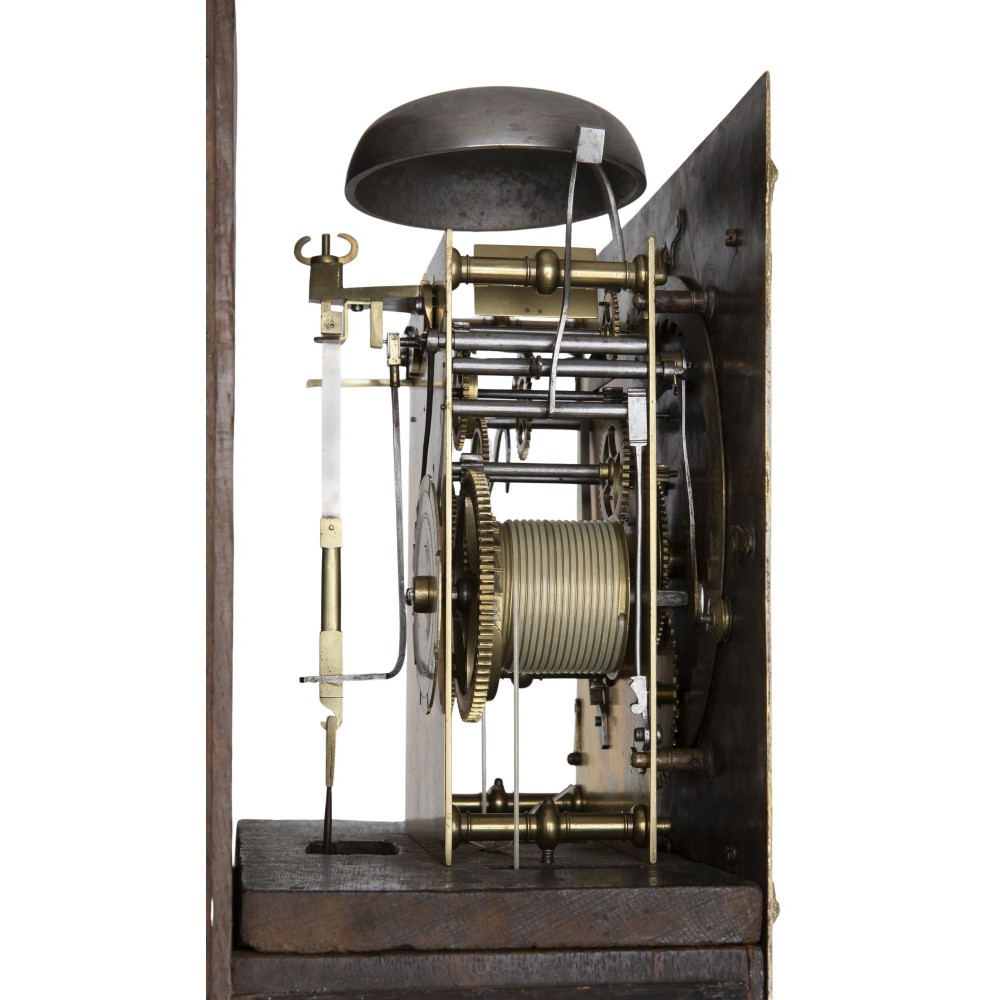
Archive II A slender late 17th-century walnut longcase clock featuring a square brass dial, barley twist hood columns, and rich figure-grained timber. View II
Archive III A slender late 17th-century walnut longcase clock featuring a square brass dial, barley twist hood columns, and rich figure-grained timber. View III
Archive IV A slender late 17th-century walnut longcase clock featuring a square brass dial, barley twist hood columns, and rich figure-grained timber. View IV
Archive V A slender late 17th-century walnut longcase clock featuring a square brass dial, barley twist hood columns, and rich figure-grained timber. View V
Enlarged Archival View
Telephone 01305 873852
Location
West Yard Barn
West Street
Abbotsbury
Weymouth
Dorset
DT3 4JT
United Kingdom

By appointment only.
Verified Since Apr 2021
Items For Sale 113
Items Sold 65
The Antique Clock Co.
Verified Since Apr 2021
View Dealer Info
Location: West Yard Barn, West Street, Abbotsbury, Weymouth, Dorset, DT3 4JT, United Kingdom, , By appointment only.
Verified
Apr 2021
For Sale
113
Sold
65
A slender late 17th-century walnut longcase clock featuring a square brass dial, barley twist hood columns, and rich figure-grained timber.
A VERY FINE AND RARE WALNUT 8-DAY LONGCASE CLOCK – JOSEPH KNIBB
Ref: SA1108462
A slender late 17th-century walnut longcase clock featuring a square brass dial, barley twist hood columns, and rich figure-grained timber.
Detail View 2
Detail View 3
Detail View 4
Detail View 5
Archival Detail
Every single antique dealer on our platform is individually approved by our internal team. We verify their professional trade history, ethical standards, and photographic quality to ensure a secure, high-standard buying environment. Upon joining, every dealer agrees to a strict 9-point code of conduct. While issues can occasionally arise, our dealers typically resolve them swiftly and directly with the buyer. In fact, since our founding in 2002, Sellingantiques has only had to step in to help resolve an issue on roughly five occasions—a true testament to the quality of our dealers and their dedication to your happiness.
Our dealers are highly experienced in packing and shipping fragile, high-value antiques. Because you are in direct contact with the dealer, you will be able to easily go through all available shipping and insurance options together to ensure your item arrives safely.
Antiques are the ultimate green purchase. By choosing historical pieces over newly manufactured goods, you completely eliminate the carbon footprint of modern mass production while preserving exceptional, timeless craftsmanship.

Originating in the Restoration and William & Mary periods, longcase clocks of this era are characterised by slender proportions, figure-grained walnut or olivewood veneers, square brass dials with spandrels, and eight-day or thirty-hour weight-driven movements.

Cabinets were typically constructed from an oak carcass overlaid with figured walnut, marquetry, or floral lacquer. Dial plates were cast in solid brass, featuring silvered chapter rings, blued steel hands, and cast brass corner spandrels.

Key features include a square brass dial under 12 inches, winged cherub or mask spandrels, barley twist columns flanking the hood, latch-mounted movement plates, and a narrow trunk case scaled to early pendulum dimensions.

A period longcase clock serves as a focal vertical anchor in an entrance hall, drawing room, or library, contrasting effectively against contemporary architectural backdrops and neutral minimalist walls.

Position the cabinet away from direct sunlight and central heating radiators to prevent veneer lifting. Apply a high-grade beeswax polish sparingly once or twice a year, and have the mechanical movement serviced by a qualified horologist every five to seven years.
items
Add keywords to the filter
Price
£100
£250000
Era
Movements
Material
Origin
Stock Location
Freshness
Online Payments
Categories