24,910  PAGES BROWSED TODAY PAGES TODAY 71  ANTIQUES UPLOADED TODAY NEW ARRIVALS
ID #SA1100412
FOR SALE
£3,350
Email
Save
Epstein Art Deco Sideboard 1930s Fine Condition
The Design Gallery
for sale €3,920     $4,255
£3,350

The Design Gallery

Sellingantiques Verified Since Sep 2024
View Dealers Stock Page
  • About Us
    Specialists in 19th and 20th century design
Id #SA1100412
PDF SHARE
SAVE

Epstein Art Deco Sideboard 1930s Fine Condition

1920 - 1940
Description

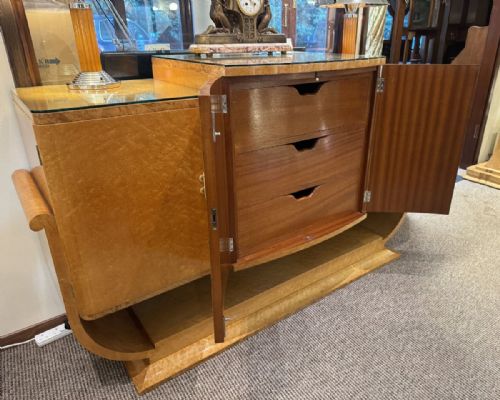
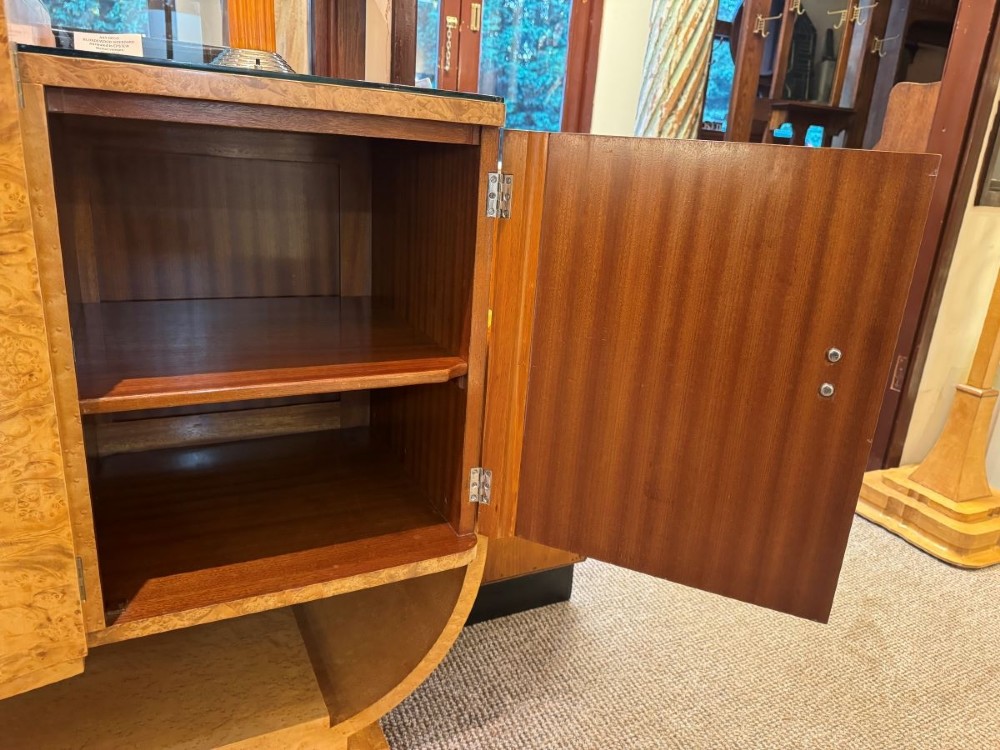
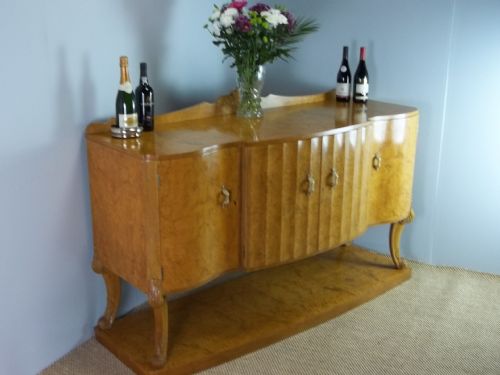
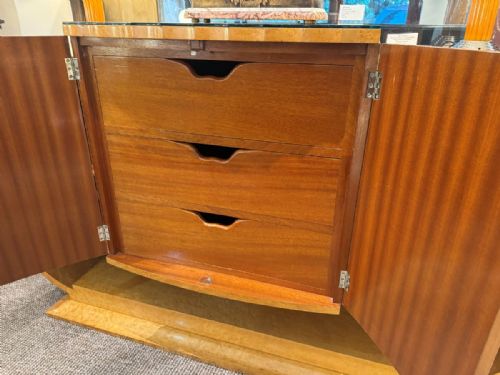
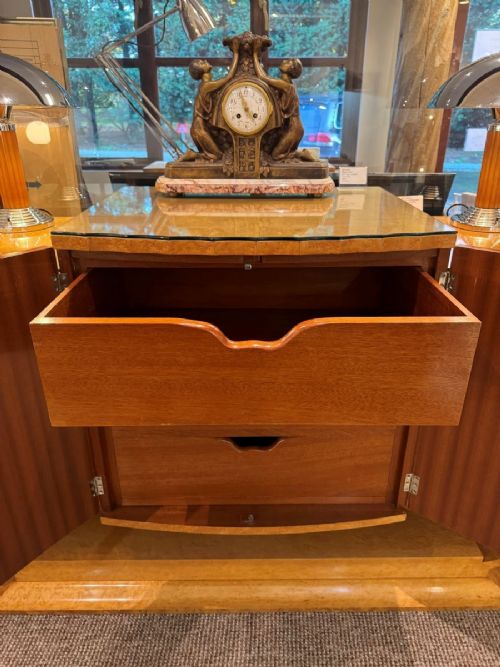
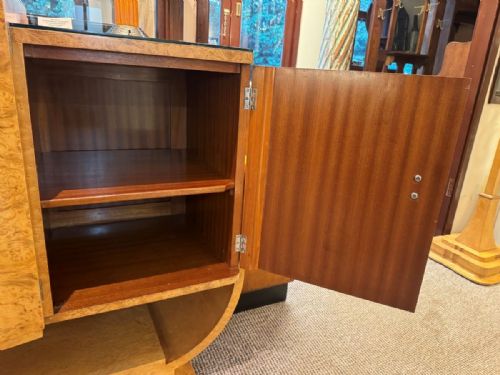
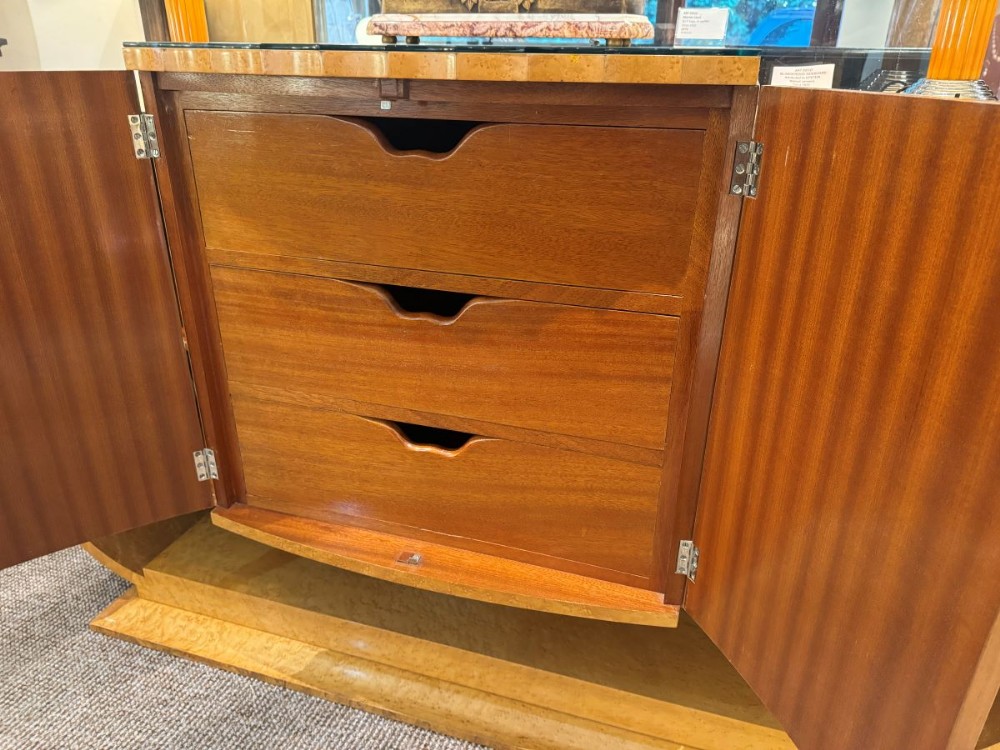
Art Deco Sideboard by Epstein, 1930s, fine condition. Maple and Bird's Eye Maple veneers. U-base and plinth. Classic fluted front. Cupboards to either side and three deep drawers to the centre section.

From a collection of Art Deco furniture at the 3000 sq.ft. Showroom and Warehouse in Marsh Green, Edenbridge, Kent 01959 561234. We have specialised in Arts and Crafts Movement and Art Deco for 24 years and wrote the chapters 'Art Deco Furniture' and 'Art Deco Ceramics' for Judith Miller's book '20th Century Design.'

EPSTEIN: The quality of the furniture produced by the Epstein brothers of London’s East End is recognised as among the finest in the British Art Deco style – both in terms of design and production. Dr Roger Shuff, a research historian who has worked with The Design Gallery for 20 years, is one of the UK’s leading experts on the firm and explains:
Morris (also known as Solomon) Epstein (1870-1940), a Russian immigrant cabinet maker arrived in London’s East End in 1890, and subsequently married Katie Fellner (1882-1960) in 1901. Their children included six sons born in the early years of the twentieth century: Reuben (1902-1965); Isaac – known as Sidney (1904-1974); David (1906-1972); Harry (1909-1996); Louis – also known as Lewis or Lou (1911-1986) and Michael – also known as Myer (1915-1999). During the 1920s all six brothers followed their father into the furniture trade as cabinet makers and joined the firm M Epstein & Sons at 1 Gun Street, London, E1. Morris retired in 1929 and his young sons – most notably Harry and Louis – went on to design and produce some of the most innovative furniture of the Art Deco period, trading as furniture makers, wholesalers and retailers under a variety of business names both individually and in partnership with one another.

Their style reflected the avant-garde influences of the Paris 1925 ‘Art Deco’ exhibition, seen in their use of curvilinear forms and rich veneers. These traits blended, almost unconsciously, with a certain grandeur and scale that derived from their family’s Russian background, and found expression in designs that were also in tune with the Modernist ethos emanating from continental Europe. The styling of the iconic ‘Cloud’ dining, lounge and salon suites, for instance, conveyed that sense of sunshine, fresh air and exercise that was promoted as the key to a healthy mind and body, and as an antidote to any lingering shadows of the horrors of the First World War.
Furniture in this ‘Art Deco’ style was produced from the 1930s until at least the 1950s, alongside the Georgian and other reproduction pieces that Morris Epstein had excelled in as a cabinet maker. Finished to high standards, many pieces were custom-made in veneers of burr maple, sycamore or walnut. After World War II, several of the Epstein brothers, including Harry & Lou, David and Michael, and Sidney had showrooms in London, Manchester, Glasgow and Dublin. A conservative, and singularly British, Art Deco style became the Epstein trademark.
Art Deco pieces from before World War II were not signed. From the 1950s, a small number of Epstein pieces in the Art Deco/Modern style were labelled ‘H. & L. Epstein Ltd’, by a company owned by Harry and Louis; others were marked ‘Epstein & Goldman’, a firm of which Sidney Epstein was a partner. While many pieces of Art Deco are often described as “Epstein”, The Design Gallery’s extensive stock, knowledge and documentary material has enabled definite attributions to fluted, demi-lune cocktail cabinets, “cloud” lounge and dining suites and certain U-base designs. Text copyright: RYS/The Design Gallery

Physical Dimensions
Height
105cm (41.34")
Width
180cm (70.87")
Depth
56cm (22.05")
Declaration

The Design Gallery has dated this Art Deco Burr Walnut Sideboard to the 1940s.

Reference Numbers
Sellingantiques Reference
SA1100412
Dealers Internal Reference
Epstein Ubase Sideboard
Dealers Notes

Specialists in Arts and Crafts Movement + Art Deco for 23 years, with a large showroom in Kent. Widely experienced in international shipping.

Description
Art Deco Sideboard by Epstein, 1930s, fine condition. Maple and Bird's Eye Maple veneers. U-base and plinth. Classic fluted front. Cupboards to either side and three deep drawers to the centre section.

From a collection of Art Deco furniture at the 3000 sq.ft. Showroom and Warehouse in Marsh Green, Edenbridge, Kent 01959 561234.

We have specialised in Arts and Crafts Movement and Art Deco for 24 years and wrote the chapters 'Art Deco Furniture' and 'Art Deco Ceramics' for Judith Miller's book '20th Century Design.
The Design Gallery

'

fig 1. A 1930s Art Deco burr walnut sideboard featuring a stepped profile, textured central doors, smooth outer cabinet doors, and a curved pedestal base.
fig 1. Epstein Art Deco Sideboard 1930s Fine Condition

EPSTEIN: The quality of the furniture produced by the Epstein brothers of London’s East End is recognised as among the finest in the British Art Deco style – both in terms of design and production. Dr Roger Shuff, a research historian who has worked with The Design Gallery for 20 years, is one of the UK’s leading experts on the firm and explains:

fig 2. A 1930s Art Deco burr walnut sideboard featuring a stepped profile, textured central doors, smooth outer cabinet doors, and a curved pedestal base.
fig 2. Epstein Art Deco Sideboard 1930s Fine Condition

Morris (also known as Solomon) Epstein (1870-1940), a Russian immigrant cabinet maker arrived in London’s East End in 1890, and subsequently married Katie Fellner (1882-1960) in 1901. Their children included six sons born in the early years of the twentieth century: Reuben (1902-1965); Isaac – known as Sidney (1904-1974); David (1906-1972); Harry (1909-1996); Louis – also known as Lewis or Lou (1911-1986) and Michael – also known as Myer (1915-1999). During the 1920s all six brothers followed their father into the furniture trade as cabinet makers and joined the firm M Epstein & Sons at 1 Gun Street, London, E1. Morris retired in 1929 and his young sons – most notably Harry and Louis – went on to design and produce some of the most innovative furniture of the Art Deco period, trading as furniture makers, wholesalers and retailers under a variety of business names both individually and in partnership with one another.

fig 3. A 1930s Art Deco burr walnut sideboard featuring a stepped profile, textured central doors, smooth outer cabinet doors, and a curved pedestal base.
fig 3. Epstein Art Deco Sideboard 1930s Fine Condition

Their style reflected the avant-garde influences of the Paris 1925 ‘Art Deco’ exhibition, seen in their use of curvilinear forms and rich veneers. These traits blended, almost unconsciously, with a certain grandeur and scale that derived from their family’s Russian background, and found expression in designs that were also in tune with the Modernist ethos emanating from continental Europe. The styling of the iconic ‘Cloud’ dining, lounge and salon suites, for instance, conveyed that sense of sunshine, fresh air and exercise that was promoted as the key to a healthy mind and body, and as an antidote to any lingering shadows of the horrors of the First World War.

fig 4. A 1930s Art Deco burr walnut sideboard featuring a stepped profile, textured central doors, smooth outer cabinet doors, and a curved pedestal base.
fig 4. Epstein Art Deco Sideboard 1930s Fine Condition

Furniture in this ‘Art Deco’ style was produced from the 1930s until at least the 1950s, alongside the Georgian and other reproduction pieces that Morris Epstein had excelled in as a cabinet maker. Finished to high standards, many pieces were custom-made in veneers of burr maple, sycamore or walnut. After World War II, several of the Epstein brothers, including Harry & Lou, David and Michael, and Sidney had showrooms in London, Manchester, Glasgow and Dublin. A conservative, and singularly British, Art Deco style became the Epstein trademark.

fig 5. A 1930s Art Deco burr walnut sideboard featuring a stepped profile, textured central doors, smooth outer cabinet doors, and a curved pedestal base.
fig 5. Epstein Art Deco Sideboard 1930s Fine Condition

Art Deco pieces from before World War II were not signed. From the 1950s, a small number of Epstein pieces in the Art Deco/Modern style were labelled ‘H. & L. Epstein Ltd’, by a company owned by Harry and Louis; others were marked ‘Epstein & Goldman’, a firm of which Sidney Epstein was a partner. While many pieces of Art Deco are often described as “Epstein”, The Design Gallery’s extensive stock, knowledge and documentary material has enabled definite attributions to fluted, demi-lune cocktail cabinets, “cloud” lounge and dining suites and certain U-base designs. Text copyright: RYS/The Design Gallery

Height
105cm (41.34")
Width
180cm (70.87")
Depth
56cm (22.05")
Date of Manufacture

The Design Gallery has dated this Art Deco Burr Walnut Sideboard to the 1940s.

Reference Numbers
Sellingantiques Ref
SA1100412
Dealers Internal Ref
Epstein Ubase Sideboard
The Design Gallery
Sellingantiques verified Since Sep 2024

Specialists in 19th and 20th century design

Dealer Profile

You can view the stock and full dealer information on the The Design Gallery Profile Page

PDF SHARE
SAVE
A 1930s Art Deco burr walnut sideboard featuring a stepped profile, textured central doors, smooth outer cabinet doors, and a curved pedestal base.
1 / 8
Archive I A 1930s Art Deco burr walnut sideboard featuring a stepped profile, textured central doors, smooth outer cabinet doors, and a curved pedestal base.

Epstein Art Deco Sideboard 1930s Fine condition

Archive II A 1930s Art Deco burr walnut sideboard featuring a stepped profile, textured central doors, smooth outer cabinet doors, and a curved pedestal base. View II
Archive III A 1930s Art Deco burr walnut sideboard featuring a stepped profile, textured central doors, smooth outer cabinet doors, and a curved pedestal base. View III
Archive IV Scale Reference for A 1930s Art Deco burr walnut sideboard featuring a stepped profile, textured central doors, smooth outer cabinet doors, and a curved pedestal base.
Archive V A 1930s Art Deco burr walnut sideboard featuring a stepped profile, textured central doors, smooth outer cabinet doors, and a curved pedestal base. View V
Archive VI A 1930s Art Deco burr walnut sideboard featuring a stepped profile, textured central doors, smooth outer cabinet doors, and a curved pedestal base. View VI
Archive VII A 1930s Art Deco burr walnut sideboard featuring a stepped profile, textured central doors, smooth outer cabinet doors, and a curved pedestal base. View VII
Archive VIII A 1930s Art Deco burr walnut sideboard featuring a stepped profile, textured central doors, smooth outer cabinet doors, and a curved pedestal base. View VIII
FURTHER BROWSING

Visitors also looked at these ⇣

Enlarged Archival View
Location
Unit 1B Starborough Farm
Starborough Road
Marsh Green
Edenbridge
Kent
TN8 5RB
United Kingdom

Opening Hours:
Fridays, Saturdays and bank holidays: 10am to 5pm

Other days by appointment.
Verified Since Sep 2024
Items For Sale 26
Items Sold 5
The Design Gallery
Verified Since Sep 2024
View Dealer Info
Location: Unit 1B Starborough Farm, Starborough Road, Marsh Green, Edenbridge, Kent, TN8 5RB, United Kingdom, , Opening Hours:, Fridays, Saturdays and bank holidays: 10am to 5pm, , Other days by appointment.
Verified
Sep 2024
For Sale
26
Sold
5
A 1930s Art Deco burr walnut sideboard featuring a stepped profile, textured central doors, smooth outer cabinet doors, and a curved pedestal base.
Epstein Art Deco Sideboard 1930s Fine condition
Ref: SA1100412
A 1930s Art Deco burr walnut sideboard featuring a stepped profile, textured central doors, smooth outer cabinet doors, and a curved pedestal base.
Detail View 1
Detail View 2
Detail View 3
Detail View 4
Detail View 5
Detail View 6
Scale Reference
Archival Detail
Every single antique dealer on our platform is individually approved by our internal team. We verify their professional trade history, ethical standards, and photographic quality to ensure a secure, high-standard buying environment. Upon joining, every dealer agrees to a strict 9-point code of conduct. While issues can occasionally arise, our dealers typically resolve them swiftly and directly with the buyer. In fact, since our founding in 2002, Sellingantiques has only had to step in to help resolve an issue on roughly five occasions—a true testament to the quality of our dealers and their dedication to your happiness.
Our dealers are highly experienced in packing and shipping fragile, high-value antiques. Because you are in direct contact with the dealer, you will be able to easily go through all available shipping and insurance options together to ensure your item arrives safely.
Antiques are the ultimate green purchase. By choosing historical pieces over newly manufactured goods, you completely eliminate the carbon footprint of modern mass production while preserving exceptional, timeless craftsmanship.

British Art Deco furniture from the 1930s is defined by geometric profiles, stepped outlines, and smooth curved bases. Cabinetmakers emphasised high-grade decorative timber veneers, such as burr walnut and maple, often incorporating streamlined architectural silhouettes.

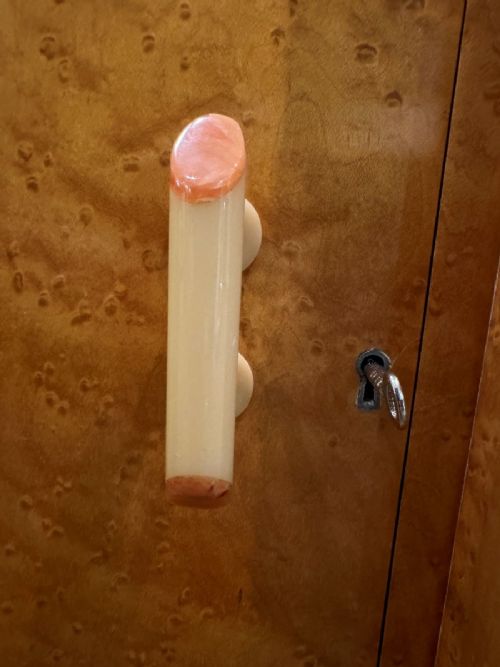
Art Deco sideboards were constructed using solid hardwood frameworks finished with book-matched veneers including burr walnut, mahogany, and birds-eye maple. Accents frequently featured ivory, bakelite, brass, or chrome hardware alongside glass surfaces.

Authentic 1930s pieces exhibit hand-laid decorative veneers, solid wood carcass construction, dovetailed drawer joints, and period-correct hardware. Look for characteristic U-shaped or cloud bases and tiered top profiles typical of the era.

An Art Deco sideboard serves as a focal anchor piece in modern dining rooms, foyers, or living areas. Its warm timber tones contrast balanced neutral walls, while the geometric form complements both minimalist and eclectic decor.

Burr walnut veneers should be kept away from direct sunlight and heat sources to prevent cracking and fading. Dust regularly with a soft microfiber cloth and apply a high-quality bees wax polish periodically to preserve the natural grain.
items
Add keywords to the filter
Price
£100
£250000
Era
Movements
Material
Origin
Stock Location
Freshness
Online Payments
Categories