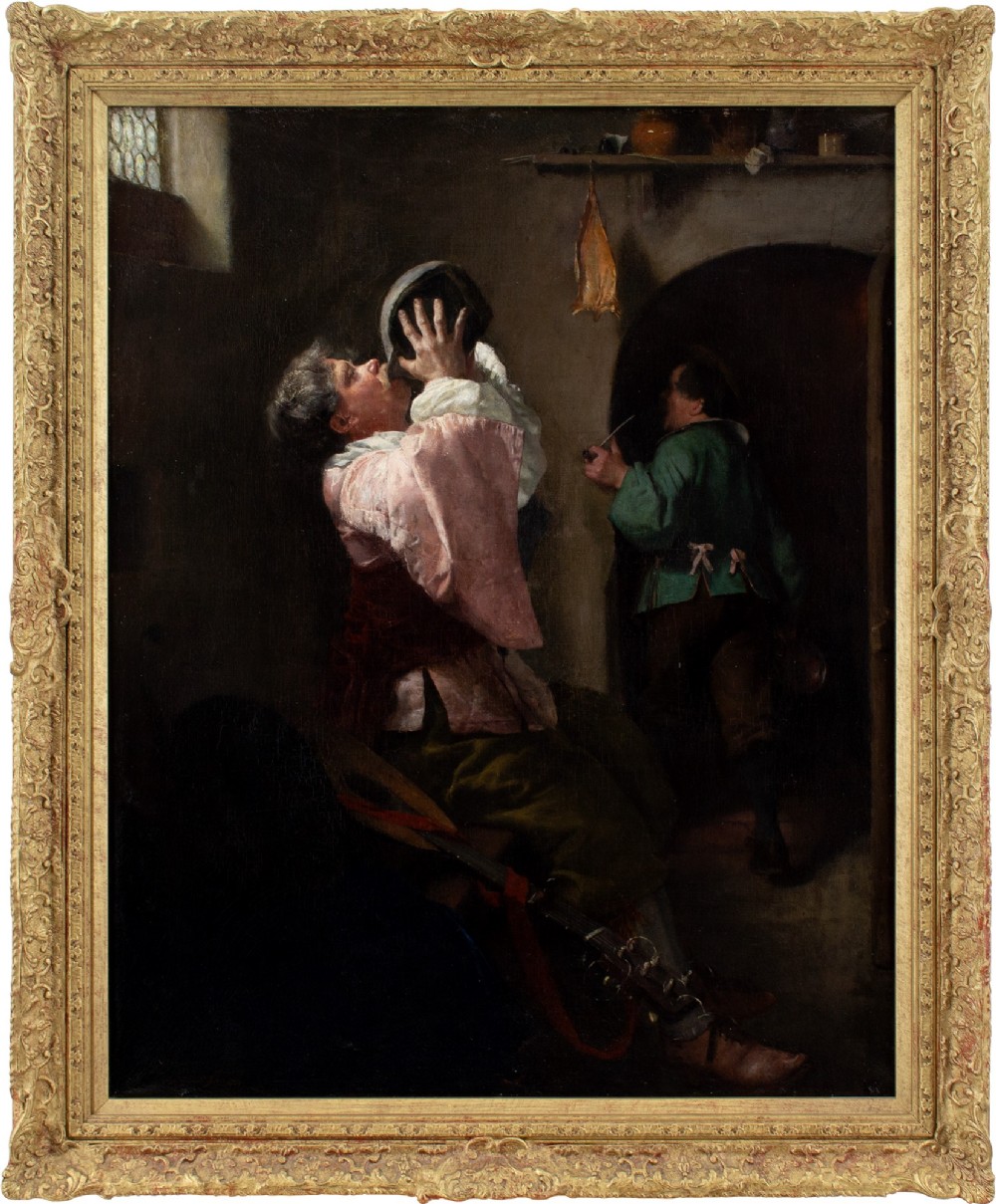
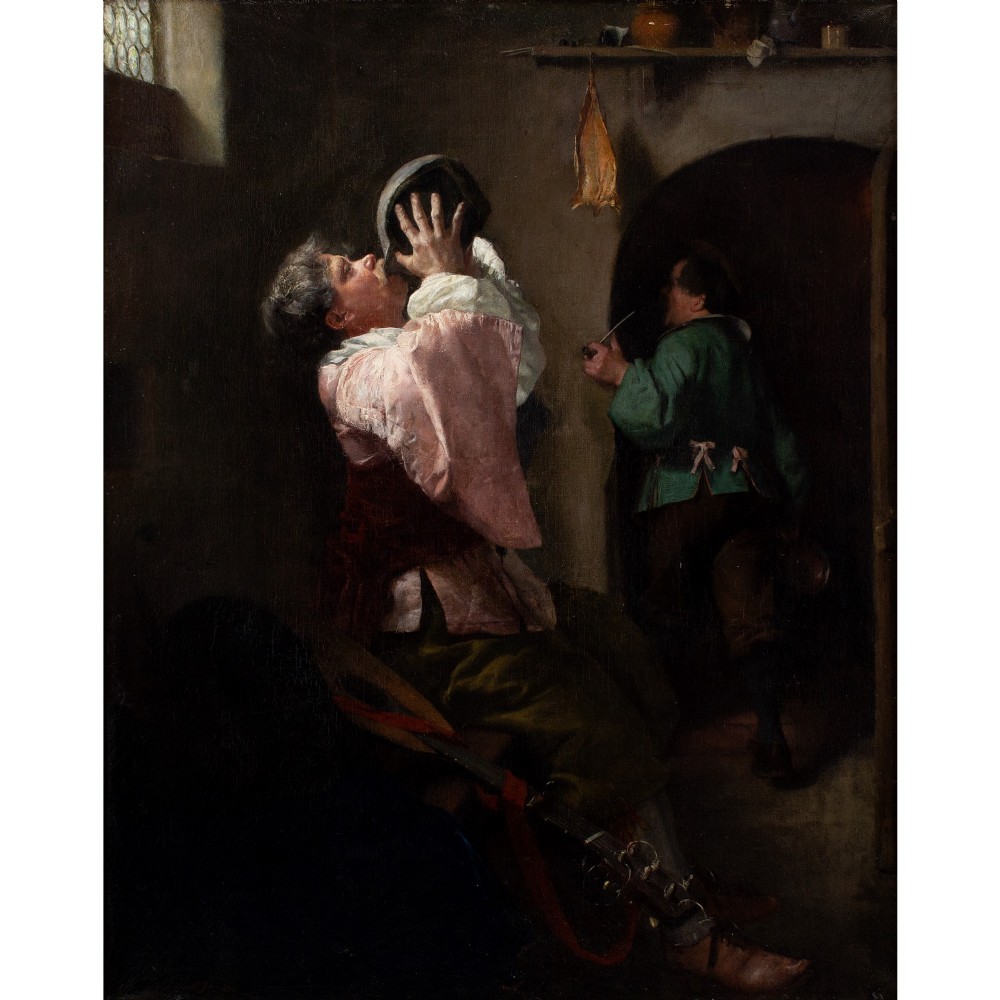
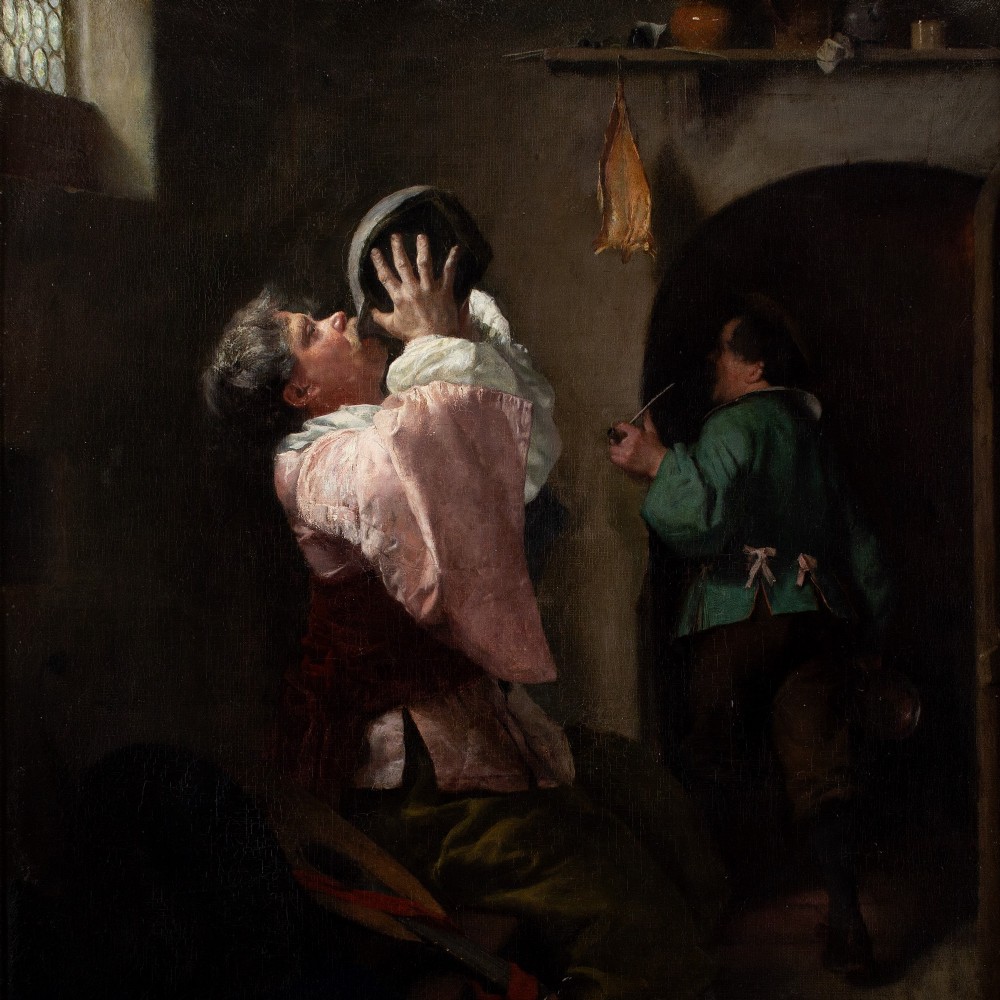
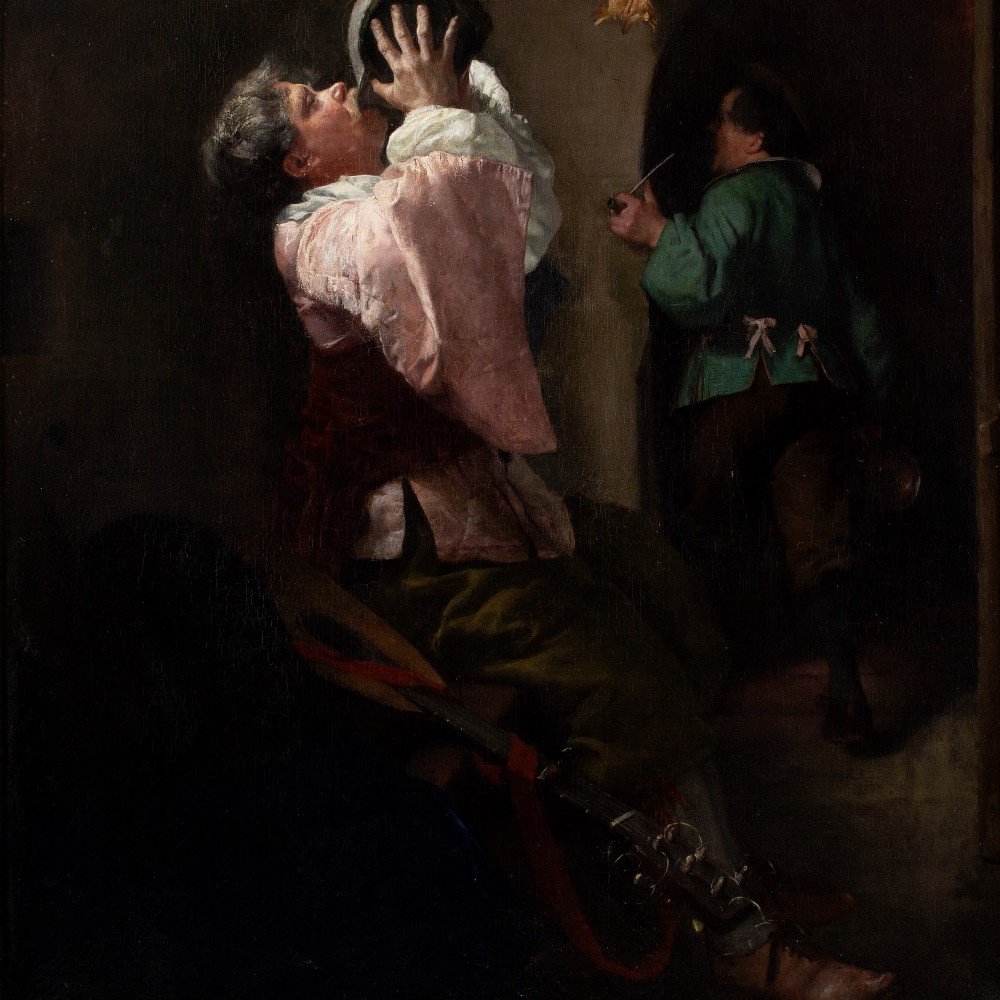
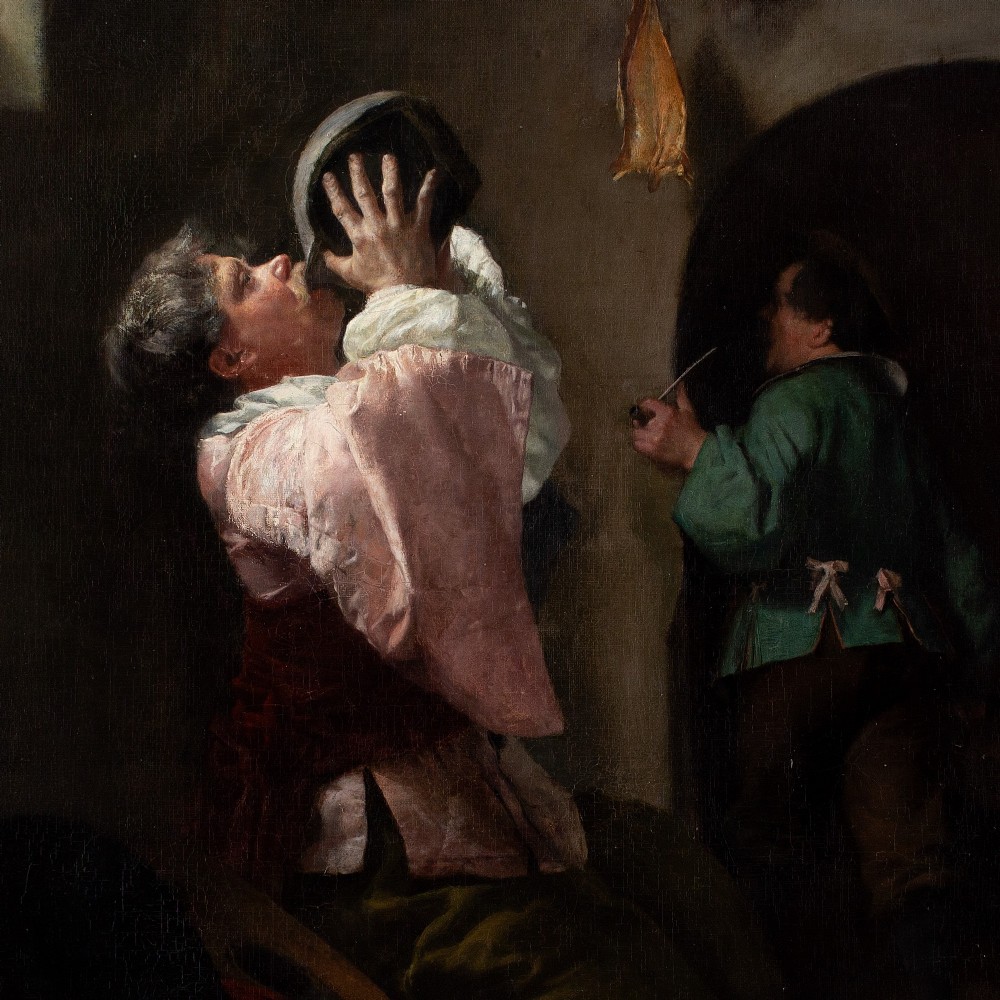
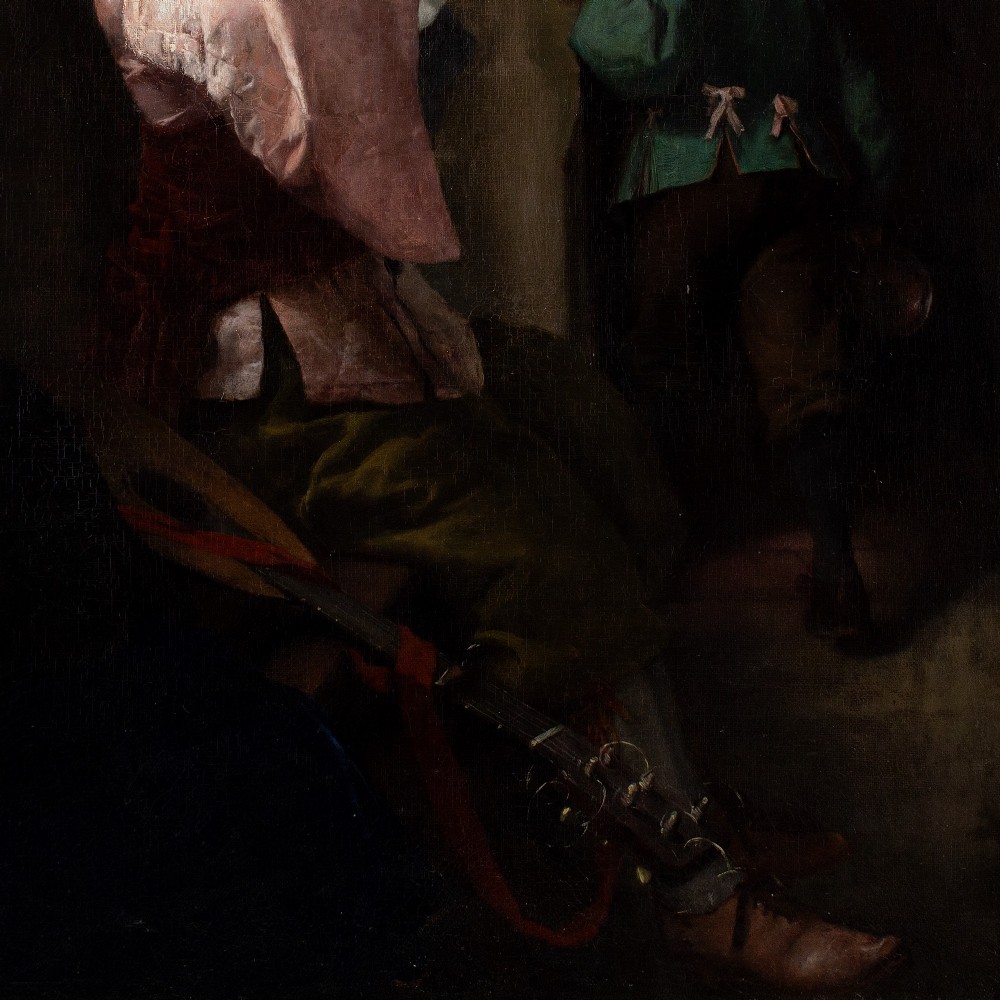
This splendid late-19th-century oil painting by British artist William John Wainwright RWS RBA (1855-1931) depicts a ‘drunkard’, dressed in 17th-century attire, hungrily gulping down liquor. Wainwright was a celebrated painter of genre subjects, interiors, portraits, and landscapes.
With his head almost horizontal, he clutches a jug and unceremoniously decants its contents. While a vivid, almost divine light, cascades through leaded windows and illuminates his pink doublet. A figure beyond smokes a pipe.
Born in Birmingham, Wainwright’s parents ran an eating house, probably from the front room of their home in Hockley Street. It would’ve been a hive of activity, frequented by regular punters from the local industries. Victorian eating houses were not usually the most salubrious of places and often reserved for men only. Plates of unspecific greasy meat, damp puddings, potatoes and fish would be served up on tarnished crockery*.
Being raised in such surroundings would’ve given
...the young lad plenty of creative inspiration and it’s likely he filled his sketchbooks with impromptu studies of hungry patrons. These were his formative experiences - immersed in the sights, sounds and abundant characters of Birmingham’s thriving industrial community.
Furnished with a skill for drawing, he attended Birmingham School of Art to hone his technique and by the age of 15 was employed as a draughtsman. His father had died early and the young lad was keen to raise funds for his family. He worked for the esteemed stained glass manufacturer, Hardman & Co - undertaking various projects in ecclesiastical settings.
Praised for his early success, he headed for Antwerp to study with the well-regarded educator, Charles Verlat (1824-1890). Verlat’s approach was entirely conventional and looked back to the Old Masters for inspiration. He famously had an argument with Vincent Van Gogh about his unconventional style of drawing.
Wainwright’s time in Antwerp was life-changing as it not only enhanced his finesse but also provided access to museums and masterpieces for study purposes. He gained a rich understanding of chiaroscuro, tone, and the underlying principles of solid composition. As such, many of his scenes are comparable with those produced by Adriaen Brouwer or Frans Hals.
Following an unfortunate incident whereby he was snubbed by the local hanging committee, he left for Paris to begin part deux of his continental education. He lived here awhile, also sending works to London for exhibition at the Royal Academy. His ‘An Ancient Musician’ was shown while he was still in France and he became a member of both the Royal Birmingham Society of Artists and the Royal Society of Painters in Watercolours.
In 1884, he returned to London, staying briefly with friends William Arthur Breakspeare and Norman Garstin, before heading for the buoyant fishing village of Newlyn in Cornwall. His time here is somewhat overstated due to the popularity of the ‘Newlyn School’ of painters - and stylistically he wasn’t part of this school at all. While its key protagonist Stanhope Forbes was painting thriving beach scenes under the glow of a Cornish morning, Wainwright was sketching gnarled fishermen in dark interiors staring intently towards the breakers.
It’s said that the bright skies of Newlyn damaged his eyesight, forcing him indoors, into the confines of his studio. But one gets the impression that he was most at home when painting timeless interiors in a 17th-century setting. Cornwall seems all too ‘modern’.
He was back in Birmingham by 1886, where he married, raised a family, and remained for the rest of his life. In 1927, he was elected as the President of the Royal Birmingham Society of Artists and held a solo exhibition the following year.
Today, as we look back across his exquisite oeuvre, we see an artist who treasured life’s character
Antique ID Number (AIDN): SA1097036
Dateline of this antique is 1880
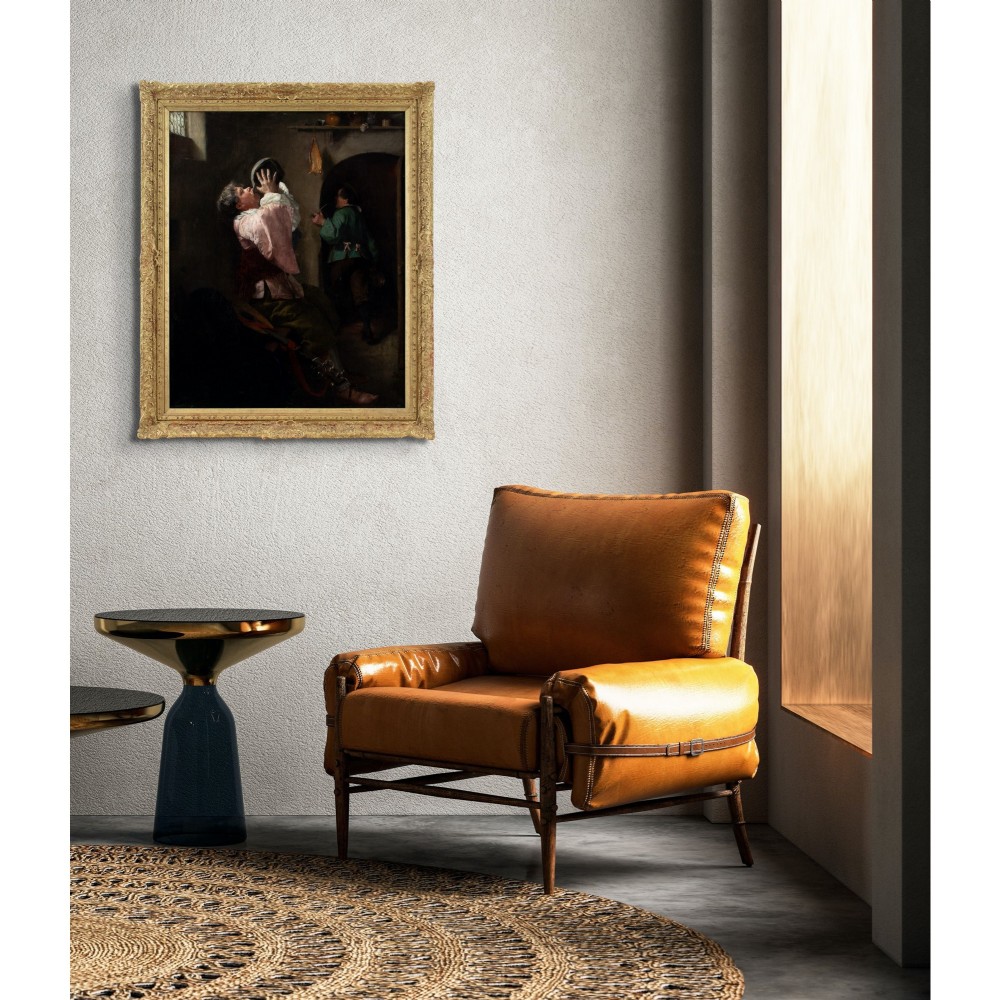
Height is 94cm (37.0inches)Width is 78cm (30.7inches)Depth is 5cm (2.0inches)





Thank you.
Your comment has been sent to Sellingantiques.