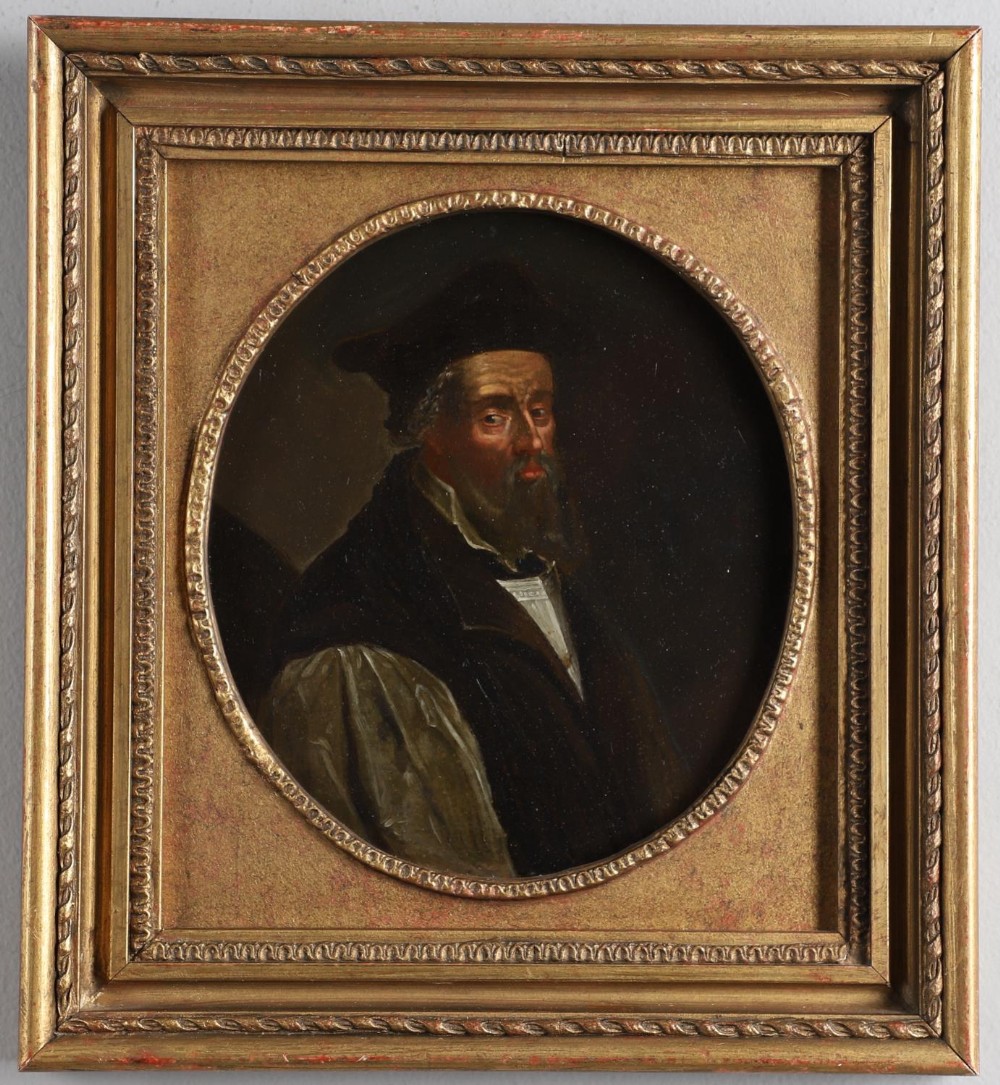
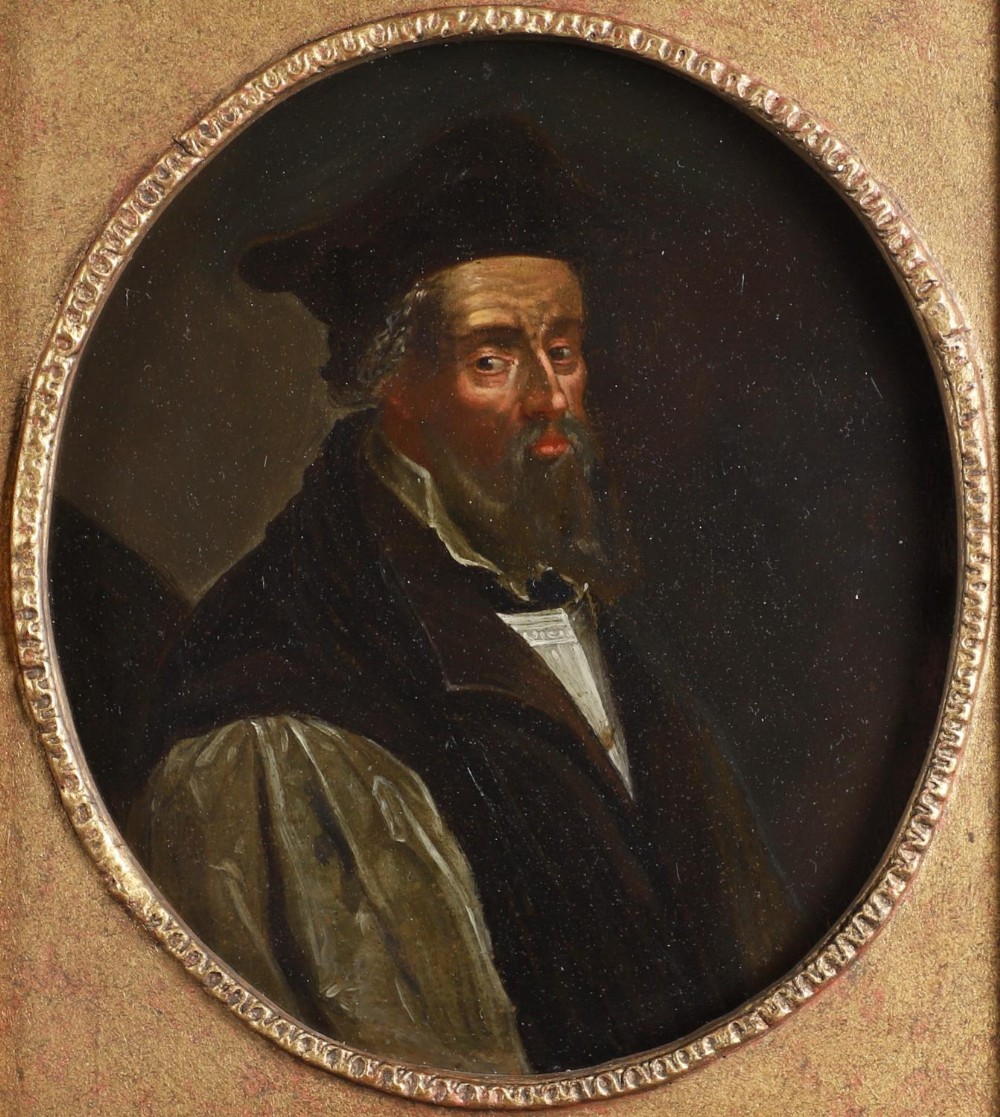
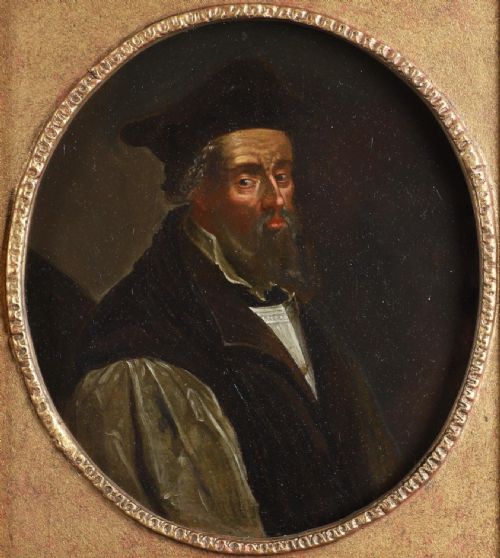
Artware Fineart has dated this Oil on Copper Portrait to the 17th Century.
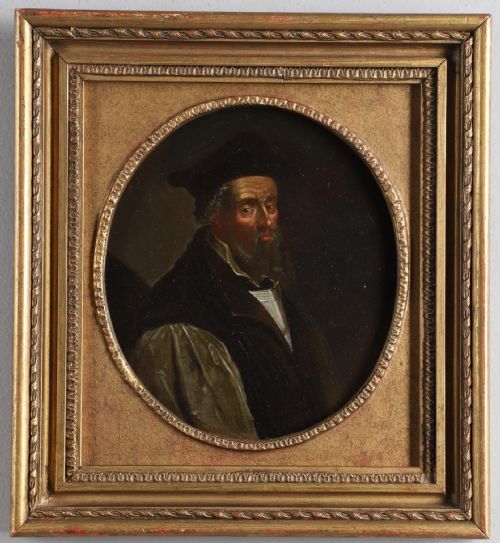
Portrait of Bishop Nicholas Ridley c.?1500 – 1555, Bishop of London & Westminster & an Oxford Martyr
oil on copper
19.50 x 17 cm.
Nicholas Ridley (c.
Ridley was one of the Oxford Martyrs burned at the stake during the Marian Persecutions, for his teachings and his support of Lady Jane Grey. He is remembered with a commemoration in the calendar of saints (with Hugh Latimer) in some parts of the Anglican Communion (Church of England) on 16 October.
Early years and advancement (c.1500–50)
Ridley came from a prominent family in Tynedale, Northumberland. He was the second son of Christopher Ridley, first cousin of Lancelot Ridley and grew up in Unthank Hall from the old House of Unthank located on the site of an ancient watch tower or pele tower. As a boy, Ridley was educated at the Royal Grammar School, Newcastle, and Pembroke College, Cambridge, where he proceeded to Master of Arts in 1525. Soon afterward he was ordained as a priest and went to the Sorbonne, in Paris, for further education. After returning to England around 1529, he became the senior proctor of Cambridge University in 1534. Around that time there was significant debate about the Pope's supremacy. Ridley was well versed on Biblical hermeneutics, and through his arguments the university came up with the following resolution: "That the Bishop of Rome had no more authority and jurisdiction derived to him from God, in this kingdom of England, than any other foreign bishop." He graduated B.D. in 1537 and was then appointed by the Archbishop of Canterbury, Thomas Cranmer, to serve as one of his chaplains. In April 1538, Cranmer made him vicar of Herne, in Kent.
In 1540–1, he was made one of the King's Chaplains, and was also presented with a prebendal stall in Canterbury Cathedral. In 1540 he was made Master of Pembroke College and in 1541 was awarded the degree of Doctor of Divinity. In 1543 he was accused of heresy, but he was able to beat the charge. Cranmer had resolved to support the English Reformation by gradually replacing the old guard in his ecclesiastical province with men who followed the new thinking. Ridley was made the Bishop of Rochester in 1547, and shortly after coming to office, directed that the altars in the churches of his diocese should be removed, and tables put in their place to celebrate the Lord's Supper. In 1548, he helped Cranmer compile the first Book of Common Prayer and in 1549 he was one of the commissioners who investigated Bishops Stephen Gardiner and Edmund Bonner. He concurred that they should be removed. John Ponet took Ridley's former position. Incumbent conservatives were uprooted and replaced with reformers.
When Ridley was appointed to the see of London by letters patent on 1 April 1550, he was called the "Bishop of London and Westminster" because the Diocese of London had just re-absorbed the dissolved Diocese of Westminster.
Vestments controversy (1550–3)
Ridley played a major part in the vestments controversy. John Hooper, having been exiled during King Henry's reign, returned to England in 1548 from the churches in Zürich that had been reformed by Zwingli and Heinrich Bullinger in a highly iconoclastic fashion. When Hooper was invited to give a series of Lenten sermons before the king in February 1550, he spoke against Cranmer's 1549 ordinal whose oath mentioned "all saints" and required newly elected bishops and those attending the ordination ceremony to wear a cope and surplice. In Hooper's view, these requirements were vestiges of Judaism and Roman Catholicism, which had no biblical warrant for Christians since they were not used in the early Christian church.
Heinrich Bullinger, a major influence on John Hooper, Ridley's opponent in
Artware Fineart has dated this Oil on Copper Portrait to the 17th Century.
You can view the stock and full dealer information on the Artware Fineart Profile Page
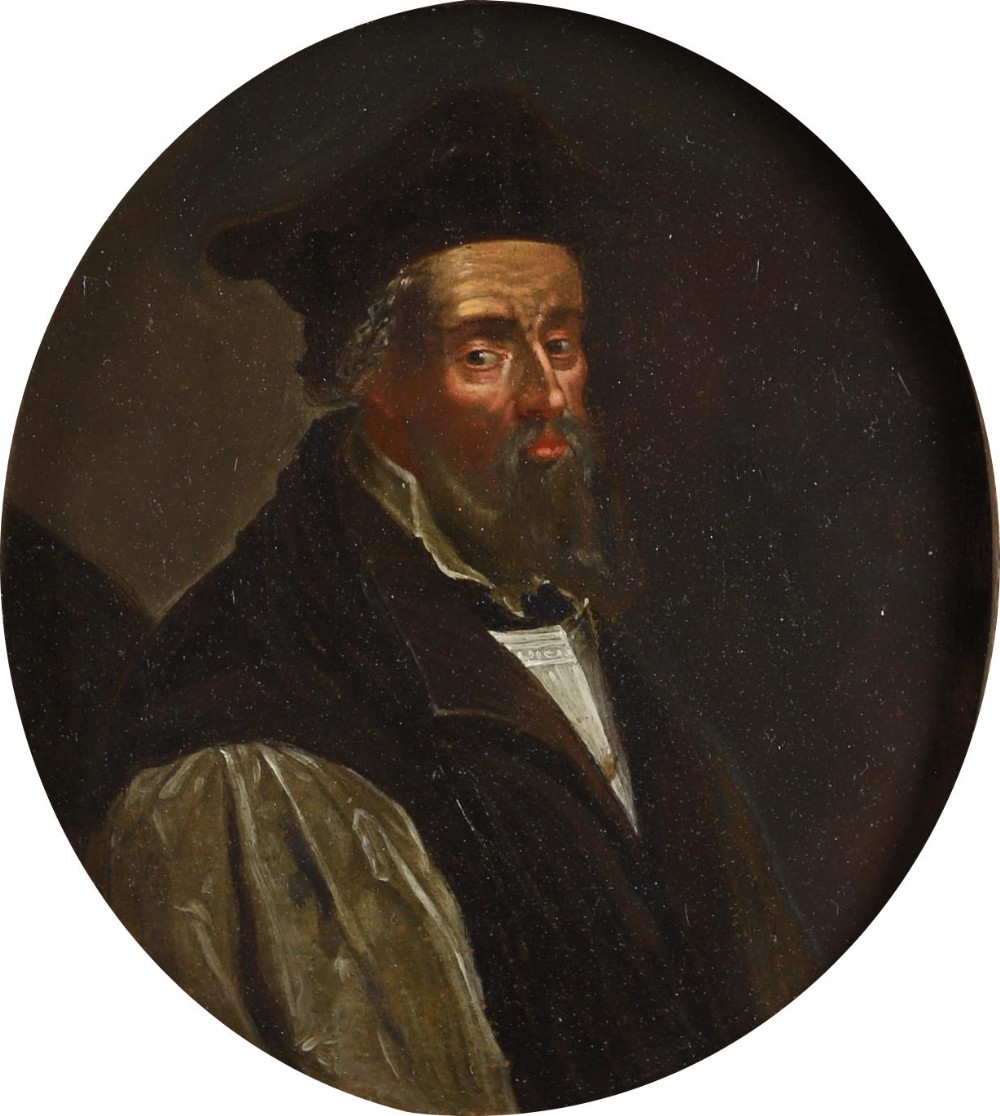
Circle of Adriaen Van Der Werff 1659 – 1722 Portrait of Bishop Nicholas Ridley C.?1500 – 1555, Bishop of London & Westminster & an Oxford Martyr portrait of Bishop Nicholas Ridley oil on Copper 19.50 X 17 Cm.