20,174  PAGES BROWSED TODAY PAGES TODAY 36  ANTIQUES UPLOADED TODAY NEW ARRIVALS
ID #SA1094070
FOR SALE
£8,750
Email
Save
A Wall Mounted and Ebonised 'True' Bracket Clock with Its Bracket and an Unusual Escapement by John Seddon of London. circa 1745.
M. C. Taylor
for sale €10,238     $11,113
£8,750
M. C. Taylor

M. C. Taylor

Sellingantiques Verified Since Oct 2021
View Dealers Stock Page
  • About Us
    Clockmakers and restorers established 1987
Id #SA1094070
PDF SHARE
SAVE

A Wall Mounted and Ebonised 'True' Bracket Clock with Its Bracket and an Unusual Escapement by John Seddon of London. circa 1745.

18th century
For Sale by M. C. Taylor
Description

An extremely attractive Georgian bracket clock that can be mounted upon its wall bracket or upon a table.

The very large and substantial double gut fusee, 5 pillar movement with an unusual Anchor Recoil escapement whereas the small anchor pallets are operated not by teeth on the escape wheel but rather, horizontal pins set through the wheel rim (the wheel has no teeth). The movement also has rack striking of the hours on a top-mounted bell and quarter repeating with 2 hammers on a further, higher pitched bell. The light pendulum with a lenticular bob has a sprung transit holdfast on the backplate. The suspension spring runs through 'chops' on the back cock and hangs from a pivoted arm mounted upon a 'rise and fall' regulation carriage that spans the plates. The movement also has a strike/non strike facility.

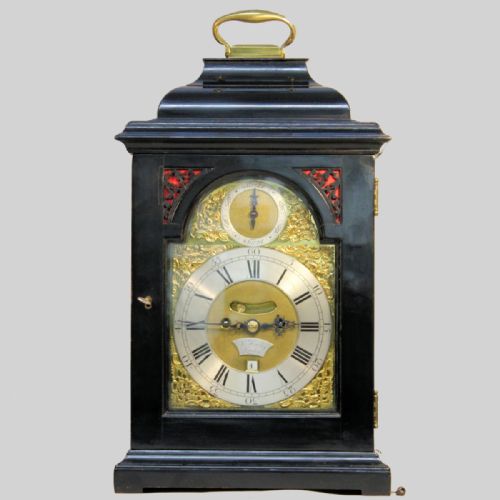
Behind a 6 1/2" wide, brass break-arch dial with cast brass 'Indian's head' corner spandrels and a silvered chapter ring with outer Arabic 5's, divided minute track and inner, Roman hour numerals. The centre is finely matted and the original hands are pierced blued steel. The arch bears 2 subsidiary silvered chapters for the regulation and strike/silent operations. Theses too have finely matted centres and blued steel 'poker' hands. Nestled between the tops of these is the silvered and shaped maker's cartouche bearing the name "John Seddon. LONDON".

Contained in a very handsome oak case veneered with ebonised fruitwood. It has an inverted bell top that is surmounted by a cast brass swinging handle. The returned all-round top moulding sits over the full-size, locking front door. This has moulded sides that terminate in lambs ears. The upper quadrants have wooden sound frets backed with red cloth and the glazing is framed with cast brass, quadrant. Below the door is again, an all-round short plinth with moulded top and sits upon 4 short and moulded block feet. The case sides have conforming and circular sound frets over rectangular glazed apertures and have brass quadrant framing. The rear of the case also has moulded side edges and a locking door with a break-arch glazed panel with further brass quadrant and 2 quarter panels. The repeat cord having a turned brass knob exits from the right lower side and finally, the clock can sit upon its well-shaped and ebonised, 3 tiered, solid oak bracket with a moulded captive edge and brass moulding.

* Originally, these clocks could be carefully carried from room to room still ticking as to not lose any time because of their very robust escapement or more importantly, carried to the bed chamber at night where the silent option would be selected so the sleeper would not be awoken at each and every hour. If the time was required then the repeat cord would be tugged and the previous hour and quarters would be sounded.

**John Seddon is recorded as working in St. James Street, London from 1743 until 1752. This clock looks absolutely fabulous on the wall and would be a true centrepiece for any room. The little known clue that tells us it was made to sit upon a wall bracket is the fact that there is no engraving to the backplate - it would be of no use because it would never be seen also, the financial saving on manufacture would have been substantial.

Condition: The movement is complete and original. It is working well with all of the functions including the repeating working correctly. The escapement works particularly well and keeps to time however, the movement is neglected and will benefit greatly from a complete overhaul which is included in the purchase price (unless not required). The dial is excellent as is the case and both have been well restored, there are no breaks just minor blemishes and signs of wear, use and age, the locks are working and the wall bracket is also in excellent conditon.

Price: The price will include a meticulous movement restoration by myself and carry a full guarantee of operation and authenticity.

Physical Dimensions
Height
48.3cm (19.02")
Width
26.7cm (10.51")
Depth
17.8cm (7.01")
Declaration

M. C. Taylor has dated this Antique Ebonised Bracket Clock to the 18th Century.

Reference Numbers
Sellingantiques Reference
SA1094070
Dealers Internal Reference
SA 14501
Description
An extremely attractive Georgian bracket clock that can be mounted upon its wall bracket or upon a table.

The very large and substantial double gut fusee, 5 pillar movement with an unusual Anchor Recoil escapement whereas the small anchor pallets are operated not by teeth on the escape wheel but rather, horizontal pins set through the wheel rim (the wheel has no teeth).

The movement also has rack striking of the hours on a top-mounted bell and quarter repeating with 2 hammers on a further, higher pitched bell.
M. C. Taylor

The light pendulum with a lenticular bob has a sprung transit holdfast on the backplate. The suspension spring runs through 'chops' on the back cock and hangs from a pivoted arm mounted upon a 'rise and fall' regulation carriage that spans the plates. The movement also has a strike/non strike facility.

fig 1. An 18th-century ebonised bracket clock with a brass handle, arched brass dial, silvered chapter ring, and matching wall bracket.
fig 1. A Wall Mounted and Ebonised 'True' Bracket Clock with Its Bracket and an Unusual Escapement by John Seddon of London. circa 1745.

Behind a 6 1/2" wide, brass break-arch dial with cast brass 'Indian's head' corner spandrels and a silvered chapter ring with outer Arabic 5's, divided minute track and inner, Roman hour numerals. The centre is finely matted and the original hands are pierced blued steel. The arch bears 2 subsidiary silvered chapters for the regulation and strike/silent operations. Theses too have finely matted centres and blued steel 'poker' hands. Nestled between the tops of these is the silvered and shaped maker's cartouche bearing the name "John Seddon. LONDON".

fig 2. An 18th-century ebonised bracket clock with a brass handle, arched brass dial, silvered chapter ring, and matching wall bracket.
fig 2. A Wall Mounted and Ebonised 'True' Bracket Clock with Its Bracket and an Unusual Escapement by John Seddon of London. circa 1745.

Contained in a very handsome oak case veneered with ebonised fruitwood. It has an inverted bell top that is surmounted by a cast brass swinging handle. The returned all-round top moulding sits over the full-size, locking front door. This has moulded sides that terminate in lambs ears. The upper quadrants have wooden sound frets backed with red cloth and the glazing is framed with cast brass, quadrant. Below the door is again, an all-round short plinth with moulded top and sits upon 4 short and moulded block feet. The case sides have conforming and circular sound frets over rectangular glazed apertures and have brass quadrant framing. The rear of the case also has moulded side edges and a locking door with a break-arch glazed panel with further brass quadrant and 2 quarter panels. The repeat cord having a turned brass knob exits from the right lower side and finally, the clock can sit upon its well-shaped and ebonised, 3 tiered, solid oak bracket with a moulded captive edge and brass moulding.

fig 3. An 18th-century ebonised bracket clock with a brass handle, arched brass dial, silvered chapter ring, and matching wall bracket.
fig 3. A Wall Mounted and Ebonised 'True' Bracket Clock with Its Bracket and an Unusual Escapement by John Seddon of London. circa 1745.

Originally, these clocks could be carefully carried from room to room still ticking as to not lose any time because of their very robust escapement or more importantly, carried to the bed chamber at night where the silent option would be selected so the sleeper would not be awoken at each and every hour. If the time was required then the repeat cord would be tugged and the previous hour and quarters would be sounded.

fig 4. An 18th-century ebonised bracket clock with a brass handle, arched brass dial, silvered chapter ring, and matching wall bracket.
fig 4. A Wall Mounted and Ebonised 'True' Bracket Clock with Its Bracket and an Unusual Escapement by John Seddon of London. circa 1745.

John Seddon is recorded as working in St. James Street, London from 1743 until 1752. This clock looks absolutely fabulous on the wall and would be a true centrepiece for any room. The little known clue that tells us it was made to sit upon a wall bracket is the fact that there is no engraving to the backplate - it would be of no use because it would never be seen also, the financial saving on manufacture would have been substantial.

fig 5. An 18th-century ebonised bracket clock with a brass handle, arched brass dial, silvered chapter ring, and matching wall bracket.
fig 5. A Wall Mounted and Ebonised 'True' Bracket Clock with Its Bracket and an Unusual Escapement by John Seddon of London. circa 1745.

Condition: The movement is complete and original. It is working well with all of the functions including the repeating working correctly. The escapement works particularly well and keeps to time however, the movement is neglected and will benefit greatly from a complete overhaul which is included in the purchase price (unless not required). The dial is excellent as is the case and both have been well restored, there are no breaks just minor blemishes and signs of wear, use and age, the locks are working and the wall bracket is also in excellent conditon.

Price: The price will include a meticulous movement restoration by myself and carry a full guarantee of operation and authenticity.

Height
48.3cm (19.02")
Width
26.7cm (10.51")
Depth
17.8cm (7.01")
Date of Manufacture

M. C. Taylor has dated this Antique Ebonised Bracket Clock to the 18th Century.

Reference Numbers
Sellingantiques Ref
SA1094070
Dealers Internal Ref
SA 14501
M. C. Taylor
M. C. Taylor
Sellingantiques verified Since Oct 2021

Clockmakers and restorers established 1987

Dealer Profile

You can view the stock and full dealer information on the M. C. Taylor Profile Page

PDF SHARE
SAVE
An 18th-century ebonised bracket clock with a brass handle, arched brass dial, silvered chapter ring, and matching wall bracket.
1 / 8
Archive I An 18th-century ebonised bracket clock with a brass handle, arched brass dial, silvered chapter ring, and matching wall bracket.

A Wall Mounted and Ebonised 'True' Bracket Clock with Its Bracket and an Unusual Escapement by John Seddon of London. circa 1745.

Archive II An 18th-century ebonised bracket clock with a brass handle, arched brass dial, silvered chapter ring, and matching wall bracket. View II
Archive III An 18th-century ebonised bracket clock with a brass handle, arched brass dial, silvered chapter ring, and matching wall bracket. View III
Archive IV An 18th-century ebonised bracket clock with a brass handle, arched brass dial, silvered chapter ring, and matching wall bracket. View IV
Archive V An 18th-century ebonised bracket clock with a brass handle, arched brass dial, silvered chapter ring, and matching wall bracket. View V
Archive VI An 18th-century ebonised bracket clock with a brass handle, arched brass dial, silvered chapter ring, and matching wall bracket. View VI
Archive VII An 18th-century ebonised bracket clock with a brass handle, arched brass dial, silvered chapter ring, and matching wall bracket. View VII
Archive VIII An 18th-century ebonised bracket clock with a brass handle, arched brass dial, silvered chapter ring, and matching wall bracket. View VIII
FURTHER BROWSING

Visitors also looked at these ⇣

Enlarged Archival View
Telephone 01202 429718
Location
995 Christchurch Road
Bournemouth
Dorset
BH7 6BB
United Kingdom
Verified Since Oct 2021
Items For Sale 68
Items Sold 139
M. C. Taylor
M. C. Taylor
Verified Since Oct 2021
View Dealer Info
Location: 995 Christchurch Road, Bournemouth, Dorset, BH7 6BB, United Kingdom
Verified
Oct 2021
For Sale
68
Sold
139
An 18th-century ebonised bracket clock with a brass handle, arched brass dial, silvered chapter ring, and matching wall bracket.
A WALL MOUNTED AND EBONISED 'TRUE' BRACKET CLOCK WITH ITS BRACKET AND AN UNUSUAL ESCAPEMENT BY JOHN SEDDON OF LONDON. CIRCA 1745.
Ref: SA1094070
An 18th-century ebonised bracket clock with a brass handle, arched brass dial, silvered chapter ring, and matching wall bracket.
Detail View 1
Detail View 2
Detail View 3
Detail View 4
Detail View 5
Detail View 6
Detail View 7
Archival Detail
Every single antique dealer on our platform is individually approved by our internal team. We verify their professional trade history, ethical standards, and photographic quality to ensure a secure, high-standard buying environment. Upon joining, every dealer agrees to a strict 9-point code of conduct. While issues can occasionally arise, our dealers typically resolve them swiftly and directly with the buyer. In fact, since our founding in 2002, Sellingantiques has only had to step in to help resolve an issue on roughly five occasions—a true testament to the quality of our dealers and their dedication to your happiness.
Our dealers are highly experienced in packing and shipping fragile, high-value antiques. Because you are in direct contact with the dealer, you will be able to easily go through all available shipping and insurance options together to ensure your item arrives safely.
Antiques are the ultimate green purchase. By choosing historical pieces over newly manufactured goods, you completely eliminate the carbon footprint of modern mass production while preserving exceptional, timeless craftsmanship.

Developed in late 17th-century England, bracket clocks were portable spring-driven clocks designed to sit on a mantle, table, or dedicated wall bracket. Ebonised cases became prevalent in the 18th century as cabinetmakers stained native hardwoods to imitate imported ebony.

Cabinetmakers utilised fruitwood, pearwood, or oak stained black to create ebonised cases, embellished with cast brass mounts, carrying handles, and glass panels. Dial plates were crafted from brass with silvered chapter rings and cast corner spandrels.

Authentic Georgian bracket clocks feature spring-driven fusee movements, hand-engraved backplates, and brass dials with silvered chapter rings rather than painted surfaces. Construction details such as hand-cut joinery, pegged framing, and period-correct movement latches indicate 18th-century manufacturing.

Position the clock on a console table, bookshelf, or mount it using its dedicated bracket on a wall space to serve as a structural feature. Combining dark ebonised finishes with neutral wall tones creates contrasting visual interest in modern living rooms or studies.

Dust the ebonised wooden case using a dry microfibre cloth and apply neutral microcrystalline wax sparingly to preserve the finish. Mechanical movements require regular winding with an appropriately sized key and professional servicing by a qualified horologist every five to seven years.
items
Add keywords to the filter
Price
£100
£250000
Era
Movements
Material
Origin
Stock Location
Freshness
Online Payments
Categories