36,878  PAGES BROWSED TODAY PAGES TODAY 90  ANTIQUES UPLOADED TODAY NEW ARRIVALS
ID #SA1093609
FOR SALE
£4,200
Email
Save
Clerke, Royal Exchange, London a Delépine Carriage Clock with English Case
Leigh Extence Antique Clocks
for sale €4,914     $5,334
£4,200
Leigh Extence Antique Clocks

Leigh Extence Antique Clocks

Sellingantiques Verified Since Sep 2024
View Dealers Stock Page
  • About Us
    Specialists in fine antique clocks
  • Trade Associations
    Leigh Extence Antique Clocks is a registered member of BADA  CINOA
Id #SA1093609
PDF SHARE
SAVE

Clerke, Royal Exchange, London a Delépine Carriage Clock with English Case

19th century
Description

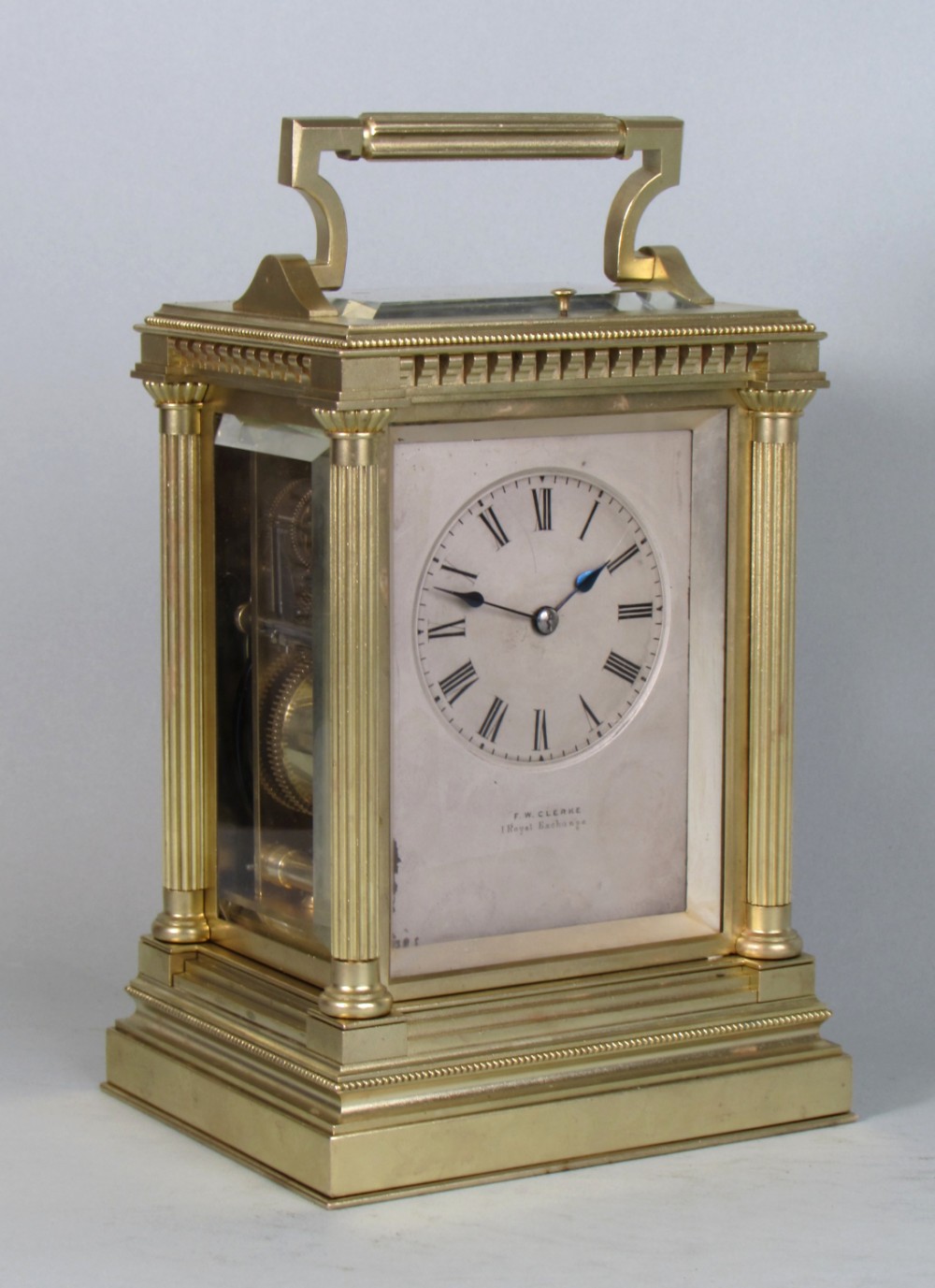
A large gilt-bronze carriage clock in the English style by Delépine-Barrois who at this time were also supplying movements and complete clocks for Jacot to finish.

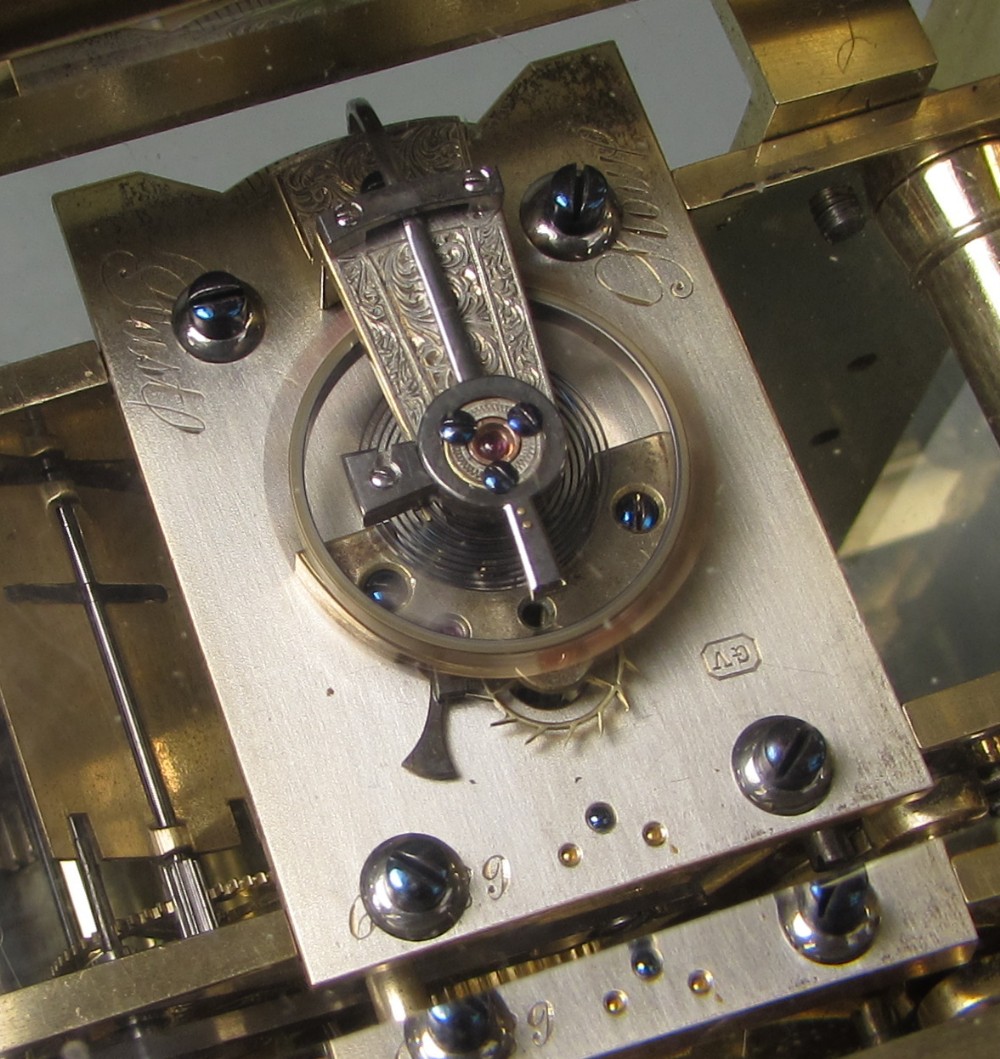
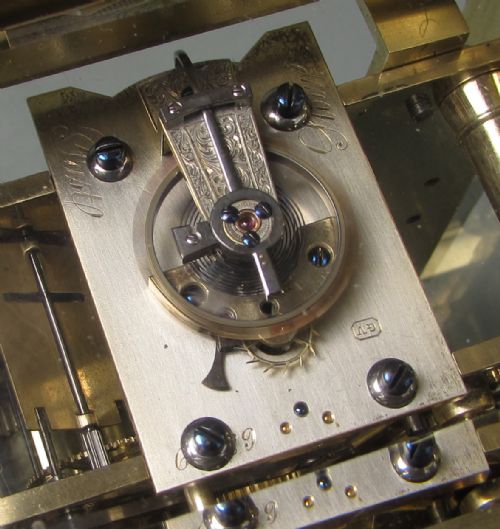
The eight-day duration movement is fitted with a platform lever escapement which is stamped with the initials 'G.V.' as seen on the platforms of other Delépine carriage clocks and numbered to both the top and the underside 68269. The balance cock is finely engraved, an adornement that was quite probably undertaken with the clock in London, and has a Breguet overcoil to the hairspring and steel bridge to stop the regulation index moving, as seen on the finer Henri Jacot carriage clock escapements.
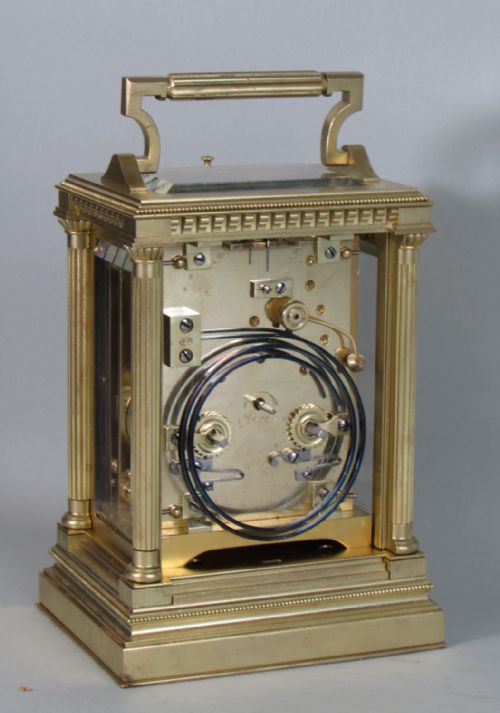
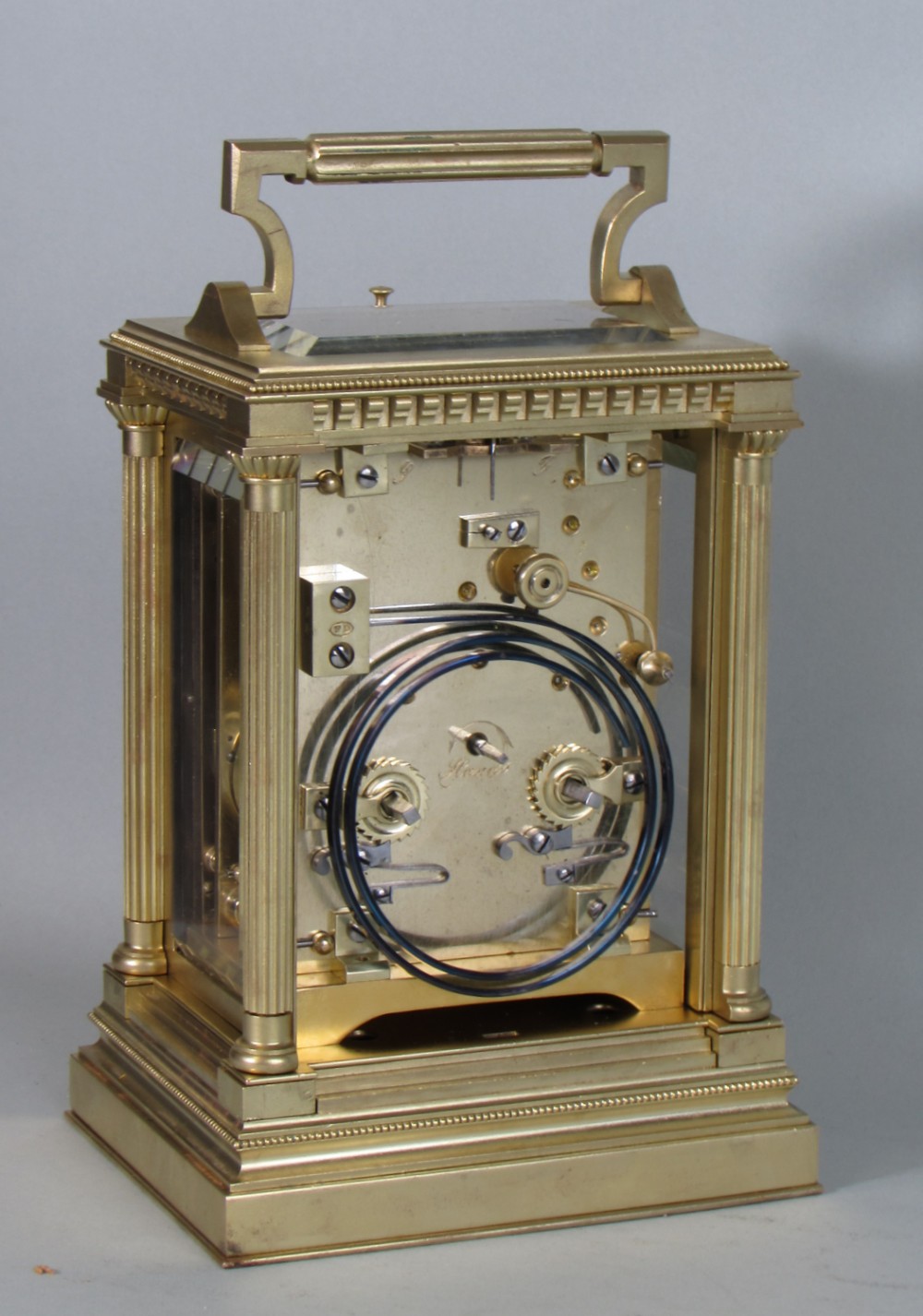
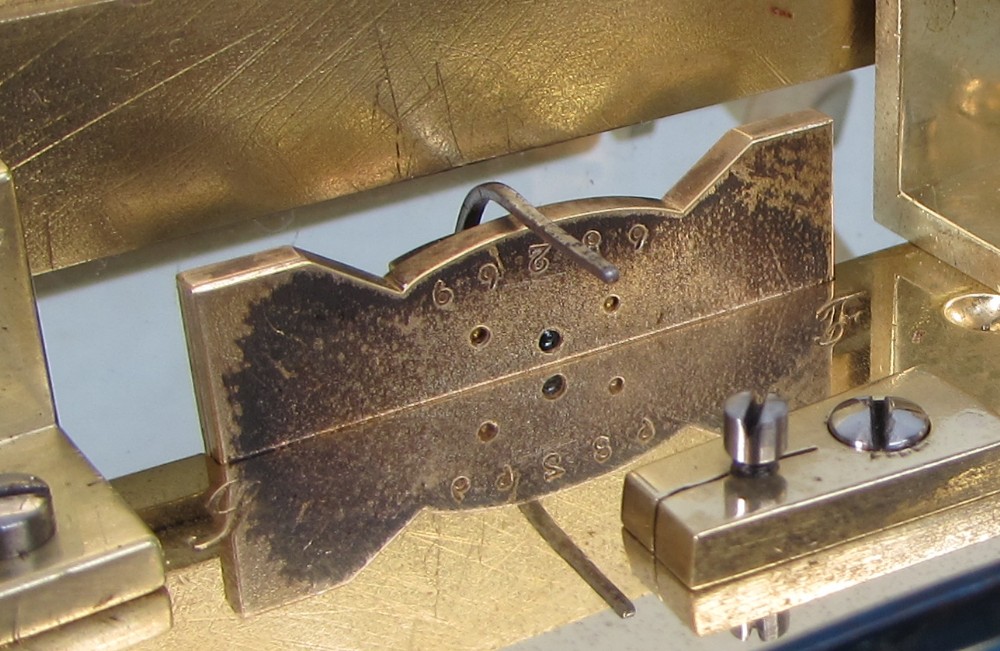
The movement strikes the hours and half-hours on a gong with the gong block stamped with the initials F.D. for the gong maker, and has a push button to the top to repeat the strike of the last hour at will. Both the backplate and rear shuttered door are stamped with a hand setting arrow design as used by Delépine.
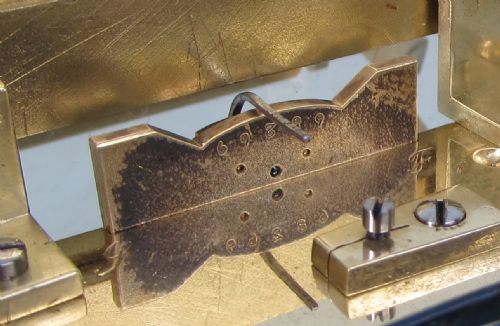
The silvered dial has black Roman hour numerals, blued steel spade hands and signed for the retailer and maker F.W. Clerke, 1 Royal Exchange.

The substantial gilt-bronze pillared case was almost certainly made by a London maker for Clerke to be fitted with the Delépine movement and is reminiscent of other clocks signed for them in a similar vein.? The case is of superb quality and when taken apart was made up of three times as many individual pieces than the normal French Anglaise-style case.
The Delépine of Delépine-Barrois is not the well-know Saint-Nicolas-d'Aliermont maker Charles-Boromé Delépine taking on a new partner after the death of Charles Canchy as previously assumed. It is in fact a relative of his named Ludovic Delépine along with Ludovic's wife Marie Barrois. Marie was a Parisian girl who had no prior horological experience as such. Her father had died in Paris and her widowed mother then married her sister's brother-in-law, the horloger Gustave Sauteur. They moved to Saint Nicolas d'Aliermont in circa 1880 where Marie met and married Ludovic Delépine in 1884. Together they formed the Delépine-Barrois business that became one of the finest carriage clock producers of the late-Victorian period and eventually succeeded Charles-Borome Delépine following his death in 1891 and therefore by descent were successors to Honoré Pons. They originally lived in a house next to the church with workshops set up in the gardens but moved across the town square to the prominent house with workshops that is well-known having been depicted on many postcards of the time, as seen above. It is quite probable that these premises were originally built by the step-uncle to Marie Barrois, the prominent horologist Augustin Sauteur, brother to Gustave.

Ludovic and Marie Delépine returned to Paris in 1912, having had an horological business running in tandem with that in Saint Nicolas from at least 1901, and their business, along with the house and workshops, were taken over by the Couaillet family.

Frederick William Clerke, born in 1820, was both a watchmaker, chronometer maker and retailer which would explain the mix between the French movement, the upgraded platform and English case.

He is recorded at 46 Bridenell Place, North Road in 1851 and by 1861 he was working at 27 Lombard Street. From at least 1864 to 1867 Frederick was recorded at 168 Fenchurch Street as a watchmaker but by 1871 he had moved the business to 1 Royal Exchange where he continued until his death in 1885.

The 1871 census shows Frederick as a ‘watchmaker employing 8 men’ and living at 1 Park Villas, Grosvenor Park Road, Walthamstow with his wife Sarah and children Florence and Fredk Jas, his mother-in-law Mary Newberry, his aunt Sarah Muston and a servant girl.

Clerke died in 1885 when his son Frederick James Clerke took over running the business and is recorded in the 1891 census as bo

Physical Dimensions
Height
20cm (7.87")
Declaration

Leigh Extence Antique Clocks has dated this Antique Brass Carriage Clock to the 1870s.

Reference Numbers
Sellingantiques Reference
SA1093609
Dealers Internal Reference
1469
Dealers Notes

Leigh Extence offers for sale antique clocks that are fully researched and validated.

Leigh is acknowledged as the world's leading expert on French carriage clocks of the 19th century and has lectured both home and abroad on the subject for over ten years.

He has had many papers published on the subject and his research is used by many of the leading auction houses in their descriptions.

Research Articles and Exhibition Catalogues are available to view on our website:

www.extence.co.uk

Unless otherwise stated, all clocks have been fully overhauled and are guaranteed as such.

Description
A large gilt-bronze carriage clock in the English style by Delépine-Barrois who at this time were also supplying movements and complete clocks for Jacot to finish.
The eight-day duration movement is fitted with a platform lever escapement which is stamped with the initials 'G.
Leigh Extence Antique Clocks

V.' as seen on the platforms of other Delépine carriage clocks and numbered to both the top and the underside 68269. The balance cock is finely engraved, an adornement that was quite probably undertaken with the clock in London, and has a Breguet overcoil to the hairspring and steel bridge to stop the regulation index moving, as seen on the finer Henri Jacot carriage clock escapements.

fig 1. An antique brass carriage clock with fluted corner columns, bevelled glass panels, a silvered dial with Roman numerals, and a hinged carrying handle.
fig 1. Clerke, Royal Exchange, London a Delépine Carriage Clock with English Case

The movement strikes the hours and half-hours on a gong with the gong block stamped with the initials F.D. for the gong maker, and has a push button to the top to repeat the strike of the last hour at will. Both the backplate and rear shuttered door are stamped with a hand setting arrow design as used by Delépine.

fig 2. An antique brass carriage clock with fluted corner columns, bevelled glass panels, a silvered dial with Roman numerals, and a hinged carrying handle.
fig 2. Clerke, Royal Exchange, London a Delépine Carriage Clock with English Case

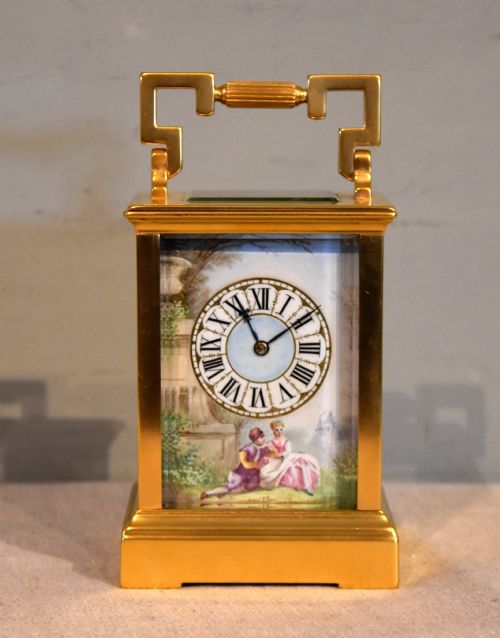
The silvered dial has black Roman hour numerals, blued steel spade hands and signed for the retailer and maker F.W. Clerke, 1 Royal Exchange.

The substantial gilt-bronze pillared case was almost certainly made by a London maker for Clerke to be fitted with the Delépine movement and is reminiscent of other clocks signed for them in a similar vein.? The case is of superb quality and when taken apart was made up of three times as many individual pieces than the normal French Anglaise-style case.

fig 3. An antique brass carriage clock with fluted corner columns, bevelled glass panels, a silvered dial with Roman numerals, and a hinged carrying handle.
fig 3. Clerke, Royal Exchange, London a Delépine Carriage Clock with English Case

The Delépine of Delépine-Barrois is not the well-know Saint-Nicolas-d'Aliermont maker Charles-Boromé Delépine taking on a new partner after the death of Charles Canchy as previously assumed. It is in fact a relative of his named Ludovic Delépine along with Ludovic's wife Marie Barrois. Marie was a Parisian girl who had no prior horological experience as such. Her father had died in Paris and her widowed mother then married her sister's brother-in-law, the horloger Gustave Sauteur. They moved to Saint Nicolas d'Aliermont in circa 1880 where Marie met and married Ludovic Delépine in 1884. Together they formed the Delépine-Barrois business that became one of the finest carriage clock producers of the late-Victorian period and eventually succeeded Charles-Borome Delépine following his death in 1891 and therefore by descent were successors to Honoré Pons. They originally lived in a house next to the church with workshops set up in the gardens but moved across the town square to the prominent house with workshops that is well-known having been depicted on many postcards of the time, as seen above. It is quite probable that these premises were originally built by the step-uncle to Marie Barrois, the prominent horologist Augustin Sauteur, brother to Gustave.

Ludovic and Marie Delépine returned to Paris in 1912, having had an horological business running in tandem with that in Saint Nicolas from at least 1901, and their business, along with the house and workshops, were taken over by the Couaillet family.

Frederick William Clerke, born in 1820, was both a watchmaker, chronometer maker and retailer which would explain the mix between the French movement, the upgraded platform and English case.

He is recorded at 46 Bridenell Place, North Road in 1851 and by 1861 he was working at 27 Lombard Street. From at least 1864 to 1867 Frederick was recorded at 168 Fenchurch Street as a watchmaker but by 1871 he had moved the business to 1 Royal Exchange where he continued until his death in 1885.

The 1871 census shows Frederick as a ‘watchmaker employing 8 men’ and living at 1 Park Villas, Grosvenor Park Road, Walthamstow with his wife Sarah and children Florence and Fredk Jas, his mother-in-law Mary Newberry, his aunt Sarah Muston and a servant girl.

Clerke died in 1885 when his son Frederick James Clerke took over running the business and is recorded in the 1891 census as bo

Height
20cm (7.87")
Date of Manufacture

Leigh Extence Antique Clocks has dated this Antique Brass Carriage Clock to the 1870s.

Reference Numbers
Sellingantiques Ref
SA1093609
Dealers Internal Ref
1469
Leigh Extence Antique Clocks
Sellingantiques verified Since Sep 2024

Specialists in fine antique clocks

Dealer Profile

You can view the stock and full dealer information on the Leigh Extence Antique Clocks Profile Page

Trade Associations

Leigh Extence Antique Clocks is a registered member of BADA  CINOA
PDF SHARE
SAVE
An antique brass carriage clock with fluted corner columns, bevelled glass panels, a silvered dial with Roman numerals, and a hinged carrying handle.
1 / 4
Archive I An antique brass carriage clock with fluted corner columns, bevelled glass panels, a silvered dial with Roman numerals, and a hinged carrying handle.

Clerke, Royal Exchange, London a Delépine Carriage Clock with English Case
Archive II An antique brass carriage clock with fluted corner columns, bevelled glass panels, a silvered dial with Roman numerals, and a hinged carrying handle. View II
Archive III An antique brass carriage clock with fluted corner columns, bevelled glass panels, a silvered dial with Roman numerals, and a hinged carrying handle. View III
Archive IV An antique brass carriage clock with fluted corner columns, bevelled glass panels, a silvered dial with Roman numerals, and a hinged carrying handle. View IV
FURTHER BROWSING

Visitors also looked at these ⇣

Enlarged Archival View
Telephone 07967 802160
Location
Pavilion Place
Exeter
Devon
United Kingdom

By appointment only.
Verified Since Sep 2024
Items For Sale 23
Items Sold 6
Leigh Extence Antique Clocks
Verified Since Sep 2024
View Dealer Info
Location: Pavilion Place, Exeter, Devon, United Kingdom, , By appointment only.
Verified
Sep 2024
For Sale
23
Sold
6
An antique brass carriage clock with fluted corner columns, bevelled glass panels, a silvered dial with Roman numerals, and a hinged carrying handle.
Clerke, Royal Exchange, London A Delépine Carriage Clock with English Case
Ref: SA1093609
An antique brass carriage clock with fluted corner columns, bevelled glass panels, a silvered dial with Roman numerals, and a hinged carrying handle.
Detail View 1
Detail View 2
Detail View 3
Archival Detail
Every single antique dealer on our platform is individually approved by our internal team. We verify their professional trade history, ethical standards, and photographic quality to ensure a secure, high-standard buying environment. Upon joining, every dealer agrees to a strict 9-point code of conduct. While issues can occasionally arise, our dealers typically resolve them swiftly and directly with the buyer. In fact, since our founding in 2002, Sellingantiques has only had to step in to help resolve an issue on roughly five occasions—a true testament to the quality of our dealers and their dedication to your happiness.
Our dealers are highly experienced in packing and shipping fragile, high-value antiques. Because you are in direct contact with the dealer, you will be able to easily go through all available shipping and insurance options together to ensure your item arrives safely.
Antiques are the ultimate green purchase. By choosing historical pieces over newly manufactured goods, you completely eliminate the carbon footprint of modern mass production while preserving exceptional, timeless craftsmanship.

A carriage clock is a small, spring-driven portable timepiece developed in the early nineteenth century, originally designed to withstand the motion of travelling in horse-drawn carriages. They typically feature rectangular brass cases, glass side panels, and top carrying handles.

Traditional nineteenth-century carriage clocks are constructed predominantly from cast and polished brass frames, bevelled glass plates, steel escapement components, and enamel or silvered metal dials.

Authentic pieces feature heavy solid brass cases with hand-bevelled glass panels, platform escapements visible through top observation glasses, and hand-engraved maker names or serial numbers on the movement plate or dial face.

Place the clock centrally on a marble mantelpiece, inside a contemporary bookshelf, or on an executive desk, allowing its metallic brass tones to contrast against neutral paintwork or dark timber backdrops.

Keep the casing dry and lightly dust it with a soft microfiber cloth. Avoid abrasive chemical polishes on aged brass lacquers, and ensure the mechanical movement is professionally cleaned and oiled by a horologist every five to seven years.
items
Add keywords to the filter
Price
£100
£250000
Era
Movements
Material
Origin
Stock Location
Freshness
Online Payments
Categories