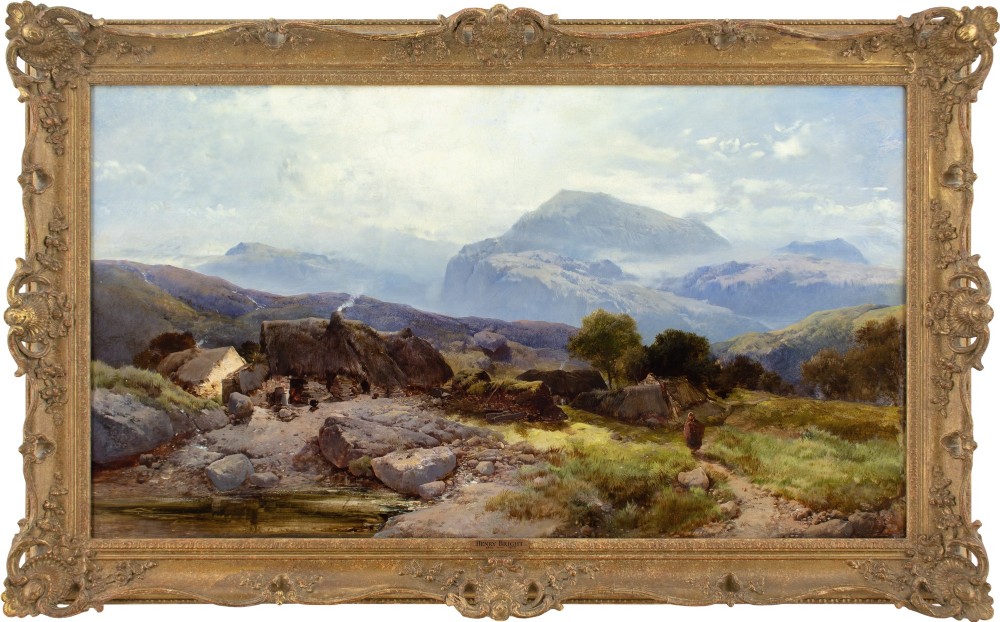
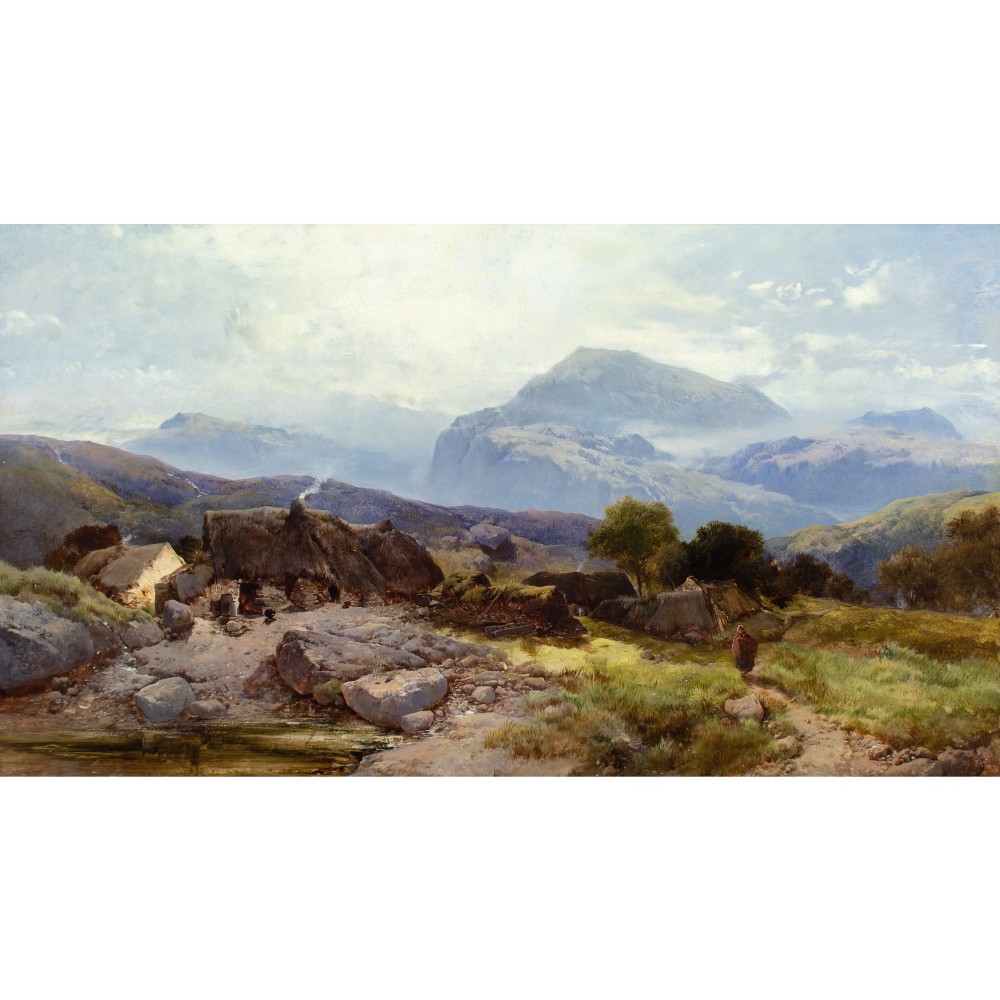
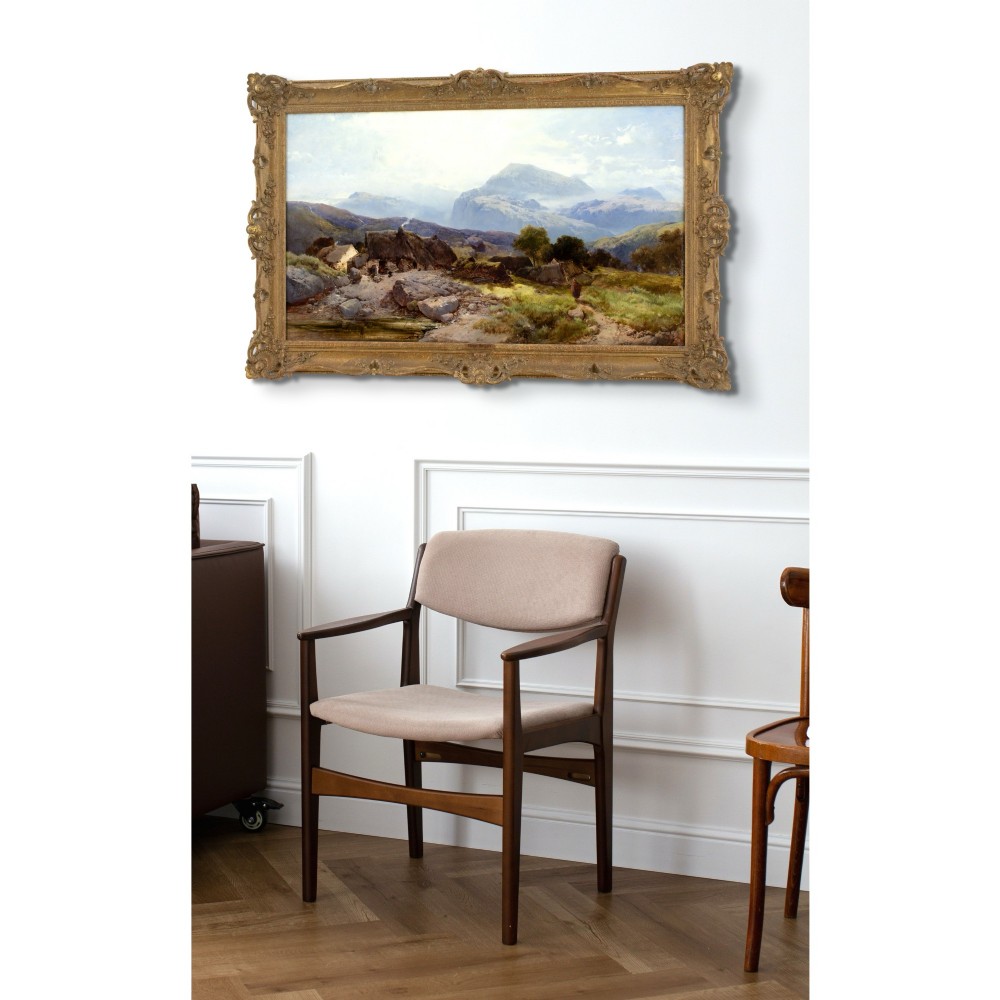
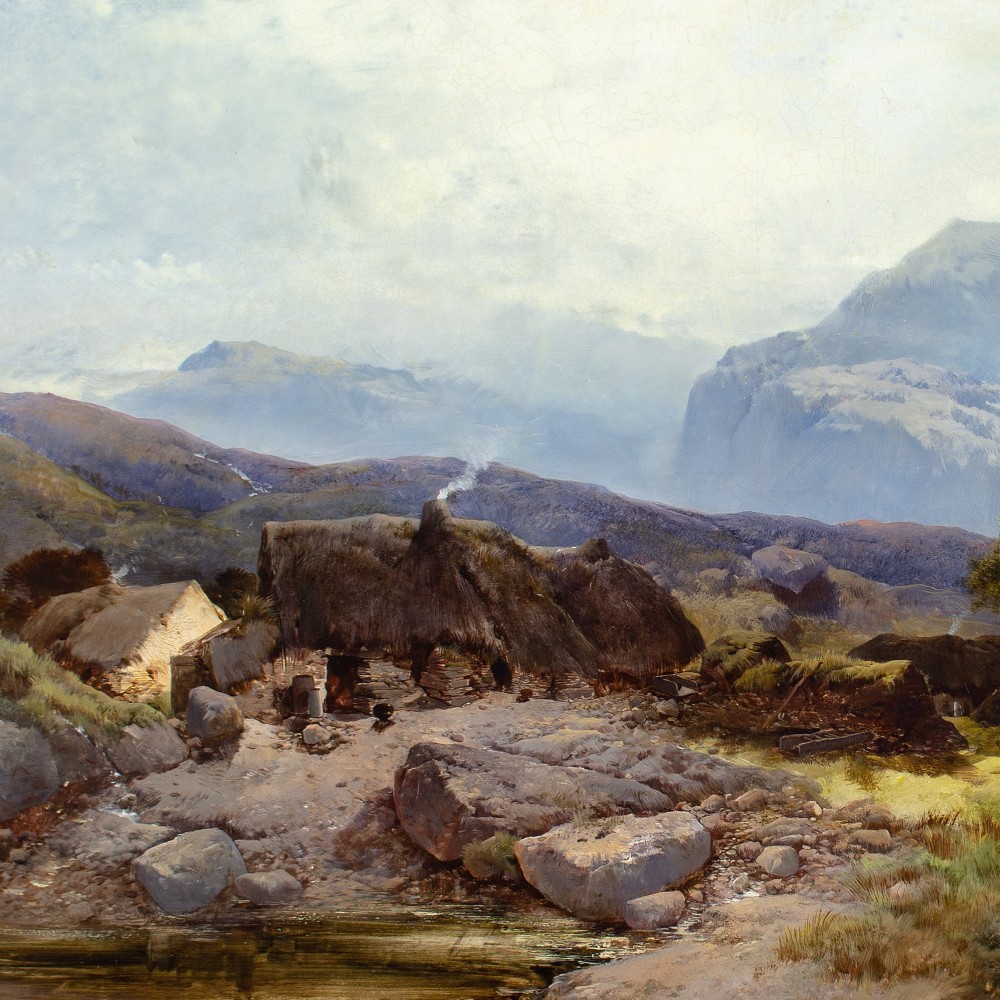
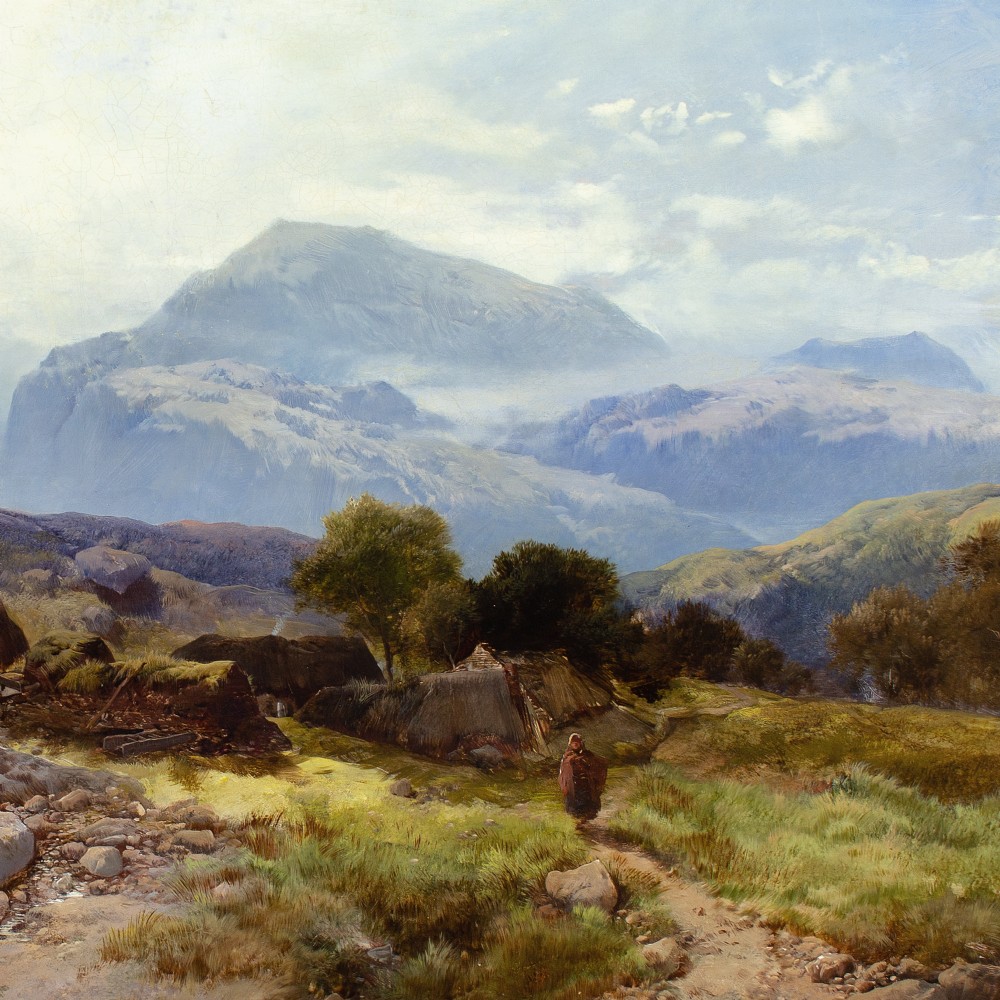
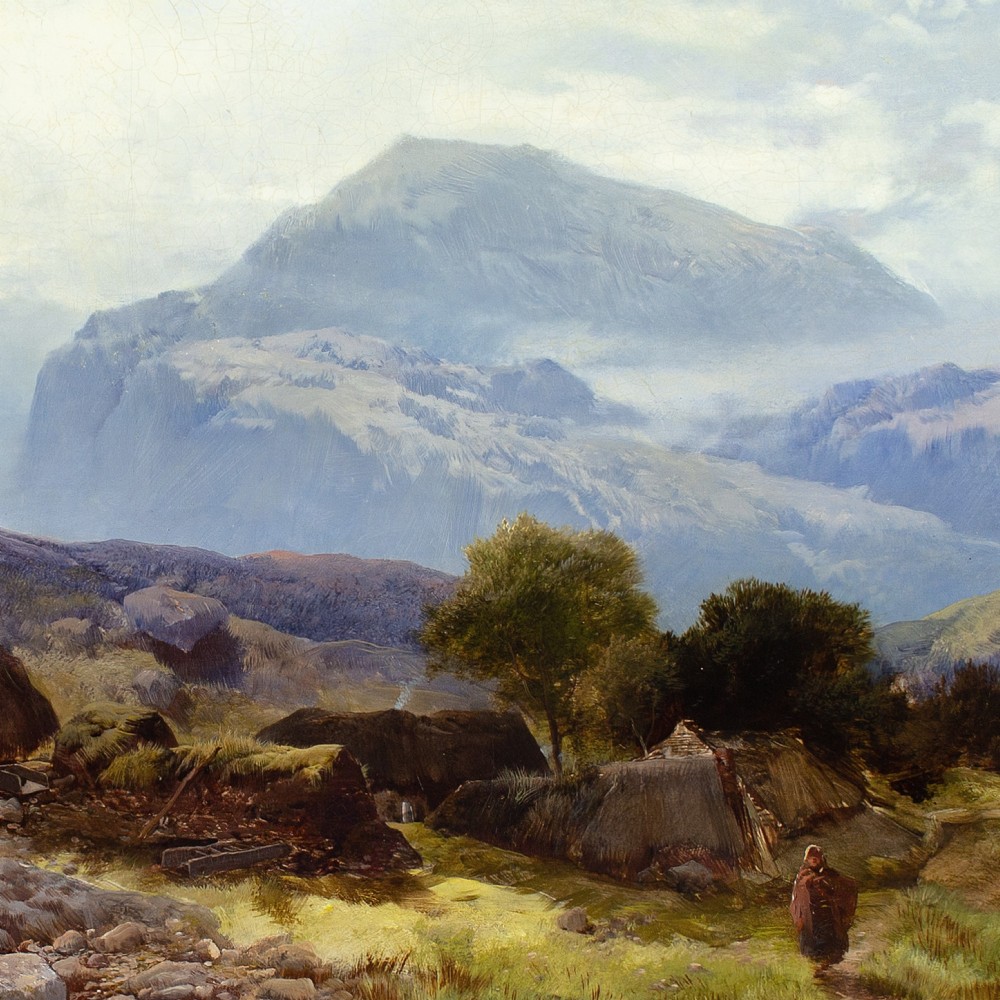
This mid-19th-century oil painting by British artist Henry Bright (1810-1873) depicts a panoramic view with cottage, pond, figure and peaks.
Nestled within the formidable Welsh hills stands a humble cottage of stone and thatch. Warmed by a comforting fire, it’s a welcome retreat amid unpredictable weather. A woman, wrapped in a heavy woollen shawl, ambles between grassy banks with the tinted peaks beyond elegantly wrapped in cool mists. On the left, the gable end of a dilapidated barn is illuminated. While in the foreground, several boulders stand adjacent to a pond.
Born in Saxmundham, Suffolk, Henry Bright’s formative years were spent pursuing a career as a chemist. His father, Jerome, a clockmaker, encouraged the young man to find a trade - dissuading him from artistic pursuits. Following an apprenticeship, he worked as a dispenser for Norfolk and Norwich Hospital, employing every spare moment to draw from nature.
There’s a fascinating character to the Suffolk countryside,
...which compels those with an eye for beauty to capture its majesty. Tranquil rivers, shimmering streams, leafy woods, rustic mills and vast irrepressible skies - coastal and inland, have inspired artists for generations. Gainsborough and Constable were smitten and Bright followed suit.
His precocious skill for drawing was soon noticed by his peers, who urged him to ditch the apothecary in favour of the brush. His decision to do so led him to Norfolk and into the welcoming arms of a provincial art movement known as the Norwich School. Influenced by masters of the Dutch Golden Age, such as Meindert Lubbertszoon Hobbema (1638-1709) and Jacob van Ruisdael (1628/9-1682), its members were inspired by the natural environment. He was trained by Alfred Stannard (1806-1889), John Berney Crome (1794-1842) and John Sell Cotman (1782-1842), each aiding his technique. And by 1836, he’d debuted at London’s British Institution, introducing him to a pool of eager buyers.
Beyond Suffolk, Bright undertook numerous study trips across the British Isles and on the continent. During one such trip, he made the acquaintance of JMW Turner (1775-1851) and the pair struck up a lifelong friendship. He accompanied Turner on at least two tours and evidently impressed the distinguished academician. A Victorian critic later commented that Bright’s skies were second only to Turner himself.
He often selected views involving complex elements such as ragged buildings, crags, wrecked mills, and transient weather effects. His version of nature was all-encompassing, not limited to clichéd vignettes of a sentimental ideal. His simple sketch titled ‘Clumps of Trees’ speaks volumes.
With his oils, he often worked on wide canvases to emphasise a panorama. Many of these use a building as its focal point, yet also convey a sense of harmony - in tone and composition. His ‘Scene in the Scottish Highlands’ sold at Christie’s in 2006.
He could also turn his hand to dramatic coastal views whereby a rolling, brooding, sky creates atmosphere and tension. ‘North Beach, Great Yarmouth, Norfolk’ is particularly Turner-esque.
His motivation to paint the truth brought with it originality and a host of exclusive patrons including Queen Victoria and the Grand Duchess Marie of Russia. During a trip to Brodrick Castle on the Isle of Arran, Scotland, he carried the latter on his back while traversing a stream.
Bright spent the majority of his career in London, exhibiting twelve times at the Royal Academy. He did so while also establishing himself as a leading drawing master for aristocratic offspring. Highly regarded in the ‘right circles’, he was soon elected as a member of the New Society of Painters in Watercolours.
In a review of his life, the art critic Frederic Gordon Roe stated that “Bright roamed the earth with an avid eye for quaint cottage corners, picturesque tree forms or g
Antique ID Number (AIDN): SA1089292
Dateline of this antique is 1850
Height is 79cm (31.1inches)Width is 127cm (50.0inches)Depth is 6cm (2.4inches)





Thank you.
Your comment has been sent to Sellingantiques.