

Regent Antiques has dated these Dutch Marquetry Walnut Armchairs to the 1700s.

The majestic central back splats are inlaid with floral marquetry decoration, the craftsmen did everything to make the backs stand out, and as a finishing touch each chair has floral marquetry with bouquets, urns and birds, which add an extra touch of elegance and finesse to these sumptuous chairs.

They have luxurious shaped drop-in seats that have been reupholstered in a sumptuous teal damask fabric, and the chairs are raised on elegant gently curving cabriole legs with carved foliate decoration and floral marquetry. They terminate in claw and ball feet typical of the period

Transform the decoration in your home with this pair of chairs fit for a King.
Condition:
In excellent condition having been beautifully cleaned, French polished waxed and reupholstered in our workshops, please see photos for confirmation.

Dimensions in cm:
Height 113 cm x Width 63 cm x Depth 47 cm
Height 50 cm
Dimensions in inches:
Height 3 foot, 8 inches x Width 2 feet, 1 inch x Depth 1 foot, 6 inches
Height 1 foot, 8 inches
Walnut
The Walnut woods are probably the most recognisable and popular of all the exotic woods, having been used in furniture making for many centuries. Walnut veneer was highly priced and the cost would reflect the ‘fanciness’ of the veneer – the more decorative, then the more expensive and desirable.

Marquetry
is decorative artistry where pieces of material of different colours are inserted into surface wood veneer to form intricate patterns such as scrolls or flowers.
The technique of veneered marquetry had its inspiration in 16th century Florence. Marquetry elaborated upon Florentine techniques of inlaying solid marble slabs with designs formed of fitted marbles, jaspers and semi-precious stones. This work, called opere di commessi, has medieval parallels in Central Italian "Cosmati"-work of inlaid marble floors, altars and columns. The technique is known in English as pietra dura, for the "hardstones" used: onyx, jasper, cornelian, lapis lazuli and colored marbles. In Florence, the Chapel of the Medici at San Lorenzo is completely covered in a colored marble facing using this demanding jig-sawn technique.

Techniques of wood marquetry were developed in Antwerp and other Flemish centers of luxury cabinet-making during the early 16th century. The craft was imported full-blown to France after the mid-seventeenth century, to create furniture of unprecedented luxury being made at the royal manufactory of the Gobelins, charged with providing furnishings to decorate Versailles and the other royal residences of Louis XIV. Early masters of French marquetry were the Fleming Pierre Golle and his son-in-law, André-Charles Boulle, who founded a dynasty of royal and Parisian cabinet-makers (ébénistes) and gave his name to a technique of marquetry employing brass with pewter in arabesque or intricately foliate designs.
Our reference: A3758
Regent Antiques has dated these Dutch Marquetry Walnut Armchairs to the 1700s.
We specialise in english and continental furniture, silver, porcelain and decorative items.
You can view the stock and full dealer information on the Regent Antiques Profile Page
Regent Antiques is a registered member of LAPADA CINOA
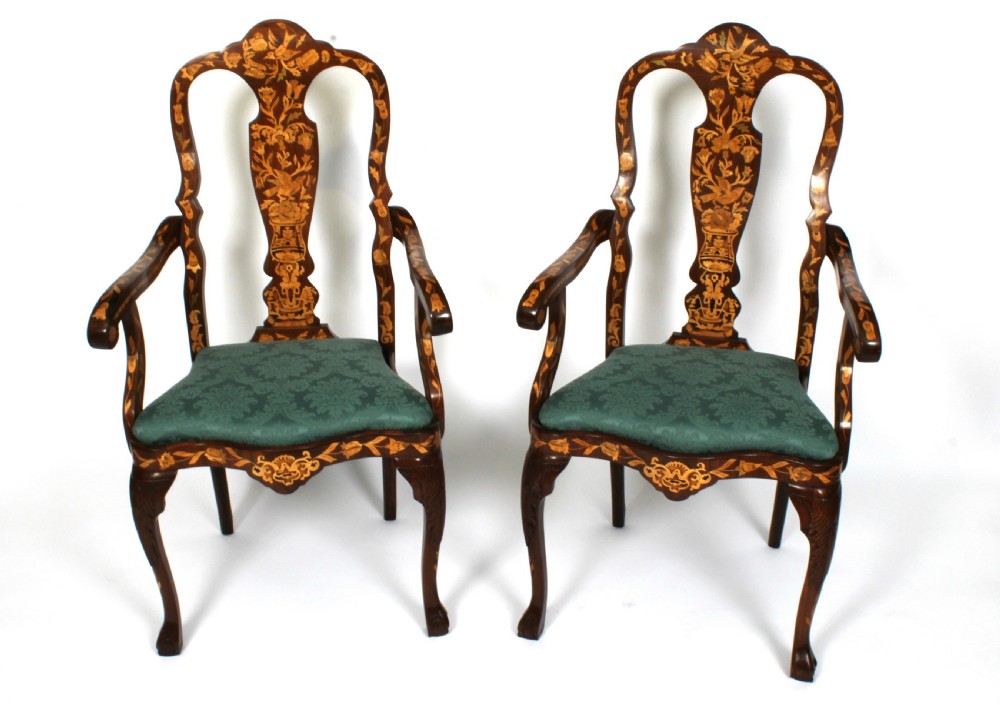

Antique Pair Dutch Marquetry Walnut High Back Armchairs Late 18th C


